Shopping in Europe
Souvenirs, Gifts, and Stuff You Can't Live Without
Goodies are everywhere. Flea markets, department stores, boutiques, vineyards, duty free shops.

If you are flying out of Schiphol Airport in Amsterdam, Netherlands you might want to pick up some last minute consumable souvenirs. There are dozens of duty free shops in the departure zone. Dutch chocolates are delicious and make great gifts.There are thousands of other items to choose from. Pick up a catalog as you enter Holland, but you will not be permitted to buy until you depart.
Carpe diem. Vivere bene! Gratia Deo.
Chapter 23 of
HOW TO EUROPE:
The Complete Travelers Handbook
John Bermont

This entire book is published totally free on-line by the author, photographer, and webmaster, yours truly, with help from my daughter Stephanie. I welcome all questions, comments, and complaints.
For contact information please see Your Blow Back. Last update .

Your Go-To Travel Store
The emptor must caveat.
This is an introduction to shopping strategy in Europe.
Closely related subject matter is at:
- Shipping Your Treasures Home: Travelers Options from Europe.
- Customs Duty, USA and Europe: Know the Rules when Crossing Borders.
- Europe's Metric System: Travel with Grams, Meters, Liters, and Centigrade.
SHOPPING DIFFERENCES
With higher taxes built into the price of everything and per capita income about the same as in America, you just won't find many bargains in the western countries of Europe. In the east you can still find good deals. In both areas you will see many unusual items, designs, materials, and fashions not found at home.
TOURIST SHOPPING
Caution — Duty Free Shops Ahead
Travelers are immediately confronted with airport duty free shops when they enter the secure departure zone of international airports. Prices of goods in these shops may be duty free, but there are few bargains. If you are considering a major purchase, say a camera or electronic device, plan far ahead. Write to the duty free shop, care of your European gateway city airport (home-bound), and request a price list at least two months in advance. Compare prices with those for the same items in your local shops or through mail order. There is also duty free shopping on most planes and on board major ferries crossing international borders.
The only bargains I have seen in duty free shops are on alcoholic beverages and tobacco products, though this depends on the duty free shop and on the country. A pretty good rule would be that one should not enter any of the Scandinavian countries without carrying the maximum of duty free booze, if you enjoy drinking. The same is not necessarily true for Holland where the retail price of most spirits is less than the price in America, except for American products.
On board some ferries, bottles look like fifths and pints, but the exact quantity is not shown on the bottle. Except in the major airports, don't expect very good selections. The same limited number of brands show up in most duty free shops. One lesson I have learned is do not buy brands you are not familiar with, unless you can afford to experiment. Don't even buy new products from known brand names. I have tasted disasters. I think that some distillers dispose of their rubbish in duty free shops.
All goods bought in duty free shops are subject to duty, if any, when you land at your destination. The duty saved is the duty of the country where you bought the item. Shopping is allowed in duty free shops only if you are departing. Arriving passengers can't even buy a candy bar until they pass the customs inspectors.

During the German WW2 occupation of the Netherlands, 1940-45, the Nazi authorities ordered the citizens to turn in all their Dutch silver and gold coins. Jewelry was exempted. Therefore, according to the jeweler I bought this from, some of the clever Dutchies made jewelry out of their money!! Here is a string of 21 silver dimes from 1943. These bracelets are virtually unknown as of 2015 and very difficult to find in any jewelry or antiek shop. I looked everywhere that summer and finally found a couple more of them in what I would have expected to be the last place they would be sold.

This bookstore window display in Kraków, Poland is crammed with Harry Potter editions. I guess that somebody likes pigeon guano all over the sidewalk, or they have a cat who will be feasting on one of these plump squabs for dinner. Ksiazka is Polish for book.
Souvenir Shops
High prices for stuff made in Brazil or Hong Kong can be found in the eighty thousand souvenir shops swarming around the tourist centers. These places are stocked with junque, but do have some useful items like Heineken T-shirts and various hats.
Consumer protection legislation is not as thorough in Europe as in America. Trinkets that appear to be of local origin may be imports from Pakistan and available at home in your dollar store for half the price. Items are identified with country of origin only when they want you to know. In Greece and the eastern European countries most of the craft work is locally made. Street markets with no overhead are the best places to shop.
When shopping for trinkets, offer a price lower than that marked. Sometimes a shopkeeper will accommodate you. If you like an item but you think it costs too much, say so. That is the easy indirect way to get some negotiations started.

This is an amazing store in Vilnius, Lithuainia. I bought a heart shaped amber charm for Stephanie in here.
Flea Markets
Some guide books on Europe boast of the great buys available at the Paris Flea Market and the Amsterdam Flea Market. Those were the old days. These places are now among the biggest rip-offs. Most of the customers are tourists. For bargains, go where the local folks shop.
There are scores of outdoor markets in Europe where the greenbacks are not grabbed so readily as in Paris and Amsterdam. Inquire at tourist offices. Look for small markets which are not so institutionalized. Permanent, roll-away, or knockdown structures occupy most of the acreage in the overpriced markets, while the cheaper markets feature merchandise displayed on old boxes or lying on the ground.

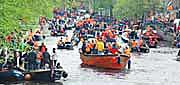
For a real out of this world shopping experience go to Amsterdam on Queen's Day. On Queen's Day in Holland people lay their junque out to sell. Here is a sale on a sidewalk in Amsterdam. The Queen abdicated in 2013 and her son took over as King on Queen's Day 2013. So, starting in 2014 the holiday became known as King's Day. See a photo log of my experiences on Queen's Day 2008 at Queen's Day, Amsterdam. This is one of the greatest one-day parties on the planet.
Flea markets are popular in Germany but are usually held at intermittent times, say every month or so at certain locations, usually a parking lot near a large shopping area or open grassy fields and usually on a Sunday. If you are out on a Sunday drive look for signs along the road. These German Flohmarkts usually have a large number of vendors from Poland selling all manner of goods, some of which look like throw-outs from the Russian army. I liberated a Russian Army officer's hat and an East German Army helmet on a trip through the eastern part of Germany. Those are good for Halloween costumes.
When buying items at flea markets, start negotiating way below the asking price. Even though the vendor sees you as a rich American tourist, there's no need to throw money at him. If something catches your fancy buy it now because you'll never see it again.
If you are a serious seeker of cheap curiosities the best place to start is by buying one of the Travel Keys books by Peter B. Manston. His encyclopedic pocket size Manston's Flea Markets, Antique Fairs, and Auctions of Germany will get you started. This is out of print but used editions are available on Amazon.com. Peter has similar books on Britain, France, and Italy.
Second Hand and Antique Shops
I love to prowl through second hand shops. I can't recall any Salvation Army or Goodwill stores in Europe but there are commercial stores selling second hand stuff. They are amazingly cheap. If you are moving to Europe for a few years second hand shops would be a good place to get your tableware and pots and pans.
Antique shops are more expensive and are a good source for jewelry and dust collectors.

Oh boy! — an open air market in Varna, Bulgaria. You can find almost any household item in these markets, plus some unusual foods and homemade booze. I would be careful with the homemade hootch.
Street Vendors
There are a few places which still have the classical fellow who comes up to you on the street with an armload of wrist watches up his sleeve. If you buy a famous brand name from one of these vendors, it's certainly a forgery. If it keeps running long enough for you to take it home with you, U. S. Customs can confiscate it.
In Lisbon, I was approached at least once a day by chaps trying to sell me a "gold ring." Each ring looked identical, and each probably would have given me a case of green finger. The gold ring trick has variations.
In eastern Europe there are a large number of street vendors who have set up tables in town squares or on busy boulevards. Books are the most common items of merchandise in Kiev and some other cities. In Budapest, one street used to be lined with women selling embroidered cloths. It looked like a human clothesline and disappeared quickly when a policeman appeared. I bought two books of beautiful Russian stamps from an enterprising fellow in the main square of Warsaw and some brass inlaid wooden boxes from another. At first it seemed rather blasphemous to be dealing in such a beautiful place but I couldn't pass up those bargains. Distilled spirits are another common item. I bought a half liter of Stolichnaya vodka for a dollar from one vendor in Bulgaria. The same bottle in a store in L'viv, Ukraine cost me 25¢. That is less than the cost of a bottle of water where I live in Michigan.

Shakespeare and Company bookstore is a landmark in Paris, France. I lived a few blocks away in the "Latin Quarter" and often found myself prowling around in here. The original store with this name was founded by Sylvia Beach in another part of Paris. It was part of the culture of the American "Lost Generation" in the 1920s, the most famous character of which was Ernest Hemingway. In my days the store owner was George Whitman, an eccentric Mark Twainish looking fellow. This store is just across the Seine from Notre Dame. If you love old book stores you must visit this one.
Postcards, Posters, Wall Calendars
You'll find a great variety of postcards: art reproductions, photos of cathedrals, nudes, and watercolors of 19th century street scenes. Prices of similar cards can vary considerably from shop to shop. The best prices can usually be found on the side streets and in open-air markets. Many cafes in Holland have a rack of free postcards, though they may not be to your taste.
Museums always have shops which sell reproductions, books, and miscellaneous mememtos. Get a mailing tube to protect your stuff as you travel. If you are planning to buy posters on the street, maybe buy a mailing tube at an office supply store. Tubes are usually not available at poster stores or from the dealers along the Seine River in Paris. Tubes can be crushed in the mail. One defense is to pack them as full as possible before mailing them home.
Wall calendars available in book stores and office supply stores make good souvenirs, and gifts. You can find well illustrated calendars featuring art, architecture, old lithographs, and other images. My beautiful 1992 Moscow calendar is still hanging on the wall 21 years later, right next to my 1994 Prague calendar.

The City Galerie enclosed shopping center in Aschaffenburg has 50 specialty shops, four department stores, and plenty of covered parking. Most stores in Germany close at 2pm on Saturday, except once a month, so get up and shop early. For groceries, shopping at the farmer's markets is far more interesting.
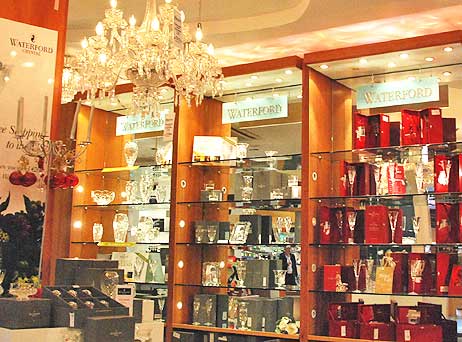
The Blarney Castle souvenir shop outside Cork, Ireland features plenty of Waterford crystal and various products emblassoned with Guinness, amongst many other items. Ireland has changed its name, according to me. It is now Guinness Island.
REAL SHOPPING
Department Stores
A visit to a major city isn't complete without a shopping trip through the major department stores and downtown specialty shops. Here you'll find the culture of modern civilization, descendants of the crude tools and pottery you went to see in the museums. Even if you're not buying, go and take a look.
For instance, visit the Kaufhof in Munich, the Galeries Lafayette and Printemps in Paris, the NK and Åhléns in Stockholm, Harrods in London, de Bijenkorf in Amsterdam, and El Corte Inglés in Madrid to name a few. Other major cities in each country have branch stores of the same name. Some of everything can be seen in these major department stores, and they often have a supermarket in the basement and a good cheap restaurant on the top floor with a view of the city. My favorite department store is BHV (the "bay hash vay") on rue de Rivoli across from the Hôtel de Ville in Paris. The basement is a fascinating hardware store. Handyman types will find an incredible assortment here, and in other hardware stores throughout Europe.
You can almost always find a clerk in the big department stores who speaks English. In some stores, clerks wear name badges with miniature flags of the nations whose language they speak. Don't look for the American flag though. Look for the British Union Jack.
Browse through clothing stores, sporting goods stores, bookstores, and furniture stores for unusual and useful items that suit your fancy and are not found in the United States.

The El Corte Inglés department store in Madrid, Spain has an annual "Cortylandia" window display. Christmas shopping in Europe is just as maddening as it is at home.

The beautiful Galleries Lafayette department store in Paris, France is an experience not to miss. Have fun! Like many department stores throughout Europe there are several restaurants and cafes, one with a bird's eye view of the north side of Paris. This is the atrium Christmas display from the perfume zone. You can also go up several floors and look out from those balconies. The exterior display was equally impressive.

The Stockmann department store in Tallinn, Estonia is well stocked. I had a great breakfast of herring, salmon, and salad in the Stockmann cafe. Buffet items are weighed at the register and sold by the amount you take. It is truly a seafood bargain. I would eat there every morning. The foreign exchange office in this store gives good rates. Stockmann is a long established Helsinki based quality store.
First Floor
Note that in stores and hotels and office buildings all over Europe, the "first floor" is what we call the second floor. Don't stand there confused when you walk in asking for gloves and are directed up to the first floor. The floor at ground level has various names, depending on the country. Many large department stores have one or two floors below ground level. This is often the bargain basement and/or a grocery store.
The large and specialty stores will ship purchases home so you don't have to carry them. When they do this the VAT, value added tax, which is already included in the posted price can be refunded to you, but a shipping charge is added which approximates the amount of the tax. Getting your VAT returned is not a work of joy. The store will probably offer to send you a check. A check drawn on a European bank will cost you maybe $30 to cash when you get home. Try to get the store to issue a credit to your credit card, assuming you paid for the item with a credit card. See chapter 24, Shipping Your Treasures Home: Travelers Options from Europe.

Potten & Pannen (Pots & Pans) in Prague is open on Monday from noon to 6 pm, Tuesday through Friday from 9 am to 6 pm, Saturday from 9 am to 4 pm, and closed on Sunday. Remember that the week starts on Monday in Europe. Traditionally everything is bolted shut on Saturday afternoon until about noon Monday. The Czech Republic is famous for its beautiful cut stemware. We brought home some champagne and wine glasses. I also found a steal on laboratory glassware. The chemical engineer in me grabbed that deal.
Grocery Stores
Grocery shopping can range from modern supermarkets to shop hopping for bread, meat, dairy products, and fresh produce in a half dozen provincial-type shops and open-air markets. There are some advantages to the provincial way of life, but you can eat up a whole morning just buying a sack of groceries. Goods, especially bread, are usually fresher at the individual shops. But open hours are limited and the quantity of goods is limited. Shop early. Enclosed shopping malls are becoming more common in Europe. These usually include a super market and/or various specialty food shops. Super markets are springing up everywhere and the days of the small shops might be numbered.
You'll notice some differences as you shop. For example, fresh produce may be selected for you by the shopkeeper, or by an attendant in large supermarkets. You can't always paw over the fruits and vegetables to get an unblemished, perfectly ripe item. In some stores milk and eggs are often left out at room temperature, not kept in refrigerated cases. Room temperature in many stores is often quite cold.

Here is a typical Holland fish shop in Haarlem, Netherlands. I love raw herring, known to the Dutch as haring. You can buy it in fish shops such as this or from fish wagons which are parked daily in various central squares of Dutch cities. If you don't like your fish raw the mongers usually have fried fishes of various sorts, mussels, and smoked eels. Smoked eel is to die for. I am getting hungry writing this.

In the basement supermarket of a large Stockholm, Sweden department store, take a number for service at the meat, fish, or cheese counters, or help yourself to packaged products just like home. Notice that the woman in the foreground has brought her own rolling shopping bag. This is common throughout Europe.
Bring your kid when you go to a German meat counter and the toddler will be given a small piece of sausage or a hot dog. Yes, they are fully cooked so you can eat them "raw." Stephanie had a free lunch on many of our shopping trips.
In a Dutch cheese shop, or the cheese section of an Albert Hein or Dekka, you will be looking at dozens of ten pound rounds of cheese on the shelves and anyplace else they can put it. The names mean nothing to you. They don't have the rubbery gunk sold in America as "cheese." They have real cheese, kaas in Holland. What do you do? Ask for a taste. It is the tradition of Dutch cheese shops to offer a sample.
In the eastern countries, the situation is different. I've seen scores of people standing in stores in some cities waiting for whatever they can get at government controlled prices. Meanwhile at the farmers market, all sorts of meats and vegetables are for sale at free market prices. So much for socialism, a demon of the last century.

At the indoor farmer's market meat is left out on butcher block tables for your selection in Kyiv (Kiev). Ukrainians have had a tough life. It has been the battleground of Europe for much of the 20th century, but it is so far from anywhere that nobody knows much about it. After my first trip I came home in tears from the misery I witnessed, 25 years ago. As of 2016 the paranoid Russians are shooting again but only in the eastern part of the country. If you need a personal guide in Ukraine write to me and I'll put you in contact with my buddy Orest in L'vov. His English is flawless.
The butcher shops are hardly different from the meat counters in some grocery stores and delicatessens at home. Meat is left open and unwrapped in glass cases, sometimes refrigerated. Point to the item you want, or try to pronounce it. Same goes for the fish shops, though the fish is always on ice.
If you are in Paris stop at Place Maubert, on Boulevard Saint Germain a couple of blocks east of Boulevard St. Michel. There is a group of shops where you can buy almost anything — cheeses, meat, fish, wine, flowers, etc. Twice a week there is a farmer's market in the square. I lived a couple of blocks away and was a regular customer. The President of France, François Mitterrand, lived in the neighborhood on rue de Bièvre, with a couple of policemen standing at ease at each end. France doesn't have a "white house" giving free room and board to the reigning culprit-in-charge.
One problem with all these butcher and baker shops is the waiting lines, or mobs. When you walk in, look around and note the people who are present. Keep your eye over both shoulders checking out new arrivals to make sure that no one makes an end run to the counter. During busy shopping hours, there may be ten customers for each shopkeeper. Keep inching forward or you could be in there all afternoon. If there's a large mob in a store, look around for the "take-a-number" dispenser. These are becoming more common.
In Europe you must bag your own groceries, in your own bag. If you didn't bring a bag, the store will usually sell you a sturdy plastic sack for the equivalent of about 25¢. It can carry about 15 bottles of beer. The clerk will ring up your purchase as she throws your goods toward the door, and the sack comes flying in at the end. You then have a panic job of bagging your groceries before those of the next customer come shooting down the ramp. Do not expect consideration, much less a smile, from the cashier. If you don't hurry up you get one of those looks like "what's your problem buster?" Pack and run.
American credit cards are never accepted at grocery stores in Europe. There might be an exception to this "never statement" but I haven't found it yet. Maybe by the next millenium credit cards will be universal. In the meantime only "chip and pin" cards can be used throughout Europe for most purchases.

You wanted to buy a dozen eggs? Sorry, they come in cartons of ten in Holland. And they are not in the cooler. Find them in the aisles. Same for milk, which is sold by the liter not the quart or gallon. Learn about measuring things at Europe's Metric System: Travel with Grams, Meters, Liters, and Centigrade.

A small market like this one in San Sebastian, Spain can supply all the provisions you need for the next couple of days. Stock up for your picnic or snack. In a nearby wine shop I saw Nivara D.O. crianza for €2,59 (about $3.60) per bottle. That's a nice beverage for a mighty fine price. While you are in San Sebastian, also known as Donostia in the Basque language euskara, visit the pintxos cafes for wine and the tiny delicacies served on toast.
Warranties
Items purchased outside the United States are not covered by warranties issued by American manufacturers or distributors of those products. And there is a small chance that foreign purchased products do not meet United States safety standards. They may even be inferior goods with forged brand labels made by children and shipped in from our "friends" in China.
On the other hand, manufacturers and stores in Europe can bend over backwards to make the customer happy. I bought a used bicycle in Holland from a bike dealer. About six months later, the crank hub broke off. The frame was a total bust. I went to the bike shop and was told to bring the bike in and the manufacturer would repair it. I did but they did not repair it. Instead, they gave me a whole new frame and reassembled the bike. Cost? Nada. Unbelievable. That is the Sparta bicycle company in Holland for you, the kind of company you wish there were more of. I have never heard of any other firm which would completely rebuild a broken item for free. And that fiets, Dutch for bike, was already years old when I bought it second hand. That was the fourth bike that I had purchased in Holland. I love them, the bikes and the Dutch, and the cheese and the herring and the beer and . . . and etc. and etc.

As is typical throughout Europe, this apteek in Tallinn, Estonia has its open hours posted on the front door, and has the addresses of other drugstores in case this one is closed. In most cities there is a rotating shift of pharmacies available 24/7. The neon green cross is the standard sign for drugstores. This one also displays the age-old symbol of the medical profession, the caduceus, a winged staff enveloped by two snakes. Notice the street name, not on a post but on the wall under the caduceus.
BARGAINS
Although almost everything costs more in Europe, there are a few items to be had at a price lower than at home.

Elizabeth's favorite souvenir of the places she visits is a locally painted ceramic plate to hang on the wall. Here she is in the amazing Grand Bazaar in Istanbul, Turkey negotiating a new find. Never pay asking price in the Grand Bazaar. Of course she also bought a carpet and that nice leather backpack. A gang of brazen gypsies nearly had their hands in her backpack as we walked on a busy boulevard in Istanbul. I couldn't believe it as Elizabeth suddenly started swinging at these girls without warning. I didn't know what had transpired. The gypsies didn't succeed in getting anything, and they jumped into a waiting car and were off before I could get a good picture.
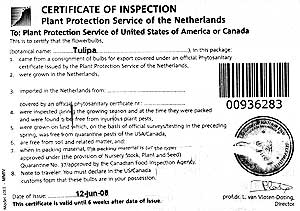
One of my favorite souvenirs is another few dozen Dutch tulip bulbs. I have planted hundreds around my yard and at the cemetery. Make sure that the bulbs you buy have this official certificate with hologram seal. If not, the U.S. Department of Agriculture will confiscate your bulbs as you pass through Customs on your return. For information you need to know about customs over there and coming home see my page at Customs in Europe: Know the Rules when Crossing Borders.
Where To Buy
Prices are normally lower in the country of origin, and lower yet in the city where made or at the factory itself. One notable example of this is Swedish table crystal and decorative handmade glass articles. These are sold at about one-fourth of the American retail price at factory showrooms. The major brands are Boda, Kosta, and Orrefors, which are also the names of the towns in southern Sweden where the glass is made. A number of other towns between Vaxjo and Kalmar are also in this business. The items on sale are seconds, but are hardly distinguishable from those on display in fashionable American stores.
Cut glass is also a specialty in the Czech Republic and the prices are very good, even on major boulevards in Praha (Prague). Other glass items are also well priced. I bought a couple of glass laboratory condensers for a couple dollars each in a side-street shop. Eastern and southern Europe have more bargains because the price of nearly everything is lower in those areas.
Not only are the prices lower but the selection is much greater when you shop in the country of origin. Look for stores selling Swiss watches and Swiss army knives when you visit Switzerland. Stephanie and I bought knives for ourselves and for gifts in Geneva. Elizabeth bought a watch on our trip through the Alps. If you've been thinking Birkenstock for your feet wait until you get to Germany for half price and an unlimited selection of styles. It's a no-brainer.
Freebees
There are a few "free" souvenirs. One item that I indulge in is the paper coasters used in bars and cafes throughout Europe. Each carries the emblem of the house brew. There is usually a stack of them within easy reach on the bar or on the table. Or take the wet one under your own glass. If you're a label saver, ask your waiter to steam the label off your dinner wine bottle. Usually he will accommodate you. If he balks take the bottle back to your hotel room and do it yourself. Matches are also a nice free souvenir when you find them. Most matches in Europe, even book matches, are wooden.

These cute little ceramic houses are given to upper class passengers on most international flights of KLM, Royal Dutch Airlines. At some point in my trip through life I was favored with a pair of them.
Officially they are booze bottles because each is filled with that exquisite Dutch beverage jenever, from the Bols distillery going back to 1575. Jenever is often called "Dutch gin." The English should more rightfully call their knock-off stuff British jenever since it was the Dutch who invented the beverage. It is the national drink of the Netherlands, served from the freezer in a unique fluted glass at every cafe.

On a down-to-earth proletarian note, beer coasters from around Europe are my always souvenirs. They are plentiful and free. I have hundreds of them and use them regularly at home for dripping wet glasses.
I do not take towels from hotels, but I do liberate ash trays from restaurants. I ask for the glass and ceramic ones but I just pocket the plastic ones. At my favorite restaurant in Amsterdam, the Luden on Spuistraat, I asked the waitress for one of their nice glass ashtrays. She went to the kitchen to check on it and came back with a comment that they are running low on them and couldn't let me have it. Later, the maître d' came by as I was admiring the candle holder. I wasn't going to ask, but she told me that I couldn't have it, and then she volunteered the ashtray! Thanks. On my way out our waitress said that she was sorry that I could not take the ashtray. I smiled. The restaurant Luden has been my favorite in Amsterdam for years — good food, ambience, service, and prices. Sorry, but you probably won't find any ashtrays in there any more. Holland is 100% smoke free, except for the "coffee shops," a euphemistic term for stores selling mary jane, a.k.a. "weed" to some of you. Pray that the USA is liberated soon. After dinner at the Luden I visit the Café Hoppe brown bar, a short walk south. It is my favorite meeting place in Amsterdam for decades, and for the past four centuries if you were one of the first patrons. For a good lunch step over to the Café Luxembourg, two doors away.
Actually indoor smoking is now prohibited almost everywhere in Europe so the supply of ashtrays has diminished considerably. They are still available at outdoor cafes.

The souvenir shop at Rosslyn Chapel, Edinburgh, Scotland features the books you would expect. Whatever you think of the Dan Brown novel which directed attention to this church I suggest that you make a visit if you are in Edinburgh. It is a short ride on a city bus. The chapel has just been refurbished and is a fascinating place.
CAVEAT SHOPPING
Embargoed
Some items for sale overseas are prohibited from entry to the United States, or require a permit for entry. A few examples are: firearms, fruits, plants, meats, uncured cheeses, drug paraphernalia, and a long list of other items. Violations can be expensive and embarrassing.
All goods from some countries are prohibited. Cuban cigars are sold throughout Europe but you cannot bring them home because of an Executive Order signed by President John F. Kennedy way back in 1962. That was after he stocked up his humidor with thousands of Cuban cigars. Beautiful and expensive Iranian carpets are sold in Istanbul but are not admitted to the USA because of Executive Order No. 12613 signed by President Ronald Reagan in 1987. Iran has been a PITA for decades.

WMF stores are located throughout Germany. You can spend some time shopping for kitchen ware here. They have thousands of things that you never knew you needed. These are German goods so you know they are not cheap. Other manufacturers also have their own retail shops.
Forged Labels
Forgery of trade marks is a serious problem for producers of high fashion wear, tennis shoes, entertainment goods, computer software, and other overpriced items.
When you return home, US Customs will confiscate any forged or copied item. Then they might fit you with a sparkling set of bracelets and provide a free trip to their secure bed and breakfast. I'd guess that you're even entitled to a free public defender. Chapter 25, Customs in Europe: Know the Rules When Crossing Borders will introduce you to regulations of the US Customs Service in addition to European customs.
Unusual Offers
While it was still a communist dictatorship, Elizabeth and I visited Budapest for a week. We did the city tour, bought some souvenirs, and splurged for dinner a couple of times. At lunch in a Russian restaurant we admired the espresso cups after a huge meal that would have fed a family of eleven. The cups included a small "hat" to place over the cup to keep the java hot. Elizabeth asked where she could buy these and after some discussion between the waitress and the manager, he offered to sell them to us.
We negotiated a deal and bought a set of six. Before leaving the restaurant a rather portly gentleman came in from the kitchen. He appeared to be the owner and had come out to look around. We didn't know it at the time we made the deal but it seemed that the manager had sold something that was not his to sell. He already had our money, and we had most of the coffee set in our day bags. But, Elizabeth had rejected one cup due to a defect and she wanted a good one. We waited some 20 minutes for a good cup to appear. Finally, from a nook near the stairs, the manager signaled us to leave and discreetly put the last cup in my conveniently unzipped day bag as we walked past him out of sight of the owner. I guess it could have been jail time for all of us if we had blinked.

All beer, wine, and distilled alcohol sold in Sweden is sold by the government monopoly Systembolaget. This can be a problem for congruent connoisseurs of fine spirits traveling on a budget. The Systembolaget operates on the premise that every drinker is also a millionaire. Therefore, bring your beverages from the duty free shop on the ferry like every self-respecting tax-dodging Swede. Then you won't have to search all over Stockholm for one of these stores with restricted hours and astronomical prices.

In Holland you can buy beer and wine in every grocery store. This is the beer display in a small market in Haarlem, Netherlands. If you had a bushel of wheat you could make bread. You could also make beer. I am thirsty. Beer is food.
Actually I had stopped drinking beer but on my summer trip in 2015 I discovered non-alcohol beer made by several breweries and sold throughout Holland. It is labeled 0.0%, pronounced null punt null. My favorite is Amstel. You can have a couple of 0.0% beers on a hot afternoon without feeling groggy.
Wine
Buying wine and returning it to the USA is a worthwhile diversion as you travel in Europe. It is relatively easy to find wine shops in the major cities which will help you select some good souvenirs and package them for your return flight. But you can no longer bring open market wine in carry-on luggage, since August 2006. You must now put your wine in checked luggage, and I do not guarantee that it will arrive or will arrive in one piece. Airline baggage handlers are notorious for busting bags. Some baggage handlers and some TSA agents are thieves and will gladly take your goods to their home if they get into your luggage. If you ship some wine in your checked luggage open your bag as soon as you get it off the luggage-go-round to see if it is still there. Most airlines have an office in the baggage claim area for reporting lost or damaged bags. That is your first stop. Good luck.
Many states in the USA restrict or prohibit entry of alcoholic beverages. Those are the states with the most churches. Even though Jesus made wine you better be careful that you don't commit a felony by bringing some ruby liquids into these states. Review chapter 25, Passing Customs: Know the Rules When Crossing Borders for more information.

Stephanie and I were driving back to Holland from Italy so I stopped in Burgundy
again to taste and buy. This region of France has a magnet out for me. Stephanie
shot this as I waited for my wine purchase paperwork. A certificate is issued
when you buy en vrac (in bulk) as I am doing here. When
we lived in Germany I would drive from Aschaffenburg to Beaune and fill the trunk
of the car with over 100 liters of that beautiful ruby liquid from 4 or 5
Dégustation stores or vineyards on a Saturday,
and then drive home with the booty. It is a bargain. You can buy 10 or 20
liter containers from the merchant, or bring your own. Get free labels,
and buy bottles and corks separately if you want to bottle it and put
some away. My corker got plenty of exercise. Drinking French wine helps
you speak French. Oui!! These are my summer driving clothes in Europe.
This photo is probably from 1998 when I was a young lad of 55.
Link:
Buying Burgundy Wine.
Have a good trip!


HOW TO EUROPE
Table of Contents
Chapter 1
Travel Like a Native In Europe
Chapter 2, Part 1
Travel Costs: How Much?
Chapter 2, Part 2
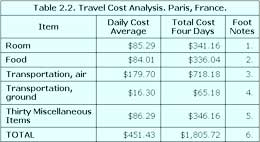
My Actual Expenses
Chapter 3
Identity and Travel Documents for Europe
Chapter 4
Travel Starts at the Airport
Chapter 5
Your Best Travel Clothes
for All Occasions
Chapter 6 Part 1
Travel Europe in Comfort and Style
Chapter 6 Part 2
Pack Your Toothbrush, Hair Blower, Toilet Paper, and Vinegar.
Chapter 6 Part 3
Travel SuppliesSmall Stuff Packing List
Chapter 6 Part 4
Bringing Valuables to EuropeNot in Your Luggage or Purse
Chapter 7
Pack Light, Let It Roll
Chapter 8 Part 1
They're Everywhere
Chapter 8 Part 2
Machines Dispense Travel Cash
Chapter 8 Part 3
Paying Your Way in Europe
Chapter 8 Part 4
Cash, Coins, Transfer, Barter
Chapter 9
Blog It
Chapter 10
Reviews of Tomes for Travelers
Chapter 11, Part 1

Why You Should
NEVER Use a Converter
Chapter 11, Part 2
Outlets, Plugs, Converters, Adapters, Voltage, Power, Frequency, Watts.
Chapter 12

Take Your Best Shot
Chapter 13

Travel Europe in Good Attitude
Chapter 14
European Travelers' Sleep Options
Chapter 15
Travel on Thy Belly
Chapter 16
Bus, Streetcar, Subway, Taxi, Bike, Shoe, Gondola
Chapter 17, part 1,
A Rail Primer
Chapter 17, part 2,
Finding Your Way
Chapter 17, part 3,
Sleeping City to City
Chapter 17, part 4,
High Seas Ferry, Highway Coach
Chapter 18, part 1
Details and Documentation
Chapter 18, part 2
Back Alley to Blazing Autobahn
Chapter 18, part 3
Police, Speed Limits, Tailgaters
Chapter 18, part 4
Adjuncts to Driving in Europe
Chapter 19, part 1
City Codes, 10-10, cell phones, PTT
Chapter 19, part 2
Priority Mail, PTT, Poste Restante
Chapter 19, part 3
Europe's Cyber Cafes and WiFi
Chapter 19, part 4
TelegramsWiring Cash and Quitting Your Job
Chapter 20

Travel in Confidence but with Caution
Chapter 21
Get Paid to Travel
Chapter 22, part 1

Things to Know Before You Go
Chapter 22, part 2
Travel to the Max as an Expatriate
Chapter 22, Special email
Dave In IrelandTechnical Details for Moving to Europe
Chapter 23
Souvenirs, Gifts, and
Stuff You Can't Live Without
Chapter 24
Travelers' Options from Europe
Chapter 25
Know the Rules When Crossing Borders
Chapter 26
Encounter The Tower of Babel in Europe
Chapter 27
Travel with Grams, Meters, Liters, Centigrade
Chapter 28
Traveling in a Distant Time Zone
Chapter 29
Travel under Your Umbrella
Chapter 30
Melding with EuropeTravel Is Interesting and Entertaining
Last Call
Pack Lists for Europe

Prime Travel Data
Elementary Travel
Information for Europe
- Austria
- Belgium
- Czech Republik
- Denmark
- Finland
- France
- Germany
- Greece
- Ireland
- Italy
- Luxembourg
- Netherlands
- Norway
- Portugal
- Slovakia
- Spain
- Sweden
- Switzerland
- United Kingdom
Up-To-The-Minute
Maps and Time Zones
Weather in Europe
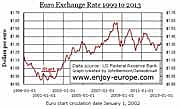
Money Exchange
Holland PhotoLogs
Queen's Day, Amsterdam
Keukenhof, Lisse

Adverts
To support this site:
Please buy your goods at:Amazon.com
Shop in your shorts!
Please clean out your cookie jar before clicking.
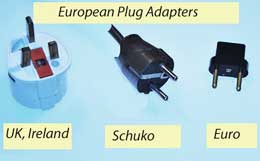
Plug adapters are needed throughout Europe. There are at least five models used in different countries.
Note: The highlighted #E number is purely arbitrary. It is meant to help quickly identify products in this advert column when you write in for electrical advice.
See NOTE TO READERS.
This adapter is for the standard grounded plug in France, Germany, and northern Europe. It does not fit in outlets of Italy, Switzerland, Ireland, and Britain.
#E-010
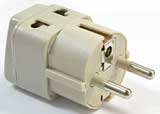 Grounded Universal 2 in 1 Plug Adapter
European Schuko plug.
4.8 mm prongs.
Equivalent to type E and F.
You can use this ungrounded Euro plug in some European countries.
#E-020
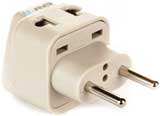 Universal 2 in 1 Plug Adapter
Euro Plug
4.0 mm prongs.
Equivalent to type C.
This is a universal plug adapter for the UK and Ireland.
#E-030
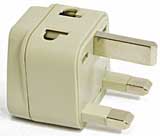 AC Adapter Plug for use in England, Scotland, Wales, and Ireland
Equivalent to type G.
Here is the Swiss version.
#E-040
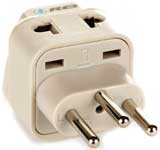 Grounded Universal 2 in 1 Plug Adapter
Type J for Switzerland
The grounded Italian model.
#E-050
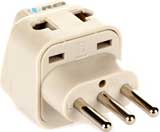 Grounded Universal 2 in 1 Plug Adapter
Type L for Italy
This 110-250 volt power surge strip has three universal outlets. Make sure your gizmos are rated for 110-240 volts.
#E-060
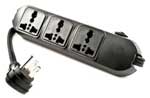 SM-60 Universal 3 Outlet Power Strip Surge Protector for Worldwide Travel.
Rolling luggage sure beats lugging a pack on your back.
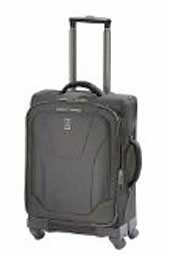 Travelpro Luggage Maxlite 2 20" Expandable Spinner
A shoulder bag for your daily walk-about.
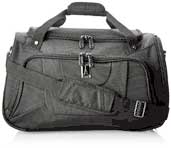 Travelpro Luggage Maxlite3 Soft Tote
Keep your stuff organized.

Luggage Packing Cubes
eBags 3pc Set
A Swiss Army Knife is unquestionably the handiest item a traveler can carry, except not on a plane.
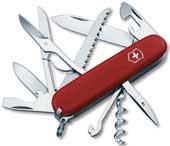 Victorinox Swiss Army Huntsman II Knife