Flying to Europe
Travel Starts at the Airport
Air ticket prices, buying tickets, frequent flyer programs, international airports,
flight search engines, TSA security, luggage, jet lag, DVT, unaccompanied minors.

Here is Stephanie at ten years old ready for solo take-off to Milan, Italy. She flew internationally for many years as an unaccompanied minor, UM for short. For more about UM see unaccompanied minor.
Carpe diem. Vivere bene! Gratia Deo.
Chapter 4
HOW TO EUROPE:
The Complete Travelers Handbook
John Bermont

This entire book is published totally free on-line by the author and photographer, yours truly, with help from my daughter Stephanie. Yes, you can copy — if you ask first. Please read my copyright and permissions statements. Visit my home page at enjoy-europe for truck loads of more helpful illustrated travel information sans pareil. If you have questions or comments after reading this chapter please see NOTE TO READERS. Updated 1 November 2015.

To travel agent or not to travel agent.
AIR FARES
The Bazaar
Unless you're going the old fashioned way by steam ship, you need an airline ticket to get to Europe. There are a number of ways to buy one. You can use a travel agency convenient and close to your home, call an airline, or call a flight consolidator, a.k.a. "bucket shop." You can also shop the internet, either through a discount travel services vendor or directly on an airline's web site.
The myriad of fares and conditions, varying from airline to airline and day to day, is a bizarre bazaar. Searching for the lowest cost fare is a tedious job, but can save you hundreds of dollars.
When shopping for the lowest fares for international travel here are the best strategies:
- fly Monday through Thursday,
- stay no more than 30 days, and
- purchase at least 14 days prior to departure.
Further, fares during late winter and early spring are normally the lowest of the year. Travel in July can cost three times as much as in April and five times as much as in February and March. The airlines are almost begging people to fly to Europe in late winter.
Then again, if you have enough miles in a frequent flyer program you don't need to buy a ticket — you can fly for free.
Connections
The cheapest fares between North America and Europe often require a connection unless you are in a major "gateway city," e.g. New York, Miami, Chicago, Houston, Los Angeles, San Francisco. A connection is a change of planes in a city between your home and your destination. There are standard minimum times allowed for connections, depending on the connection city, to allow you and your luggage to make the connection. If your first flight is delayed, you, and more likely your checked luggage, may miss the next flight. Bad weather is the most frequent culprit. Airlines are not responsible for bad weather or the delays. You are on your own if you miss the connection.
Within Europe
I rarely fly within Europe, preferring the trains and ferries. Besides crossing waters in a hurry, there may be other times when you want to use a plane. For example, going from Geneva to Amsterdam by train is a 12 hour ordeal with at least two changes. After some diligent searching I found a 90 minute direct flight on KLM for the same price as the train.
Europe is starting to relax air price controls so that it won't cost more to fly from Frankfurt to Berlin than it costs to go from Frankfurt to New York. Probably the smart way to fly within Europe is to use one of the new budget airlines. There are now dozens of these small carriers due to liberalization of flight rules within Europe. The leaders are Ryanair, easyJet, Air Berlin, German Wings, and Condor. The fares are cheap, as low as $15 in some cases, but the restrictions and cost of extras is severe. You can easily pay more for luggage than for your ticket. Read all the small print twice before buying a ticket from one of these airlines. Some of these budget airlines are zero on frills and fly to secondary airports in metropolitan areas. So pack a lunch and be prepared to buy a bus or train ticket to actually reach the city you are aiming for.
TRAVEL AGENTS
What is a Travel Agent?
Travel agents make reservations and sell tickets for air travel, package tours, auto rental, hotels, rail passes, and related services. The travel agent normally receives a commission from the airline or tour operator so the cost to you is the same as if you purchased the ticket direct. Travel agents are a very convenient source for tickets, saving you the time and anxiety that you would otherwise spend standing in line at the airport, browsing the internet, or scouring through big city newspapers. If you know what you want, usually one call is all it takes.
Limitations
Finding a really good travel agent is a really big challenge. All of them make mistakes once in a while, and a few are incompetent. I have heard of some atrocious blunders. Remember, it's your time, your money, and your dream trip so select an agent with care. Ask friends who have traveled overseas for recommendations. Discuss your plans with agents to see if they seem to know what they are talking about. See if they will take time to offer advice and if they will shop around for you for the lowest cost tickets. Unfortunately most agents are overworked and can't volunteer much time for anything.
Travel agents are not required to be experienced travelers and few have the ability or time to provide you with personal trip planning. If an agent has been where you are going, he/she probably traveled at the partial or full expense of a tour operator. The agents I have met in my travels who were on one of these "fam trips" (familiarization trips) were more interested in enjoying the entertainment than in scrounging around for ideas and information that would help their customers. Lucky you if your travel agent is one of the exceptions.
Commissions
Travel agents do not receive a salary from the airlines. Travel agents make their living from commissions on the services and products they sell. However some airlines have eliminated travel agent commissions. Commissions are typically 10%, but some tours offer 20% or more, plus bonuses and freebees for the agent. So, when you go into a travel agency asking for the cheapest ticket, don't expect jet speed service. But if you get it, tell your friends.
DO IT YOURSELF
If you are in or near a major gateway city there are many airlines to chose from. The competition is good, helping to get a good price.
Airline Web Sites
All airlines have web sites providing schedules and ticket purchase capabilities. See the category Airlines for Travel to Europe in the TRAVELERS YELLOW PAGES section of enjoy-europe.com. Special deals are always popping up in your email inbox if you put yourself on email alert lists. Many airlines send out a weekly newsletter by email touting their bargains, new routes, and special offers for earning frequent flyer miles, many of which do not require a flight.
When you search on line use the +/- 1, 2, or 3 day option if you can manage that. Fares on adjacent days can be strikingly different.
Call the Airlines
I still use the phone now and then. Websites can be overbearing and airline personnel can reduce the time it takes to find a flight and make a reservation. The reservation agents have immediate information on fares and routes and know where to find it. Of course, you must call up several airlines to see which has the best schedule and fares to suit your plans. This can be a very worthwhile endeavor, though time consuming. You may find that slight changes in your plans can give you more direct flights or save you money. You can save hundreds of dollars by phoning around.
On Line Do-Alls
There are several internet services which offer sort of a "universal" reservation and ticketing service. Major companies in this bargain air fare business are linked in the category Discount Air Travel, Europe of the TRAVELERS YELLOW PAGES. These services are very good, but none is totally complete. Try several and you'll see the differences. Before purchasing, check with the airline or your travel agent to see if a better deal is available.
Flight Consolidators
Flight consolidators are a unique business. They probably offer the cheapest tickets available, and the seats are on major airlines. They can do this by buying seats in bulk from the airlines at steep discouonts and then reselling them. This sounds a bit crazy. Why would the airlines sell their product at a steep discount to let others resell it in competition? The answer, according to websites of the consolidators, is that the airlines feel that they cannot sell these seats at regular prices and they are not allowed to, or do not want to, sell at a deep discount to the public. They would all be going nuts in a losing price war.
We saved a lot on Stephanie's 2002 trip to Italy by buying through a consolidator shop in Los Angeles. They and others quoted us prices on regular flights of major European carriers like KLM, Lufthansa, and Swiss at prices 1/3 less than the carriers themselves. These shops have different deals with different airlines.
Some consolidator shops place tiny adverts in the Sunday travel sections of major metropolitan newspapers, e.g. the Los Angeles Times and the New York Time. I have listed three of them in my TRAVELERS YELLOW PAGES page at Discount Air Travel, Europe.
Flight consolidators within Europe also offer very good prices on scheduled flights. My favorite travel agency had been NBBS in Holland, until they closed shop, another casualty of 9/11. My Christmas 1999 round trip from Amsterdam to Los Angeles and Chicago was only $350 plus tax. On top of that United Airlines bumped me up to business class for free, and allowed me into the Red Carpet Lounge at Dulles Washington Airport where I find myself writing this in the comfort of plush chairs and carpeting with free espresso, juices, and cookies, plus magazines, a football game on TV, and a bar. You don't mind a long connection in these surroundings. It sure beats the chrome and plastic corral where I usually find myself.
FREQUENT FLYER PROGRAMS
Fly for Free
Many people can by-pass the travel agent and the need for opening up their checkbook altogether. The airlines' frequent flyer programs have put zillions of free miles at the disposal of the public over the years. This must be a good deal for the air carriers also because the foreign airlines have followed suit.
If you travel on business, you're probably already enrolled in half a dozen of these programs, and you're always trying to maximize your credits with one particular airline. It doesn't do you any good to have 10,000 miles with each of five different airlines. You need 50,000 miles with only one airline to be awarded a free ticket to Europe. Award levels vary and depend on the airline, time of year, and class of service. People with these miles seldom have time to use them, but can let family members do so. I've flown my wife, daughter, and father-in-law many times overseas but have only used the miles personally a couple of times. If you have a relative who flies a lot, call him/her and see if you can borrow some mileage, maybe repayable in picture postcards from Istanbul?
Blackout Dates
In using your miles you will normally find a few inconveniences. Many airlines have blackout dates during which they will not allow you to fly with the FF miles, or will demand more miles during these periods. Airlines without blackout dates require you to use more of your frequent flyer miles to get a ticket during high season. High season is usually the entire summer plus the Christmas holidays, and maybe other busy periods.
Availability of Frequent Flyer Seats
Most airlines have a fixed maximum number of seats for free flyers. When these seats are taken they will not accept you. If you fall into this predicament and can't get a confirmation on the day you want to go, call up your reserve of patience and persistence. Just keep calling, like every week or twice a week and, as the day approaches, every niht. It is likely that someone will cancel or change their reservation. Persistence pays.
It's also possible that the airline will open up more seats for frequent flyers. If they are running a half full airplane the airline would be smart to make more seats available to the frequent flyers for whom they have such affection. Sometimes you wonder.
FF Flexibility
A very nice feature of using frequent flyer miles to go to Europe is that flights can be changed without penalty on some airlines. If you buy a super discount ticket and want to change your return date it will cost $100 to $150 on most carriers. With FF miles, call the reservation center and see if a flight is available for the day you wish to change to. If you change return flights after you have a ticket you may be required to get your ticket reissued. Allow time for that.
Sign Up
If you don't regularly fly or belong to a frequent flyer plan, sign up for one anyway. On your flight to Europe, make sure the miles are logged into your account. For the number of miles logged on four round trips between Europe and North America, most airlines' programs will award you a free flight.
And you don't even need to fly to gather up frequent flyer miles. Our daughter Stephanie flew to Italy using miles accumulated on Elizabeth's British Airways VISA card. True, she had to fly on British Air which meant changing planes in London, but it a was a free flight. I met a woman who charges her new cars to her VISA card so she can rack up more miles.
I use my American Express card at every instance when I buy anything from groceries to telephone service to airline tickets because I'm enrolled in their frequent flyer plan. For a nominal annual charge (getting to be not-so-nominal), every dollar I spend with the Amex card counts as a "mile," and can be transferred to several different frequent flyer programs. This company and others offer double miles and even quintuple miles during special promotions. Amex also has Delta Airlines branded credit cards. These are even a better deal. Just for accepting a Delta Platinum SkyMiles credit card, at an annual fee of $150, I was given 50,000 miles, and double miles any purchase at Delta.
The long distance telephone companies give out miles, rental car companies donate, some grocery stores, and even some cereal boxes give them away. I picked up 5,000 miles from cereal box coupons a few years ago. Do not pass up opportunities for free travel. It is beautiful!
AIRLINES
Services
Which one should you do business with? Commercial air carriers all provide certain minimum standards of safety and service as dictated by law. If you are afraid of flying, have faith. The pilot wants to get home and watch his favorite TV show just like you. For US domestic carriers, statistics indicate that there are about three times as many who die on the planes during normal flight as who die in crashes. A heart attack on board is more likely to end your days than an airplane uh-oh. You probably have a better chance of having an auto accident on the way to the airport than of having your plane go down.
Actually, there are differences in the caliber of in-flight service, food, and on-time arrival between airlines. These differences are variable since they depend on the weather, the size of the plane, length of flight, and other factors.
For links to most of the airlines flying to Europe see my TRAVELERS YELLOW PAGES section at Airlines for Travel to Europe.
Charter Air Lines
Charter air carriers normally offer the lowest published fares. Tickets for these flights are available through travel agents, and the charter carrier itself, e.g. Martinair, LTU, Condor, and others. There are conditions that you must suffer if you are going to take a charter, especially rules about refunds in case you cancel. These charter carriers normally fly only during the summer season, and only to a very select group of cities.
Specials
New routes by new carriers usually mean good cheap fares. Some junior European airlines are trying to start up international service and offer very good rates. Some major American carriers are also trying for a foothold in certain European cities, probably the reason that I had that beautiful round-trip on United from Amsterdam to Los Angeles for less than you would pay for a flight from Chicago to Detroit.
SCHEDULES
Official Airline Guide, OAG
Which airline is flying from Yourville to your destination, or nearby? In the good old days, any travel agent with his Official Airline Guide, Worldwide Edition, could thumb up the right page and read off any schedule on the planet. The OAG monthly could also be found in most American business offices in the custody of the secretary of the highest ranking person, or lying among the phone books. Many business travelers would rather spend an hour or two figuring out their itinerary with this book than leave it in the hands of a travel agent.
The OAG has gone modern. It now offers a subscription print edition as in the good old days, but also has a web site, CD, and mobile service. If you travel often on business one of these subscriptions can probably save you time, money, and trouble. Contact OAG for more information.
Multi City Reservations
If you have a business trip to Europe ask about stuffing in a pleasure stop at one end of your business affairs. Sit by a pool somewhere and write your trip report and fill out your expense report before heading back to the turmoil of the home office. Most airline internet sites allow you to make multi city reservations. A layover like this is usually no extra cost when flying at full fare.
Timetables
Airlines used to publish full system schedule booklets. These schedules also described food services, stops and connections, seating plans, equipment, and include airport site plans. When you are the airline web site look for the system timetable and download it to your net book. It will come in handy if you need to change reservations during your trip.
Delays
Getting there on time with all your wits and belongings in tact depends on a lot of people and things working together. Sometimes they don't.
Every once in a while the TV evening news features a story about a bunch of whiners who had to wait an hour or so for their flight. So what? Bring a book. Have a beer. Meet somebody new. But sometimes it gets excessive. Recent news reports of passengers sitting in a plane on the tarmack for 12 hours and not being allowed to get off have received attention in Congress. A new law establishes potential fines of $27,500 per passenger for any flight stuck on the tarmack for more than three hours. The airline pays this to the govenment, not to the poor folks sitting in the plane.
A key part of the flying equation is the pilot. There is probably no other cause of delay and frustration more profound and/or devastating than pilot strikes. However most delays are due to weather and the pilot has no control over that.
Connection times on international flights are set to allow you to change planes and possibly clear Customs and Passport Control in your connecting city. Meanwhile the airline is finding your luggage and shooting it out to the carousel. For flights returning to the USA you have to claim your luggage, clear customs, and then recheck it on your connecting flight. Nice theory.
I advocate packing light and not checking any luggage. Nevertheless, I have been in the check luggage situation on several of my extended business trips. For those few flights where I made an overseas connection, my bags usually do not make it. Air France left my bags in Paris on one occasion even though I had an overnight layover. I had time to take the R.E.R train to the city, have a beautiful dinner in Montparnasse, take a long stroll through the Left Bank, and return to my airport hotel for a good night of sleep before continuing the next day. My luggage which had been checked through to my final destination missed the flight. In another case, British Air didn't have time to transfer my bags at Heathrow due to a late start from Amsterdam. When I arrived in Detroit my luggage didn't. BA gave me an allowance of up to $75.00 per bag to spend as I needed. My bags showed up at the house two days later, but the money I spent for clothes and other necessities was repaid by the airline. New rags for free — I should have spent the whole allotment. Northwest missed my connection in Detroit on my last return from Amsterdam. If you ask they will give you a shave kit which includes a T-shirt.
AIRPORT PROCEDURES
Parking
Most airports have short term and long term parking. Short term is closer to the terminal, and is more expensive.
Entering the parking lot may be your first encounter with airport security. There may be armed National Guard troops or police on duty to check the trunk of your car and give you a cursory look-over. More about security below.
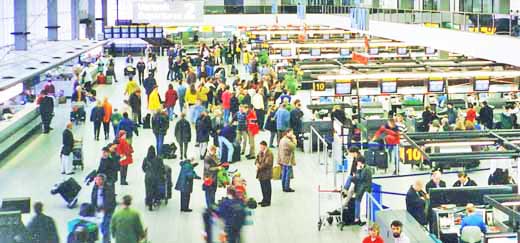
Terminal 2 at Schiphol Airport, Amsterdam, The Netherlands is a busy place. Allow yourself plenty of time to check in, check your luggage, grab some duty-free goodies, pass security about 5 times, walk about a mile to the departure gate, and get on the plane with 45 minutes to spare. Flight time is wheels up at 300 MPH.
Check-In
Many airlines allow you to check in from your home or office using the airline's web site. Print out your boarding pass and save time at the airport. Unfortunately many poeple do not have access to a printer to print the return flight boarding pass. If you don't check in from your computer you do it at the airport. Use your frequent flyer card and swipe it through the machine at the check-in line. What? You don't have a frequent flyer card! For pete's sake — get one. You can also key in your confirmation number. The machine's screen will take you through the process and eventually print out your boarding pass with seat assignment.
If you have baggage to check you go next to the departure counter and find the line for your class of service — tourist, business, or first class. The agent will print out your baggage ID strip and put it on the handle. Then the agent will print the claim tags for your checked bag(s) and stick them on the back of your boarding pass. The gate number for your flight will be on your boarding pass and the check-in agent will probably circle it so you can find it amongst the other stuff written there, then wave his/her arm in the general direction. The boarding gate is somewhere back in the caverns of the airport. You will get there, eventually.
On your way to the gate you will encounter the security metal detector and the x-ray belt for your carry-on items. There will probably be a lot of people waiting there so it is a good idea to get moving toward your gate without delay. If you are boarding your international flight you will also need to stand in line for passport control.
The gate closes 10 to 30 minutes before scheduled flight time. After that you are left behind. I have been left behind a few times. It is the worst experience in travel to see your plane standing at the gate for 20 minutes but they have already locked the door. One time my flight was three hours late and the door of my connecting flight was locked when I finally got there. I saw the plane at the gate with the pilot's window open. He was talking to the gate attendant. I jumped and waved where they could see me. After about ten minutes they finished their chat and the gate attendent opened the doors for me. The flight safety drill had already been given so the steward gave me a personalized version, per FAA regulations.
Overbooked
Airlines typically overbook their flights, if they can. If they have 200 seats on a plane they sell maybe 220. They do this because some people will not arrive for the flight and the airlines want to fly as full as possible. This can create opportunity if the number of people who show up exceeds the number of seats. Volunteers are sought out who will give up their seat and take the next flight in exchange for discounts or free flight vouchers. If you are involuntarily denied passage you are considered "bumped." Airlines are obligated to get you on the next available flight to your destination, even if that means flying on another carrier. But they won't tell you that. Instead they'll offer you compensation in the form of a reduced fare voucher or a free flight. This is negotiable.
Due to an error at Northwest Airlines there was no information in the computer about me when I showed up to fly to Detroit from Amsterdam one fine day at Schiphol Airport. They finally found my record and told me that I was supposed to have been on the flight yesterday. Today's flight was 40 seats overbooked with not a fat chance of getting on board. But I went through all the security stuff anyway - it took over an hour. At the gate the NW folks gave me a seat right off even though there were still dozens of people behind me. My seat was at one of the doors, where they like to put big people. These seats have advantages of plenty of leg room, but have no seat in front of you under which to stash any carry on items like this computer I'm working on at the moment. It has to go in the overhead bin for take-off and landing.
Seat Selection
The airline web sites allow you to select your seat. This is really handy. You can see which seats are available, and which are the preferred seats. These are the ones in the exit rwo with an extra 5" of knee room and are normally reserved for frequent fliers. The web site won't let you sit there without having special status but if you call the reservations desk you might be able to talk your way into one of these seats. I have.
Sometimes at check-in you are given the rude surprise that your reserved seat has been reassigned and there is no seat available. Or you might be told to wait a little bit, which could turn out to be 15 to 30 minutes. Several airlines have put me "on hold" at the counter in the last few years. While I waited the airline agent was poking around on his computer terminal, or would disappear for a while through one of those doors behind the baggage belt. I can wait here or at the gate I figure, so I wait here. Apparently what the agent does in each of these instances is find a seat for me in business class or first class. I've been bumped up a few times flying trans-Atlantic, on United, Air France, and KLM, and within Europe on Lufthansa. On one of my KLM round trips Los Angeles - Amsterdam I was bumped up to business class each way, and with a ticket that only cost me $400! That's flying. Besides being treated like a prince on the plane you also have privileges to the airline's VIP lounge at both airports.
If you think that I was given privileges because I wrote a travel book, it can't be. The author of this book, "John Bermont," is just a pen name. I travel under my real name.
Even after boarding a British Airlines flight in London with an assigned seat on one flight I was told by the stewardess that someone else had the same seat. I didn't want that window seat anyway, and after some diplomacy with another stewardess I was given an aisle seat with nobody in the seat next to it. This transpired after having been told three times that the plane was completely full without a single seat available. So, be polite but resolute. It can help to ask other flight attendants or the purser. Once anyone in charge of anything digs in his/her heels there is no turning back or mind changing allowed in this life, especially with Europeans.
Complain, negotiate
Food and beverages are free on all international flights that I am aware of. This has been airline industry standard practice since they started flying over the ocean. Domestically the airlines have always charged for alcoholic beverages but provided a free lunch in coach class. Everything has been *free* in first class, but you really paid through the nose for that ticket. The airlines have started charging for food on domestic flights, and have raised the price for drinks to what you would pay at the Waldorf Astoria.
You may be on a domestic flight unless you live near a gateway city. Then you pay for your own groceries, and you should expect good quality with those prices. Recently I did not get what I expected. The brie was hard and dry. I complained to the flight attendant when they came around to pick up. The FA offered to refund my $7.00. As I was passing my empty vodka bottle to her I suggested that she just give me another shot. She happened to be working in the first class cabin where they pour it from the big bottle. She came back with a glass full of my poison.
SECURITY
The New War
Thanks to deviates who try to hijack or bomb planes, or just murder people for the fun of it, everybody and everything going on the plane is subject to several checks. This is nothing to fool around with so just follow instructions and do as you are told. Your life and the lives of many others depends on it. Fooling around with security can be a Federal felony with prison time plus 5 figure fines.
It has become war since September 11, 2001. The attack on the United States and on civilization has brought mass murder to a monstrous new level. While hundreds of innocent people were killed on the planes, thousands more were killed at their desks on that unbelievable morning. My personal experience with terrorist murder is in the dedication to this book, with additional notes in chapter 1, What's It All About?. The security measures are designed to prevent another event, and so far millions of passengers have flown without another successful attack. But there are plenty of devils still out there, hiding and planning their next move. Be vigilant and call authority when you see something out of the ordinary. There may not be time to call authority and the people on the "shoe bomber" and the "underpants bomber" flights learned. Quick action by passengers saved the lives of hundreds of people.
As you read this section you should realize that security checks take time. There are hundreds of people on your plane and perhaps a dozen planes taking off within a short period of time. Expect a line at each check point. Do not arrive at the last minute. For international flights, airlines recommend that you arrive 2 to 3 hours before flight time. Bring a book, a sandwich, and a beverage.
First Check
Your first security check happens when you walk up to the counter with your ticket or boarding pass. You must show a photo ID. Your checked luggage is subject to x-ray examination and/or hand search, either in your presence or behind the wall. The x-ray equipment is very strong and will damage undeveloped photo film, if you still use a film camera. In some airports and with some airlines you must wait near the check-in counter until your bags are x-rayed or searched. Swabs and quick analysis machines are used to detect the presence of bomb making chemicals.
For many years the check-in attendant would also ask you if you packed your own bags and if you are carrying anything for anybody. This procedure was discontinued in 2002. I think that this procedure should have been retained. It is virtually innocuous and may trigger a reaction in one person which one day will save a flight full of people. The questions make you think and cost nothing compared to the massive security which is in every airport.
Second Check
After leaving the check-in counter you proceed to your gate and encounter the security check point on the way. The usual practice at security check is to place all of your carry-on items in plastic bins on a belt which runs everything through an x-ray machine. The drill is:
- Take your laptop out and put it in one of the plastic bins you see stacked at the beginning of the belt.
- Remove your one quart sack of liquids from your luggage and put it in a bin.
- Take off your coat, shoes, and belt and put them in a plastic bin. Sometimes there is a shoe horn and a chair available to help you get your shoes back on.
- Empty your pockets, including your wallet, and put the contents in a plastic bin. I suggest that you temporarily put your wallet and valuables in your cabin baggage while you are going through security. Otherwise this small stuff can be exposed to everybody within eyesight and you might be distracted or delayed by TSA just long enough for someone to make a heist at the other end of the security belt. It happens.
- On signal from the guard walk through the metal detector and/or body scanner. Follow orders because the TSA people can do whatever they like with you and your stuff. The United States Constitution and Bill of Rights seem to be invalid at airport security.
Experts look at everything on their screen. If there is something they don't recognize you are then requested to open your bags for a hand search. There will be a small poster there advising you what cannot be brought on board the plane, either in your carry-on luggage or in your pockets. In my chapter 6, Your Packing List for Europe, is a complete run down on carry-on baggage and the carry-on rules.
Meanwhile, as your goods are going through the x-ray machine, you walk through an open door device which checks you for metallic objects. This is not an x-ray machine so don't worry about being zapped. Before you go through, you should have emptied your pockets of coins, keys, and anything else made of steel, copper, silver, etc. Some of these metal detector door devices are so sensitive that they will buzz for a dime. I have been asked to go through as many as three times before passing without sounding the alarm.
In 2011 I was drawn out of line and "requested" to hold my hands out palm up. Thereupon the TSA guy swabbed my palms and put the swabs in a little machine. The first time this happened the machine started flashing a message in red — "explosive material." Then they did a SEARCH. My bag was emptied and all my electronic gizmos were removed and brought to another room. I was patted down real good and all my pockets were searched. The process took about half an hour before they returned my gizmos and let me board. I had the swab treatment again a few months later. This time the machine didn't flash the "explosive material" message, but the process did take about 10 minutes on top of the 40 minutes that I had to wait in the regular line.
Major airports are now equipped with special "x-ray" body scanner machines which can see through your clothes. No further comment.
Third Check
Even after going through without setting off the alarm, I have been searched a number of times with a hand-held metal detector. More than that, I am usually given a police-type frisking in Amsterdam's Schiphol Airport — arms up and a complete pat down. They started doing that with me years before 9/11, and it has happened again and again since then.
Fourth Check
After passing through the metal detector and/or body scanner, you retrieve your pocket change, eyeglasses, calculator, and other stuff you may have given to the attendant. Then you retrieve your belongings which went on the belt under the x-ray eye. If you passed a camera through the belt, you may be asked to open it and let the security guard look through it. If you passed a laptop computer through, the security guard may wipe parts of it and put the wipe cloth in a device which can detect certain substances.
With all the activity around the x-ray belt there is a danger of losing or forgetting something. You've got those TSA blue shirt idiots giving commands, people in front of you gathering up their stuff and putting their belts and shoes back on, and another row of gray plastic boxes coming down the conveyor behind you. Your wallet and all of your ID, boarding passes, credit cards, and cash are in one of your gray boxes. This is madness. Your home and car keys are in there also along with your camera and laptop computer. Make sure you gather up all your stuff before leaving the conveyor.
Fifth Check
At the gate during boarding there is another check. Randomly selected people are called aside and requested to go through a personal search of their carry-on bag and their pockets. Some are asked to remove their shoes for further inspection.
Special Checks and TSA Insanity
At times of national emergencies, other measures may be enforced. During the 1991 Gulf War we had to take all the batteries out of our cameras, video recorders, computers, and other devices and pack the batteries separately.
Amsterdam has always had tight security, with a possible final check at the boarding gate. At one time, just before you board the plane, they had an additional procedure. There were a dozen security officers in front of the gate. They interviewed everyone for about 5 minutes with plenty of questions and redundant questions to trip up the liars. They would jump on anything out of the ordinary, like my changed ticket.
Recently I flew out of Houston and the TSA did something I've never experienced or seen before, or even heard of. I was selected out of the line at security. Then they swabbed both sides of both of my hands and put the swab in a machine. The machine reported back in red, "explosive material." Thereupon I was padded up and down all the way and all of my carry-on stuff was examined. They took all of my electronics into another room for further investigation. Should I be looking for a bug in my cell phone? After a half hour of this crap I became an American again. Their explosive material machine needs to go back to the drawing boards. It is a comic/tragic flop. Fortunately I had plenty of time before my flight.
Besides a bacon and egg sandwich that morning, the only thing I had handled was a freshly washed T-shirt which I later discovered still had the aroma of the junk perfumes that P&G puts in their detergents. I suggest that you wash your hands thoroughly before approaching the checkpoint of the TSA, a.k.a. Totally Stupid and Arrogant.
But I guess I don't have much to complain about compared to an incident in Florida a week after my event. The TSA encountered a 95 year old wheelchair bound woman suffering terminal cancer. TSA was not satisfied until they gave her the full pat down and removed her adult diaper. The official TSA spokesperson issued a statement saying that everything was done according to proper procedures. I think we are witnessing the birth of the American gestapo.

This TSA poster at Michigan's MBS (Midland, Bay City, Saginaw) airport provides the important current regulations for carry-on luggage. Be ahead of the game and check tsa.gov before you go to the airport.
Another victory for TSA -- they opened and inspected my checked bag at Orange County, California and broke the zipper. I had locked it with a wire tie but they did not re-lock the bag. They just put a card in the bag saying they had to open it by law and blah, blah, blah. Overall there seems to be more blue shirt TSAers than passengers in the airports, and half of the TSAers are walking from point X to point Y with their coffee and donuts instead of checking the citizens getting on the planes. If there was ever an organization that hired from the bottom of the barrel TSA is it. If the TSA ever gets unionized God help us. President Reagan is not available.
The horror of TSA seems to never stop. In the last week of June 2011, another story hitting the news has it that a Nigerian guy passed TSA security and even got on board a plane in New York using a day old boarding pass, a five year old expired university ID, and a police report stating that his passport had been stolen. The name on the boarding pass was different than the name on his university ID. Heck, university ID is not even recognized as a valid identification for passing security. He was discovered half way to Los Angeles when a flight attendant noticed that he was sitting in a seat that was supposed to be empty. He was reported to Los Angeles FBI but released. After sleeping in the airport this crud attempted to board another flight the next day and once again passed through TSA security with a day old boarding pass, his university ID, and police report. At the gate he was prevented from boarding the plane. The FBI dug a little deeper this time and found that he was carrying 10 fraudulent boarding passes.
In February 2013 the TSA made the national news again with an incident involving a 3 year old wheelchair bound girl and her teddy bear. Allegations that the girl and her parents were detained were denied by the TSA. The TSA further denied that a pat-down of the child had taken place, though TSA admitted that the so-called officer at the gate "did initially mention a pat-down." The TSA blog on their screw-up further states "Incidents like this can trigger a lot of emotions, but please keep the TSA's mission in mind." It would be well if the TSA could lead by example and know it's own mission.
By the way, videos of part of this incident were shown on national news programs. There is an urban myth that it is illegal to take photos inside airports or at security points. In fact the TSA officer in the incident of the three year old girl made a statement to that effect. The TSA has debunked that in their blog Can I Take Photos at the Checkpoint and Airport? So bring your camera or video recorder and be ready to shoot if you wish. But if you see a sign banning photography along with a reference to a munincipal or state law, don't shoot. If it ain't posted it ain't a law, unless the judge says otherwise.
Self Defense
For personal security, always seal your checked bags. I use a black wire tie to secure the zipper to another zipper or strap ring. This prevents free-lance shopping by airport personnel. A wire tie works better than any suitcase lock I've seen, and it is inconspicuous. You have to cut it to get it off. Nail clippers work well, and are allowed on the aircraft in your pocket.
Emergency Contact
Your airline may or may not give you a card before you board on which you can write the name, address, and phone number of someone to contact in case of an emergency or accident.Many airlines allow you to do this on their website before you go to the airport. You have the option of declining.
ON THE PLANE
Seat Assignment
Seating on the plane is by assignment only. Your seat number is shown on your boarding pass. If, after takeoff, you want to move to another seat just get up and do it. If you see a seat that you particularly like, make your move as soon as the doors are closed. I made the mistake of asking the stewardess for an OK to move to another seat on a KLM flight. The hard headed Dutch flight attendant told me to wait until the doors were locked, and later told me to wait until the fasten seat belt sign was turned off. On other flights I just got up and changed seats with no problem. On this KLM flight someone else did the same before the control freak stewardess came back to me. Never again mister nice guy for me. Get up and change seats and don't budge unless you are asked by the flight attendant.
Seats are numbered starting with row 1 in the very front of the plane. That is in either first or business class. Across the plane, seats are lettered starting with A at the port side (left side) window. If there are 8 seats across, as on many 747s, seat H is at the starboard side window. If there are 10 across then K would be the window seat because they normally don't use the letter I.
You can normally get a seat assignment when you buy your ticket on line rather than waiting until you check-in. Since I suffer from acrophobia, I prefer the aisle. If you want to look out the window, and control the window shade, request a window seat. With a window seat you have to ask the person on the aisle to let you out when you need to use the toilet. Conversely, on the aisle you are likely to have an occasional nudge and an "excuse me" from your row mate. Teenagers sitting by the window like to pole vault out to the aisle and are less likely to disturb you than if an older person was sitting over there.
If you are a big person and want extra leg room, request a bulkhead seat or a seat at an emergency exit door. Then you won't have a person in front of you leaning his seat back and crushing your kneecaps. You won't have any problems getting out for the pottie, or being disturbed by someone else wishing to go. I am 6'0" and can even cross my legs in the *preferred* exit row seats.
Seats in the emergency exit rows are only allowed to be used by people who can assist the flight crew in an emergency. The flight attendant will ask if you are capable and willing to help.
Seats in the emergency exit row are the best because there is extra leg room. The airlines have begun charging extra for these seats. They are also above the wing, a quiter and smoother flying place to be rather than in the back of the plane.
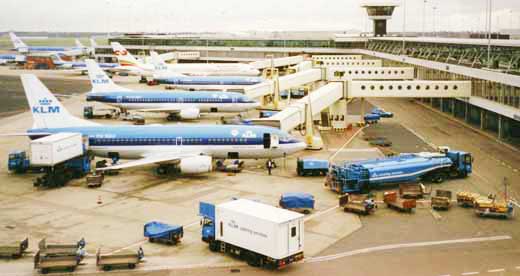
This is what is going on outside the departure gate while you are waiting to be called to board. At Schiphol Airport, Amsterdam, KLM Royal Dutch Airlines rules the tarmac. Here is a plane getting serviced for take-off. The white trucks bring the food and beverage, the big blue tanker brings the kerosene fuel, and the little cart trains bring the luggage. Passengers board through the long white things which are variously called jet bridges, jetways, gangways, and other names.
Boarding
After getting to the departure gate, you will have to wait for your section to be called before boarding. Planes are normally boarded in a standard order -- disabled people, people with toddlers, first class, business class, and then tourist class. Tourist class is boarded by rows, starting with the highest numbers which are in the back of the plane. When the batch of rows including yours is called, snap to and get right up to the attendant who is taking boarding passes and allowing people on the plane.
It's a good idea to be early on the plane. If you are first on for your row you can put your carry-on luggage in the overhead bin. If others get there first and fill it up with their stuff you will have to hunt around for a place to put your bag. You might even be asked to check it in the luggage hold.
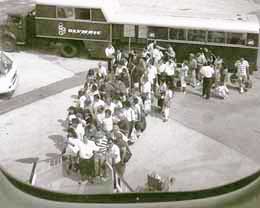
If your airline is not blessed with a jet bridge you may have to climb some stairs. Here is the view from the window of a jumbo Boeing 747 picking up passengers in Athens, Greece. These passengers were carried across the tarmac by that trailer. Sometimes passengers must walk to the planes, and sometimes there is a jack-up bus so passengers do not need to climb. I shot this from the business class upper deck of a Singapore Airlines fright from Frankfurt to Singapore.
Safety Instructions
After everybody is seated and the doors are closed the flight attendants begin the safety instruction. They show you how to buckle and unbuckle your seat belt. They demonstrate the use of the emergency oxygen masks. They demonstrate the manner of putting on, strapping down, and inflating the emergency flotation vest. They point out the emergency exits. Sometimes the safety instruction is given over the video screens. Most people seemingly have something more important to do than pay attention to the safety lesson. Sad.
Eating
Most flights provide meals, anything from a mini baggie of sugared peanuts to a full dinner and a breakfast depending on flight duration, time of day, and class of service. Chances are that your eastbound trans-Atlantic flight will include dinner and/or lunch and/or breakfast. Meals on international flights are not as bad as those on domestic flights, except that I've never had a breakfast worth eating on any flight.
Just before writing this paragraph I had a nice lasagna for dinner, courtesy of KLM. Food and soft drinks are free. Alcoholic beverages are free on trans-Atlantic flights, with seemingly no limit most of the time. A stewardess on a 2008 KLM flight poured half of the 50 ml bottle for me and kept the rest! I had never before seen that. Later that year I flew Northwest (now Delta) to Paris. The French guy next to me was ordering drinks two at a time. So did I. Five days later on my return flight I had the same steward. He remembered me and just automatically gave me doubles on every order. I should have tipped him. It is reported that some American carriers are now charging for beer, wine, and spirits on international flights.
Flights within Europe are short and there is little time for regular service. Sometimes there is a bin of bagged food in the gate area. It's self service. On a morning flight from London to Amsterdam the flight attendants zipped through the plane literally throwing a covered styrofoam plate in everybody's lap. Who wants British food anyway?
European business class is a necessary sop for upper level employees, and a joke. I have enjoyed it but for the short flights under two hours it is of dubious value. During dinner on a flight from Brussels to Edinburgh, I turned around and noticed that the tourist class was also sitting in six-across seats and appeared to be enjoying a nice meal like us in business class. I asked the stewardess what the difference was between business class and tourist class. She was taken aback for a moment, then replied that we had a hot meal and theirs was cold. I asked if that was it and she said that we also got champagne! That was a surprise because no champagne was offered.
When making airline reservations, inquire about the availability of special meals. There is no extra charge for this service. For medical and religious reasons, all airlines will provide special meals to passengers. They also offer a selection of plates besides the normal chicken and beef. Children's meals are also available. I sat next to a fellow from India who requested a Hindu meal. The stewardess should have had his seat number on a list of special meals, but didn't mention it. So if it doesn't come out, ask. The flight attendant probably has it but it may have the wrong seat number on it.
On one flight to Europe the only meats on-board were ham and pork. Several people sitting near me asked for something different, but the flight attendant had nothing else to offer. So, if there is something you'd rather not eat, let them know before the plane is up above the clouds.
You must reserve special meals at the time you buy your ticket. It's too late when you see the passenger next to you dive into a chilled seafood plate. He has the only one on the plane.
Smoking
Fortunately, most airlines are flying smoke free these days. But there is a chance that you'll be on a flight with smoking allowed if you fly somewhere outside Europe or the USA. If you are sensitive to smoke, request a seat in the middle of the no smoking section. On one overseas flight I was in the first no smoking row and the smoke wafted back for eleven hours. I and everybody around me suffered from coughs and sneezes for the last half of the flight.
Headsets
If you want to listen to the recorded music or the sound track of the on-board movie, use a headset provided by the airline. Headsets are normally free on trans-Atlantic flights and you are invited to take it with you when you get off. The darn things are virtually worthless so I won't be doing that again. I'll let the airline throw it away.
Electronic Gizmos
During take-off and landing all electronic devices must be turned off. In the air, laptop computers and game devices may be operated. Using mobile phones and other communications devices is prohibited during flight. On a recent domestic flight the fellow sitting next to me had a GPS. It was interesting watching that and looking out the window to see where we were.
Entertainment
Tourist class passengers are treated to a recent release from Hollywood. I just watched an old Christmas episode from "Cheers" with Sam Malone and his merry gang where everybody knows your name. You might also see a rebroadcast of the BBC or CNN news, plane route maps and information, and a video clip describing the country you are about to land in. Games and music are also available. The absolute worst video clip I ever saw was on a KLM flight from Amsterdam to Manama, Bahrain. The flight was on New Years Eve and the video showed celebrations around the world. While the video was showing all that champagne bubbling down the gullets of happy folks everywhere on the planet, our plane was sitting on the tarmac in Kuwait. We were dry because Kuwait is a "dry" country. It was a New Years Eve not to be forgotten, like my last bug in the eye. Another thing I didn't like about that flight was the part where we flew along the southern border of Iraq, very low and very slow on the Saudi Arabian side of the line in the sand. That was between the two Gulf Wars.
Business and First Class passengers are normally provided with an individual video screen on their arm rest. You can watch any of several movies or rock concerts or whatever else, and switch channels just as if you were at home.
Climate on Board
International flights pass through air that is about 60 below zero and extremely dry. Sometimes the inside air can feel almost as cold. Bring a sweater on board if you have thin blood. Ask for an extra blanket if you need it.
To avoid dehydration drink plenty of your favorite beverage. I don't go along with those people who say drink juices and water and avoid alcoholic drinks. I don't drink fruit juices unless they have been fermented first. Fruit juices are full of fructose and I'm sweet enough already. Alcoholic beverages, especially red wine, help warm you up, are excellent relaxants, and have been found to benefit your heart.
On-Board Magazine
In the pocket attached to the back of the seat in front of you is the current issue of the airline's on-board magazine. These magazines normally have a few good articles, schedules of movies on-board, maps of the carrier's system, a duty free shopping catalog, crossword puzzles, beaucoup plenty of advertisements, and a coupon for joining the airline's frequent flyer program. Join. It's free and you can get free flights.
What's Down Below
If you want to know what is down below on the ground check out the maps in the on-board magazine. You might be able to figure it out. These maps show big arcs from city to city, not straight lines. To understand why, use a globe and a piece of string to locate the shortest route between your departure and arrival cities. You'll see that a flight from Los Angeles to Amsterdam flies further north than one from New York to Amsterdam. You could also bring a GPS but it probably won't do much for you when you get out over the Atlantic.
Landing
On the plane, keep a note of the expected landing time. If you have an alarm watch (see chapter 6, Your Packing List for Europe), set it for about one hour before arrival. When the alarm rings, get in line at the toilets for a pit stop. Toilets get awfully busy just before landing, and the bumps start as the plane descends through the clouds. Sometimes people get injured as they are standing in line if the plane goes through rough turbulance.
POTPOURRI
Baggage
Please see chapter 24, Shipping Your Treasures Home from Europe and chapter 6 Your Packing List for Europe , for regulations about checked and carry-on baggage. One potentially important point is that baggage allowances within Europe are less than they are for trans-Atlantic flights. Check with your airlines.
Take Off Time
When you make your reservations keep in mind that you are normally required to check in about three hours in advance of flight time for international flights. Add to this the time it takes to get to the airport. When flying from the USA to Europe this can be managed easily, especially if you have taken my advice to fly on an evening flight to help avoid jet lag. When coming home many people opt for a mid-morning flight, say 10 AM. This requires you to be at the airport by 7 AM and probably to leave your hotel by 6 AM. Your options for transportation will be limited and you may need to take an expensive taxi. Choose a mid-afternoon flight if one is available.
Caveat Emptor
Regardless of which airline you choose, check your ticket or boarding pass immediately and thoroughly on receipt. Everything on it means something, and if you do not understand it, ASK! It's YOUR trip and mistakes are against YOUR good times for which you cannot be refunded, even if you do get all of your money back, which you probably won't. Consider yourself fallible and the one you are dealing with as fallible and get slightly, temporarily, paranoid. Mistakes are especially likely when you are making changes. Make sure that not less and not more than you intended was changed. Check and recheck. And when dealing overseas with someone who does not speak American English or speaks it with an accent, write down your intentions. This will reduce the chance of an error, but it will not eliminate it.
If you decide to go by way of a package tour, know what you are buying. Read all the terms and conditions to make sure that you and the tour are in harmony. Compare what you are getting with what you will need to spend. See chapter 2, On Budget in Europe for a list and descriptions of expense items. Ask for clarification in writing for all generalizations, maybes, and obfuscations. Good luck.
Airport Code Letters
Every airport in the world has a three character alpha code. For example, Los Angeles is LAX and Amsterdam is AMS.
Flight Number
Every "flight" is assigned a flight number by the airline. This includes two letters designating the name of the airline company and 2 to 4 numbers for their flight number, for example, XY1234.
A flight may be non-stop or it may stop along the way in various cities. For best use of your time select a non-stop flight. Multiple stop itineraries usually offer more economical travel, and more frequent flyer miles. You may have more than one flight number and ticket. This would normally mean that you get off and board another flight in a city along the way.
Code Share
Sometimes a single flight can have two flight numbers when it is on a route served by partner airlines. For example, over the years one of my favorite flights to Europe was on KL602, non-stop Los Angeles to Amsterdam on KLM Royal Dutch Airlines. This was also flight NW8602 in the Northwest Airlines schedule. Same plane, different name.
The most unusual code sharing I have seen is with American Airlines and the Thalys. American Airlines does not fly to Brussels, but has a code share with the Thalys between Paris and Brussels. Thus, if you book an AA flight to Brussels you'll be flying into Paris and then taking the high speed train to Brussels, designated as AA7395 with aircraft type TGV. TGV is the French designation for high speed train. The Brussels airport city code is a strange one, ZYR for the Brussels Midi train station. You probably want to go to the Brussels Central station so hop on the next local train to the center of the city.
Equipment
"Equipment" is airline jargon for the type of airplane. Most international airlines fly "jumbo jets" — the Boeing 747 or 767, DC-10, or Airbus 300 series. Formerly they also used the Lockheed TriStar L-1011, which is, in my judgment, the nicest riding plane ever built. But it is a gas guzzler so you don't see this one very often, unless you are flying in Saudi Arabia. If I ever become a billionaire I'll buy a TriStar and learn to drive it. The big birds are definitely more comfortable than the smaller planes on those long overseas flights.
Seats
Some carriers put more seats on a plane than others. I have been on budget domestic flights with five rows of seats jammed in where there were just four windows. There was virtually no room for my knees. It is reported that this is also done on some international charter flights. So if you're a big person you might want to check on this before buying a low cost ticket for a ten hour flight.
Multiple Terminals
This probably applies to only a few large city airports. In Los Angeles, for example, there is a separate international terminal, yet not all international flights arrive at or depart from the Bradley International Terminal. There is a similar situation in Detroit. Paris, London, and other large European airports have more than one terminal. Check with your travel agent to determine which terminal your flight departs from and returns to before you head for the airport. Getting lost in a big airport minutes before your flight time is just no fun.
INTERNATIONAL AIRPORT FACILITIES
More Than at Home
International airports offer a number of facilities not normally seen in US domestic airports. Of course, you will nearly always find bars, restaurants, car rentals, gift shops, ATM machines, and newsstands.
Duty Free Shopping
After obtaining a boarding pass you can browse through the "duty free shops." Items featured are usually luxury goods, alcohol, and tobacco. You cannot use the duty free shops when you land. They are only for departing passengers.
Many airlines also offer duty free shopping while you are on board. There will probably be a catalog of items in your seat pocket or there will be a duty free section in the in-flight magazine. If you don't want to buy and don't want to be disturbed ask the flight attendant to skip you before you fall asleep.
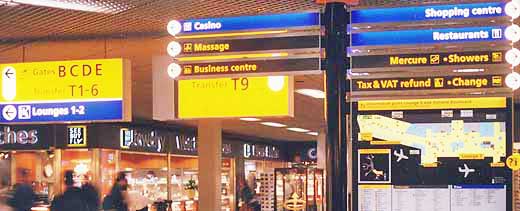
You may have noticed that this chapter is top heavy with photos from Schiphol Airport, Amsterdam. It is my favorite airport, and one that I've been through many many times. Here is a photo of an inside street sign indicating a few directions. You could almost live in this place. The Mercure is a hotel right in the airport. Paris' Charles de Gaulle airport has a very convenient Sheraton Hotel inside.
Banks
Before there were ATM machines there were banks. Remember those? Most international airports have a bank which primarily serves as a money exchange office. When you land get enough local currency to get you to a bank in town where you will probably receive a better exchange rate for your dollars. If you have an ATM card use it in a machine at the airport and extract the cash you will need for the next few days.
Luggage Storage
Some airports offer baggage check rooms and/or luggage lockers. For example, Amsterdam's Schiphol Airport has short term lockers and long term attended luggage storage on the lowest level of the terminal. It's very convenient. This is on the "land side" of security. Schiphol also has luggage lockers in the secure area.
Observation Deck
If you like to watch the planes taking off and landing, most airports have an outdoor deck or restaurant area to accommodate you.
Airline Lounges
Major airlines have exclusive lounges at many airports. You must join at a ridiculous annual price or be invited. The facilities usually include free WiFi, free drinks, munchies, and sometimes more substantial food. Because I am one of Delta Airlines' frequent flyers with a lot of miles Delta has given me several free passes to the Delta Sky Clubs over the past few years. That is nice of them. On one flight to Detroit I got into a conversation with the fellow getting off in front of me. He was a member and invited me to the club where we had a good time and met a bunch of other frequent flyers. That was nice of him.
Note that the WiFi hotspot range sometimes extends beyond the door of the club. If you want to grab some free internet time sit near a club and see if you can log on. I've done this while waiting for a delayed flight.
Train Station
Many European airports are connected to the city center by local or international trains. If you have a Eurailpass you can start using it to get to town right from the airport. If you are staying there for a few days you might want to pay for a ticket to extend the validity of your Eurailpass and not waste a day on a short hop.
Other Ground Transportation
In addition to direct train service in many cities, European airports are served by taxis, metro lines, city buses, hotel buses, and/or airline buses. There is always a way to get to your hotel. Options are not as plentiful early in the morning or late at night. Keep this in mind when you make your reservations.
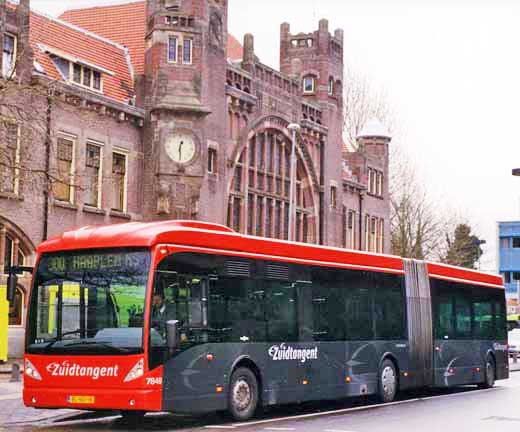
Zuidtangent 300 bus is my favorite transport from Schiphol Airport to Haarlem, The Netherlands, my home town in Europe. The castle-like structure behind the bus is the Haarlem train station, a classic. Tickets for buses and trains in Holland is rather strange. See the procedure at OV-chipkaart.
DEEP VEIN THROMBOSIS, DVT
The information in this section is paraphrased from the web site of the Alaska Department of Health. This is not meant to be medical advice, and is surely not complete. Studies continue on DVT. For more information see your doctor. Do not sue me.
What is DVT?
DVT is clotting in the veins of the legs. It has been known for decades that this condition can happen when taking long haul air flights like those you will make in crossing the Atlantic. However, there is no proof that flying per se is a cause of DVT because DVT is fairly common in the general population, affecting approximately one in 2,000 people. DVT is associated primarily with sitting in one position for many hours. Wheelchair bound patients are susceptible. There are a number of other contributory factors having to do with advanced age, family history, pregnancy, recent hip or knee operations, and your personal health history regarding blood clotting.
DVT is a life threatening condition. The clots can break loose in the leg veins and float along to lodge in the lungs, This causes pulmonary embolus, PE. This can cause the lungs to collapse followed by heart failure. If the floating clot lodges in your heart it can be heart failure pretty quick as your pump muscles quit.
The first symptom of DVT is a sharp pain in one leg. You may have swelling, tenderness, or redness, especially in the upper calf. The condition frequently occurs after the flight, sometimes days later. The symptoms of subsequent PE are breathlessness and chest pain.
Preventing DVT
The obvious and easiest way of reducing the risk of DVT is to get some exercise on the plane. In-your-chair isometrics, deep breathing, bending, and foot massage every hour or so would be good. Many frequent travelers, including me, take a hike around the plane every once in a while. You never know who you will see on board.
Diet and medication can also be considered. Some people advocate aspirin for its reported anti-thrombotic properties. This is held in dispute by others. Some people advocate one or more of the aspirin substitutes. Avoiding excessive alcohol consumption and drinking plenty of water are also suggested. Wearing elastic stockings is reportedly helpful.
There are some public advocacy groups which blame the close seating in tourist class for DVT. There is no room to move around in the seat — you can't even cross your legs unless you are under 10 years of age. A few airlines show in-flight videos discussing DVT and how to prevent it. Most airlines do not mention it.
JET LAG
You may have heard of jet lag as one of those late-night "comedians" interviewed a well-traveled "starlet" on his program. However, it is real.
What's This?
Jet lag is a discomfort caused by your body's attempts to move all of its daily functions ahead or behind in accordance with the number of time zones you have crossed. For example, at 5 PM in Los Angeles, it is 8 PM in New York, and 1 AM in London. A nonstop flight departing Los Angeles at noon arrives in London at 11 PM Los Angeles time, just about bed time. But it will be 7 AM in London. Your body wants to sleep. It's certainly not ready for breakfast, much less a British breakfast, and a day at the Tower followed by a night on the town.
Prevention
For flights to Europe it is a big help if you are able to sleep on the eastbound flight. Sleep will be difficult if you are crammed into an undersized seat with oversized persons jammed in on both sides and pigging the armrests. It can be getting uncomfortable in six hours, but you may have four more to go. And when you can't get your mind off your discomfort, you can't relax and sleep.
In going to Europe I have found it helpful to get on a plane after having had only a couple hours of sleep the night before. I am a procrastinator and a last-minute man. I am usually up very late the night before a flight to Europe packing my bag. It is also helpful, especially when flying from the eastern time zone, to fly as late in the evening as possible. Flying from Detroit, for example, you can depart at about 4 PM and arrive in Amsterdam at 6 AM the next morning. That corresponds to midnight in Detroit where your body clock is still residing. You are past your bedtime but the world around you is just waking up. Instead, you can take a later flight at about 11 PM from Detroit which arrives in Amsterdam at about 1 PM the next afternoon. You are pretty sure of getting at least a few hours of good sleep on the late plane because it is flying during your normal sleep time. You'll arrive much more refreshed than if you take the afternoon departure.
I think that this prevention is far and away the best cure. I haven't had jet lag since I started using the late night flights to Europe about ten years ago.
Adding to your discomfort when arriving early morning in Europe is the probability that you will not be able to check into your hotel until noon. One way to shake off the initial effects of jet lag is to take a good hot shower and change your clothes. If you are scheduling an early arrival then also schedule an early check-in.
Cure
No quick fix has yet been found. The only cure for jet lag is time. The common rule of thumb is that it takes approximately one day to cure each time zone traversed. I would say that this is for a complete cure. You will be almost normal in one third of this time, depending on how you behave and on the direction in which you are traveling.
There is some dispute among sufferers whether it is easier to recuperate when going east or when going west. I find the adjustment easier when traveling from Europe to America. The entire flight westbound is during daylight and you arrive only a few hours later than you departed, by local clock time, even though the actual flight time can be half a day. It is equivalent to staying up way past your normal bedtime though you have a whole night to catch up on your sleep. But it sometimes hits me a couple of days later.
There is a "drug" which reportedly can reduce the effects of jet lag. It is widely available on the internet. Please consult your doctor before using this substance.
Surviving Jet Lag
On arrival after a six to ten hour flight, you can expect to be a bit edgy and hypersensitive, but not necessarily tired. You'll be just blah blah and feeling like you have a mild flu. Struggle through the day to stay awake until the right local sleeping time. This forces your body to begin getting in step with local time. You will awaken often during the first night, and probably won't sleep at all if you dozed off during the first day. Falling asleep during your first day will prolong your jet lag by at least a day. One of my worst episodes left me feeling hung over for several days. That's not a good way to spend your Paris vacation time. Don't sleep and don't even nap on your first day.
On the second day, you will feel OK in the morning, but become extremely drowsy in the middle of the afternoon. You will be sleepy that evening, but get only a restless sleep, probably waking several times. Have a big pasta dinner to help you sleep through the night.
After your first two brutal days in Europe, the third day will feature a marked increase in your comfort. Tiredness will set in during the afternoon. Stay up until at least 10 PM so that you won't wake up before 4 AM.
By the fourth day you will have forgotten that you had jet lag. Keep moving and have a wild night. That's all.
If you want to refer back to this topic, bookmark it, or send a link to your friends use this Jet Lag Link to get back here in a click.
UNACCOMPANIED MINOR, UM
What is UM?
Children from about 5 years and up can travel alone. The minimum age depends on the airline. It's called Unaccompanied Minor status, UM for short. We have flown Stephanie unaccompanied to Italy almost every year since she was 7. She has made over 15 trans-Atlantic flights on her own, plus a number of additional legs within Europe and the USA. Initially we flew her on non-stop flights from Los Angeles to Milan where her aunt lives. Starting when she was 10 she began making connections with the assistance of airline personnel. Alitalia has discontinued its non-stop LAX-MXP service forcing her to make connections for the future. But Stephanie is 25 now and is an accomplished international traveler. In addition to her annual Italian getaway she has recently spent 6 weeks studying Spanish in Salamanca, Spain. While she was there she thought it would be fun to get in a bull ring with a baby bull. Then she lived in Paris for a month while attending the Alliance Française. Hmmm, that's where Mommy met Daddy. Find Stephanie's blog of her trip at O hey Europe.

Stephanie was so eager for her first solo trip to Italy that she ran down the ramp before we knew it. We had to get the gate assistant to bring her back so I could take her photo, and so we could give her a good-bye hug and kiss. Here she is at seven years old wearing her Alitalia UM red-striped badge and satchel for her passport, ticket, and other important documents.
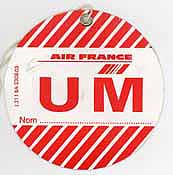
Here is the flight badge of courage for junior passengers on Air France.
Back to UM. The procedures are rather simple. The airline needs to know certain information about the identity of the person who is bringing the child to the airport and the person who is picking him/her up. Names, address, relationships, and telephone numbers are needed. A chain of custody is made so that at the end of the trip you will know who was responsible for your child at all times. To pick up the child, the receiving adult must present a passport or other official identification.
Services
Airline personnel help with boarding at airports. Non-passengers are prohibited beyond the first control point which is still a mile from the security and passport check points. The boarding area makes up most of the airport. Therefore you have to leave your kid in the hands of the airline for over an hour before flight time. Amsterdam's Schiphol Airport has a kid play zone so they won't get bored. I've flown Stephanie from Schiphol to Malpensa in Milan and to Heathrow in London, each time signing her away long before flight time.
Connections
Though non-stop service is certainly better, faster, and safer, you can not tell the airline where to land. The child may need to make a connection. Stephanie has connected in Chicago with United Airlines, London with British Air, in Paris with Air France, and in Frankfurt with Lufthansa. Everything normally went OK, except she mentioned that the fellow from Air France was not too well informed or prepared for his assignment. He left Stephanie and three other kids waiting alone while he returned somewhere to get a key for a locked door, whereupon a couple of stewardesses started asking the kids some questions, in French. Duh? The fellow came back and all went OK for her continuing flight to Geneva where I was living at the time. On another connection, Lufthansa lost her bag in Frankfurt but got it to her in Milan the next day. Nothing unusual about that. But she was very upset that the stewardess did not wake her up for breakfast on the leg to Milan. Even though Stephanie woke up during the food service she was not given any breakfast. In my experience, Lufthansa crew are the second least helpful of any airline except Iberia.
Unaccompanied minors wear an envelope on a string around their neck. This has their passport and flight documents. Air France also put a small tag on her dress.
No Last Flight
Scheduling a child for UM status is slightly more difficult than for making adult reservations. Generally, airlines will not allow a child to make a connection if the flight they are connecting to is the last flight of the day from a connecting city. Some airlines will allow this if the child is at least 12, or 15, or some other minimum age and flying UM. Some airlines with only one flight a day from an American gateway city will allow a UM to make the connection to Europe because international flights are rarely canceled.
Kids Meal
Make sure you order the "kids meal" for the UM flight. If not you will discover that Air France does not serve French fries and that kids don't necessarily like French food. But, Stephanie says, the deserts are superb.
Cost
The international airlines charge extra for UM status if a connection is required. This is to offset the cost of extra staff who are guiding your little angel to the next flight. It is generally priced per flight leg. Making a connection means two legs.
Additional Considerations
Besides what is required by the rules and regs of the airlines you want to provide your kid with enough documentation that he or she will not be stranded in the hands of a foreigner who "no speeka da ingrish," just in case. I always provided Stephanie with a one page sheet containing copies of her passport and air ticket. I also included complete contact information for her in Europe and back home, our insurance policy name and number, and assurances that we would pay whatever wasn't covered by the policy in case she had an accident or got sick. I had this notarized and signed it. Stephanie carried a copy with her at all times. She never needed this as far as I know, but that is OK by me.
Things change in the travel business, especially airline things. Also, every airline does things their own way. If you are considering using UM services for your child contact your airline ASAP to get clued in on their procedures. Follow thier instructions to the letter. Stephanie had many succesful trips as a UM on many airlines and there is no reason why your child can't enjoy the same.
If you want to refer back to this topic, bookmark it, or send a link to your friends use this unaccompanied minor link to get back here in a click.
Tp help you keep your head on straight as you prepare for the multitude of things to do in preparation for your trip see Last Call: Travel Prep and Pack Lists for Europe.
Have a good trip!
NOTE TO READERS
I welcome questions, comments, complaints, and compliments. If you have any concerns about your trip to Europe that have not been covered well enough on my web site please do not hesitate to write. Ask, cuss, discuss, or whatever. I read every email and update my pages when I see a question repeating, Then I will not get that question again, hopefully. In some cases readers have been so generous with their time and talent that I have included their emails verbatim, e.g. chapters 22 and 25.
I do not open attachments. I do not click links to web pages of any kind. I will reply in a day or two, usually.
My email address is [email protected].
Do not forget to smell the hyacinths. At your liesure scroll through the Table of Contents of How To Europe: The Complete Travelers Handbook and read all 30 chapters, FREE on line. Good deal! You'll probably find the answers you seek, and some you didn't know you needed.
FREE
This web site is totally free for everyone, and a labor of love for me. To keep it afloat I receive a commission from Amazon.com for all goods purchased through the adverts I have selected, and any other products you might buy when you are on the Amazon site. Amazon has almost everything for sale, except the Brooklyn Bridge and Mount Rushmore.
Please visit my on-line store at
 .
Your support is most gratefuly appreciated. TIA.
.
Your support is most gratefuly appreciated. TIA.
To like and like not:


Adverts
To support this site:
Please buy your goods at:Amazon.com
Shop in your shorts!
Please clean out your cookie jar before clicking.
Rolling luggage sure beats lugging a pack on your back.
 Travelpro Luggage Maxlite 2 20" Expandable Spinner
A shoulder bag for your daily walk-about.
 Travelpro Luggage Maxlite3 Soft Tote
Keep your stuff organized.

Luggage Packing Cubes
eBags 3pc Set
The two gallon size is excellent for packing your clothes, but it is hard to find in Europe.
 Two gallon plastic bags
ZipLoc by SC Johnson
Inconspicuously lock your zippered luggage with a black wire tie.
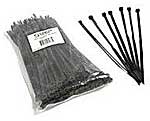 Cables to Go 43036 Cable Ties - 100 Pack (Black)
A Swiss Army Knife is unquestionably the handiest item a traveler can carry, except not on a plane.
 Victorinox Swiss Army Huntsman II Knife
Note: The highlighted #E number is purely arbitrary. It is meant to help quickly identify products in this advert column when you write in for electrical advice.
See NOTE TO READERS.
Plug adapters are needed throughout Europe. There are at least five models used in different countries.
This adapter is for the standard grounded plug in France, Germany, and northern Europe. It does not fit in outlets of Italy, Switzerland, Ireland, and Britain.
#E-010
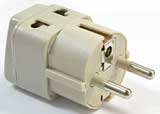 Grounded Universal 2 in 1 Plug Adapter
European Schuko plug.
4.8 mm prongs.
Equivalent to type E and F.
You can use this ungrounded Euro plug in some European countries.
#E-020
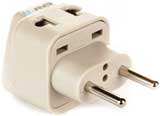 Universal 2 in 1 Plug Adapter
Euro Plug
4.0 mm prongs.
Equivalent to type C.
This is a universal plug adapter for the UK and Ireland.
#E-030
 AC Adapter Plug for use in England, Scotland, Wales, and Ireland
Equivalent to type G.
Here is the Swiss version.
#E-040
 Grounded Universal 2 in 1 Plug Adapter
Type J for Switzerland
Here is the grounded Italian model.
#E-050
 Grounded Universal 2 in 1 Plug Adapter
Type L for Italy
This 110-250 volt power surge strip has three universal outlets and an American grounded plug so it needs a plug adapter for the countries you are visiting. Make sure your gizmos are rated for 110-240 volts.
#E-060
 SM-60 Universal 3 Outlet Power Strip Surge Protector for Worldwide Travel. 110V-250V with Overload Protection.
If your gizmos charge through a USB port this can keep you going. European cars have the same 12 volt system as American cars.
#E-200
 Scosche Dual USB
Car Charger
The links in this pink field take you directly to a page at Amazon.com. The Amazon page details the item, and in most cases includes candid and critical comments from others who have bought the item.
Amazon pays my site a small commission when you click and order an item, if you put it in your shopping cart within 24 hours based on the cookie they set on your computer. If you don't want to make a quick decision just put it in your shopping cart, think it over, and come back later. The revenue covers the cost of maintaing this web site and keeps it free to users.
You benefit when buying here because Amazon has:
- 20% - 30% discount on many items,
- free shipping deals, direct to your door,
- no sales tax on internet purchases in most states,
- zillions of products, well almost,
- fast delivery even when it is free,
- shipment tracking in UPS, USPS, FedEx,
- easy returns if you are not happy with the product.
You win we win. Thanks for your support!!
Have a good trip in life,
John Bermont
Note: Italicized notations by the author.
This 50 watt 220/110 volt step down transformer is good for very small 110 volt appliances and light duty chargers.
#E-070
 Travel Smart by Conair 50-Watt International Transformer
Wear a money belt under your shirt to protect your passport and valuables, especially if you are staying in hostels or dorms.
 Lewis N. Clark RFID Blocking Waist Stash
An RFID blocking wallet protects your passport and credit cards from identity theft in public places.
 Travelon RFID Blocking Passport Case
Inconspicuously lock your zippered luggage with a black wire tie.
Cables to Go 43036 Cable Ties - 100 Pack (Black)
A Swiss Army Knife is unquestionably the handiest item a traveler can carry, except not on a plane.
Victorinox Swiss Army Huntsman II Knife
This will come in very handy very often.
 Fenix LD15
High Performance
LED Flashlight
To help find your way on the winding and poorly posted roads of Europe. It works for civilian travelers also.
 Lensatic Military Marching Compass
This is my book, available at Amazon.com. The last edition was published in 2003. Critical up-dates are on this web site.
 How To Europe
The Complete
Travelers Handbook
by John Bermont
The best travel guide to all of Europe.
 Europe on a Shoestring
Lonely Planet
A comprehensive guide to 3,000 hotels and restaurants in 44 major cities throughout Europe, in English. Separate books in the Michelin Red series cover individual countries in greater detail. This is a must have for frequent travelers.
 Main Cities of Europe 2015
Michelin Guide
Michelin will get you on the right road.
 Europe Map Michelin
This camera includes a GPS that automatically sets the internal clock depending on which time zone you are in.
 Panasonic Lumix ZS20 14.1 MP High Sensitivity MOS Digital Camera with 20x Optical Zoom
One of my favorite books. Ernest Hemingway in Paris.
 A Moveable Feast
by Ernest Hemingway
A Moveable Feast
by Ernest Hemingway
Rolling luggage sure beats lugging a pack on your back.
Travelpro Luggage Maxlite 2 20" Expandable Spinner
A shoulder bag for your daily walk-about.
Travelpro Luggage Maxlite3 Soft Tote
Keep your stuff organized.
Luggage Packing Cubes
eBags 3pc Set
The two gallon size is excellent for packing your clothes, but it is hard to find in Europe.
Two gallon plastic bagsZipLoc by SC Johnson
Inconspicuously lock your zippered luggage with a black wire tie.
Cables to Go 43036 Cable Ties - 100 Pack (Black)
A Swiss Army Knife is unquestionably the handiest item a traveler can carry, except not on a plane.
Victorinox Swiss Army Huntsman II Knife
Wear a scarf for comfort and style.
 Very soft houndstooth neck scarf, Kanye West style, different colors available
Rolling luggage sure beats lugging a pack on your back.
Travelpro Luggage Maxlite 2 20" Expandable Spinner
A shoulder bag for your daily walk-about.
Travelpro Luggage Maxlite3 Soft Tote
Keep your stuff organized.
Luggage Packing Cubes
eBags 3pc Set
The two gallon size is excellent for packing your clothes, but it is hard to find in Europe.
Two gallon plastic bagsZipLoc by SC Johnson
Inconspicuously lock your zippered luggage with a black wire tie.
Cables to Go 43036 Cable Ties - 100 Pack (Black)
A Swiss Army Knife is unquestionably the handiest item a traveler can carry, except not on a plane.
Victorinox Swiss Army Huntsman II Knife
Note: The highlighted #E number is purely arbitrary. It is meant to help quickly identify products in this advert column when you write in for electrical advice.
See NOTE TO READERS.
Plug adapters are needed throughout Europe. There are at least five models used in different countries.
This adapter is for the standard grounded plug in France, Germany, and northern Europe. It does not fit in outlets of Italy, Switzerland, Ireland, and Britain.
#E-010
Grounded Universal 2 in 1 Plug Adapter
European Schuko plug.
4.8 mm prongs.
Equivalent to type E and F.
You can use this ungrounded Euro plug in some European countries.
#E-020
Universal 2 in 1 Plug Adapter
Euro Plug
4.0 mm prongs.
Equivalent to type C.
This is a universal plug adapter for the UK and Ireland.
#E-030
AC Adapter Plug for use in England, Scotland, Wales, and Ireland
Equivalent to type G.
Here is the Swiss version.
#E-040
Grounded Universal 2 in 1 Plug Adapter
Type J for Switzerland
Here is the grounded Italian model.
#E-050
Grounded Universal 2 in 1 Plug Adapter
Type L for Italy
This 110-250 volt power surge strip has three universal outlets and an American grounded plug so it needs a plug adapter for the countries you are visiting. Make sure your gizmos are rated for 110-240 volts.
#E-060
SM-60 Universal 3 Outlet Power Strip Surge Protector for Worldwide Travel. 110V-250V with Overload Protection.
If your gizmos charge through a USB port this can keep you going. European cars have the same 12 volt system as American cars.
#E-200
Scosche Dual USBCar Charger
This 50 watt 220/110 volt step down transformer is good for very small 110 volt appliances and light duty chargers.
#E-070
Travel Smart by Conair 50-Watt International Transformer
Wear a money belt under your shirt to protect your passport and valuables, especially if you are staying in hostels or dorms.
Lewis N. Clark RFID Blocking Waist Stash
An RFID blocking wallet protects your passport and credit cards from identity theft in public places.
Travelon RFID Blocking Passport Case
Inconspicuously lock your zippered luggage with a black wire tie.
Cables to Go 43036 Cable Ties - 100 Pack (Black)
A Swiss Army Knife is unquestionably the handiest item a traveler can carry, except not on a plane.
Victorinox Swiss Army Huntsman II Knife
This will come in very handy very often.
Fenix LD15High Performance
LED Flashlight
To help find your way on the winding and poorly posted roads of Europe. It works for civilian travelers also.
Lensatic Military Marching Compass
This is my book, available at Amazon.com. The last edition was published in 2003. Critical up-dates are on this web site.
How To EuropeThe Complete
Travelers Handbook
by John Bermont
The best travel guide to all of Europe.
Europe on a ShoestringLonely Planet
A comprehensive guide to 3,000 hotels and restaurants in 44 major cities throughout Europe, in English. Separate books in the Michelin Red series cover individual countries in greater detail. This is a must have for frequent travelers.
Main Cities of Europe 2015Michelin Guide
Michelin will get you on the right road.
Europe Map Michelin
This camera includes a GPS that automatically sets the internal clock depending on which time zone you are in.
Panasonic Lumix ZS20 14.1 MP High Sensitivity MOS Digital Camera with 20x Optical Zoom
One of my favorite books. Ernest Hemingway in Paris.
A Moveable Feast
by Ernest Hemingway
Rolling luggage sure beats lugging a pack on your back.
Travelpro Luggage Maxlite 2 20" Expandable Spinner
A shoulder bag for your daily walk-about.
Travelpro Luggage Maxlite3 Soft Tote
Keep your stuff organized.
Luggage Packing Cubes
eBags 3pc Set
The two gallon size is excellent for packing your clothes, but it is hard to find in Europe.
Two gallon plastic bagsZipLoc by SC Johnson
Inconspicuously lock your zippered luggage with a black wire tie.
Cables to Go 43036 Cable Ties - 100 Pack (Black)
A Swiss Army Knife is unquestionably the handiest item a traveler can carry, except not on a plane.
Victorinox Swiss Army Huntsman II Knife
Wear a scarf for comfort and style.
Very soft houndstooth neck scarf, Kanye West style, different colors available
This 50 watt 220/110 volt step down transformer is good for very small 110 volt appliances and light duty chargers.
#E-070
Travel Smart by Conair 50-Watt International Transformer
Wear a money belt under your shirt to protect your passport and valuables, especially if you are staying in hostels or dorms.
Lewis N. Clark RFID Blocking Waist Stash
An RFID blocking wallet protects your passport and credit cards from identity theft in public places.
Travelon RFID Blocking Passport Case
Inconspicuously lock your zippered luggage with a black wire tie.
Cables to Go 43036 Cable Ties - 100 Pack (Black)
A Swiss Army Knife is unquestionably the handiest item a traveler can carry, except not on a plane.
Victorinox Swiss Army Huntsman II Knife
This will come in very handy very often.
Fenix LD15High Performance
LED Flashlight
To help find your way on the winding and poorly posted roads of Europe. It works for civilian travelers also.
Lensatic Military Marching Compass
This is my book, available at Amazon.com. The last edition was published in 2003. Critical up-dates are on this web site.
How To EuropeThe Complete
Travelers Handbook
by John Bermont
The best travel guide to all of Europe.
Europe on a ShoestringLonely Planet
A comprehensive guide to 3,000 hotels and restaurants in 44 major cities throughout Europe, in English. Separate books in the Michelin Red series cover individual countries in greater detail. This is a must have for frequent travelers.
Main Cities of Europe 2015Michelin Guide
Michelin will get you on the right road.
Europe Map Michelin
This camera includes a GPS that automatically sets the internal clock depending on which time zone you are in.
Panasonic Lumix ZS20 14.1 MP High Sensitivity MOS Digital Camera with 20x Optical Zoom
One of my favorite books. Ernest Hemingway in Paris.
A Moveable Feast
by Ernest Hemingway
Rolling luggage sure beats lugging a pack on your back.
Travelpro Luggage Maxlite 2 20" Expandable Spinner
A shoulder bag for your daily walk-about.
Travelpro Luggage Maxlite3 Soft Tote
Keep your stuff organized.
Luggage Packing Cubes
eBags 3pc Set
Wear a scarf for comfort and style.
Very soft houndstooth neck scarf, Kanye West style, different colors available