What's It All About?
Travel Like a Native in Europe
Genesis of a travel book.
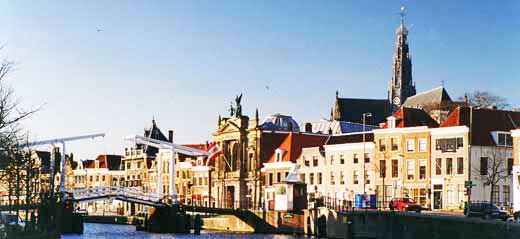
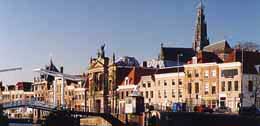
This was my first home in Europe — in the city of Haarlem, The Netherlands, about 17 minutes from the heart of Amsterdam. For two years I lived in the ground floor apartment of the house on the right. This is the corner of the river Spaarne and the canal Bakenessergracht. Most of the buildings in this neighborhood are about 300 years old. The Teylers Museum, the oldest museum in The Netherlands, is the building with the wings on top. The Sint Bavokerk, also known as the Grote Kerk, (Big Church) rises above the city. This counter-weighted lift bridge, the Gravestenenbrug, is attended full time during working hours to let boats pass up and down the Spaarne.
Carpe diem. Vivere bene! Gratia Deo.
HOW TO EUROPE: The Complete Travelers Handbook - - Chapter 1 - -

This entire book is published gratis on-line by the author, photographer, and webmaster, John Bermont, a DIY job with help from my daughter Stephanie. I welcome all questions, comments, and complaints.
For contact information please see Your Blow Back. Last update .

Your Go-To Travel Store
You can't swim in a car pool.
This handbook is a practical guide to independent budget travel in Europe. It will save money, time, and grief for first-time visitors. There are 30 illustrated chapters plus a number of appendices. Enjoy Europe!
AN ALMOST FATAL MISTAKE
Transfer To The Netherlands
The boss walked into my office one fine California morning and asked how would I like a transfer to the company's office in The Netherlands. This doesn't happen every day. I begged for some time and after a few days of thinking it over I decided what the heck and accepted. A few weeks later I landed on a chilly drizzly October morning at Amsterdam's Schiphol airport to begin a two year adventure in Europe, though I was lucky to live through the first month.
Just a Leaf
Shortly after arriving, I borrowed a friend's car to run some errands. While driving on a narrow street, another car suddenly came speeding from the opposite direction. The Dutch driver flashed his lights and honked his horn but continued to race ahead as if I was just a leaf on the pavement. He seemed eager for the inevitable head-on collision, and was probably cussing as loud as I was but we couldn't hear each other.
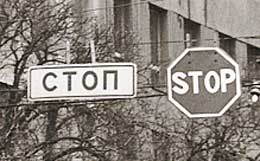
My only escape was to jump the curb and drive across someone's front lawn. Then I circled the block to see what, if anything, I had done wrong. The only visible sign at the street where I turned in was a round red board with a white band across it. That was something I had never seen before. Later, a Dutch neighbor explained that this road sign means "Do Not Enter — Wrong Way." It's always posted at the exit end of one-way streets. A similar sign is now used in the United States on expressway exit ramps, with the wording which is rarely seen on the European signs. Heck, even if the sign had the wording I couldn't have read it anyway. Learning Dutch is difficult and takes some months, or years.
GENESIS OF A BOOK
Living and Working in Holland
Initially I shared an apartment with a couple of guys in the seaside village of Zandvoort while we looked for permanent places. I got lucky and found a one bedroom furnished apartment in the center of historic Haarlem.
I made the short drive to the office every day, by car or bike. Though it was the same work I had done in California, the office environment and worker attitude were totally different.
After work was much different also. Being single, I didn't have much in common with most of the Americans in Holland. The majority of them were married, had families, and socialized through the American Women's Club. My life was almost entirely among the Dutch and I got to know them quite well. That was especially true of the friendly patrons at the Proef, strategically located around the corner from my apartment. I was the "Yank" — a name the Dutch affectionately use for Americans.
Shipping my car over to Holland turned out to be an excellent move. I put it to good use on the roads all over northern Europe on weekend and one-week trips. I made drives up to Stockholm, over to the former East German border, down to the Italian Riviera, and many areas in between. I learned how to drive in Paris like a real Frenchman, drive legally at 120 mph on the German Autobahnen (expressways), and maneuver around Sunday strollers on narrow rural roads.
Returning for Adventure
After nearly two years in Holland I went back to California but it wasn't long before I started to regret leaving Europe. I decided to return, but this time strictly as a traveler. I was still single and had saved enough money to take some time off from the usual work routine.
To get ready for the return trip, I quit my job and spent two months in full-time preparation. While sorting through most of the popular guide books, plus a library of books, pamphlets, and maps accumulated while living in Holland, it appeared that a new book would be helpful. For example, up until 2006 you could not find a description, much less a reasonable illustration, of the critical "Do Not Enter" sign in any other European guide book. A popular book in which you can find it now also plagiarizes a lot of other material from How To Europe. That guru "author" knows a good thing when he sees it.

The round red one with the white belt is "Do Not Enter." Learn more about the rest of those important European traffic signs in chapter 18 part 2, European Streets and Roads: Back Alley to Blazing Autobahn. Seeing as how this is Amsterdam, a city with one of the finest public transportation systems and most confusing driving conditions on the whole planet earth, just don't drive here, unless you can read those little white boards with other qualifiers written in good crisp Dutch while a taxi snooks up your tailpipe and two bicycles brush you on the right as a pedestrian and dog step out in front of you on the left. After you pass that gauntlet you hear the warning CLANG!! of a tram right in front of you. You should have taken the tram. See chapter 16 City Transport in Europe: Bus, Streetcar, Subway, Taxi, Bike, Shoe, Gondola.
My nearly fatal mistake on the one-way street was only one of many "dumb foreigner" blunders I made in Europe. Each cost me time, cash, or grief, or all of the above. Sometimes the local citizens were not very amused. Many things are different over there and I had to learn it all the hard way. As I learned the ropes, it became apparent that other Americans on their first trip were just as confounded by the mores of Europe as I was when I arrived the first time.
Many guide books presume a reader's familiarity with the new surroundings, sometimes copy mistakes and overstatements from each other, and are usually wordy and flowery galore. It was my intention in How To Europe to introduce Americans to the art of travel through the multi-culture of Europe, spiced with personal anecdotes to enhance an understanding of the new adventures travelers will experience on their first trip to Europe.
So a year after leaving Europe I returned with a notebook, a camera, and a three-month EurailPass. I covered most of Europe in almost constant travel, from Bordeaux in western France to Vienna in eastern Austria to Narvik in the north of Norway. Then I spent an additional three months visiting and studying in Amsterdam, Paris, and London — the core triangle of Europe. After another three-week refresher trip through nine countries in 1981, I published the first edition of How To Europe the following spring.
The book reviews were very nice.
American Library Association's Booklist said ". . . outstandingly practical
. . ."
The Los Angeles Times said ". . . exceedingly complete . . ."
The International Travel News, the best
travel journal there is, said "Bermont has a knack for picking out
and clarifying the things that usually baffle American visitors."
Many others echoed the same sentiments.
The following year I was back again hitting the four corners of then Western Europe — Helsinki, Finland to Dublin, Ireland to Lisbon, Portugal to Athens, Greece — crisscrossing by train and boat for ten weeks ending in early 1984. The second edition went to press later that year and sold out three printings in three years.
I let the book sleep after getting married, having a child, and holding a regular job. I am a chemical engineer. But I continued traveling and taking photos and eventually published the fourth edition in 2003. This web site is a continuing update of my book.
The Changing Times
Europe has undergone incredible changes in my experience over the past four decades, but most things are still the same. The things that are still the same are the artifacts and natural wonders that people have always gone to Europe for, and always will.
Eastern Europe:
The most significant change is the fact that the Berlin Wall is down and the communist dictatorships of Europe are gone. We are now free to travel in most of what was once a huge prison, the so-called Peoples Democratic Republics. There are still a few of these bastardizations left in other parts of the world but Europe is rid of them, with the possible exception of Russia and a couple of its friends. Prior to November 1989 East Germany was the equivalent of North Korea or Iran in 2015 with a dictator feared and detested by its citizens and nearly everybody else in the world.
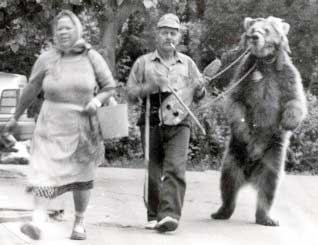
Uh oh, they saw my camera. This couple with their pet grizzly came quickly to get a donation. We were stuck in traffic in Constanta, Romania but got moving before the bear paws reached us.
New Technology
The technological revolution of the 1990s has helped Europe immensely. It has brought the archaic telecommunications systems up to and above the quality we enjoy in the USA. The caliber of transportation — plane, train, and auto — has improved dramatically. Unfortunately so has the frequency of traffic jams and crowded trains.
Living in France, Germany, and Switzerland
I've also changed since the first edition of my book in 1982. I moved myself to Paris in the summer of 1986 to work on the third edition and to study French at the Alliance Française. There I met Elizabeth and amour. Our daughter Stephanie was born in late 1987. Then, the company I worked for transferred us to Germany in 1991 for a three year period. Taking advantage of the new freedoms in the east I drove throughout eastern Europe, going into the Ukraine twice. We finished up the German experience with a one month drive as far as Istanbul, returning back to Germany via Bulgaria, Romania, Poland, and several other countries. My January 2006 trip included travels by bus through Estonia, Latvia, Lithuania, and Poland, all of which were former captives of the commies in Moscow. This Internet edition will get you up to speed on travel in the former "Evil Empire." My first 2008 trip was an intense one week in Holland to help the Dutchies celebrate the fantastic one-day party known as Queen's Day and to welcome the beautiful blooming tulips at Keukenhof. My 2009 round about of Britain and Ireland reacquainted me with lands I hadn't seen in some years. See much more about my qualifications at Who Is John Bermont?
Europe's New Money:
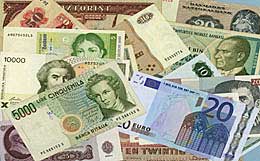
The euro is the new currency of about 1/3 of the nations in Europe. This is a momentous step for Europe, and a great benefit to travelers. No longer do we need to exchange money every time we cross the borders of many countries in Europe. How sweet it is. There are still more than 30 other countries in Europe which have their individual currencies, though the euro is legal in some of these. For more about the euro see Euro and Other Currencies: Exchange Rates for Travel in Europe.
Unmovable Artifacts:
But for the most part the character and charm of old Europe remains — the monuments are still where they have been for hundreds of years. Notre Dame Cathedral plus a thousand monuments and museums have not moved a millimeter, and won't. You do not need this year's date on the cover of your guide book.
WHAT IS THIS BOOK?
Most people think of travel books as guide books. Au contraire, mon ami, for How To Europe is not really a travel guide book. This means that it is not a catalog of hotels, restaurants, and sights, telling you what is "comfortable" or "cheap" or "charming" or whatever. There are many good and many not so good guide books doing this already. You'll find recommendations and cautions for buying guide books in chapter 10, Guide Books and Maps: Tomes for European Travel.
A Travelers Handbook
Rather than a specific guide book, How To Europe is a general and practical handbook for Americans planning a do-it-yourself trip to Europe. It is essential reading for first-time travelers and will probably enlighten and amuse even experienced Europhiles. I've received letters from native Europeans telling me how much they've learned from this book. Other much better known travel writers have told me how much they like this book. Some of them have even copied from it. Damn plagiarists are everywhere. Among my unique advantages as a travel writer are that I have lived in four countries in Europe, speak some of the languages, have European relatives and friends whom I visit, and have traveled just about everywhere and by any means.
How To Europe is zero-base. This means it does not presume that you know how to drive on a German expressway, use a French telephone, get service in a Dutch restaurant, find a hotel in the Ukraine, or board an Italian train. Amongst many other things, what it does do is show you how to find the best values in any city in Europe without guiding you and a thousand other Americans to the same cheap hotels and restaurants. You'll learn how to travel like a European, thus getting the most from your time and money while dodging the travel gremlins.
At least as important as anything, How To Europe teaches you how to avoid becoming another victim of the ever-present pickpockets and baggage thieves operating throughout Europe. Thieves are concentrated in the major cities and resort areas, but can strike anywhere and anytime. This ubiquitous army of villains, usually not native to the locale, can mess up your trip — very seriously. Security should always be on your mind. See the first section of chapter 8, Pickpockets in Europe: They're Everywhere.
Photos To Learn By
Together with the captions, the photographs explain many of the mundane but essential points of life in Europe, those things that differ from our upbringing in America. Reviewers of the first two editions have especially noted the uniqueness and value of these photos. And for flattery, after teaching another travel writer how to take photos he has copied many of mine in his own books. My travel photography tips are at chapter 12, Photography in Europe: Take Your Best Shot.
I took all of the pictures in the book and on this web site, except for a few as noted or as obvious. Most of the chapters available on line do not include the photos because of the size of the files. A single photo has about the same file size as the text of a complete chapter. Also, if you order the complete book (see the advert in the right hand column) please be aware that the photos in the book are all black and white. This internet edition is far more up to date than the 11 year old print edition. I should start calling that one the legacy edition.
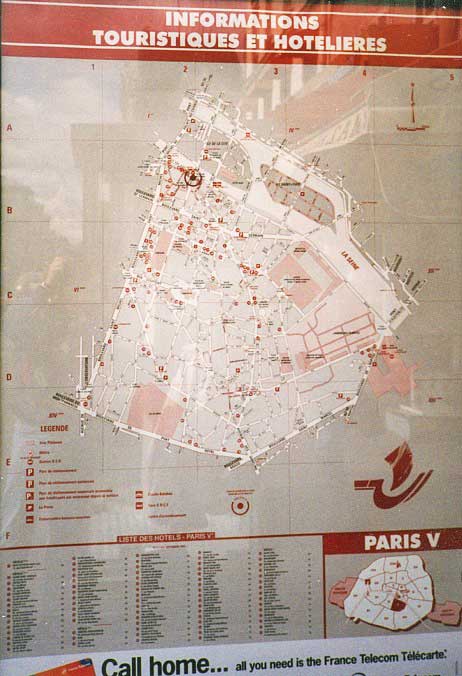
The Fifth Arrondissement (fifth ward) of Paris welcomes visitors with this street side map locating hotels and sights. The bulls eye is accompanied by the words vous etes ici (you are here). My Paris apartment was just a tad southeast of the bull's eye on rue des Trois Portes, 200 yards from the back door of Notre Dame Cathedral. Check the inset "Paris V" to see where you are in the city — I should say THE City.
Really Straight Talk
Here and there I recommend some products, publications, and services, and offer a few words of caution about other things which did not measure up. I paid retail for everything in my travels and received no payment or other consideration for any comment in this book. I mention this because virtually all travel writers accept free air travel, ground transportation, hotels, and/or meals from companies in the travel business. That is why you rarely, if ever, read a travel article with the least bit of criticism of anything. Those who bite the golden hand are not invited to eat again. I didn't take any freebees so I can tell it like it is.
I have been to every place I've discussed in this book. I did not hire others to "research" or write this book or take the photos. If you see a book with a famous author's name on the cover — it is marketing bull. Most of the popular guide books these days are written by hired writers for politically correct corporations. Those travel writers are paid to travel. I pay to travel, on my own budget — very tight.
From the Algarve to the east side of the Ukraine, Iceland to Istanbul, Narvik to Naples, I've traveled the rails and roads throughout Europe. I've slept in hotels deluxe and on deck chairs, dined in gourmet restaurants and picnicked on park benches, and walked the boulevards and back alleys of cities big to small. I was lost and found, rained on, frozen, sun burnt, insulted, complimented, ripped off, embraced, and scorned. How To Europe gives it to you straight, no matter what your schedule, budget, or attitude.
EUROPE, WHY NOT?
Why go to Europe? Curiosity, culture, entertainment, sports, adventure, relatives, roots, education, business, a job, medical, diet, or just plain fun may entice you. If you haven't made the decision yet, the holdup is probably due to one of three things: money, time, or timidity.
Can't Afford It?
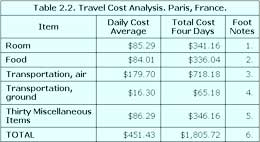
A major problem is the high cost. Travel is expensive. But a few things are cheaper in Europe, most are negotiable, and airline and hotel bargains can be found with diligent searching. Despite the high cost of travel, you can budget accurately with the information presented in chapter 2, On Budget in Europe: Travel Costs. How Much?. The key to low cost travel is up-front smarts and plenty of cautious shopping. Do a little home budget swapping to tide you over. You might want to postpone buying a new car to put some European flavor in your life.
Don't Have Time?
Another problem for most of us is lack of time. A standard American corporate vacation of two or three weeks is hardly enough to see one country, much less the four dozen or so in Europe. Request an extra four or five weeks of unpaid leave from your job and go on your own. A longer tour will enable you to get your feet on the ground and wander off the dusty tourist trail. By the way, Europeans are horrified when you tell them that you are allowed a two week vacation. In most of Europe the standard vacation is four to six weeks. Some companies even pay their employees for a "13th month" so they have enough money to enjoy themselves on vacation.
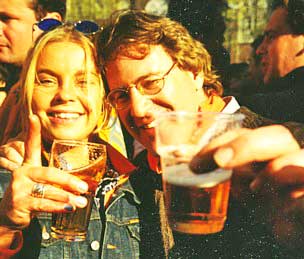
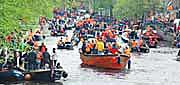
A couple of celebrants brandish their beers at Koninginnedag (Queen's Day), formerly an annual huge event throughout the streets and canals of Amsterdam, The Netherlands on April 30. I kept pace. What a beautiful day. My 2008 trip is photo logged at Queen's Day. As of April 30, 2013 the Dutch throne is occupied by a king. So the 2014 and subsequent celebrations are known as King's Day, celebrated on King Willem-Alexander's birthday, April 27. The kid should not have moved the date but I'm sure the Dutch can deal with that.
Afraid of All Those Foreigners?
Aside from the limitations of time and money, many Americans are afraid to go. The adventure of travel is not always fun. On the road, aggravations often outnumber the laughs. Travel is not always relaxing. It can be tiresome visiting strange places with different languages, money, customs, food, and poor service. Why leave the security and comfort of home to find yourself lost in France in the rain? But look at this from another perspective. Your nest is just another place on our earth and those strangers are just as human as you and your home town neighbors.
If you really do find yourself in trouble over there, help is readily available and it usually comes with a bigger heart because you are a foreigner. Just ask. Women, of course, must be a little more careful than men. For encouragement and advice, ladies should consult the books of Mesdames Georgia Hesse, Louise Purwin Zobel, Dena Kaye, and Eleanor Adams Baxel. Some of these books are decades old but the advice is timeless.
And after reading How To Europe you should have as much confidence in visiting Europe as you have in going to your corner grocery store.
You Are Already Too Thin?
My last reason for not going to Europe is not especially profound. If you've watched the evening news at all for the past few years you certainly have heard about the French paradoxes. One has to do with their high consumption of wine and their less than (American) average incidence of heart disease. The other has to do with their dietary intake of beautiful rich foods — lamb, duck, paté, cheeses — with their inverse correlation to the American waistline. You rarely see fat French people. So, if you don't want to lose weight, don't go on a one-month French restaurant crawl. Especially, I encourage everyone to stay out of Bourgogne (Burgundy), one of the least touristed regions of France and my favorite for food and wine.
THE TERROR
The unspeakable monstrosity which struck America and civilization on September 11, 2001, cannot be ignored by those planning a trip, or even by those going to work every day. Actually, many more innocent people were killed at their desks that morning than were killed on the planes. The surprise "911" attack by a small group of al-Qaida terrorists on American soil killed more people and did far more damage than the huge Japanese military attack on Pearl Harbor, December 7, 1941. A new and brutal war without limits or front lines started up all around us. It has been going on for three times longer than World War Two and it seems to be just getting warmed up. The enemy is well organized, financed, and concealed. The head of the evil was finally found and sent to Hell with a bullet in his bloody brain on May 2, 2011. Thank you, gentlemen of the United States Navy Seals. We can expect that another murderer will take his place and try to establish his place in infamy.
Personal Experience with Terror, Annette
The effects of terror hit close to me years ago. The first edition my book HOW TO EUROPE: The Complete Travelers Handbook, published in 1982, and all subsequent editions, are dedicated to an early victim of a terrorist bombing, my dear friend Annette Kampinga. She was an adventurer and became a flight attendant to see the world. Annette was murdered on December 31, 1980 in Nairobi, Kenya. The coward who killed her had placed a time bomb in his closet at the Norfolk Hotel that afternoon and flew off to Saudi Arabia without checking out of his room. His bomb exploded just above the ballroom as the New Year's Eve party was getting underway. The son of a bitch murdered 20 people.
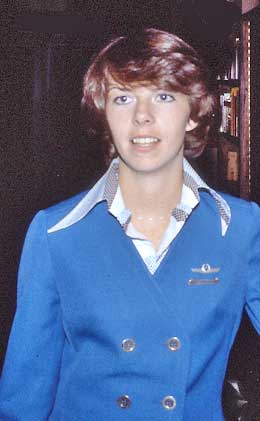
Annette Kampinga was an international flight attendant for KLM Royal Dutch Airlines at the time she was murdered.
Before she became a stewardess she was my secretary in Amsterdam. Before that she was my girlfriend. I was surprised to see her in the office on her first day because she worked somewhere else, and I had no idea.
Annette was from South Africa and had moved to Holland. She was full of spunk and created her world. One morning I found her perched on a table in the middle of the big open office, proudly smoking one of my fine Sumatra coronas. She didn't ask. I loved it. My Dutch boss was furious.
Another time Annette got a colleague to drive us to Maastricht for the Carnaval celebration. Thanks Bob, wherever you are now. Annette painted our faces and we passed for another group of really really crazy Dutchies at the really really crazy Carnaval, the Limburg version of "Fat Tuesday." It is one of the highlights of my life.
Annette was the only person ever allowed to drive my car, a beautiful white Porsche 911S. Coming home from a party one night where I certainly had too much, she was in the driver's seat. She clutched on command. I shifted. Even when I am over the limit and couldn't see straight I could still shift. The ears tell you when. If you've ever driven a manual transmission you know.
After two years on the job assignment in Holland I returned to California. Annette and I spoke often by phone. She kept pushing me to return to Holland, and to write the book that I was always talking about. Chemical engineers do not normally write travel books. I needed a kick in the behind. I did return, finally, a year later. And this is the book she never saw, but for which she was the spark of creation, HOW TO EUROPE: The Complete Travelers Handbook. But by the time I returned it was too late for Annette and me. We were still friends but she had found another man in another part of the world. He was a lucky guy, until December 31, 1980. My condolences. And my condolences again to Annette's sister in South Africa who contacted me a few years ago. Ms. Kampinga, if you see this please write again because I no longer have your email. My computer crashed and I lost everything. And the same to the KLM flight attendant who also contacted me. You airline folks are in almost as much danger as our police these days. Godspeed.
A Note of European History to Keep in Mind
The world wide "war on terror" appears to be another "phony war." The original "phony war" was conducted by France and Britain after declaring war on Germany in September 1939 on the heels of the Nazi invasion of Poland. Nothing much happened after those declarations, other than having Hitler and Stalin divide up Poland and straightaway enslave the population. Hitler's Blitzkrieg against Poland is well known but Stalin's bloody attack from the east two weeks later is barely mentioned in the history books.
Hitler looked north and invaded Norway and Denmark the next spring. Then his Blitzkrieg moved against the BeNeLux countries and France in May 1940. The Germans overran everything all the way to the English Channel in six weeks. He then looked east and invaded Russia in June 1941. That was called Operation Barbarossa, the largest military expedition in world history. The Germans were repelled at the gates of Moscow. Ironically it was a secret treaty between Russia and Germany in August 1939, the Molotov-Ribbentrop Pact, that provided Hitler with his eastern cover so he could initially attack north and west. Stalin covered Hitler's back and then Hitler stabbed Stalin in his back. Couldn't have happened to a nicer guy. Except then, Stalin became the ally of the USA with massive collateral damage after the war.
The Nazi tyranny lasted for several years throughout much of Europe. After defeating Hitler's forces in North Africa, an American/British joint air-sea-land invasion of Sicily on July 9, 1943 under the command of General Patton and General Montgomery succeeded in driving the German army off the island in less than six weeks. The Germans fled to mainland Italy and most of the Italians put their guns down. A year later, commanded by General Eisenhower, Americans led the invasion on the French beaches at Normandy, June 6, 1944, D-Day. They sealed victory in Europe eleven months later on May 7, 1945.
There was no final body count but it is estimated that over 50 million people perished in World War Two. With radical insane dictators running several well-armed nations these days, plus plenty of ISIS murderers and wannabees strutting around, war will certainly happen again. In fact, it is already here but nobody wants to say it out loud.
Near Encounters
Closer to my own body, I was evacuated from Los Angeles International Airport along with hundreds of others when someone phoned in a bomb threat. On another trip I flew to Amsterdam and traveled on to Paris just a few days after President Reagan bombed Libya in April 1986. My friends were concerned that I might be flying into a war zone but one hard slap of the bully Al-Qadhafi set him back. Al-Qadhafi returned with the bombing of PanAm flight 103 over Lockerbie, Scotland in 1988. His agent murdered 243 passengers, 16 crew, and 11 people going about their lives on the ground. The son of a bitch Qadhafi is now with his master in Hell.
While living in Paris that summer of 1986 I enjoyed the beauty and charm of the City, and met the beauty and charm of Elizabeth who became my wife later that year. One afternoon I was walking past the Hôtel de Ville in the center of the city at about noon on a warm sunny day. Suddenly a police car screamed around the corner and almost rolled behind me. I kept walking and a few blocks further I happened on a building with all of the windows on the 4th floor blown out. The story was that a bomb went off in a men's room of what is the French equivalent of the FBI. The assistant director was killed. In following days other bombs were set off around Paris. One was in the post office of the Hôtel de Ville, a small post office I used often. Some customers were murdered in that bombing. Army patrols were everywhere. In all train stations 3 man squads with carbines armed and ready marched continuously through the crowds. This was deadly serious business.
I flew into Frankfurt in January 1991, a few days before the first Gulf War started. I flew out a week later on PanAm while the other five in our group jumped ship and thought they would be safer on Lufthansa. All of us made it home safely.
Five years later I was in Al Khobar, Saudi Arabia, June 1996. A terrorist gang blew up the Khobar Towers and murdered 19 American servicemen. That bomb went off a couple of miles from my apartment with effects remarkably similar to those of the Oklahoma City bombing. The truth on the Al Khobar attack is still concealed, though Osama bin Laden was the mastermind whispered about at the American Consulate. I made regular Friday visits to the Consulate library to read magazines and got to know the staff quite well. Newspapers in Saudi Arabia had no information on the bombing. In fact, The USA Today edition a week or so later mentioned on the front page that there was a complete story on page 10. I looked in every one but page 10 had been ripped out of every copy on the newsstand. That's a "religious" dictatorship for you.
Amsterdam to Detroit
It happened again — on Christmas Day 2009. Northwest flight 253 from Amsterdam to Detroit was saved by a young Dutch fellow. When he saw the smoke he jumped over seats, pulled the bomb from the terrorist's crotch, put out the flames, and subdued the son of a bitch. Secretary Napolitano, head of the Department of Homeland Security, claimed that the security systems "worked." Ms. Napolitano is a prima-facie dingbat and amateur spin doctor. Airline security systems and enforcement were an absolute total failure that day. Hundreds of people would have been murdered had it not been for the quick and decisive reaction of one passenger. Thank God. The Dutch fellow needed hospital care for his burned hands. I flew from Los Angeles to Atlanta the day after this terrorist attack. If there was any added security compared to the week before when I flew to Los Angeles it was well hidden.
Benghazi to Boston
Well, there they go again. It was Benghazi in September 2012 and Boston in April 2013. After the fact investigations usually turn up evidence to suggest that these domestic terrorist attacks could have been prevented, but at what cost to civil liberties. Only Sherlock Holmes could have figured out what some young guys would be doing with pressure cookers in Boston. On the other hand there was more evidence of possible problems in Benghazi or somewhere that day. The terrorist attack came at 3:30 in the afternoon Washington, D.C. time on the anniversary of the attack on the World Trade Center, 11 September 2001, an event best known as 911. Who was on watch for Benghazi?
Paris, San Bernardino, Brussels and where next?
The new scourge in the terrorist world is ISIS, the Islamic State of Iraq and Syria. It is also called IS and ISIL. The French government has named it Daesh. The Daesh cutthroats do not like that term so it is good enough for me. Agents of this axis of evil staged more mass murder attacks in Paris on 13 November 2015, in San Bernardino, California on 2 December 2015, and again on 22 March 2016 in Brussels, Belgium. This will continue until presidents and prime ministers stop being political hacks doing social justice wimp work and get busy commanding armies to destroy the evil.
The Will of God
One of my brothers, Mike, was murdered in south Chicago. He stopped his taxi for the wrong "customer" who immediately shot him. The Chicago police supposedly know who did it but never arrested anybody. It's a cold case now, 25 years after the fact.
Have no fear when traveling, but be alert and ready for action. Those people on the "shoe bomber" flight from Paris saved themselves. Perhaps, some day, so must you and your fellow passengers.
The bottom line on mass murder by terror is that it will happen again. The savages are amongst us, planning and waiting. But the odds are that it will not happen to you if you fly every day for the next 50 years. Let your Maker select your inevitable last day. You enjoy your life while you have it. Don't let the bastards get you down.
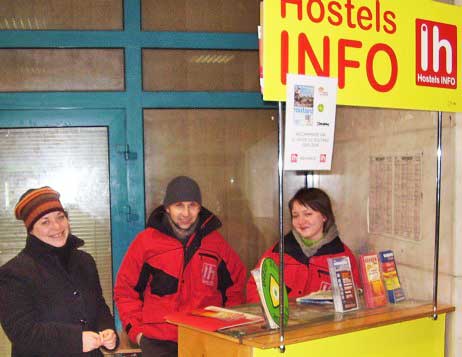
The crew of this hostel information stand in the Krakow, Poland train station will find you a low cost bed for the night. They were very helpful to me. It was a cold January morning in the unheated station but these dedicated people tolerated the deep freeze with a smile. Krakow is a city you must visit.
WHEN AND WHERE
When should you go to Europe, and where should you go?
In Season
Americans traditionally travel in the summer. That's equally true in Europe. Northern Europeans head for the sun, sea, and sand around the Mediterranean in July and August. Many also take winter holidays, skiing in the Alps and other cold climes.
Out of Season
Those who have the opportunity to travel off-season are lucky. You can travel more economically and in far less crowded circumstances with a spring trip. Air fares are drastically lower off-season, and the roads and trains are noticeably less crowded. Off-season is anytime other than July and August and the holiday periods around Christmas and Easter. April through June is the best off-season travel period. On my 30 day trip in January 2006 the trains were nearly empty except for rush hour. I found myself alone in hostel rooms with up to a dozen empty beds.
The obvious feature of off-season travel is that it is cooler in the south and colder in the north. The opposite is true of in-season travel, since it can get uncomfortably hot and humid in southern Europe during the summer. Spring is the driest time of year in northern Europe. You are less likely to get rained on in April and May, and the length of daylight is about the same as in July and August.
A significant problem when traveling in the fall is that hotel space may be scarce or impossible to find in major cities. This is caused by the plethora of trade shows and business conventions in the big cities. These are known as fairs and congresses to most Europeans. Go to one if you have the chance. These exhibitions feature everything from French cuisine to hazardous waste treatment, and many are open to the public, not just to those in the trade.
All the Seasons
Those with a transportable profession can enjoy Europe
throughout the year, and have someone else pay the bill. Just get
a job in Europe. I've lived and worked in The Netherlands, Germany, and
Switzerland. Not only do you get a salary boost but there can be other
financial rewards as well, depending on your employer. See more
about this in:
chapter 21,
Working in Europe: Get Paid to Travel,
chapter 22 part 1,
Moving to Europe: Things to Know Before You Go and
chapter 22 part 2,
Living in Europe:
Travel to the Max as an Expatriate.
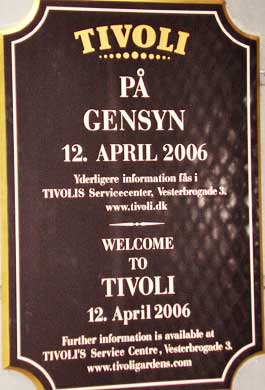
Tivoli is an amusement park in Copenhagen, Denmark, right across the street from the railway station. It is great for kids and adults of all ages and not as stodgy or as expensive as another famous place which has copied some of its designs, and added a talking mouse. Enjoy Tivoli Garden from mid spring to the end of fall. Exact dates vary from year to year. It also has a Christmas season from mid November to the end of the year.
Special Events
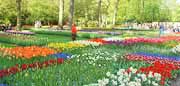
Your interest in special events may dictate your timing. Oktoberfest, for instance, is held in late September in Munich. The tulips bloom at Keukenhof, Holland, in middle spring, weather permitting. These and other events can live with you for life.
Where is the best place to go?
Friends and students are always asking me which place in Europe I like the most. My preferences would be of little value to anyone else. These places are mostly associated with memories of the people I met there, whether locals or other travelers.
Pick your own pleasure. Prepare thoroughly for your travels using the general and specific information in this book, as well as other books discussed in chapter 10, Best Guide Books for Europe: Reviews of Tomes for Travelers. Make your own itinerary based on your lifestyle and preferences. Chapter 30, Melding with Europe: Travel Is Interesting and Entertaining , presents an overview of the kinds of activities that are possible, although I don't pretend to list everything. Nobody can prescribe a universal list of all the "good stuff" or "the best." Chapter 30 is just a peek at the menu. You must make your own selections.
HOW TO GO
Should you travel alone, with a friend, or with a group? Each way has its advantages.
Solo
When single I usually traveled alone. Now that I am single again I travel alone again. This offers the best opportunities for meeting local citizens and other travelers. Getting in a train compartment or sitting at a table on a ship, I would tell the others "Sorry, I only speak English." At least half the time, this would result in a non-stop conversation with a local citizen that lasted until one of us got off the train, or the boat docked, or one of us fell asleep. Sometimes I would practice my French or German or Dutch, depending on the situation. If I happened to meet another vagabond or two from some spot on the planet we would sometimes team up for a couple of days. These are great experiences. You're never alone unless you want to be.
When traveling with a EurailPass in first class, you are likely to meet educated Europeans and other travelers from the United States, Canada, Australia, South America, Japan, and China. It is even easier to meet others on the overnight ferries between Ireland and France, between Greece and Italy, between Sweden and Finland, between Finland and Estonia, and others. Seating in the bars and restaurants is crowded, and you'll have a lot of spare time. Only a hermit could avoid meeting someone on board. Travelers have a great deal in common, develop camaraderie, and help each other with tips on hotels, cafes, sights, and rip-offs.
You don't have to be a man to travel alone. I've met American and Australian college girls, and even a few ladies in their sixties, on their own, all over Europe. At the Romanian border leaving Bulgaria we met a young French woman traveling in a Citroen 2CV with her dog. That's adventure in a tin can, the auto known as the "duck." 2CV was pronounced "dough-che-vo" in Holland. They are probably all in junkyards or museums by now.
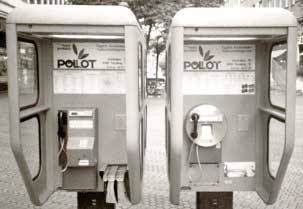
Use a coin or a card. The German phone on the left accepts coins. The one on the right accepts telephone cards. This picture reminds me of a study done by a sociology professor at the University of Aachen, Germany. On side by side phones he put a "Nur Herren" (men only) sign on one and a "Nur Frauen" (women only) sign on the other. A couple dozen people used the phones while he and his class observed at a distance. All the men used the men's phone and all the women used the women's phone, with one exceptional exception. They rushed over to interview the woman to discover why she had shown contempt for the German obsession with obedience. She was French. You might think that maybe she couldn't read German, but that is unlikely. More likely she proudly displayed the French addiction to disobedience, especially regarding anything that is not French. Viva la France!
With Friends
Traveling with a friend, or friends, requires compromises from each. Preferred itineraries must be agreed on, and it sure helps if everybody is on the same general budget. Being with a small group puts you in a better bargaining position when negotiating the room price with a hotel keeper. Another advantage of traveling in company is that the hotel rooms are better. You get a lot more comfort at a lower per person cost in a double room.
Family With or Without Child
When I was married, most of my traveling was with Elizabeth, and often with our daughter Stephanie in the car or on the train. Family people will recognize the pilot/navigator scenario with nearly constant back-seat commentary "Are we there yet?" until the little one falls asleep. The extra hotel cost is usually none or negligible, though a soft drink for the kid normally costs more than a glass of beer or wine.
Excess baggage in the extreme was a problem when traveling on the trains and negotiating the train stations with two-year old Stephanie. A kid of that age has more luggage than two adults. Families have the option of parking the kid(s) with a relative or friend so mom and dad can have a vacation on their own. We did that for our one month expedition to Istanbul and our week in Budapest.
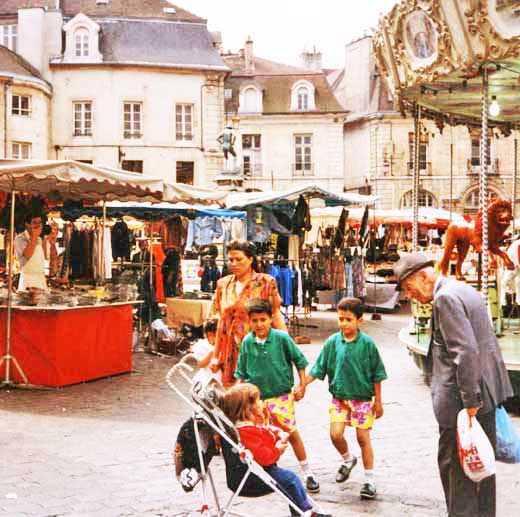
We took Stephanie on most of our road trips. Here she is making new friends from her stroller at a market and fair in a French village. Notice the weather-worn statue in the background. Most town squares in Europe have a statue or fountain.
Package Group Tours
It can be a lot of work traveling on your own. Do-it-yourselfers make many decisions every day. If you choose to travel with a group on an organized tour, you'll find that tour directors do most of the work and make most of the decisions for you. Group tours usually include hotels, air and ground transportation, guided sightseeing excursions, many meals, and time off for independent side trips.
Advertised tour prices are always per person, double occupancy. Solo travelers pay a "single supplement." Tours are ideal for the timid, for those who do not have time or inclination for detailed travel planning, and for those who would rather sit back, enjoy the sights, and leave all the routine details in the hands of experienced tour managers.
I scoff at package group tours for anyone except the physically handicapped. Tours are overpriced, rigid in schedule, and full of Americans looking out the bus window. Anybody who has graduated from high school can travel independently in Europe, especially after reading How To Europe.
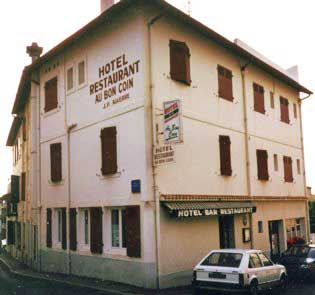
Traveling off-season in May I was probably the only guest in this Biarritz, France hotel. A couple of months later there would be few rooms available in the city. This clean, economical, and comfortable little hotel is way up the hill from the beach, and that is a hike. In compensation, there is a great little Basque restaurant a few blocks away.
THE COST OF TRAVEL
Prices of products and services are mentioned on a very limited basis in this book. How To Europe is designed to be valid for several years into the future. Therefore only indicative prices are given for a few representative items. Remember that most books which include prices are in error before they are printed, which is many many months before you get your hands on them. For example, the 2015 edition of a popular guide book was available in September, 2014. By the time you travel in the summer of 2015 the information is already 12 to 15 months out of date.
In chapter 2, On Budget in Europe: Travel Costs. How Much?, you'll learn how to make a detailed budget for your travels. First, here are some general notes to keep in mind.
Prices
In virtually any major city you can find meals for $5 or $500. The same goes for sleeps, but with a floor price of about $30. Be a frugal traveler, but don't pick the cheapest places to bunk in. Select what appears to be clean and amenable. Pass it up if the price is not right. For hotels, negotiate — always. See the detailed discussion on negotiating for a hotel room in chapter 14, Hotels, B&Bs, Hostels, Homes: European Travelers' Sleep Options. You can save 20% to 50% at almost any hotel with any number of stars almost every night almost anywhere no matter what your budget and no matter how expensive the hotel. My negotiating strategy has nothing to do with the fact that I wrote a travel book since I travel under my real name, not mentioning my nom de plume "John Bermont" or anything about this book, except sometimes on check-out if I need some additional information.
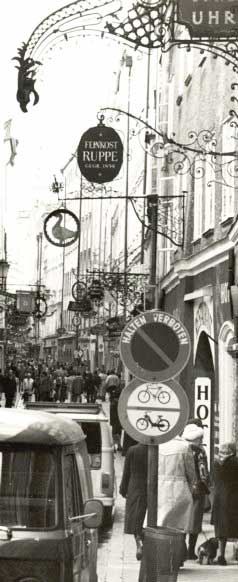
This beautiful walk street in Salzburg, Austria, can turn your clock back a few decades. Parking within reach of the No Parking sign (blue and round with a red slash) is a common European pastime. The other sign prohibits entry to bicycles and mopeds.
Inflation
Another reason prices are not given in How To Europe is that dirty "I" word — inflation. As we all know, prices are always changing, usually up. In some European countries inflation is higher than in America. In others it is less.
However, the inflation rate for the overall economy does not translate equally to the inflation rate for the discretionary economy. Travel services are cyclic in demand, but fixed in supply. They don't haul extra hotel rooms into Paris when tourist season starts. Small changes in demand can move the price dramatically. Big changes in demand, for instance between off season and in season, can change prices by an order of magnitude. Nothing demonstrates this better than the price of flying to Europe. Compare a ticket in February to one in May to one in July.
In the chapters dealing with air travel, hotels, and dining, I present tried and true strategies for reducing your outlay regardless of your budget. You might think it cheesy to negotiate and/or shop around over these things, but just call it a game for profit. You can't lose and you can save beaucoup bucks. Depending on your situation you can save enough for a tea kettle or a new Porsche.
Dollar Exchange Rate
Another cost factor in the travel equation is the value of the dollar. Currency exchange rates change continuously. The dollar may be worth more or less in European currencies at the time of your travels.
There is much more about money in chapter 8, ATMs in Europe: Machines Dispense Travel Cash. The euro is the new currency of the European Union, most of the members that is. The euro symbol is €. Other major currencies of Europe are the British pound £ and the Swiss Franc. For current exchange rates see Euro and Other Currencies: Exchange Rates for Travel in Europe.
GET READY
"If it wasn't for the last minute, a lot of things wouldn't get done," according to a sign in my brother's apartment. But a successful and favorably memorable trip requires careful preparation. You are better off planning far ahead and using that last minute for good-bye hugs and kisses.
Your Itinerary
I read a few travel forums on the internet where people write in asking questions about where to go or proposing a list of cities and asking if it sounds reasonable. For Pete's sake, get a map! Get some guide books! If you can't think for yourself then take a planned bus tour.
Your Schedule
There are many things to do before you go. The first is to make a planning schedule, notwithstanding the old adage about the plans of mice and men. This assures that you will get everything done without a last-minute panic. The earlier you begin, the easier it will be. Two months of preparation is appropriate, but six months would not be out of order for a long journey. If you wait until the last minute you will have to hurry and be faced with the old Dutch adage: "The hurrier you go the behinder you get."
For a planning schedule use a calendar desk pad, available at stationery stores. Keep it in a conspicuous place as a daily reminder.
Lists
Next, begin your check lists. A long piece of adding machine paper is ideal. Have at least three lists: "Things to do before leaving," "Things to buy before leaving," and "Packing list." Carry these lists in your pocket, reviewing them daily, scratching off items as they are done, and adding new items which come to mind. Review chapter 5 What to Wear in Europe: Your Best Travel Clothes for All Occasions and chapter 6 Pack Light Field Test: Travel Europe in Comfort and Style to get you started.
A summary packing list is presented in Last Call: Travel Prep and Pack Lists for Europe.
Additional lists such as "Things to buy in Europe" and "Things to do and see in Europe" can be made as you study guide books and tourist brochures and talk to other travelers. Write this stuff down because you will be distracted as you cope with the daily issues of travel.
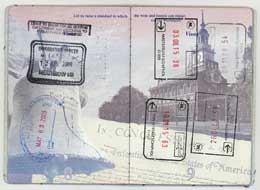
The first thing on your list should be "Get a passport." That should also be the first one you cross off. Go to your local post office and get an application right now. It can take about a month with normal processing. Ask the clerk what the current wait period is when you get the application. The process can be expedited to a week or so if you pay a heavy fee.
GENERAL NOTES
Redundancies
Because of the relationship between several topics in the book and my objective of making every chapter as complete as possible on the subject at hand, there are some redundancies in the book. These second looks are not long and usually concern items like the Michelin, Lonely Planet, and Thomas Cook publications, and The International Travel News, an inexpensive and extremely informative monthly magazine. These should be emphasized anyway.
Terminology
For brevity, throughout the book, certain areas of Europe are referred to without listing each of the countries to which a comment is applicable. The conventional and created terms used throughout the book are:
The Continent: all of Western Europe excluding Ireland and Great Britain.
The Islands: Ireland and Great Britain.
Scandinavia: Denmark, Norway, Sweden, Iceland, and Finland.
Iberia: Portugal and Spain.
The Mediterranean countries: Portugal, Spain, Italy, Greece, Cyprus, and Malta.
The Eastern countries: All of those formerly under communist domination. The names have changed and some have broken up into pieces. As of this writing, the names are Russia, Ukraine, Belarus, Moldavia, Romania, Bulgaria, Albania, Macedonia, Serbia, Montenegro, Bosnia and Herzegovina, Croatia, Slovenia, Hungary, Czech Republic, Slovakia, Poland, Lithuania, Latvia, and Estonia. Former East Germany is not necessarily in this group. It received special privileges from former West Germany which has brought it into the modern world much faster than the others from the former Soviet Bloc. I first visited a dreary Dresden in 1992 and then had the privilege of seeing the rejuvenated city in 2006. It was much improved, and probably has the best tram system in Europe. Some people in the "eastern" countries prefer to say they are in "central" Europe. Technically they are correct. The center of my National Geographic map of Europe is in Poland. But, for the time being, Eastern Europe is still that part of Europe formerly known as "peoples democratic republics" — the countries from which citizens used to risk their lives fleeing. I know one man who made it out alive. Many others were shot in the back as they tried to escape to freedom.
Of course, Portugal does not front the Mediterranean, but France does, and some people do not consider Finland to be part of Scandinavia. But these six groupings indicate convenient demarcations in customs, food, weather, and the general character of the peoples. Examples will be seen throughout the book.
A small piece of Turkey lies in Europe. This is a good enough reason to go to Istanbul, truly a fascinating city that you don't want to miss in this life.
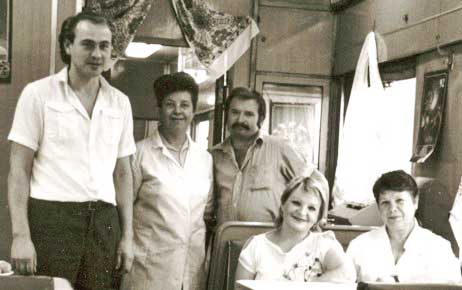
The dining car crew consented to pose with a smile during my 21 hour rail journey across the Ukraine.
Spelling and Speaking
There is no consistency in this book on spellings of cities and places. This is deliberate because there is no consistency anywhere on spellings, or on pronunciations. You have to stay loose and get a smell for things — like Corinth and Korinthe, Munich and München, Göteborg and Gothenburg, Basel and Bâle, and scores of other places with two or more names. Deal with it. If you try to buy a train ticket to Orleans when you are in France be prepared for a blank stare. The French pronunciation is something like Oh-lee-ohn. Tip: write it down. "Orleans, 2nd class, time of departure, number of persons."
Generally, foreign words are italicized in this book with the American translation (in parentheses) right next to it. I say American translation, not English, because there are some dialectical differences between American and British "English." See more on this subject in chapter 26 Languages, Numbers, Alphabets: Encounter the Tower of Babel in Europe.
Have a good trip!


HOW TO EUROPE
The Complete Travelers Handbook
Table of Contents
Chapter 1
Travel Like a Native In Europe
Chapter 2, Part 1
Travel Costs: How Much?
Chapter 2, Part 2
My Actual Expenses
Chapter 3
Identity and Travel Documents for Europe
Chapter 4
Travel Starts at the Airport
Chapter 5
Your Best Travel Clothes
for All Occasions
Chapter 6 Part 1
Travel Europe in Comfort and Style
Chapter 6 Part 2
Pack Your Toothbrush, Hair Blower, Toilet Paper, and Vinegar.
Chapter 6 Part 3
Travel SuppliesSmall Stuff Packing List
Chapter 6 Part 4
Bringing Valuables to EuropeNot in Your Luggage or Purse
Chapter 7
Pack Light, Let It Roll
Chapter 8 Part 1
They're Everywhere
Chapter 8 Part 2
Machines Dispense Travel Cash
Chapter 8 Part 3
Paying Your Way in Europe
Chapter 8 Part 4
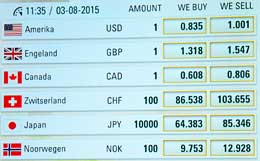
Cash, Coins, Transfer, Barter
Chapter 9
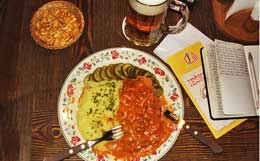
Blog It
Chapter 10

Reviews of Tomes for Travelers

Chapter 11, Part 1

Why You Should
NEVER Use a Converter
Chapter 11, Part 2
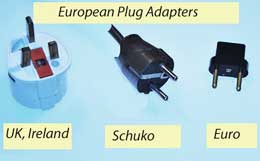
Outlets, Plugs, Converters, Adapters, Voltage, Power, Frequency, Watts.
Chapter 12
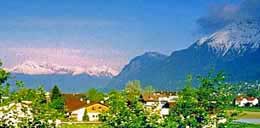
Take Your Best Shot
Chapter 13

Travel Europe in Good Attitude
Chapter 14
European Travelers' Sleep Options
Chapter 15
Travel on Thy Belly
Chapter 16
Bus, Streetcar, Subway, Taxi, Bike, Shoe, Gondola
Chapter 17, part 1,
A Rail Primer
Chapter 17, part 2,
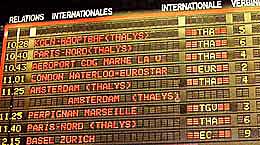
Finding Your Way
Chapter 17, part 3,
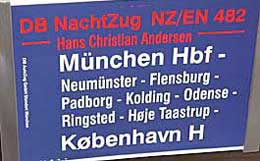
Sleeping City to City
Chapter 17, part 4,
High Seas Ferry, Highway Coach
Chapter 18, part 1
Details and Documentation
Chapter 18, part 2
Back Alley to Blazing Autobahn
Chapter 18, part 3
Police, Speed Limits, Tailgaters
Chapter 18, part 4
Adjuncts to Driving in Europe
Chapter 19, part 1
City Codes, 10-10, cell phones, PTT
Chapter 19, part 2
Priority Mail, PTT, Poste Restante
Chapter 19, part 3
Europe's Cyber Cafes and WiFi
Chapter 19, part 4
TelegramsWiring Cash and Quitting Your Job
Chapter 20

Travel in Confidence but with Caution
Chapter 21
Get Paid to Travel
Chapter 22, part 1

Things to Know Before You Go
Chapter 22, part 2
Travel to the Max as an Expatriate
Chapter 22, Special email
Dave In IrelandTechnical Details for Moving to Europe
Chapter 23
Souvenirs, Gifts, and
Stuff You Can't Live Without
Chapter 24
Travelers' Options from Europe
Chapter 25
Know the Rules When Crossing Borders
Chapter 26
Encounter The Tower of Babel in Europe
Chapter 27
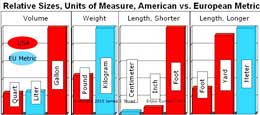
Travel with Grams, Meters, Liters, Centigrade
Chapter 28
Traveling in a Distant Time Zone
Chapter 29
Travel under Your Umbrella
Chapter 30
Travel Is Interesting and Entertaining
Last Call
Pack Lists for Europe
Prime Travel Data
Elementary Travel
Information for Europe
- Austria
- Belgium
- Czech Republik
- Denmark
- Finland
- France
- Germany
- Greece
- Ireland
- Italy
- Luxembourg
- Netherlands
- Norway
- Portugal
- Slovakia
- Spain
- Sweden
- Switzerland
- United Kingdom
Up-To-The-Minute
Maps and Time Zones
Weather in Europe
Money Exchange
Holland PhotoLogs
Queen's Day, Amsterdam
Keukenhof, Lisse
Adverts
To support this site:
Please buy your goods at:Amazon.com
Shop in your shorts!
Please clean out your cookie jar before clicking.
Plug adapters are needed throughout Europe. There are at least five models used in different countries.
Note: The highlighted #E number is purely arbitrary. It is meant to help quickly identify products in this advert column when you write in for electrical advice.
See NOTE TO READERS.
This adapter is for the standard grounded plug in France, Germany, and northern Europe. It does not fit in outlets of Italy, Switzerland, Ireland, and Britain.
#E-010
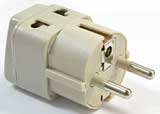 Grounded Universal 2 in 1 Plug Adapter
European Schuko plug.
4.8 mm prongs.
Equivalent to type E and F.
You can use this ungrounded Euro plug in some European countries.
#E-020
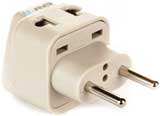 Universal 2 in 1 Plug Adapter
Euro Plug
4.0 mm prongs.
Equivalent to type C.
This is a universal plug adapter for the UK and Ireland.
#E-030
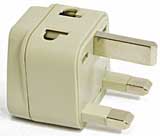 AC Adapter Plug for use in England, Scotland, Wales, and Ireland
Equivalent to type G.
Here is the Swiss version.
#E-040
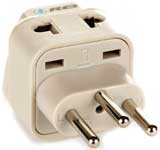 Grounded Universal 2 in 1 Plug Adapter
Type J for Switzerland
The grounded Italian model.
#E-050
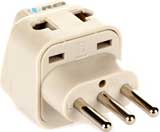 Grounded Universal 2 in 1 Plug Adapter
Type L for Italy
This 110-250 volt power surge strip has three universal outlets. Make sure your gizmos are rated for 110-240 volts.
#E-060
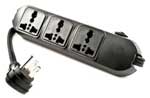 SM-60 Universal 3 Outlet Power Strip Surge Protector for Worldwide Travel.
Rolling luggage sure beats lugging a pack on your back.
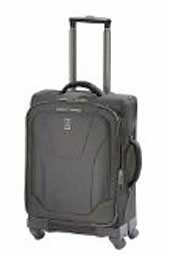 Travelpro Luggage Maxlite 2 20" Expandable Spinner
A shoulder bag for your daily walk-about.
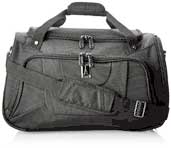 Travelpro Luggage Maxlite3 Soft Tote
Keep your stuff organized.

Luggage Packing Cubes
eBags 3pc Set
A Swiss Army Knife is unquestionably the handiest item a traveler can carry, except not on a plane.
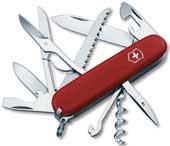 Victorinox Swiss Army Huntsman II Knife