Shipping Your Treasures Home
Travelers Options from Europe
Luggage, air freight, store services, priority mail, DHL, FedEx, UPS, freight forwarders, moving companies.

Post offices throughout Europe offer priority mail service to the United States, and provide standard boxes to customers as part of the deal or for an extra charge. Here are two priority parcels sent via the Dutch PostNL Primera which successfully made it from Haarlem, The Netherlands to Midland, Michigan in 7 to 14 days.
The small box is a number 4, measuring 305x215x110 mm. What? You don't know what an mm is? See my chapter 27, Europe's Metric System: Travel with Grams, Meters, Liters, and Centigrade .
The green sticker is a Douaneverklaring CN22 form. This is the same as the USPS Customs Declaration CN22. Holy cow! The Dutch and Americans use the same form number! The larger parcel has a more detailed CN23 form which is valid for shipments of up to 20 kg.
Carpe diem. Vivere bene! Gratia Deo.
Chapter 24 of
HOW TO EUROPE:
The Complete Travelers Handbook
John Bermont

This entire book is published totally free on-line by the author, photographer, and webmaster, yours truly, with help from my daughter Stephanie. I welcome all questions, comments, and complaints. For contact information please see NOTE TO READERS. Updated 21 December 2015.

Your Go-To Travel Store
How to get your goods home from Europe.
ALL THAT NEW STUFF
There are several ways of getting your new purchases from way over there to your terra firma. It depends on what you bought and where. You can bring them on the plane as checked or carry-on luggage, use air freight, let the store ship them for you, use regular mail or parcel post from a post office, or use an air express service. If you have a ton of stuff contact a moving company.
For big items a freight forwarder is in order. Pack them yourself and drive them to the pier. For a house full let a moving company pack and move your goods door to door.
This chapter also includes several anecdotes of my exasperating moments in big city post offices. You won't find anybody named Albert Einstein working at the post office.
ON THE PLANE
If you followed the trusty rule of pack light when you went to Europe, your luggage consists of only one carry-on bag plus a purse, briefcase, or laptop computer. Now you can return home with additional checked luggage. There may be an additional charge, depending on your airline and your class of service. The poor folks in the back will probably be dinged for an extra bag, but not likely up in the first cabin. Nevertheless, this is probably the easiest and cheapest way to get small things home.
The checked pieces do not have to be suitcases or steamer trunks. Cardboard boxes, well wrapped and taped, will serve almost as well but you'll have to sign a waiver of responsibility for damage. That means that the airline can bust things up and not pay you for the damage. It would be better to buy a duffle bag and a bicycle lock that you can put through the grommets.
Baggage Allowances
There are two methods in use for determining baggage allowances on international flights. Baggage can be measured by the number of pieces or by weight.
Note: The following is what I have experienced on many airlines over many years. Different airlines have different rules so verify your baggage allowance directly with your airline before packing. Also, ground personnel sometimes get a little testy about what you bring on board. I once had to rearrange my carry-on items when making a connection in Barcelona to keep the Iberia Airlines folks happy.
By Number: For flights between the United States or Canada and Europe, baggage is controlled by the number of pieces. For most airlines the allowance is one carry-on cabin bag which has a Total Linear Measurement (TLM) of no more than 45 inches, plus one checked bag. The allowance for first class and business class is greater, depending on the airline. TLM is the sum of the height plus length plus thickness. Get out a tape measure. You are also allowed to bring in a purse, briefcase, or laptop computer with your cabin baggage.
The weight limit for checked bags is generally 50 pounds. Any bag weighing more than that is charged a hefty fee. First class and business class pasengers may get up to 70 pounds, depending on the airline. You try to lift 70 pounds and you'll wonder why they allow that much.
By Weight: For most international travel, excepting flights to and from North America, baggage is limited by weight. The total weight of checked plus carry-on baggage must not exceed 20 kg (44 lbs) for tourist class passengers and 30 kg (66 lbs) for first and business class passengers. This is much less than you can bring across the Atlantic Ocean. If you disembark and catch another flight in Europe, say from Milan to Madrid, you will be controlled by this weight rule for your intra-Europe flight leg, unless you checked your luggage through to your final destination.
As stated, there are exceptions to these general rules so check with your airline before heading for the airport. Some airlines offer more generous luggage allowances, and/or slight modifications to these rules. However, the general trend is toward less luggage, higher fees, and much stricter enforcement than in the good old days. I used to see people coming on board carrying several last minute shopping bags full of souvenirs.
To find out specifically what your airline allows for baggage consult their web site. URLs for major airlines are given in the Airlines section of my on-site TRAVELERS YELLOW PAGES.
Excess Baggage
If you break the rules you pay, or maybe the airline will not even let you break the rules. Excess baggage charges are assessed if you want to haul more than the free baggage allowance. However I have seen cases at airport check-in where no excess baggage was allowed on board. There may not be enough room. Check with your airline before packing. Do not assume.
For the piece method on flights between North America and Europe, excess baggage charges are levied per bag. Cost depends on your origin and destination, the size and weight of the item, and your airline.
On flights using the weight method, the excess baggage charge is levied per kilogram above the allowable weight.
Special conditions exist for skis, surfboards, bicycles, scuba gear, and other bulky sports equipment. The same goes for musical instruments. Ask your airline or travel agent for details long before your departure date.
What is the effect of these differing rules? It all depends on how much stuff you have and where you are going. As an example, a few years ago I packed my bags and flew off from Miami to London and then caught a commuter flight to Amsterdam. I was well within the allowances on the seven hour flight to London. No extra charge. But for the connection within Europe it was another story. British Airways charged me $25 for excess weight on the one hour flight from London to Amsterdam. Those were the days before I learned to pack light.
Customs Declaration
An hour or so before your flight touches down on your return to the USA, the flight attendants will pass out a "Customs Declaration" form to every family. Fill this out on the plane and give it to the US Customs agent as your last step when entering the country. Notice question number 11, in particular. Many food products are not allowed. Make sure that you have read chapter 25, Passing Customs before you went to Europe.
AIR FREIGHT
Air freight can be used for items which are too big to mail and need to be sent in a hurry. I've used air freight several times over the years. Everything arrived.
Air freight offices may be in another terminal at the airport or out on a dock someplace, maybe in another building. Ask your airline. However, if you are departing from Amsterdam, KLM has a convenient freight office at Schiphol Airport. I used this and received two day service to Los Angeles. It is much cheaper than paying the excess luggage charges if you are over the limits.
LET THE STORE DO IT
Duty Free
Many of the larger department stores and luxury goods stores in Europe advertise that they will ship your purchases for you. There will be a "Duty Free" decal on the front door along with all the credit card decals. The store charges you for the shipping costs, of course, but they offer to get you a tax refund at the same time. Value added taxes in various countries have been mentioned in previous chapters. These taxes can be over 20% and are already included in the price. In effect you are getting a nice discount.
If you export your purchase you are eligible for a refund of all of the value added tax. For a big ticket item this can easily exceed the cost of air shipment. Normally you pay the full amount of the item plus shipping, and fill out the paperwork. The store does the rest.
Cashing the Refund Check
Some weeks or more after the item you bought arrives home you will receive a check for the tax refund. The check will be in foreign funds and drawn on a foreign bank. It will cost you at least $30 to cash this check at any bank in America. I still have one of these checks from years ago because I would have lost money by cashing it. So duty free sounds nice but it may not be especially worthwhile.
Self-Service Duty Free
The tax refund is also available if you carry the item with you on the plane. It is not required that the store ship the item. When you check in for your flight ask the attendant for directions to the customs office. Go there and go through the motions. They mail the customs paperwork back to the store and several months later you receive your refund check. The net result will be the same. You will have to cough up to cash the check when it arrives.
Regular Mail
For very small items put them in an envelope and mail them. Stop in a stationary store and buy a bubble lined bag and go to the post office. You can mail these as regular letters in most countries. Many post offices even sell the bubble bags.
Parcel Post
The postal services of most countries have maximum weight limits for regular mail. This is usually one or two kilograms. When the weight is above this, new rules take over. It's usually possible to mail items of 20 or 30 pounds, but often you must go to a separate office or building to do so.
Some countries make it easy, and others make it a test of will power. Athens makes it easier than any. In my travels, my most exasperating moments occurred when dealing with postal clerks in Madrid, Amsterdam, Paris, and Munich. Mailing a parcel from Europe is not always easy. See the section "PTT Case Studies" below. Deal with suburban or small town post offices whenever possible.
Boxes for Sale
Most post offices sell boxes and packaging material to make it easy for you to mail your treasures home.
The Ellinika Taxidromia, Athens parcel post office, just off Sindagma Square, is the best I found in Europe. If you bought so much at the "Greek Art" shops all over the city that it won't fit in your luggage, bring it to El Ta and mail it home. Surprisingly, one package of books I mailed took only three weeks by boat to Los Angeles, but another took two months. I guess that the second boat took the scenic route. You'll find paper and string in the El Ta to wrap your goods, plus friendly English speaking service.
Customs Green Form
When mailing parcels to the United States the US Customs green form will be given to you by the postal clerk in Europe. It is very simple. Just declare what you are sending and its value. If you use one of the bubble envelopes in Holland the green form is not required.
Ask for the Boat
Postal clerks always assume that everything going to the United States is air mail. Specify surface mail, not air mail, or it might cost you much more. In some countries the only service available is air mail. They don't use the boats any more. Rates typically jump at every kilogram or half kilogram so it is best to make up your parcels to a weight just under an even kilogram.
Priority Service
For faster service, pay big bucks (usually) and ship your goods by priority mail. That should take no more than a week. Always compare the cost of priority mail with boat mail. Sometimes the premium for fast service is surprisingly low, and sometimes the slow service is not so slow, especially for small items.
Rates and regulations regarding size, weight, and allowable contents vary from country to country. Rules are posted in the local language in post offices. Have a look before wrapping your things.
BOOKS
I have mailed more parcels from more countries in Europe than anybody on my block. In various trips, the score is maybe 100 packages from about 20 countries. Why? Because most of my souvenirs are books and travel pamphlets (the better to write this book of course). Books are heavy. I don't like to carry them around so I get to a post office as soon as possible.
Book Rate
The rate for printed matter is much cheaper than for regular parcels. If you are mailing a lot of stuff it would pay to separate the books and declare them at the post office for the lower rate.
These low rates for books apply only up to a certain weight. This is usually 5 kilograms, equal to 11 pounds. And the low rates only apply to surface mail, not to air mail. The parcel must be wrapped in a way that it can be opened for postal inspection.
Books can normally be mailed at the window used for mailing letters. You can have good luck or a challenging test of will power when mailing books, as you'll see in one of the case studies below.
Duty Free
A nice feature of mailing books is that they are duty free at United States Customs. But books violating United States Copyright Law are prohibited. The Government doesn't want you shipping any obscenity home either.
On the outside of the parcel, below your return address, print "Contents: Books, Printed Matter" followed by the local word for book, e.g. livre in France, Buch in Germany.
PTT CASE STUDIES
If you have a package to mail, you better have some tolerance and patience. Postal clerks are not rocket scientists. They are government bureaucrats. I recount a few of my exasperating postal minutes in the following sections.
Screaming Under My Breath in France
One of my episodes at a Paris post office illustrates the kind of problems you can have. I had mailed two parcels of books early in the day and received excellent service from a woman attendant who sorted out the packages for me and got each one just under the 5 kg limit for books. After having heard horror studies about La Poste I was pleasantly amazed.
Returning later in the day with more books and some excess clothes, a young male attendant decided that the limit was 2 kg for books and offered no help in sorting out the parcel. After some ten minutes of warm argument in French, I asked the fellow in line behind me for help. He said something quickly to the clerk, bought some stamps, and walked out. The clerk then tended to the next person in line. I went to the back of the line and eventually made it back to the window, much to the surprise of the postal clerk. I had worked the parcel of books to under 5 kg and I pointed to the regulations clearly posted on the wall. He accepted it this time and sold me the stamps. Then he told me I had to get out of the way and stand at the closed window adjacent to his to finish wrapping my parcel. This time I was shocked because he spoke in perfect English! It was about time to wring his neck.
But I followed his directions. Just as I finished wrapping and taping the boxes, my beau femme from the morning opened this window. Immediately arms and hands with packages reached over both of my shoulders as other customers tried to get their stuff in to her before me. I shoved and won!
On Fire in Portugal
One of my favorite souvenirs is a "Monopoly" game from each country I visit. These are bulky and not in tune with the philosophy of pack light. Since they are not too heavy, about two pounds each, I scoot right over to the local post office with each new one and mail it home.
It was a bit of a nuisance mailing this in Lisbon. Portuguese Correio regulations have it that any parcel over one kilogram must be wrapped with string (no tape!) and then sealed with sealing wax. Unfortunately, my souvenir Portuguese "Monopoly" game weighed 1006 grams, a quarter ounce over the limit.
The post office clerk instructed me to have the box prepared for shipment at the tobacco shop across the street. After tying it with string, the tobacco shop woman sort of lost control in putting on the sealing wax. She was melting the wax with a candle when suddenly the wax and my package caught fire. She got it under control without much damage. My "Monopoly" game and books (no sealing wax on the books) arrived home in five weeks.
An Afternoon in Madrid
Spanish post offices are a whole new world, and I'm glad that they are unique. First, nobody speaks English. You have to ask around among the other customers and locate a translator who knows what is going on in there. What is obvious is that people should bring a book for the long lines.
The first line I had to stand in was at the Preparacion de Paquetes window. There a woman wrapped my box in string (it was already securely taped), put a metal seal on the knot, and collected her fee. The seal was like the seal on your house electric meter.
Next I stood in line at an unmarked desk where an elderly man was filling out two different forms, one in triplicate, for each customer's package. After standing in that line for about twenty minutes, he told me in sign language to fill out the forms myself. Then I had to wait a while longer for the fellow to look up again and sign my forms.
Next stop was the line leading up to a window labeled Franqueo Internacional where I bought the stamps for the package, via barco (ship). But the clerk would not accept the package!
He directed me over to another line, which was thankfully a short one, at the Admision de Paquetes window, por avion (by air) or por superfice (by surface). I gave the box and paperwork to this clerk. He rubber stamped everything like he was driving nails, gave me one of the duly stamped and/or nailed papers, and waved me adios!
My Monopoly game, Spanish edition, arrived in Los Angeles about a month later.
Now I guess that this procedure is necessary because two packets of books and another small parcel that I mailed the same day in the regular post office took a lot longer to get here. It was four months.
AIR EXPRESS SERVICES
For important items you need in a hurry, contact one of the international air express services, e.g. FedEx, DHL, or Airborne. These services can get a package overseas in either direction in two or three days, and charge you appropriately for the speedy service.
More information about these services can be found in part 2 of chapter 19, Sending Mail to & from Europe.
FREIGHT FORWARDERS
For shipping furniture and other big items, you can use a shipping company. As discussed in part 1 of chapter 22, Moving to Europe: Things to Know Before You Go. I shipped my car from Long Beach to Rotterdam, and back to Long Beach again two years later. And I shipped eight oak barrels of personal belongings from Rotterdam to Long Beach. This do-it yourself approach is easy, and inexpensive compared to using a moving company.
Phone Ahead
Contact a shipping agent a few weeks before you plan to make your move. Look in your yellow pages or the internet under "International Freight Forwarding" for an agent near you. Do a search also for your destination. Find a company in both listings and make a phone call. Describe what you want to ship. The price is based on volume, so the agent will be more interested in the dimensions than in the weight.
The shipping agent will book space on a ship for you. His fee for paperwork, phone calls, and for knowing what papers to fill out and what calls to make could be about 5%. The agent will tell you which ship he has booked and advise you when to take your chattels to a specific pier at the port. Marine insurance is sold by the agent for approximately 1% of the declared value.
Packing List
Make a packing list of all items in your shipment. Include the cost and country of origin for each item. The packing list will save time when clearing Customs and will also be invaluable to present to the insurance company in case the ship sinks.
Pack Tight
Pack everything securely. Wooden crates and barrels are more resistant than cardboard boxes to forklift trucks at the port. Pack tight. Sweaters and towels make good packing stuffers.
Inspect
At the port, observe the inspection of your goods and get a copy of the inspection report and a receipt. About a week after the goods are put on board, the agent will mail you the original bill of lading (B/L). The B/L is your ticket for reclaiming your goods.
Pick Up Quick
To claim your goods, present the B/L at the agent's office at the pier and pay whatever extra charges are demanded. There always seems to be some additional port charge. Present the packing list to the customs inspector. He may inspect the cartons or simply collect duty based on the packing list or just wave you out of there.
While your goods are in the port, they are subject to carelessness, vandalism, and theft. After the ship arrives, it will take several days for the agent to send notice that the goods are ready to be picked up. Don't delay. Get them quickly before somebody breaks or steals them. Make a thorough inspection and if there is any damage, return to the agent's office immediately and file a report.
The port at Long Beach made it a bit difficult to get my oak barrels out. They had put them in the back of the warehouse and would not allow me to drive in to get them. I had to slip $5 to a fork lift operator to get him to move them out to the dock where I could roll them into my van. My car had a drained battery when I got to it and after I got it started the radio was on and tuned to a local station. The music lover also liked my car compass and had detached it for his own use.
MOVING COMPANY
A moving company would be appropriate if you are shipping a house full of furniture. Our moves to and from Germany were handled by moving companies. This is very expensive. Fortunately the company I worked for was paying for it. For more information on this option, see part 1 of chapter 22, Moving to Europe and chapter 21, Working in Europe.
Have a good trip!
NOTE TO READERS
I welcome questions, comments, and complaints. If you have any concerns about your trip to Europe that have not been covered well enough on my web site please do not hesitate to write. Ask, cuss, discuss, or whatever. I read every email and update my pages when I see a question repeating, Then I will not get that question again, hopefully. In some cases readers have been so generous with their time and talent that I have included their emails verbatim, e.g. chapters 22 and 25.
I do not open attachments. I do not click links to web pages of any kind. I will reply in a day or two, usually.
My email address is [email protected].
Do not forget to smell the hyacinths. At your liesure scroll through the Table of Contents of How To Europe: The Complete Travelers Handbook and read all 30 chapters, FREE on line. Good deal! You'll probably find the answers you seek, and some you didn't know you needed.
FREE
This web site is totally free for everyone, and a labor of love for me. To keep it afloat I receive a commission from Amazon.com for all goods purchased through the adverts I have selected, and any other products you might buy when you are on the Amazon site. Amazon has almost everything for sale, except the Brooklyn Bridge and Mount Rushmore.
Please visit my on-line store at
 .
Your support is most gratefuly appreciated. TIA.
.
Your support is most gratefuly appreciated. TIA.
To like and like not:


Adverts
To support this site:
Please buy your goods at:Amazon.com
Shop in your shorts!
Please clean out your cookie jar before clicking.
Note: The highlighted #E number is purely arbitrary. It is meant to help quickly identify products in this advert column when you write in for electrical advice.
See NOTE TO READERS.
Plug adapters are needed throughout Europe. There are at least five models used in different countries.
This adapter is for the standard grounded plug in France, Germany, and northern Europe. It does not fit in outlets of Italy, Switzerland, Ireland, and Britain.
#E-010
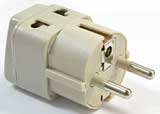 Grounded Universal 2 in 1 Plug Adapter
European Schuko plug.
4.8 mm prongs.
Equivalent to type E and F.
You can use this ungrounded Euro plug in some European countries.
#E-020
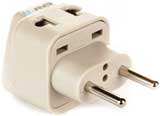 Universal 2 in 1 Plug Adapter
Euro Plug
4.0 mm prongs.
Equivalent to type C.
This is a universal plug adapter for the UK and Ireland.
#E-030
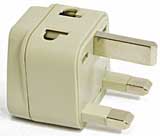 AC Adapter Plug for use in England, Scotland, Wales, and Ireland
Equivalent to type G.
Here is the Swiss version.
#E-040
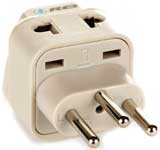 Grounded Universal 2 in 1 Plug Adapter
Type J for Switzerland
Here is the grounded Italian model.
#E-050
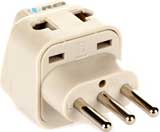 Grounded Universal 2 in 1 Plug Adapter
Type L for Italy
The links in this pink field take you directly to a page at Amazon.com. The Amazon page details the item, and in most cases includes candid and critical comments from others who have bought the item.
Amazon pays my site a small commission when you click and order an item, if you put it in your shopping cart within 24 hours based on the cookie they set on your computer. If you don't want to make a quick decision just put it in your shopping cart, think it over, and come back later. The revenue covers the cost of maintaing this web site and keeps it free to users.
You benefit when buying here because Amazon has:
- 20% - 30% discount on many items,
- free shipping deals, direct to your door,
- no sales tax on internet purchases in most states,
- zillions of products, well almost,
- fast delivery even when it is free,
- shipment tracking in UPS, USPS, FedEx,
- easy returns if you are not happy with the product.
You win we win. Thanks for your support!!
Have a good trip in life,
John Bermont
Note: Italicized notations by the author.
Absolutely the best battery for digital cameras which use AA batteries.
#E-120
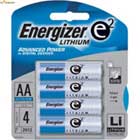 Energizer
AA Lithium Batteries
4 Pack
An RFID blocking wallet protects your passport and credit cards from identity theft in public places.
 Travelon RFID Blocking Passport Case
This is my book, available at Amazon.com. The last edition was published in 2003. Critical up-dates are on this web site.
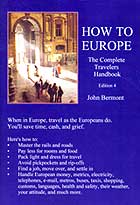 How To Europe
The Complete
Travelers Handbook
by John Bermont
The best travel guide to all of Europe.
 Europe on a Shoestring
Lonely Planet
A comprehensive guide to 3,000 hotels and restaurants in 44 major cities.
 Main Cities of Europe 2015
Michelin Guide
Rolling luggage sure beats lugging a pack on your back.
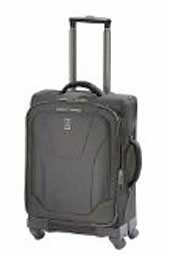 Travelpro Luggage Maxlite 2 20" Expandable Spinner
A shoulder bag for your daily walk-about.
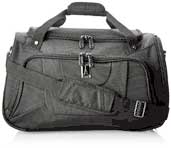 Travelpro Luggage Maxlite3 Soft Tote
Keep your stuff organized.

Luggage Packing Cubes
eBags 3pc Set
A Swiss Army Knife is unquestionably the handiest item a traveler can carry, except not on a plane.
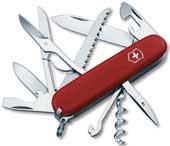 Victorinox Swiss Army Huntsman II Knife
To help find your way on the winding and poorly posted roads of Europe.
 Lensatic Military Marching Compass
Inconspicuously lock your zippered luggage with a black wire tie.
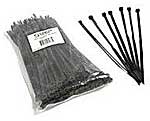 Cables to Go 43036 Cable Ties - 100 Pack (Black)
Ernest Hemingway writes about his life in Paris. I lived there about 50 years later.
 A Moveable Feast
Ernest Hemingway
The classic journal of a Brit who moved to France.
 A Year in Provence
Peter Mayle
Ms. Mayes went and bought the house she fell in love with in Italy.
 Under the Tuscan Sun
Frances Mayes
This humorous introduction to Holland is spot on.
 The Undutchables
Colin White
and Laurie Boucke
Wear a scarf for comfort and style. Nobody will ever suspect that you are an American.
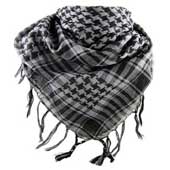 Very soft houndstooth neck scarf, Kanye West style, different colors available