Sending Mail to and from Europe
How to send mail and receive mail in Europe.
Air Mail, Priority Mail, Express Services, PTT, Poste Restante, Amex Client
 Your Go-To Travel Store
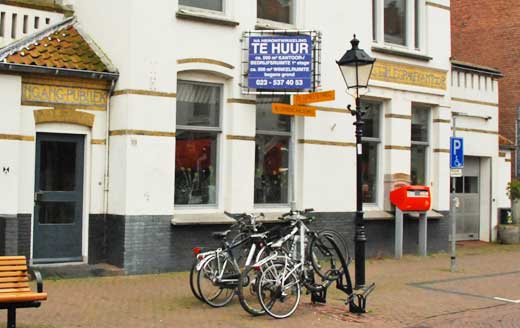
In the last century this building was the post office in Bloemendaal, a nice village just west of Haarlem, The Netherlands. It is now a building for rent. The Post, Telegraph, Telephone, the "PTT" for short, has ceased to exist in Holland. Mail service is now provided by Post NL which has a personal service countertop in many stores throughout the country. Look for the Post NL logo on bookstores.
The bright red thing out front is a mail box with slots big enough for nothing but letters. Also out front are a few Dutch bicycles. If there is a word more emphatic than ubiquitous to describe the presence of bikes in Holland I would use it. They are everywhere.
You might want to bring a map, dictionary, and guidebook when you visit Hollnad. Pocket size dictionaries are hard to find over there, and always more expensive than in the United States.
Carpe diem. Vivere bene! Gratia Deo.

This is chapter 19.2. The entire book is published free on-line by the DIY traveler, author, photographer, and webmaster —yours truly— with help from my daughter Stephanie and good friend Paula in Haarlem, Netherlands. Questions, comments, complaints, and contributions are welcome. Please click footnote. Patronage at my euro-shoppe™ keeps this site on line. Updated .
No news is not good news.
This Internet edition of chapter 19 is divided into four parts because it is so big. The four parts are:
- 19.1 Telephoning to, from, and within Europe
- City codes, 10-10, telephone cards, cell phones, PTT
- 19.2 Sending Mail to and from Europe
- How to send mail and receive mail in Europe.
- 19.3 Internet and Email
- Europe's Cyber Cafes and WiFi.
- 19.4 Telegrams
- Wiring Cash and Quitting Your Job.
STAYING IN TOUCH
A few words from home can really brighten your day. We all like to receive mail, and it is even more pleasant when we're overseas and out of touch with daily hometown life.
E-mail via the Internet is cheap, fast, and readily available throughout Europe. Telephone and snail mail service between the USA and Europe generally works well and is reasonably priced. You can even send faxes to many post offices in Europe for hand delivery or customer pick-up.
Travelers should be aware of the services provided by the US Postal Service, your long distance telephone carrier, the various PTT of Europe, American Express offices, and on-line email services — and the limitations and foibles of each.
US MAIL
United States Postal Service, USPS
You have to think about what will happen with your mail while you are gone, unless there is someone at home to empty the mail box every day. The post office can do one of two things with your mail while you are dancing around Europe: hold it or forward it. But they will not forward it to Europe.
Vacation Hold: If you will be gone for a short time, request hold service from your local postmaster. Pick up an "Authorization to Hold Mail" form 8076 at the post office. Fill it out and give it to your mail carrier. The post office will hold mail for up to 30 days. After that, it is returned to sender. When you return home go to the post office with your driver's license for ID, pick up your mail, and request continuation of home delivery.
Forwarding: The post office will not forward mail to an address in Europe because the rate for overseas delivery is about 50% higher than for first class domestic mail. So, instruct the post office to forward your mail to a reliable friend or relative. If you want your mail while you are still in Europe give your friend a supply of self-addressed envelopes, stamps, and promises of beaucoup exotic gifts for prompt remailing services.
In lieu of asking the post office to forward your mail, request a neighbor or family member to check the mailbox for you and remail the first class items. This may save a significant amount of money that would be spent for forwarding magazines.
Form of Address for Mail to Europe
If you are traveling, how do you get your mail? You can have it addressed to you at Post Restante at a post office near you in Europe or have it sent it to an American Express office. More about these services below. For mail sent to you in Europe instruct your friends to address it clearly. Ask them to print your name in block letters, and capitalize and underline your last name. Do it like so:
Your NAME
Poste Restante
Post office street address (if known)
Post Code and City
COUNTRY
You may not receive mail because of misinterpretation of handwriting or because it is filed under your first name. If you are expecting something and it is overdue, ask for the mail by your first name.
Most cities have more than one post office so it is a good idea to specify the one you will be near. Otherwise, your Poste Restante mail will probably be delivered to the main post office in the city.
Post code is the same as the American zip code. In Europe it is placed in front of the city name on the same line. For example my post code in Geneva was 1202 and the third line of my address was 1202 Geneva.
If there is an alpha character or two in front of the numbers this represents the country. For example CH for Confederation Helvetica (Switzerland) or D for Deutschland (Germany). My Geneva address could have been written as CH 1202 Geneva. Those alpha characters are not required and are not used very often.
Some post codes include alpha characters. For example, all post codes in England and Holland include alpha characters.
If you are living in Europe with a regular street address, the street name is usually written first followed by the number as in Holland. Sometimes the house number is first but is separated from the name of the avenue by a comma as in France. It depends on which country you are in.
Capitalize and underline the name of the country. This will help the USPS postal clerk get the envelope in the international sack. No guarantee.
USPS Categories of Service
The official USPS web site presents the various types of international mail services.. Cost is a function of delivery speed. This information changes fairly often so check the current tariffs before sealing your letter or package.
Visit your post office and tell a clerk what you plan to do before you seal your envelope or parcel. The clerk can give you advice, prices, and estimated delivery times. For some categories the USPS provides envelopes or boxes. And for some categories the cost is a flat fee for as much as you can stuff in the envelope, up to four pounds. To get started visit the USPS web site.
All mail between the USA and Europe is now sent by air. It takes up to a week to reach Europe with the basic air mail service, though I have received mail in two or three days at times. For faster service, type the address. The post office uses machines to read and sort mail and this seems to speed up the service. Use the post office printed forms. It might be easier to fill out the forms if you have an old typewriter laying around. Remember those? Use your cursive handwriting at your own risk.
RECEIVING MAIL IN EUROPE
There are two popular options for receiving mail when traveling in Europe. One is general delivery and the other is American Express offices. If you are living and/or working in Europe you have other possibilities.
Poste Restante
Poste Restante means "General Delivery" in French and is recognized throughout Europe. Mail addressed to a person Poste Restante will be held until called for. In Germany and Austria, you can use Postlegernd instead of Poste Restante. In Spain use Lista de Correos and in Portugal, Lista de Correios.
Mail can be addressed to you for pick up at the central post office in any city in Europe. Some secondary post offices in Europe accept Poste Restante mail. Post offices accepting Poste Restante mail are shown on the maps in the Michelin Red Guides and Michelin Green Guides. Street addresses can also be obtained from national and city tourist offices. If you have taken up short term habitation in a large city, go to your local post office to see if general delivery is accepted. Then give your friends the address and post code for that post office.
Call for mail, with your passport in hand for identification, at the post office within 30 days or it may be returned. Look for the Poste Restante or Lista sign in the post office. There is usually a special window for this service.
I have picked up mail in a number of cities with no problems. But I've seen the clerks go quickly through the stack and miss mail. A sharp-eyed girl in front of me in Madrid saw her name go by and asked the clerk to back up and pull out the letter.
It might help if you ask your friends to put a special mark on the envelope with a felt tip pen or use a special colored envelope. That would make it much easier for you to spot your mail over the clerk's shoulder. Say, ask your correspondents to draw a happy face on the front and back of the envelope, and don't forget to capitalize and underline your last name.
There is sometimes a small fee for Poste Restante mail.
Amex Client Mail Service
A common postal facility used by many Americans is an American Express office. These are located in most major cities. It appears to be a gratuitous service by Amex management who are primarily in the business of selling tickets, tours, and traveler's checks, and exchanging dollars for local wampum. Mail not claimed in 30 days is returned to the sender. Quality of the personnel at the mail window has been average to incompetent. Also the mail window is not open during the entire business day even though the rest of the office may be open. Do not count on this service for transfer of money or important messages.
Card holders and those carrying Amex traveler's checks can pick up mail addressed to them at many Amex offices. American Express offices or representatives are located in about 100 cities in Europe, but the representative offices do not offer the client mail service. Get the booklet from American Express listing addresses for all offices and indicating which ones offer client mail service. Confirm the information with the office you plan to use before telling your correspondents to send your birthday cards. The Amex Internet site make casual mention of this service but provides no details.
There is a small charge to those who are not Amex customers. Show them a travelers cheque or your Amex credit card to receive free service.
MAIL FROM EUROPE TO THE USA
PTT
PTT is an almost universal appellation in Europe for "Post -Telegraph - Telephone". It is a combination post office, phone company, telegraph office, bank, and central office for miscellaneous government functions. In Spain and Portugal, it is CTT or just CT, since "Post" is Correo or Correio, respectively, over there. The post office in Greece is ELTA.
Travelers should normally use the post office when buying stamps. Some PTT offices still have telephone sections for making long distance telephone calls. More about PTT in part 1 of this chapter at Telephoning to, from, and within Europe.
Form of Address to the USA
Almost everybody recognizes the USA as the USA, except maybe postal clerks. I have begun using the local word for the USA in addition to the letters USA. For example, when I lived in Geneva, Switzerland, the bottom line on my envelopes to the USA reads just like this in big bold print: États-Unis d'Amérique USA
États-Unis d'Amérique means United States of America in French, the official language in Geneva. German or Italian are the official languages in other parts of Switzerland.
Postage Stamps
Buying stamps for postcards and letters can be difficult or easy. To experience the difficult method, walk into any Paris post office and in straightforward English ask for stamps for air mail postcards to the United States. Mark Twain could have found a collection of words to describe the result more aptly than I — no stamps.
A better way is to bring a postcard to the post office, already written out, addressed, and containing the key words: "United States of America, États-Unis d'Amérique - USA" with the Priority Mail sticker attached. The term "Air Mail" (Par Avion in France, Mit Luftpost in Germany) is no longer an official designation over there. In Paris, also show the clerk a slip of paper with the word timbre written on it. In other cities, the clerk will probably know that you want a stamp for the card, or will speak English. Most Paris postal clerks can speak English but refuse to do it, unless you start up speaking in French in which case they will refuse to speak French. You'll probably have even more trouble in Madrid where the clerks really can't speak English. Over in Rome, do your post office business at the Vatican. There's a post office next to the ice cream vendor at the Piazza San Pietro (St. Peter's Square). That ice cream is really delicious. They call it gelato in Italy. In most other countries it is called Italian ice. Hey, I'm just the messenger.
Nuisance Items
In big city post offices, lines normally develop toward the right of the window. Stay close to the person in front of you or someone will butt in. The inbuttee will usually be a little old woman or a pair of chatting teenage girls. Staying close enough to prevent butt-ins almost requires that you keep your chin pressed to the neck of the person ahead of you. Some inbuttees must consider this a game. They know from a glance that you are an American and that they can get away with butting in. If you encounter one, ask her what time it is. That will let her know that you are already in line. If not, just step in front of her.
Clerks at big city PTT offices are probably the worst derriere pains in Europe. For better service, and for fewer butt-ins, go to offices in the suburbs or in smaller cities.
On the other hand, one amazing event in my career as a postal cliént occurred at the small town post office in Alzenau, Germany, just east of Frankfurt a/M. I went to the window with an airmail letter destined for the United States. The clerk took out a ruler and measured the length, whereupon he charged me about 50% extra. I had used an American envelope which is about an eighth of an inch longer than the German Bundspost normally accepts. I howled but it did no good. That was the last time I went to a window with my envelopes. From then on I just put normal postage on them and dropped them in the outside box, with no problems.
Keep in mind that postal employees are not qualified to shine the shoes of rocket scientists. They are simply bureaucrats and government clerks with life time jobs putting stuff in little boxes. If you need anything more than that you have to spell it out for them.
Extra Stamps
Buy some extra stamps while in the post office to avoid standing in line again. If you don't use them all, bring them home and give them to the neighbor's children. Or frame them as souvenirs and nail them to the wall.
Parcels
Information on mailing parcels is presented in chapter 24, Shipping Your Treasures Home from Europe: Travelers Have a Number of Options.
EXPRESS PARCEL SERVICES
Reliable but Expensive
Most American businesses have given up on the US Postal Service for everything except employment rejection letters and junk mail. Companies like FedEx, DHL, and Airborne Express are the preferred method for sending business papers to make sure they arrive. These services are also available internationally. They are expensive, but can deliver to most European addresses in two to four business days. Prices are extremely high so only use these when you absolutely must have something in a hurry.
Customs Gotcha
If you use one of these express services it is more likely that your parcel will be opened for customs inspection in Europe. This usually adds two days to the delivery time. The express service asks you to fill out the customs declaration. This can lead to a significant expense. European duties on some items can easily exceed the value of the goods.
When Elizabeth traveled with our two-year old Stephanie she needed some additional plastic bottle liners. These were not available in Europe. I sent them over to her by FedEx. FedEx cost as much as the bottle liners. On top of that, the French customs duty was about equal to the cost of the liners. To sum it up, the total came to about three times the cost of the bottle liners.
When shipping documents to Germany, the value declared by my company for one package was "no commercial value." The German customs service opened it to make sure. The content was just a rough draft of a sales presentation. On one document they charged about $15 customs duty plus $3.00 tax, and included 12 pages of paperwork with the invoice. It was unbelievable.
To stay under the radar of European customs collectors I have had good results with the good old US Postal Service. Gifts sent to Germany and Holland in December 2007 sailed through without getting bit in the butt by customs agents. Shipping costs with the post are also cheaper, by about 70%. Use the special USPS Priority Mail shipping boxes for the best rate. Paying $35 for a few pounds might gag you for a moment, but $120 at FedEx or UPS will do even more damage to your respiratory system.
MORE COMMUNICATION INFORMATION
This Internet edition of chapter 19 is divided into four parts because it is so big. The four parts are:
- 19.1 Telephoning to, from, and within Europe
- City codes, 10-10, telephone cards, cell phones, PTT
- 19.2 Sending Mail to and from Europe
- How to send mail and receive mail in Europe.
- 19.3 Internet and Email
- Europe's Cyber Cafes and WiFi.
- 19.4 Telegrams
- Wiring Cash and Quitting Your Job.
Have a good trip!



HOW TO EUROPE
The Complete Travelers Handbook
Chapter 1
What's It All About?
Travel Like a Native In EuropeChapter 2, Part 1
On Budget in Europe
Travel Costs: How Much?Chapter 2, Part 2
Europe on WHAT! Per Day?
My Actual Travel Expenses, in Tables and FootnotesChapter 3
Passport and Visas
Travel and Identity Documents for EuropeChapter 4
Flying to Europe
Travel Starts at the AirportChapter 5
What to Wear in Europe
Your Best Travel Clothes for Every Occasion
Chapter 6 Part 1
Pack Light Field Test
Validating Your Europe Packing ListChapter 6 Part 2
Personal Care Items
Toothbrush, Toilet Paper, Vinegar.Chapter 7
Luggage for Europe
Pack Light, Let It RollChapter 8 Part 1
Pickpockets in Europe
They're EverywhereChapter 8 Part 2
ATMs in Europe
Machines Dispense Travel CashChapter 8 Part 3
Cash and Credit
Paying Your Way in EuropeChapter 8 Part 4
Money Potpourri
Cash, Coins, Transfer, BarterChapter 9
Your Travel Diary of Europe
Blog ItChapter 10
Guide Books and Maps
Tomes for Travel in Europe
Chapter 11, Part 1
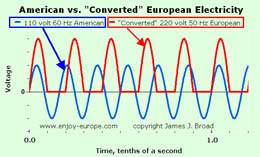
An Electric Converter in Europe
Electric power converters supposedly change 220 volts to 110 volts.Chapter 11, Part 2
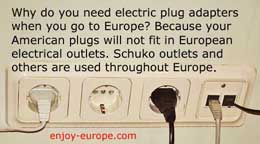
Plug Adapters for European Outlets
American plugs do not fit in any power outlet in Europe.Chapter 11, Part 3
European Voltage Essentials
220 Volts Power 50 Hz Frequency.Chapter 12
Photography in Europe
Take Your Best ShotChapter 13

Bring a Smile to Europe
Travel in Good AttitudeChapter 14
Hotels, B&Bs, Hostels, Dorms, Homes
European Travelers' Sleep OptionsChapter 15
Eating In Europe
Your Need for FeedFor all 30 chapters and much more see
HOW TO EUROPE
The Complete Travelers Handbook
Free to use but not to abuse.
Copyright:
Internet edition
© 2001-2016 James J. Broad
All rights reserved. Tous droits réservés.
This is copyrighted material. Do not reproduce, copy, plagiarize, re-craft,
store, modify, extract, transmit, or purloin any part of this
publication in any nation in any form or by any means or for any purpose whatsoever without permission
in writing.
Copying:
You may print one paper copy of this web page for your personal use.
Permissions:
If you want to adapt any part of this material to use in your blog, forum, web site, book, article,
speech, term paper, movie, video, or any other media please write to me and get
permission before you do so. Otherwise it is a copyright violation or plagiarism.
Plagiarism includes paraphrasing text and copying ideas. Imitation,
the old saying goes, may be the highest form of flattery. However, plagiarism is outright theft and is usually
compounded by the lies of the perpetrator.
Everything on my web site is original, created at great personal expense
in time and cash in the course of my extensive travels throughout Europe. Please respect my property.
For detailed descriptions of the many forms of plagiarism see
Plagiarism.org and
A Plagiarism Guide for Students.
For permission to use material from this web site contact:
[email protected].
Bloggers and Webmasters:
You may link the URL http://www.enjoy-europe.com/hte/chap19/mail.htm freely. Please do. When you link please send the URL for your linking page. I will be happy to return the favor if your site has significant content for travelers in Europe.
Free, free, and free
This web site is totally free for everyone, and a labor of love for me.
Support
To keep enjoy-europe.com afloat I advertise scores of travel related books and products. My site receives
a commission from Amazon.com for all goods purchased through the advert links. These advert links are
displayed on individual pages and on my on-line store at
. Your support is most gratefully appreciated. TIA.
Your Blow Back
I welcome questions, comments, and complaints. If you have any concerns about your trip to Europe that have not been covered well enough on my web site please do not hesitate to write. Ask, cuss, discuss, or whatever. I read every email and update my pages when I see a question repeating,
Utilities:
- How To Europe: The Complete Travelers Handbook.
- Home.
- To the top of this page
- E-Mail to John Bermont
- Meet the Author
- Privacy Policy
- Site Map
- Advertising Policy