Your Travel Diary of Europe
Blog It
Daily journal, travel blog, netbook computer, audio recorder, video recorder.
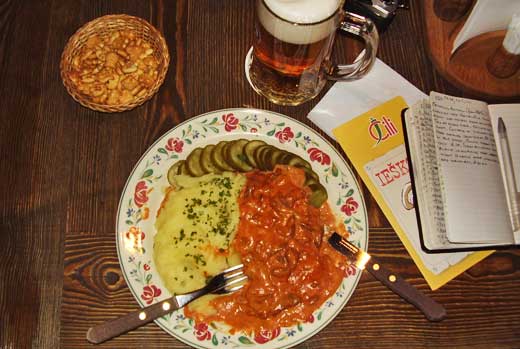
My travel log book is always ready for notes, especially while waiting for dinner. This Vilnius restaurant was recommended by my hostel desk clerk when I asked for a place which served typical Lithuanian food. My notes mention that I had a 4 cl "Originali Lietuviska" vodka, a half liter of Svyturio beer, and this plate of beef Stroganoff with mashed potatoes. My review: "just OK." But the price was not bad at all, equivalent to about $10.40 all in. I noticed three chicken-like birds in a cage near the front door as I was leaving. I asked the waitress what the animals were doing there. She said "They live here." You see some strange things as you travel. Notice my fork on the left side of the plate. I am right handed but always eat with my left, as do virtually all Europeans. If you don't want to look like an American keep that fork in your left hand. See my chapter 15 Eating in Europe for much more on this subject.
Carpe diem. Vivere bene! Gratia Deo.
Chapter 9
HOW TO EUROPE:
The Complete Travelers Handbook
John Bermont

This entire book is published totally free on-line by the author and photographer, yours truly, with help from my daughter Stephanie. Yes, you can copy — if you ask first. Please read my copyright and permissions statements. Visit my home page at enjoy-europe for truck loads of more helpful illustrated travel information sans pareil. If you have questions or comments after reading this chapter please see NOTE TO READERS. Updated 8 December 2015.

Make like Marco.
If Marco Polo had not written it down nobody would know that he had gone to China.
TRAVEL DIARY
Why?
A well kept travel journal can be more interesting than a load of photographs, reversing the cliché. Your friends will want to know all about your trip, and your diary will be your authoritative reference. Use your travel diary as a supplement to your photography. Next winter you can assemble your photos and notes and the other junque you pick up. Ten years from now, or fifty, you'll be glad you did. Maybe you can publish your travel memoirs. Heck, if you can write a letter you can write a book.
In addition to serving as a diary, your travel record should also serve as your personal data book.
The Book
My favorite type of diary is a small 3½" by 5½" book with 192 lined pages. It has a sewn binding, flex cover, mini pocket in the back, a ribbon page marker, and a band to wrap around it. This is a scosche shorter than your passport, but thicker, and easily fits in a hip or breast pocket. You can look through the rack of little black books in a large stationery or office supply store and select one that suits you. Don't buy one with the dates already in place. You want to do this yourself because you will write several pages for some days and almost nothing for others. I found a little book called "Markings" made by C.R. Gibson on Amazon. It is perfect. I wrote my definition from it. See the advert at the top of the pink column on the right.
Prepare Your Diary
You want to start your log before you leave by writing down some important information. It is extremely handy to have all of this data in one place.
- Identity:
Start by writing your name, home address, European address (if any), email address, and phone number inside the front cover. Also, you might state that you will pay the postage and/or a reward if a finder will mail it back to you. - Passport:
Record your passport number and place and date of issue and/or glue a copy of your passport ID page inside the front cover of your travel book. - Address Book:
Record addresses, phone numbers, and email addresses of all of your family and friends in a few pages so you won't need to tote along a separate address book. - Logistics:
Note all of your flight information. This includes your flight record number (reservation number), ticket number, flight numbers, departure and arrival times, and cities of course. Record the phone number of your travel agent or whoever it was that you bought your plane ticket from. - Internet:
If needed, record your ISP's URL, DNS numbers, email and news servers, and dial up number. If you have roaming access get the details from your ISP. This would be a good time to sign on for a free email account from one of the major internet service providers. These allow you to keep in touch using any internet connection anywhere on the planet. - Itinerary:
Write in your expected itinerary, must-sees, must-dos, and shopping list. - Calendar:
Tape a calendar inside the back cover. I prefer one like those in the back of small desk calendars.
Optional
The following information can be recorded in your travel journal but you may want to put it on a separate piece of paper instead and keep it in your wallet. As you can see, if someone picked your travel journal your identity would be compromised but not lost.
- Business and Professional Contacts:
Record the name, address, and phone number of your bank, insurance company, employer, boss's home, doctor, dentist, landlord, clubs, church, lodge, and whomever else you may want to to contact in an emergency. Include account numbers, I.D. numbers, due dates, and etc. - Credit cards:
Record the name, address, phone number, monthly payment date, and last 4 digits of the account number for each of your active credit cards. Keep the user names, PIN numbers, and passwords out of your book. - Travelers Checks:
Record the brand name and serial number of each of your traveler's checks, if you still use those dinosaurs. Do not throw the receipt away. - Miscellaneous Accounts:
Go through your checkbook for the last year to see who you do business with. Write down names, addresses, phone numbers, account numbers, and due dates. You may not need the information while in Europe, but if you do, getting it will be expensive and a peck of trouble from the other side of the Atlantic. - Passwords:
If you have a short memory write down a clue word for your user names, PINs ("personal identity numbers"), and passwords on a separate small piece of paper, but do not write the actual user names, PINs, or passwords. Secret this away in your wallet. The general rule in Europe is that PINs should be 4 digits. If yours is not 4 digits change it before you go. For your PINs use numbers, not alphabetic characters, because most keypads only have numbers. The general rule of 4 digits may be a traveler's legend, but the lack of alpha characters on European ATM keypads is nearly universal. To make this easy you could use your Mother's birthday as your PIN. If she was born on October 15 that would be 10/15 in the American way of writing dates. Drop the slash and use 1015. Do not use your own birthday since that is one of the first choices for most people, and thieves know this. If you use your Mother's birthday that will be a reminder to send her flowers, which she will really appreciate.
Where and When
After all of the above, the little book-to-be is ready to serve as your daily journal.
Start each day with an entry of the date, day of the week (you can easily forget while traveling), and city you're in at the moment, underlined. Writing in the temperature and weather conditions is something else that will be interesting later.
Make notes while waiting for service in restaurants, waiting for trains to depart (writing in a moving train is usually difficult), on ships, and before you start counting sheep. It's interesting to write in restaurants. Service seems to speed up when the waiter sees you writing. Maybe (s)he thinks you are writing a review of the restaurant. Why not? I have been questioned about what I was writing in my book. Never leave it on the table unattended. It is more valuable than your camera.
What Goes in Your Diary
Chronologically record names, addresses, and phone/fax numbers of hotels and restaurants, room numbers, menu items, and prices you paid. Mention sights, letters and cards sent, weather, and miscellaneous info that might prove useful later. Make a note on anything that strikes your fancy or that you might want to recommend to others later. Write in contact information for people you meet on your trip with whom you intend to keep in touch, even if you never do.
How Much
Also, keep detailed records of your expenses and currency exchange transactions. This will help you in checking your credit card bills, and in completing your expense report. Many times you do not receive receipts for small items that add up over the weeks. If you have any thoughts about becoming a travel writer, even an article for your local newspaper, this record will be valuable in establishing your expenses when calculating your taxes. It's not a deduction — it's a business expense on your schedule C.
Take the time to write out what the expense was for. My records become so cryptic when I'm in a hurry that it's difficult later to figure out what some things are.
Make a note of the name of the local currency and its value compared to the US dollar, "USD,"or whatever your native currency is.
NETBOOK COMPUTER
One of the handiest travel devices I own is a netbook computer. I take it with me wherever I go. It is a full blown computer in a very petite case and weighs almost nothing. Well, actually it weighs 1,321 grams, just under 3 pounds. Add in the carrying case, battery charger, and operating manuals and it's up to a whopping 4 pounds 2 ounces.
My machine is an Asus Eee PC 1000. It runs on the Linux operating system. I chose Linux for security since most of the hijackers and computer crackers attack MS Windows system computers. MS continues to make it easy to hack into their system, much to the delight of the hackers and the ones making the really big money, the anti-virus software companies. The latest model advertised in the right column comes with Windows 7. You can download and install Linux.
WiFi
The Asus has a built in WiFi device which allows me to go on line in many hotels, B&Bs, cafes, trains, and ships. Sometimes it is "free." Internet "cafes" typically charge $5 to $15 per hour. Libraries, if you can find one, are less expensive and often free for limited time use. If you are planning to do a lot of internet time a service like Boingo would probably be worthwhile. Boingo seems to be everywhere.
Photographs
The Asus has an SD card slot. This allows me to take the memory cards out of my cameras and plug them into the computer for direct transfer of my photos. I can view them on screen immediately. I use Picassa3. A free download is available at Picassa. Then, with Adobe Photoshop, I can crop and edit the ones I want to keep. Here is a link to the latest version, Adobe Photoshop Elements 12 (Win/Mac).
Spreadsheet
The Asus computer software includes a spreadsheet. I use this on the return flight home to do my expense report, sorting through my receipts and travel journal to see where I was and what I bought. If you are in the business world you know how important that expense report is. The flight home is 8 to 10 hours of dead time, a perfect opportunity to get it all done.
Speak and Peek with Skype
The Asus has a camera and microphone built in. I recently learned to use this to keep in touch with Stephanie in Paris using Skype. Skype is the greatest invention since round wheels. You get a free download and free telephoning around the world, with on screen video of the person you are talking with. See the advert at the bottom of the column on the left.
Downside
There is no built-in CD or DVD player on an Asus. However there are USB ports to connect external devices, plus a LAN port.
TRAVEL BLOG
I have never done this but I have seen many other travel blogs on the web. Establish an account at Blogger or WordPress. Download the free software. Follow directions and upload text and photos as you travel. See Internet and Email: Europe's Cyber Cafes and WiFi for details of going on line throughout Europe. Let your friends know the URL of your blog so they can follow you around Europe, and comment back. You'll have a permanent record of your expedition when you return. Always keep a back-up on a flash drive. Your parents will feel more secure knowing where you are, and your friends will wish they had gone with you.
My daughter Stephanie spent most of the 2010 summer in Paris and Italy. She started a blog which you can read at O hey Europe. My brother Chris and wife Katie also blogged their 2010 summer trip to Holland, Denmark, and France at DancinginDenmark&Mo. They went back in 2014 and posted their blog guybrobrew.com/. Ken Northrup, a reader of this site, emailed me with a link to his blog at Ken's Travel Blog - A Journeyman's Companion. Ken's slant on some things is not the same as mine, but what the heck. Everybody has a different set of experiences in Europe and you learn from all of them. Ken has some really good photos of his meals in Scotland, with commentary.
If you start a blog of your European trip send me the URL and I'll get you linked also.
AUDIO TAPE RECORDER
Convenient
A cassette tape recorder is a handy way of making notes of your travels. I have found this to be an especially worthwhile endeavor while driving alone through Europe. You see a lot of unusual things and don't have time to stop and write it down or take a picture. I used a tape recorder on drives through France, Sweden, Germany, Poland, Hungary, Ukraine, and Czechoslovakia. The recordings made on the spot jiggle the memory better than photos. In addition to being interesting and amusing when you play it back later, the background sounds of radio and street noise bring back more of the experience. Just imagine yourself as Howard Cosell, turn on the machine, and start talking about what you see, what you're doing, and what you're thinking (within reason).
Microcassette
Microcassette recorders are much smaller, lighter, and more convenient to carry than ordinary recorders. This is a plus if you are traveling by train or other public transportation. I carry one in a pocket of my jacket in all my travels. My Sony has been working like a champ for 15 years.
Tapes
Bring some cassette or microcassette tapes to fit your recorder. Tapes can also be purchased in Europe.
VIDEO RECORDER
Advantages
A video recorder is an outstanding way to record your travels in Europe. I have used a Sony 8 mm video recorder for a number of years throughout Europe. It is really nice if you are traveling with your family. These moments won't come again but you have them forever.
I have upgraded to a tiny digital video recorder, a Canon HD DVR. It is much smaller and produces better results than the magnetic tape of a VCR. Portable VCRs had a short life span in the commercial market. New technology comes out every hour.
Battery
DVRs come with rechargeable batteries and a battery charger brick. Check that it is good for 110-240 volts and 50/60 Hz before bringing it to Europe. See chapter 11, Electricity in Europe: Converters, Plugs, Adapters. Voltage, Power, Frequency for details. It is a good idea to carry a fully charged spare battery at all times.
NTSC, SECAM, PAL
With the proper plug connections, you might think that you can watch your videos using the televisions in your European hotel rooms. Sorry. Television systems are different in Europe. The USA did have a television broadcast system called NTSC. Europe did not. The television systems formerly in use in Europe were SECAM and PAL. That is history. The cart has tipped over.
Europe has gone digital like the United States. But their broadcasting systems are still different. The net result as explained by Dave in Ireland: Technical Details for Moving to Europe, Chapter 22 is that any American TV, DVD, or video is basically non-functional in Europe.
Have a good trip!
NOTE TO READERS
I welcome questions, comments, complaints, and compliments. If you have any concerns about your trip to Europe that have not been covered well enough on my web site please do not hesitate to write. Ask, cuss, discuss, or whatever. I read every email and update my pages when I see a question repeating, Then I will not get that question again, hopefully. In some cases readers have been so generous with their time and talent that I have included their emails verbatim, e.g. chapters 22 and 25.
I do not open attachments. I do not click links to web pages of any kind. I will reply in a day or two, usually.
My email address is [email protected].
Do not forget to smell the hyacinths. At your liesure scroll through the Table of Contents of How To Europe: The Complete Travelers Handbook and read all 30 chapters, FREE on line. Good deal! You'll probably find the answers you seek, and some you didn't know you needed.
FREE
This web site is totally free for everyone, and a labor of love for me. To keep it afloat I receive a commission from Amazon.com for all goods purchased through the adverts I have selected, and any other products you might buy when you are on the Amazon site. Amazon has almost everything for sale, except the Brooklyn Bridge and Mount Rushmore.
Please visit my on-line store at
 .
Your support is most gratefuly appreciated. TIA.
.
Your support is most gratefuly appreciated. TIA.
To like and like not:


Adverts
To support this site:
Please buy your goods at:Amazon.com
Shop in your shorts!
Please clean out your cookie jar before clicking.
This is my favorite pocket size travel journal.
It is 5½"x3½"x½".
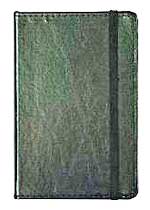
Markings by C.R. Gibson Brown Ruled Paper Bonded Leather Journal, Small (MJ3-4792)
For reading maps and other stuff with fine print.
 Bausch and Lomb 2X Folding Lighted Magnifier
This will come in very handy very often.
 Fenix LD15
High Performance
LED Flashlight
Wear a money belt under your shirt to protect your passport and valuables, especially if you are staying in hostels or dorms.
 Lewis N. Clark RFID Blocking Waist Stash
An RFID blocking wallet protects your passport and credit cards from identity theft in public places.
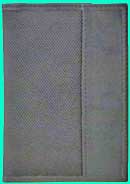
Travelon RFID Blocking Passport Case
The links in this pink field take you directly to a page at Amazon.com. The Amazon page details the item, and in most cases includes candid and critical comments from others who have bought the item.
Amazon pays my site a small commission when you click and order an item, if you put it in your shopping cart within 24 hours based on the cookie they set on your computer. If you don't want to make a quick decision just put it in your shopping cart, think it over, and come back later. The revenue covers the cost of maintaing this web site and keeps it free to users.
You benefit when buying here because Amazon has:
- 20% - 30% discount on many items,
- free shipping deals, direct to your door,
- no sales tax on internet purchases in most states,
- zillions of products, well almost,
- fast delivery even when it is free,
- shipment tracking in UPS, USPS, FedEx,
- easy returns if you are not happy with the product.
You win we win. Thanks for your support!!
Have a good trip in life,
John Bermont
Note: Italicized notations by the author.
Rolling luggage sure beats lugging a pack on your back.
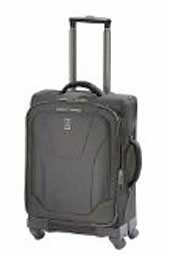 Travelpro Luggage Maxlite 2 20" Expandable Spinner
A shoulder bag for your daily walk-about.
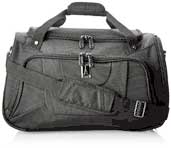 Travelpro Luggage Maxlite3 Soft Tote
Inconspicuously lock your zippered luggage.
 Cables to Go 43036 Cable Ties - 100 Pack (Black)
Note: The highlighted #E number is purely arbitrary. It is meant to help quickly identify products in this advert column when you write in for electrical advice.
See NOTE TO READERS.
Plug adapters are needed throughout Europe. There are at least five models used in different countries.
This adapter is for the standard grounded plug in France, Germany, and northern Europe. It does not fit in outlets of Italy, Switzerland, Ireland, and Britain.
#E-010
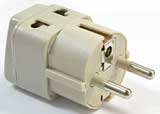 Grounded Universal 2 in 1 Plug Adapter
European Schuko plug.
4.8 mm prongs.
Equivalent to type E and F.
You can use this ungrounded Euro plug in some European countries.
#E-020
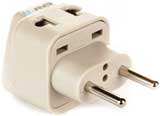 Universal 2 in 1 Plug Adapter
Euro Plug
4.0 mm prongs.
Equivalent to type C.
This is a universal plug adapter for the UK and Ireland.
#E-030
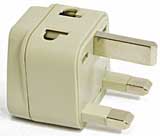 AC Adapter Plug for use in England, Scotland, Wales, and Ireland
Equivalent to type G.
Here is the Swiss version.
#E-040
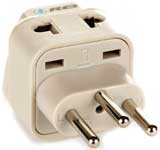 Grounded Universal 2 in 1 Plug Adapter
Type J for Switzerland
Here is the grounded Italian model.
#E-050
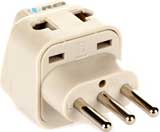 Grounded Universal 2 in 1 Plug Adapter
Type L for Italy
A Swiss Army Knife is unquestionably the handiest item a traveler can carry, except not on a plane.
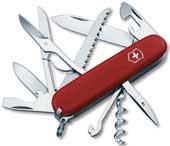 Victorinox Swiss Army Huntsman II Knife