Eating In Europe
Your Need for Feed
How to find a good value restaurant, cafe, or bistro. European eating procedure,
menus, coffee, tea, drinks, cheese platters, toilets, smoking, paying, tipping, doggie bags.
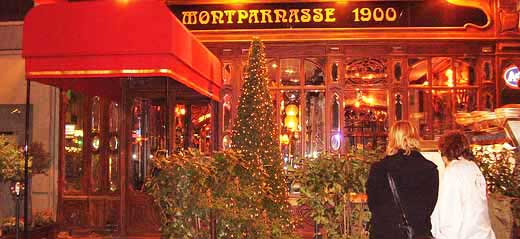
Two prospective clients examine the menu of one of my favorite restaurants in Paris, Le Montparnasse 1900. Its web site describes it with with these words: "sumptuous Art Nouveau décor — a skylight with glass in warm tones, mirrors with beautiful wood frames, a long, finely-worked wooden balustrade and soft lighting over it all." I agree completely, since about 1978 when I first came here. In those days it was named Bistro de la Gare and I was a frequent client. It looks the same inside, for the past 100 years or so, but the menu quality has changed. I suggest that you avoid the steak. Get something that the French are best known for — fish, fowl, or a mammal smaller than a bull.
Carpe diem. Vivere bene! Gratia Deo.
Chapter 15 of
HOW TO EUROPE:
The Complete Travelers Handbook
John Bermont

This entire book is published totally free on-line by the author, photographer, and webmaster, yours truly, with help from my daughter Stephanie. I welcome all questions, comments, compliments, and complaints. For contact information please see NOTE TO READERS. Updated 8 December 2015.

Your Go-To Travel Store
Man cannot live by Maxims alone.
It's a constant question — "Where do we eat?" Being as how we're not birds who pick their dinner from the ground, we must seek out and decide between hundreds of places on a trip to Europe. The search can be fun, or a gruel, as you decide between menus, prices, and locations.
HOW TO FIND A GOOD RESTAURANT
You have probably brought along a guidebook or two. These looked worthwhile when you bought them but often turn into waste paper and extra weight when you go to use them. My take on using guidebooks is in chapter 10, Europe Guide Books and Maps: Tomes for Travel. I can't recall ever getting a good restaurant tip from a guide book. Most of them, for example, boast on and on about the rijstafel menus at Indonesian restaurants in Amsterdam. Well, boosh on that. Indonesian restaurants are to Holland what Taco Bell joints are to the USA, and they smell just as bad.
This chapter will give you travel proven strategies for finding your own unique eating discoveries anywhere in Europe, or anywhere in the world for that matter. It also provides a general overview of the features of eating out in Europe which you'll find to be slightly different than dining out in your home town.
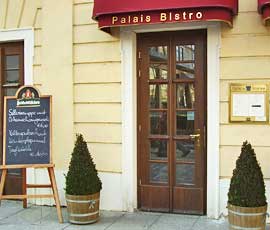
An upscale hotel is nearly always a great place for lunch. I was roaming around Dresden, Germany and came upon the Taschenbergpalais Kempinski Bistro. Germans like to dress up and go out for dinner on Sunday afternoons. This restaurant brought in a crowd while I was eating. The hotel has a wine shop in the lobby featuring Saxony Anbaugebiet products. These are virtually unknown in the USA because this wine region is tiny and was formerly in East Germany, a very very nasty place until 1990. For an introduction to German wines see German Wine Labels: Taste and Spit.
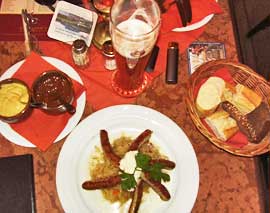
Here is my mid-day meal at the bistro — sechs Nürnberger Rostbratwürstchen mit Sauerkraut, Meerrettich, und süper Senf which I washed down with a half liter of Paulaner Hefeweißbier Naturtrüb. This was absolutely delicious and a great value. That horseradish could bite your nose off, if the super mustard didn't get it first.
Streetwise Info
There is an easy way to find a good restaurant anywhere in Europe. Rather than use the guidebooks and lists you bought or were given just stop someone on the street and ask for a recommendation.
The recommendation will depend on whom you ask, of course. Select someone of approximately your own taste, determined by their age, clothing, and general appearance. If you are looking for specific items, e.g. fish, steak, pizza, vegetarian, etc., mention that. Be ready with a pen and paper to write down the name of the restaurant, or ask them to do it since you probably won't know how to spell steak house in their language. Directions will be confusing, so be ready with the city street map that you picked up at the tourist office when you arrived.
It may easily take 10 minutes to get the message and several more passers-by may stop to offer assistance and comment during the intercourse. Europeans are not in such a hurry as Americans and they are generally happy to take a few minutes to help you out. Don't be too surprised if someone goes 10 minutes out of his way to escort you to his favorite restaurant. And if the person to whom you have made inquiry happens to have a car nearby, he might insist on driving you there.
This works everywhere. You might be amazed at the enthusiastic assistance you receive. But just imagine that if someone with a foreign accent stopped you on the street in Chicago and asked for a recommendation, you would help them out also, wouldn't you?
Upscale
For the better places, ask owners of shops when you are making other purchases. People in trade and business eat out often and probably know the owner of their favorite restaurant. They can recommend restaurants of good value, off the beaten tourist trail. And when you arrive at the restaurant if you mention to the owner or head waiter that it was recommended by Monsieur Shopkeeper, you may receive a better table, portion, and service. Of course you can always ask your hotel keeper, though he would be inclined to have you eat in the hotel restaurant if there is one.
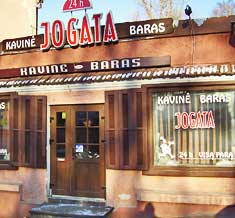
On a cold January day in Vilnius, Lithuania I stopped in the cozy Cafe Jogata for a warm-up coffee.
Downscale
If you walk in and see all the wait staff dressed in grungy denim you can pretty much assume that you are at the lower end of culinary experiences, probably off the chart. I take a look at the menu and then usually walk out. I do not care to be served food by someone who hasn't washed the bod or scrubbed the duds in days.
Look and Ask
You can window shop the menus of restaurants before sitting down. Virtually every restaurant posts its menu in the window or on a board out on the sidewalk. Sometimes it is on a chalkboard inside. The first time I walked into a particular restaurant in Paris and asked for the carte the waitress plunked a pair of binoculars on the table and pointed to the chalkboard about 30 feet behind me. This became one of my favorite restaurants in Paris, Roger la Grenouille, until it was redecorated a few years ago. The patrons, staff, food, and prices were outstanding. As for me, my favorite meal there was tête de veau, calf brain. Yup, you can eat anything in France, and love it.
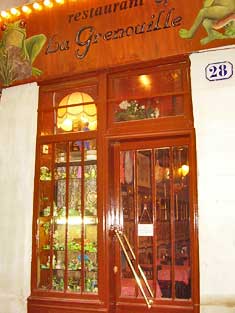
Roger la Grenouille in Paris, France is hidden away on a side street in the 6th. Too bad this restaurant is not as crazy or as tasty as it once was. The special desert was a classic. A plate with two half peaches bracing a pillar of ice cream was served without silverware to an unsuspecting woman. There was no mistaking what it represented. There was only one way to eat it. Nearby clients screamed in laughter. Hey, this is/was Paris. Among my travel treasures is the book "Roger la Grenouille" by Claude Delay, personally autographed for me by Mme. Roger.
In Brussels, the seafood is prominently exhibited in front of the restaurants. In other cities ask to see what they have in the kitchen if it is not displayed. I remember with a smile the time that three new-found fellow travelers from South America and I were given a tour of the kitchen in a Patras, Greece restaurant. The owner took the lids off the pots and described what they were cooking.
After I go in a restaurant and take a seat, I usually take a stroll. I cruise around the place and discretely look at tables to see what people are having. If I see something that looks appetizing I might ask the customer. It is fun and worthwhile to look at the plates and ask the eaters what they are having and how it tastes. Honest — just do it. I do this in the USA also. If someone asked you, you would tell them, wouldn't you?
I also ask the waitress about any item with which I am unfamiliar. In only a few countries will a waitress know the American name for something unusual. However, there are always other diners within earshot who are only too eager to help. I became familiar with ostrich this way in a Düsseldorf restaurant a few years ago. If you like steak you will love ostrich, sometimes confused with emu. I don't know them apart either. In German ostrich is der Strauß, also spelled der Strauss.
A variation of my restaurant modus operandi is to keep an eye on the plates that the waiter is bringing out. When I see something interesting go by I ask what it is.
On the Road
Out on the highway, you'll probably pull over whenever you're hungry and can find a place to slip the car in. The best country to drive around in is France. Small to large country restaurants all over the country serve the best meals every day of the year. In the hills of Slovenia and Croatia just about every roadside eatery has a couple of lambs roasting on the charcoal out in front. I love roasted lamb. On the tollways in Italy and France, restaurants are provided for travelers at rest stops just as in the USA, except it is not the junk food you get on the Ohio Turnpike. The food is not bad and the prices are reasonable. Similarly, rest stops on the Autobahnen in Germany usually have a restaurant with respectable food and prices. You can also pull off the highway and find a Stube in a nearby town.
Out on the road from Athens to Istanbul, we pulled into a roadside place where not a word of our lingoes were spoken. The owner escorted us into the kitchen where the meats on the menu were described as "moooo", "baaaa," and "oink." That worked for us. The chicken was obvious.
On the Train
Most people on trains have packed a lunch because train food can be a bit expensive, and somewhat less than delicious if you buy from the cart being pushed down the aisle. Those sandwiches would make hospital food something to die for.
Eating in the dining car of a long distance express train is different. It is even more expensive but is often a memorable experience. I have had some excellent meals in dining cars and in my seat with free delivery from the kitchen. Learn more about dining on the trains in chapter 17, part 2, Eating On Trains.
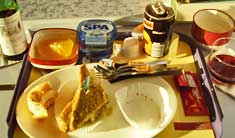
The Thalys train now has a monopoly on the tracks between Amsterdam and Paris. Reservations are required and an obligatory supplement covers a standard lunch on some trains. Here is part of my lunch. At least it saved me time in Paris and got me through the afternoon.
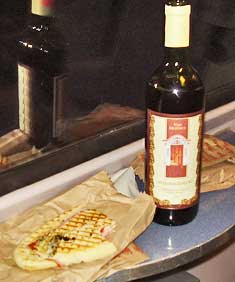
"Can you do that?" is a question I am sometimes asked about whether it is allowed to bring a bottle of wine on a train. "I do it every time!" is my answer. Here is my late dinner on an overnight train from Prague, Czech Republik to Dresden, Deutschland. No wine glass — no problem, as long as there are no dregs in the bottle.
Low Budget Cuisine
For the lowest cost eating make yourself a picnic. Go to the butcher, the baker, the wine shop, and the cheese shop and buy a little of each. To save time, go to a supermarket. Take your groceries to a park bench, your hotel room, or your train and make yourself comfortable. Cut the bag open and use it as your tablecloth. Lay out your spread and start fixing your own. Wash down a couple of high protein sandwiches with a few glasses of Chateau Rouge and you're set for the afternoon or evening. Some of my finest meals have been at the table in my hotel room with a baguette, tomatoes, paté, a couple of beautiful smelly French cheeses, plus a bottle of wine, of course. You can do this for a few days to save up enough for a night at Maxims.
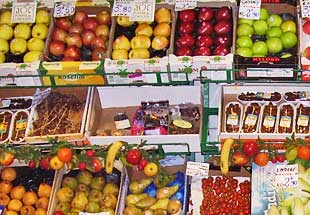
A market in Paris displays its produce outside. This is common throughout France and all of Europe. I suggest that you walk inside to get a bag and ask the owner if you are allowed to pick over his goods, before you start picking over his goods.
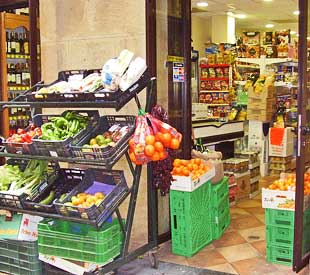
A small market in San Sebastian, a.k.a. Donostia in the Basque language Euskara, can provide all you need to do your own picnic. Get a sack of bread, ham, cheese, tomatoes, oranges, and wine to enjoy a budget meal at your leisure. Don't skip beautiful San Sebastian and its pintxos (tappas) bars on your tour of Spain.
To expand your culinary experiences, picnic with some local specialties, raw. Steak tartare (raw ground meat) is on the menu of the best restaurants and sandwich shops in Europe. Less the spices, the same thing is found at the butcher shop. In Holland it is called steak Americaine.
I don't understand that because Americans are not big on eating raw anything, much less raw hamburger. I remember a business lunch with some Kansas oil men some years ago. My boss reserved a table at one of the top French restaurants in Orange County, California where our office was located. When I saw it on the menu I immediately ordered the steak tartare. The chef rolled out a small table and parked in front of us. It had a plate full of raw hamburger with a raw egg perched on top of the heap, along with an assortment of spices and such. He asked who had ordered the tartare. I raised my hand. He proceeded to blend the meat and egg with a little bit of everything on the table. Then, with an appropriate flourish, he placed the plate in front of me. One of the Kansas men asked "Well, ain't cha gonna cook it?" That made my day. The steak tartare was delicious.
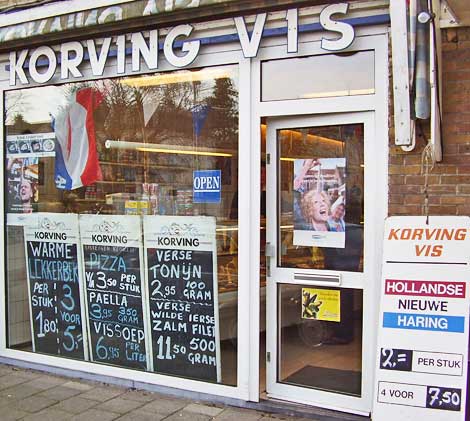
This typical fish shop in Haarlem, Netherlands is just a short walk from the B&B Paula.
Some raw, pickled, and smoked fishes are delicacies all over northern Europe. Nieuwe haring (fresh raw herring) in Holland is delicious. Buy it in a fish shop or fish stand, right ready for your champagne picnic. The Lijnzaat fish stand at the Botermarkt in Haarlem is my favorite. Here you can also buy cooked fish, sandwiches, and herring just like the Dutch. These stands are typical throughout The Netherlands. Raw herring is served with chopped onions and sometimes a sliced pickle. The fish monger will cut the raw fish into bite sized pieces to eat with a toothpick. The traditional way to eat it is to pick it up by the tail, put your head back, and chomp off a mouthful at a time. The day before my return flight to the USA I go over to the Lijnzaat and buy 40 of the little darlings. The fish monger vacuum packs them for me and I freeze them overnight at the B&B Paula.
It is allowed to bring raw fish into the USA so I have herring for an appetizer for many weeks after I return home. Many food products can not be brought into the USA. Read United States Customs before you go buying up stuff and packing your suitcase.

I bought a raw herring at the city market behind the train station in Vilnius, Lithuania and brought it "home" to my hostel. For lunch I washed it down with a glass of my favorite Russian beverage.

Here is another fish I "caught" in Vilnius. This is a fried pike with a veggie garniture at restaurant Forto Dvaras Lietuviski Patiekalai. My log book entry reads "good wholesome and tasty and cheap, a good meal and a deal." Meal, 30 cl beer, and a 4 cl vodka totaled out at $8.03. You would spend four times as much in Paris for that. Notice that I have my travel journal and DSLR camera at the ready. I took this photo with my pocket camera.
RESTAURANT POTPOURRI
European restaurants are more varied than the hotels, and almost as varied as the people. Generally, restaurants are individually owned and are much smaller than at home. Except for the fast sprouting "golden arches" and similar competitors imported from the USA and England, there are few restaurant chains in Europe. However, London is sprouting more and more KFCs, BKs, and McDs than you could imagine. They'll be sprouting bigger waistlines and more diabetics soom.
Hours
This discussion does not apply to McDs, KFC, BK, and other fast food junk joints.
Restaurants are closed for a good part of the day, and that part of the day varies from place to place. For instance, it's almost impossible to have dinner in France before 7 pm, but difficult to get it after 6 pm in Norway. Spain and Greece probably have the most unconventional eating hours. Most people in those countries eat lunch between two and four in the afternoon, then have dinner between nine and midnight. In Scandinavia, many better restaurants have a live band and dancing in the evening. They charge a hefty price just to walk in the door. In Germany, most restaurants have a Ruhetag (day off). The Ruhetag is normally Sunday because business people cannot write off expenses incurred on a Sunday.
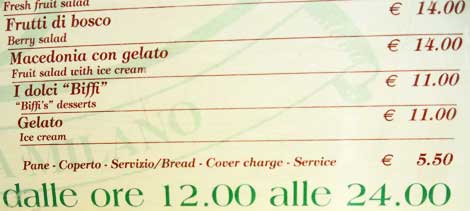
The Ristorante Biffi Galleria in Milano charges €5.50 just to sit down. This restaurant is open non-stop from noon to midnight without a siesta. A scoop of ice cream, call it gelato in Italy, costs about $22.00 in this place, including service charge at the summer 2013 euro exchange rate. This is far more than I paid for a full lunch at the Taschenbergpalais Kempinski Bistro in Dresden, Germany, pictured above. Are the Italians nuts? You don't have to answer that question. See more about money in Europe at The Euro and Other Currencies.
In most countries, virtually all restaurants are closed on local holidays. In Holland everything is also closed on New Years Eve, the biggest night out for Americans. Things are changing in Amsterdam so that it is now possible to party out on NYE.
Fixed eating hours generally don't apply to bar food. You can get a snack in most bars and cafes during the day and late at night, and at a reasonable cost. In Britain and Ireland bar food was about the only food I ate, except for breakfast at the B&Bs where I stayed. Breakfast in B&Bs on the Islands is pretty much the same all over, a very filling plate of eggs, ham/bacon, potatoes, tomatoes, toast, juices, and coffee/tea. Only once in two weeks was I disappointed — canned tomatoes. Ugh.
Water
After getting a table, the first punishment for Americans in northern European restaurants is: do not pass go, do not collect a glass of water, go directly to eating. Actually there are at least two ways to get a glass of water. One is to order bottled water, and pay for it. Another is to order a cola, beer, tomato juice, or whatever, and a glass of water at the same time. The water usually comes for free, unless it's bottled water. Specify ice if you want it and be happy with the meager cube delivered.
On the other hand, in many restaurants in the Mediterranean countries, a carafe of water is brought to your table with the menu. But it would be a good idea to avoid drinking water other than from a sealed bottle in southern and eastern Europe, especially during the summer. Catching an intestinal bug can be devastating.
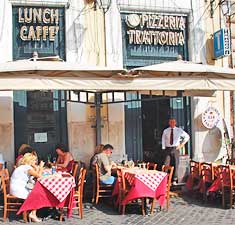
In Europe many restaurants have extensive outdoor seating. The waiter stands ready at attention at this trattoria in Rome, Italy.
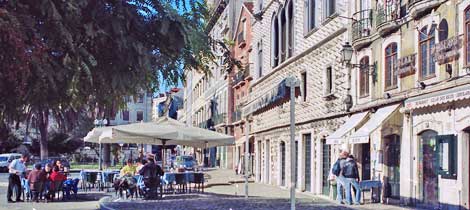
This Lisbon, Portugal restaurant has a tent set up in the parking area for the tables. It can get very stuffy indoors in southern Europe, even in the winter. This photo was taken in January.
Service
Second punishment is the "service." Holland has probably the worst restaurant service in Europe, but no country has service of as good a quality as we are accustomed to in the USA. You might sit helpless for ten minutes while the waiter stands five feet away reading a newspaper. Take it easy! The waiter or waitress gets 15% of the tab which is already included in the price of everything on the menu, or added on before you get the bill. Why move fast if the tips are fixed? A German friend of mine told me that her father finally got tired of waiting for service in one Dutch restaurant so he walked over to the waiter's station and asked the waiter, who was having a cigarette with a friend, "When are you going to bring the menu?" The waiter replied that it wouldn't be long, and added, "You have to wait in the doctor's office too, don't you?"
At a two star restaurant in Paris, there were more penguins than customers, but most of them posed discreetly out of earshot. It was impossible to get anything until they determined that it was our turn. "Penguin" is my term for a waiter in a tuxedo because that is what they look like.
I stumbled upon a Metzgerei (butcher shop) in Frankfurt a/M (am Main) serving great sandwiches, salads, and beverages — cheap, fast, and good.
At most bars in Britain and Ireland you go to the bar and order your food and drink. Pay for it and grab your beer or ale. Find a seat and tell the bar man where you are going. In 5 or 10 minutes your food will be delivered to your table. I'll never order fish and chips again. Ugh. Chili is good.
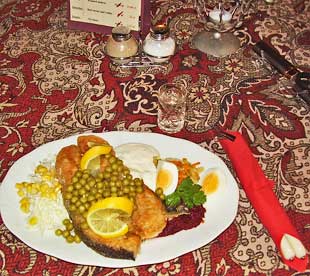
This perfectly fried salmon at restaurant Wisniowy Sad Kawiarnia in Krakow, Poland was one of the best meals I have ever had in Europe. For about $8.40 I had a vodka, small beer, and the plate full of salmon, peas, and other food you see here. Go east for good dining at fantastic prices.
Fast Service
There are exceptions to every rule, and the best exception to the surly café service in Paris is at the Triadou Haussmann near the Gare St. Lazare (St. Lazare Train Station). I had the funniest, fastest waiter in my life there. Ask for the service rapide if it is still advertised on the front window. By the way, the bad reputation of France is due, in my opinion, to the malcontents who serve as café waiters in Paris. The average Frenchman is as hospitable as the average American, and Parisians in general are par with Chicagoans when it comes to the friendly factor.
If you are really in a hurry to eat, tell the head waiter immediately, before sitting down. Otherwise forget it, and forget about going anywhere for the next couple of hours. It's just not right to eat French food in a hurry, and they normally won't let you do it.
Bummer Service
Don't let waiters intimidate you, bring things you didn't order, and jack up the prices. In Madrid, a waiter left a full bottle of wine on my table and I promptly told him to replace it with the half bottle I had ordered. Then I ordered squids at 525 pesetas (this was before the euro) and he brought a plate with a large fish on it. He had already made me wait long enough, so I ate it. Then he gave me a bill for 900 pesetas, the price of the fish I had eaten. I shoved that back at him and reminded him of what I had ordered. A couple more waiters and a few minutes later, they brought me a bill for 525 pesetas which I paid. It was a darn good fish.
In Paris I ordered a demi at a café. The waiter brought out a half liter glass of beer. I reminded him that I had ordered a demi and asked him to take it back. He stood there playing dumb. I stood up and told him to go fly his kite, well actually I made it a bit more understandable by commenting on his maternal canine ancestry or something to that effect. I walked over to another café.
In Athens I went out to dinner with some doctors from Latin America, fellow travelers I met on the boat from Italy. The service was good, but the waiters pulled some exorbitant stunts. They kept delivering little trays of sauces which we thought were included with the appetizers we had ordered. When the bill came, we found out that those little trays cost two to five dollars each. Watch out in the Plaka section near the Acropolis. The food and entertainment are great, but the bill can bust your budget with the slick "service."
Coffee and Tea
There is quite a difference in the types of coffee served in Europe. In England and Ireland it is black or white. "White" is with cream. Expresso, also called espresso, is my addiction. This is a strong, two sip coffee served in France and Italy usually accompanied by a twist of lemon peel. Coffee is very black in Spain and Portugal, but not especially tasty. Greek coffee is a sweet, two sip cup, half of which is fine muddy grounds. Ask for "o-hee sak-reen" if you don't want a pound of sugar in your Greek coffee, and don't stir it up! Turkish coffee also comes with a half cup of grounds which doesn't leave much room for the liquid.
I was never a tea drinker until late 2009 when I discovered green tea. Now it is my first beverage of the day, followed by an espresso later in the morning. Teas, even green teas, all have a distinctive taste. If you are a tea drinker I recommend that you bring a supply of your favorite.
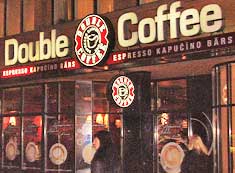
The Double Coffee store in Riga, Latvia has a familiar look to it. I didn't taste.
Cocoa
For those who want to stay awake and do not want to take coffee, eat dark chocolate. A few ounces of dark chocolate has about as much of the alkaloid caffeine in it as a cup of coffee, and is a better pick up for me than caffeine. Chocolate can keep me awake for half the night. I carry a bar of dark bitter chocolate with me all the time for a quick afternoon pick up.
Menu
The word menu is often used to denote a particular dinner selection, and card (carte or karte) refers to what we think of as the menu. On the card are often several menus of three to seven course meals in addition to the á la carte lists. The menus allow substitutions, if stated, and they are less expensive than assembling a meal from the á la carte lists. Look for daily specials which can be posted on cards on your table, on a blackboard hanging on the wall, or posted out front on the sidewalk.

Here is a typical "carte" showing a number of four course "menus" at a restaurant in Paris. For €16.50; (~$22.00) you can choose one item from each group. The first group is normally called the "entree" which is the starter, not the main course as in the USA. Next comes the "plat," the main course. Then you have a choice of desert or a selection from the cheese board. The cheese board normally has about a dozen small wheels of various French cheeses and you are allowed about a 50 gram wedge from three of them. The salads are presented last. Wine is not included in the price. Please don't try to order someting not on the carte or mix up the order of the meal. Then you are in higher priced "á la carte" territory. Know some French or bring a good translating dictionary. The waiter does not have time to teach you French, and may be embarrassed by his/her English ability, if any. If you can't figure it out just throw a dart. In a good French restaurant you can't go wrong.
Always look for a line at the bottom of French menu cards saying "Service 15% comprise." This means that a service fee, call it the tip, is included in the prices. If you don't see this line then a service fee of 15% will be added to the total. Do not tip, or if you feel you should tip make it no more than a few percent, and only if the service is very good.
Often you will be told, after you order an item, "it is finished." The translation of this is that you won't be eating that one today because they haven't had it available for a week. In the eastern countries, menus list many items, only a few of which have prices next to them. Most of the priced items are available.
For an excellent introduction to European menus, consult the practice menus in the Marling Menu Masters. Reading the menus, even with a translating dictionary, is difficult until you've been in a country for a week or two and know what to expect. Many of the better restaurants provide an English translation menu. Some of these translations are confusing or amusing. Almost every one translates "escargots" to "snails." This sort of spoils the essence of slugs baked in butter and garlic. Once you get the drift of the local language you will probably prefer to order from that menu rather than the English language one.
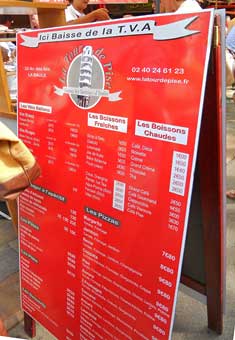
A sidewalk sign board shows the daily offerings of a small restaurant in the French sea side village of La Baule. There is often a chalkboard posting daily specials.
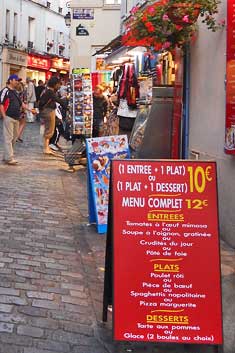
Cafes are plentiful in the famous and touristy Montmarte district of Paris. Tourists who don't like tourisy places should just stay home.
Prices
Restaurants on high rent boulevards are not likely to provide a good value meal. It may be good but it will be expensive, not a good value. In major cities, you'll often find good restaurants in the financial district. If you see a few banks on a street, look around for a place to have lunch. Top hotels also have good menus. I try these places for lunch when the increased price is not as bad as it is in the evening. Many top hotels have a main restaurant plus a lower cost bistro. Do the bistro, unless you are on a corporate or government expense account.
Conversely, palatable food at cheap prices is likely to be found in the neighborhood of a university. For really cheap food walk right into the university cafeteria and get in line. To save money one day a group of us from the Alliance Française walked into the cafeteria at the Sorbornne in Paris. The food was cheap, but awful. Bring your own ketchup! Our lunches at the AF were pretty darn good, especially on lamb cous cous day. I love cous cous. I would bring my girlfriend who worked at the French Ministry of Finance. That was before I met Elizabeth at the Alliance Française.
As a general rule, you can eat much better at a lower cost in a nearby smaller city than in a large city. For instance, from Nice, go over to Antibes for dinner. With a Eurailpass this trip costs you nothing. If you are in Amsterdam go over to Haarlem for lunch. The Cafe Brinkmann there makes a super burger and you can sit on the patio observing the medieval city square, the Grote Markt. You won't find anything like that in Amsterdam.
In general, it costs less to eat and drink as you go south and east. In northern Europe, the best values are to be had in Greek and Italian restaurants, in small cafes and bars, and at smorgasbords where you can pork out at a reasonable cost. Prices are already low in Spain, but if you want to save a little more, eat at the barra ("bar") rather than at a mesa ("table").
The champions in low cost eating are in the eastern countries, and the further east you go the lower the cost goes.
In the west, fine restaurants can be within everyone's budget if you're not too hungry, or if you know what to order. One of the most magnificent stuffings I ever had cost less than two Big Macs at a top hotel in Stockholm. The sillbord was an appetizer of nine assorted types of herring, baked potato, sour cream, and cheeses, and could feed two people plus a doggie bag. One beer and a cup of coffee almost doubled the price.
Tip
A 15% service fee (call it the tip) is usually included in the price of everything in most restaurants and bars in Europe. Look for a note on the menu. When the 15% service fee is not included in the printed price, it is always added to your bill and demanded by the waiter. This add-on method seems to be a common practice in Scandinavia, Italy, and Paris.
So as a general rule it is not necessary to tip in Europe and most people don't tip. The waiter has already tipped himself by the 15% service fee. The price on the menu is normally the total you will pay, tax and tip included.
Tax
The service fee notation will sometimes be accompanied with a mention of the national sales tax. The tax can be known as T.V.A., ETC, V.A.T., MOMS., I.V.A, or some other initials. Consult your Berlitz or Marling for the local name. The tax ranges from 7% to over 20% depending on the country. Tax is always included in the menu prices.
Menu prices and bills don't always look the same. The prices on the bill may be shown without the tax, and then the tax is added on. The result should be the same as the total using the prices on the menu. If you are in doubt, ask for an explanation. If they made a mistake, give them a wide berth on offering a rationalization.
Always ask the owner if you can look at a menu before sitting down and ask if those prices include service and tax. Do not ask the waiter after he presents the bill whether or not his tip has been included. That is tacky and will embarrass him, if he knows the meaning of the word tip.
Extra Costs
In Italy many ristorante and trattoria menus have a pane e coperto (bread and cover) charge stated at the top of the menu. You must ask for butter for the bread, but the butter is often free. The bread charge is in addition to the 15% service charge.
In Athens, many cafes charge extra at Christmas. A note on one menu said, in English, that the service charge is increased for the period December 16 through January 15 due to the Christmas bonus, from 16% to 28%. Not all of them were doing this.
Tastes Good and Not So
Americans are beef eaters. European beef generally does not taste as good as that in the USA, and/or may be tough. Spain is a possible exception to this statement. In the rest of Europe look for an Argentine steak house for the closest resemblance to American beef. If it is taking you five minutes to chew a cut of beef then cut it thin at an angle, across the grain. This makes it much easier to eat.
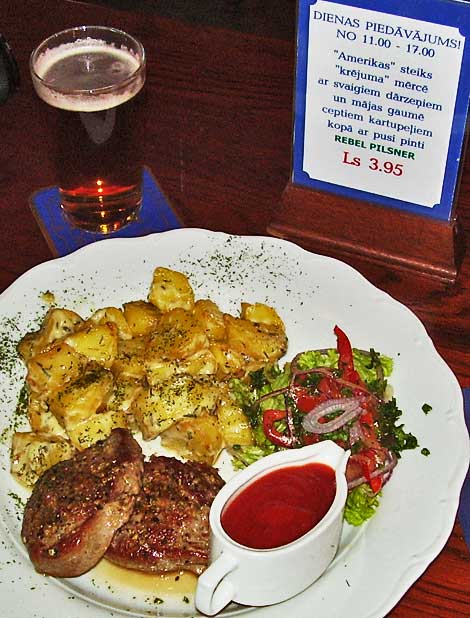
I had an excellent steak lunch at the Dickens Pub in Riga, Latvia. It was the daily special as you can see. Just in case you sort of forgot to learn Latvian before going over there you'll find an American version on the flip side, which says: "Today's Special, 11:00-17:00(5:00 PM), American steak with "cream" sauce, green vegetables, fried potatoes and a half pint of Rebel Pilsner. The steak and potatoes were great but the house pilsner was piss. I couldn't drink it and ordered a different beer. Ls. 3.95" The Latvian currency is the Lat and the symbol is Ls. As of March 2014 the Lat is worth about $1.98 so this lunch, with beer, would cost about $7.82, including tax and tip. Heck I could have three of these for the price of one cup of gelato in Milano.
Pork, lamb, chicken, fish, and cheese in Europe is usually better than that in America. Eat the local products and in-season specialties for better dining and lower prices. E.g., spring is Spargel season in Germany. This is a tasty large white asperagas.
However, the quality varies remarkably within Europe. The British truly deserve their well-earned reputation for consistently bad tasting food. Whenever possible eat in a Greek, Italian, or French restaurant in London. For a lower cost eat in pubs. Also, avoid any place on the Continent with a British sounding name. Tip: Anglais and Londres are French words meaning English and London, respectively.
Our experience in Istanbul was outstanding. The food at a local café near Topkapi Gate was so good that we ate there just about every night, taking "our table" on the balcony to watch the worlds walk by. It was fascinating. Other clients and the owner were good conversationalists.
For the best overall dining in my book, get out into the French countryside. Go to Burgundy (between Dijon and Lyon) and the Loire Valley (between Orleans and Angers) for great groceries, fowl, meat, and wine at a reasonable cost. The triangle formed by Geneva, Orleans, and Strasbourg should have some ebullient epicurean moniker attached to it. When I lived in Holland, a friend told me that for my vacation I should eat my way through France. That is outstandingly good advice.
On my way south from Holland to France, as I discovered years later, I should have been stopping in Brussels. You can become addicted to mussels in this city. Skip Brussels and you have doomed yourself to having passed up some of the best eating on the planet. Antwerp is just as good, and a more interesting city to boot.
I have had memorable and low-cost meals in all of the Mediterranean countries, and great fish in Portugal and Scandinavia. During the fall, wild game is available in many restaurants in Germany, Holland, and France. I love wild rabbit in Holland and deer in Germany. Fall is also the time for real bock beer from the keg and Beaujolais Nouveau wine in France. This wine goes great with Thanksgiving turkey.
Food in the eastern countries was generally pretty bad in the early 1990s but has really improved. I found some excellent moderately priced restaurants in the beautiful old town centers of Tallinn, Riga, and Vilnius. Prague and Krakow are also high on my list of good food at a reasonable price.
Most travelers still bring along something to eat when going to the east since there is no telling what you are going to be served. The Chicken Kiev I was served every night at the hotel in Kiev seemed to contain something different each time. I'm sure the situation will improve, but in the meantime, just accept it as part of the experience. Actually one of the worse meals I ever had was the owner's specialty in a small German hotel. It was a hausgemacht (home made) sausage with blood still dripping out of it. The owner beamed as I ate it — to avoid offending him.
A few years after the Fall of the Wall (that was November 1989), I had dinner in Leipzig (former East Germany) with a couple of business colleagues and the situation can be described as bizarre at best. We were seated at a table with a drunk, a stoned drunk with his cheek on the table and fast asleep. They soon took him out. Our meals came in shifts, at various temperatures and with some semblance of what we though we had ordered. My colleagues were Germans and they were just as shocked as I. It was about the only place in town and we were just short of starvation at the moment, so we suffered it. The situation has improved considerably in the former East Germany as I learned on my last visit to Dresden.
Breakfast
Breakfast is often the first and most diffiult decision of the day. Virtually all hotels offer breakfast but it not cheap. They charge for the convenience.
It is usually more practical and certainly more economical to have a picnic breakfast in your room. Buy some bread or buns, cheese, ham, fruit, and whatever in a market the day before and eat in your room. Hotel keepers do not like this because loose food attracts mice and insects, and there are leftover crumbs on the floor. So be neat and clean to avoid trouble with your hotel if you eat in your room.
I often stay in bed and breakfasts. This solves the breakfast issue. Breakfasts are usually very filling and the overall cost is less than a hotel room without breakfast. But beware of hotels which call themselves bed and breakfast establishments. These are not true B&Bs run by a widow or an elderly couple.
Hostels often provide an excellent breakfast at a bargain price. Hostels which do not provide a breakfast always have a kitchen where you can store your food and make your meals.
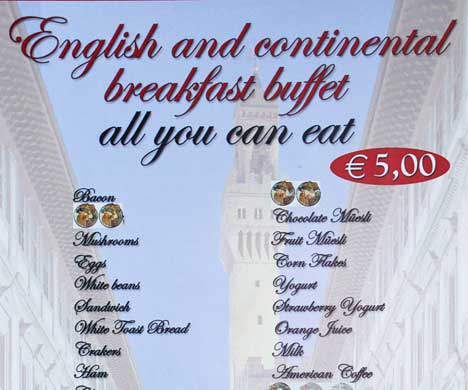
Here is part of the breakfast menu at the Plus Hostel in Florence, Italy. What a deal! For more information about hostels see Hostels in Europe. [Photo by Stephanie.]
Seating
In some restaurants, every vacant table displays a "reserved" card. Probably none of these tables is reserved. Ask the head waiter for a table and you will be seated immediately if you are properly dressed, i.e., no Levis and no Nikes.
If you walk in and notice that every table is occupied, ask the head waiter for a seat anyway. He will sometimes seat you at a table partially occupied by other guests, at least one of whom wants to practice English. Don't be bashful. This is an excellent opportunity to meet Europeans. If you don't know the local language, simply say "Hello," and then add that you are a tourist from America and sorry but you only speak English. You'll probably have a pretty good conversation going in seconds.
Sugar & Spice
Sugar and fake sweetener are usually on the tables. Salt and pepper are also present, but in northern Europe it is white pepper, not black pepper.
Eating Procedure
How do you eat? I was taught at home to cut my food, then put the knife down, transfer the fork to my right hand, put my left hand in my lap, fork the food into my mouth, eat the food, put the fork in my left hand, spear some food, pick up the knife, and start again. Europeans laugh when they see this. They keep the fork in the left hand and they keep it busy. They keep the knife in the right hand cutting or scooping food up on the fork and only put the knife down to take a drink of wine or beer.
Europeans normally break off a piece of bread instead of biting off a piece. Sandwiches are usually open face and are eaten with a knife and fork.
When finished with your soup, put the spoon in the saucer that the soup bowl came in. When done with your dinner, put your knife and fork on your plate with the handles on the right side. Waiters understand these positions and are more likely to clear your table when they see them.
At a seafood restaurant in Portugal, instead of knives and forks, the waiter gave most people a mallet and a small square of wood. It was a noisy restaurant, and the people were having a great time bashing open those crab legs.

Here is part of the inventory at the Dickens Pub in Riga, Latvia. How do you know which beer to drink? I guess you'll have to sample them all, in moderation. Do not drink and drive in Europe. Enforcement is strict and penalties are harsh.
Alcoholic Beverages
Many Americans start dinner in a restaurant with a cocktail. In Europe people will start with a glass of dry sherry or another wine derivative.
Beer, wine, and locally distilled spirits are part of the way of life in most of Europe. Children are brought up with spirits on the table and consequently it is no big deal to turn 21 for the first legal drink as it is in the USA. Some cafés are posted with a minimum age, 16 or 18, but usually not. I've never seen anybody checking ID in a bar or restaurant, and there aren't many such establishments that I have walked by without making a visit. However, you might be turned away from many places regardless of your age. If your shoes don't meet spec you can be bounced. See chapter 5, What to Wear in Europe: Travel Clothes for all Occasions, to learn how this works.
The exception to liberal drinking laws is Scandinavia. They have a pretty weird attitude on alcohol up there. Official policy is to make it as difficult as possible to have a drink. In Finland, it is against the law to sell gin, vodka, or akvavit (a nicely flavored distilled grain alcohol) in a café unless it is mixed with soda or juice in a drink. What a way to ruin good booze. Then again, I've seen Swedes tanking on cognac and Coke. All alcohol sold in Finland is controlled by the state monopoly ALKO. This company imports French wine in bulk and bottles it under its own labels, OY ALKO. In Sweden, alcoholic beverages are sold by the state monopoly Systembolaget. These unusual laws create aberrations which tourists can take advantage of. For example, wines in Swedish restaurants are not marked up as high as beer. For the price of three beers, you can get a full bottle of French Beaujolais or German Riesling.
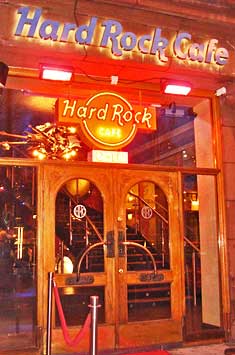
The Hard Rock Cafe in Oslo, Norway welcomes you with the usual decor and menu, but with some amazing prices. Oslo is arguably the most expensive city in Europe. On top of that the price of alcohol throughout Scandinavia is up there in the moon landing chronicles, legendary. Travelers who drink should never enter Scandinavia without bringing in the maximum of duty free beverages, enough to get through the ordeal. If you are coming on a ferry there will be a duty free shop on board. If you are coming from Estonia to Finland or Sweden you can stock up really cheap before getting on board, and there is no duty or limit because these countries are all in the European Union. All the Finns and Swedes do it. They bring a dolly with them for shopping case lots. You can too.
Before ordering any distilled spirits anywhere specify what size you want. The menu normally gives prices for 2cl and 4cl. In the Scandinavian and Mediterranean countries, you might get 8cl if you just order the "big one." Specify 4cl if that is what you want. For reference, one ounce is just south of 3 cl, centiliters.
There are very strict laws regarding drinking and driving in every country. For more details, see chapter 18, European Driving Habits and Laws: Police, Speed Limits, Tailgaters.
Toasting
Americans toast by clanking glasses with an appropriate "To your health!" or something like that. My Dad always said "Here's mud in your eye." In Holland, Germany, and some other countries the custom does not include clanking the glasses. But it does include a straight eyeball-to-eyeball stare for a second as you hold your glass up. Steady there.
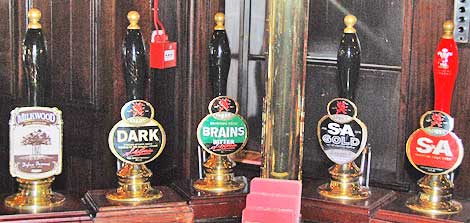
Here is an assortment of ale handles at a pub in Cardiff, Wales. Imported European, Australian, and American beers are also available from an ice bucket. Did you go all the way to Cardiff to have a bottle of Bud Light? You must be stupid. Have a pint of Brains, the one in the middle.
Dessert
The desserts offered after dinner in Europe are beautiful. They are not big but they are beautiful. From cream cakes to fresh fruit to the darkest chocolate creations, you normally have a challenging choice.
I rarely take a dessert. I'm sweet enough already. I prefer the cheese platters. You cannot imagine how many beautiful cheeses there are in Europe. In better restaurants the waitress will bring out a platter with maybe a dozen wedges of cheese on it. You choose three, a piece of each will be cut for you, and your bread basket will be refilled. If you think that "American" cheese is cheese you are about to get re-educated.
I was with distant relatives Ida and her son Hermann in Austria a few years ago. We were driving around the Tyrol visiting other distant relatives. At each stop we were offered chocolate cake and coffee. I was full but Hermann stopped for lunch anyway. Since I wasn't too hungry I ordered the cheese platter. The waitress brought it out and left it on the table. I cut off a few modest sized pieces for my lunch. When we were done and had paid the bill Ida picked up a couple of napkins, wrapped up all the rest of the cheeses, and put it all in her bulging purse. There must have been a couple of pounds of cheese there! I'll bet that was the last time that they left the platter on the table. Ida and I had plenty of cheese for the next few days.
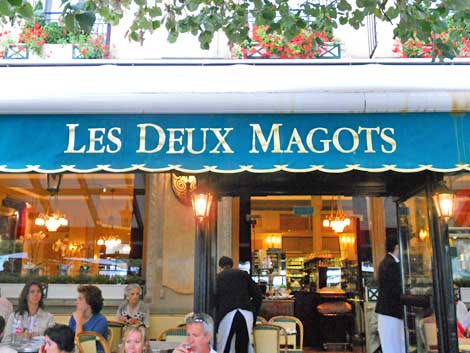
Les Deux Magots is an old and famous cafe at Place Saint Germain des Prés, Paris 6th. See and be seen while you make notations in your travel log and bust your beverage budget for the day. The name translates as the "two Chinese figurines" and not what you are thinking. [Photo by Stephanie.]
The Bill
After eating, getting attention and getting the bill is often a challenge. Wave at the waiter. When he notices you, hold up your left hand and mimic writing squiggles on it with your right. He will understand.
When the waiter presents the bill, check the prices versus the menu, and the addition. In Holland and in Spain I have had a different menu and prices shown to me after I questioned the price of dinner. In Holland the waiter went back to the kitchen after my protest and came back ten minutes later with a menu on which he had taped little squares of paper with higher prices. I couldn't believe it. "Be fair," I said, and paid the amount shown on the table menu.
Mistakes in adding up the bill are common, and most of the time the numbers run a little high. Many restaurants are changing to computerized bill printing. This is nice because now they are legible. Handwriting and numbers are difficult to interpret in Europe. I haven't found any errors in arithmetic on the electronic bills, but have seen cases where the price or quantity of an item was inflated. Also, make sure that something you didn't order is not slipped onto your bill.
Bar Food
For good food at reasonable prices, eat in a bar. At almost any time during the day in Holland and Dutch-speaking parts of Belgium, ask for an uitsmijter (white bread topped with ham or cheese and two sunny-side up eggs) or erwtensoep (delicious heavy pea soup with sausage) and roggebrood (black rye bread) with raw bacon on the side, but only available during the winter. In France and French-speaking parts of Belgium ask for a croque monsieur (toasted ham and cheese sandwich) or a croque madame (toasted ham, cheese, and egg sandwich). In Greece, the taverns have all kinds of things to eat and you usually get an appetizer with your drink.
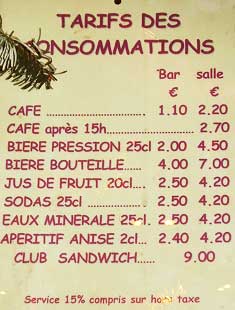
This is the price of goods at a bar in Paris, the Caffé Leffe in the Montparnasse area I believe. You know where and what I was sipping if you have read this far. Prices at the bar are half of table prices. The biere pression is a 25 cl draft, almost 8½ ounces. The biere bouteille is a 33 cl bottle, just a scosche over 11 ounces. There, I did the math for you. If you have forgotten what the metric system is have a look at Metric System in Europe: Travel with Grams, Meters, Liters, and Celsius. Notice that the bar charges more for coffee after 3:00 PM (aprés 15h), and that a 15% tip and tax is included in the prices.
At bars in Italy they do make it a bit difficult to get served. First survey the food on display and then go over to the cashier and pay for what you want. Then go back to the counter with the receipt and order your food. Give the receipt to the waiter/waitress behind the bar as payment. He/she will promptly give it a rip and throw it on the counter next to your selection. It's doubly difficult for those of us who don't speak Italian. How do you tell the cashier what it is that you want when the unknown delicacy is on a counter 30 feet away? Somehow it happens.

I enjoy a good high protein croque madame at the Cafe du Metro, Paris 5th at Metro station Maubert-Mutualité, which Elizabeth said I never pronounced correctly. I lived around the corner from this traditional cafe. A croque madame is egg, ham, and cheese on bread, toasted open face. I don't see any ham on mine.
Over in Madrid, the tourist office will give you a city map showing where most of the taverns are located. Each one has a selection of things to eat and I spent several days making the rounds trying all the tapas possible. In one bar, I ordered paella — a heap of saffron rice with a few small clams, crabs, and pieces of chicken. There I was in a public place staring at two little red crabs hiding in my rice, and they were staring back at me! They were about three inches across and too small to break open. What else could I do? They were already cooked, so I ate them, eyeballs, shell, and all. They were crispy like potato chips and tasted pretty good.
If you're starving late at night in Holland, ask for a tostie while you have a beer and trade tales with your new-found Dutch friends in a cozy brown bar. A tostie is a cheese or ham sandwich popped into the toaster.
Pubs in Britain and Ireland are always a good place to eat just about any time of the day. Menus are usually scrawled on blackboards in front of the bar or behind the tap or out on the street. Order and pay at the bar and take a seat. The bar man will bring it to you shortly. Sometimes the bars have pans in a steamer so it can be dished out to you immediately.
Toilets
Toilets in restaurants are usually marked with the symbol of a man or woman, i.e., skirt and slacks, or have the local name for "man" or "woman" on the door. Some may simply have a triangle on one door and a circle on the other. Other obtuse symbols can also be seen. If uncertain, ask, or wait to see who comes out or goes in.
Toilets normally go under other names over there but are never called the "bathroom." Though often labeled W.C. (for water closet), local names like toalet in Scandinavia, services or aseos in Spain, or loo in Britain are commonly used. Generally you can get what you want by asking for the "toilet" or W.C., but pronounced as "wee cee" (France, Italy, etc.), or "vay say" (Germany, Holland, eastern Europe, etc.).
The eastern countries normally use the hammam, a form of toilet that is simply a square ceramic depression in the floor. It has two elevated shoe shaped platforms in it and a hole in the middle. You'll find these in many cafes in France, Italy, and the eastern countries. Learn to squat.
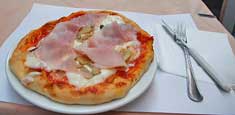
Yes, you can get a pizza in Rome, Italy. This one features a generous portion of ham. [Photo by Stephanie.]
Do not expect toilet paper in European toilets. Let yourself be surprised. Tip: you won't often be surprised in the eastern countries. If you find toilet paper you might not recognize it, except for the fact that it is in the toilet stall.
I never eat in MacDonald's "restaurants" but I'm glad they are parked in a few countries with less than standard sanitary standards. MacDonald's toilets have clean thrones and white toilet paper.
Virtually all toilets in Europe require payment. There may be a dish with coins in it near the door, with or without an attendant watching over it. If the attendant is not present she is probably mopping up around the men's urinals. Guys, don't turn around until you zip up.
Emergency Snack
There are few things more uncomfortable than hunger so travel on a full belly and/or with some snacks in your day sack. You'll have an unusual timetable, not always of your own making. Arrival times will not be regular, and trains can run late, causing missed connections and late arrivals. On the highways, traffic jams can be worse than anything you've seen at home.
Carry some bread, cheese, and fruit on the train or in your car. Carry a can of sardines or some other durable at all times for those late night emergencies. A chocolate or granola bar can tide you over for a couple hours. A spoonful of peanut butter is another great snack.
Smoking
Even though there are beaucoup more smokers in Europe than in the USA the no smoking laws have reached Europe. In many countries you cannot smoke in any public building, including restaurants, cafes, and pubs. If you puff, walk around and find a cafe with outdoor seating and ashtrays.
Where it is still allowed it is fashionable to smoke cigarettes. Also, cigars are common and acceptable for an after dinner smoke, outside. Holland has great cigars, and they're cheap. Holland is one of the countries which has banned indoor smoking, except for marijuana in "coffie houses." Have a joint. I was amused in Copenhagen to see two women light up cigars after eating. Apparently this is an old tradition of Danish women.
Doggie Bags
There are no doggie bags in Europe. This should not stop you from rolling up your leftovers and some bread in a paper napkin and taking it back to your hotel. It might be all the breakfast you need tomorrow morning.
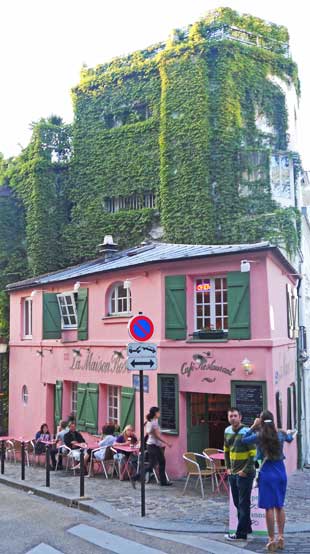
This is a beautiful little restaurant, La Maison Rose, in the Montmarte district, Paris 18th. Notice the No Parking sign accompanied by an icon of a tow truck. Scoffing this sign will cost you more than dinner, for sure. The girl in blue obviously likes the scene, also. [Photo by Stephanie.]
Have a good trip!
NOTE TO READERS
I welcome questions and comments. If you have any concerns about your trip to Europe that have not been covered well enough in this section please do not hesitate to write and ask. When you write please include relevant details, per the folowing paragraphs.
I do not open attachments. I do not click links to web pages of any kind. I will reply in a day or two, usually.
Do not forget to smell the hyacinths. At your liesure scroll through the Table of Contents of How To Europe: The Complete Travelers Handbook and read all 30 chapters, FREE on line. Good deal! You'll probably find the answers you seek, and some you didn't know you needed.
My email address is [email protected].
FREE
This web site is totally free for everyone, and a labor of love for me. To keep it afloat I receive a commission from Amazon.com for all goods purchased through the adverts I have selected, and any other products you might buy when you are on the Amazon site. Amazon has almost everything for sale, except the Brooklyn Bridge and Mount Rushmore.
Please visit my on-line store at
 .
Your support is most gratefuly appreciated. TIA.
.
Your support is most gratefuly appreciated. TIA.
To like and like not:


Adverts
To support this site:
Please buy your goods at:Amazon.com
Shop in your shorts!
Please clean out your cookie jar before clicking.
Rolling luggage sure beats lugging a pack on your back.
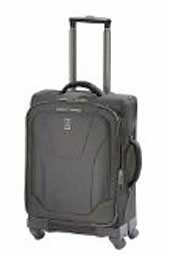 Travelpro Luggage Maxlite 2 20" Expandable Spinner
A shoulder bag for your daily walk-about.
 Travelpro Luggage Maxlite3 Soft Tote
Keep your stuff organized.

Luggage Packing Cubes
eBags 3pc Set
The two gallon size is excellent for packing your clothes, but it is hard to find in Europe.
 Two gallon plastic bags
ZipLoc by SC Johnson
Inconspicuously lock your zippered luggage with a black wire tie.
 Cables to Go 43036 Cable Ties - 100 Pack (Black)
Your negotiating assistant will save you cash, as described in chapter 6.
 8-Digit Display Hand-Held Calculator by Sharp
A Swiss Army Knife is unquestionably the handiest item a traveler can carry, except not on a plane.
 Victorinox Swiss Army Huntsman II Knife
What a dandy of a camera! It includes a GPS that automatically sets the internal clock depending on which time zone you are in. You'll always know where and when you took the shot.
 Panasonic Lumix ZS20 14.1 MP High Sensitivity MOS Digital Camera with 20x Optical Zoom
Bring home the memories.
 Olympus FE360 8MP Digital Camera with 3x Optical Dual Zoom (Silver)
This is the camera that I use,
 Nikon D60 10.2MP Digital SLR Camera (Body Only)
with this amazing zoom lens,
![Nikon 18-200mm f/3.5-5.6 G ED-IF AF-S VR [Vibration Reduction] DX Lens](http://www.enjoy-europe.com/images/B000BY52NU.jpg) Nikon 18-200mm f/3.5-5.6 G ED-IF AF-S VR [Vibration Reduction] DX Lens
Nikon 18-200mm f/3.5-5.6 G ED-IF AF-S VR [Vibration Reduction] DX Lens
and this filter to reduce reflections and enhance colors.
 HOYA 72mm Circularizing Polarizing Filter
This tripod clamp is a handy accessory.
 CLAMP-POD Adorama SMALL 4001
Absolutely the best battery for digital cameras which use AA batteries.
 Energizer
AA Lithium Batteries
4 Pack
Plug adapters are needed throughout Europe. There are at least five models used in different countries.
Note: The highlighted #E number is purely arbitrary. It is meant to help quickly identify products in this advert column when you write in for electrical advice.
See NOTE TO READERS.
This adapter is for the standard grounded plug in France, Germany, and northern Europe. It does not fit in outlets of Italy, Switzerland, Ireland, and Britain.
#E-010
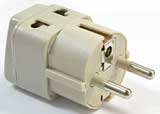 Grounded Universal 2 in 1 Plug Adapter
European Schuko plug.
4.8 mm prongs.
Equivalent to type E and F.
You can use this ungrounded Euro plug in some European countries.
#E-020
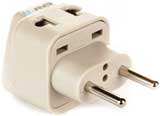 Universal 2 in 1 Plug Adapter
Euro Plug
4.0 mm prongs.
Equivalent to type C.
This is a universal plug adapter for the UK and Ireland.
#E-030
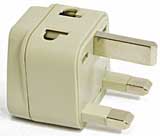 AC Adapter Plug for use in England, Scotland, Wales, and Ireland
Equivalent to type G.
Here is the Swiss version.
#E-040
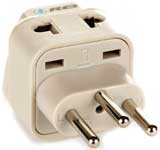 Grounded Universal 2 in 1 Plug Adapter
Type J for Switzerland
Here is the grounded Italian model.
#E-050
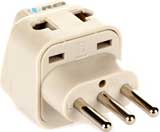 Grounded Universal 2 in 1 Plug Adapter
Type L for Italy
This 50 watt 220/110 volt step down transformer is good for very small 110 volt appliances and light duty chargers.
#E-070
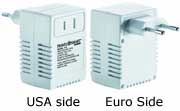 Travel Smart by Conair 50-Watt International Transformer
This little booklet is my favorite map of Paris.
 Michelin Paris Pocket Atlas (by Arrondissements) Map No. 16
A pocket map of Amsterdam that won't get soggy in the drizzle.
 Streetwise Amsterdam Map - Laminated City Center Street Map of Amsterdam, Netherlands
Here is the heart of London, a very big city.
 Lonely Planet London City Map
Wear a scarf for comfort and style. Nobody will ever suspect that you are an American.
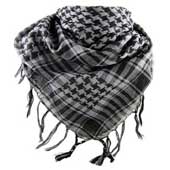 Very soft houndstooth neck scarf. Various colors available
You know it's going to rain. Be ready.
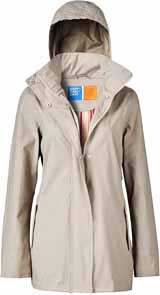 Happy Rainy Days
Women's Jacket
 Anne Klein Women's Classic Double-Breasted Coat
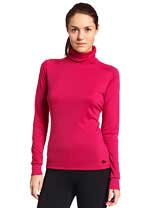 Hot Chillys Women's Peach Skins Solid T-Neck Shirt
 Clarks Women's Wave.Run Slip-On
 Tilley Endurables TH9 Women's Hemp Hat
For leg comfort on the plane.
Arriva Travel-Tec Travel Legwear with Smart Compression Technology
My favorite T-shirt/undershirt has a pocket for securely carrying passport, cash, and credit cards under my outer shirt.
 Hanes Tagless Short Sleeve Tee with Pocket
 New Casual Grey Herringbone Wool Cap
A pocket size combo phrase book and dictionary, with American pronounciation. Ideal for travelers.

French At a Glance
Barron's Educational Series

Spanish/English English/Spanish
Larousse Mini Dictionary

Greek
Oxford Mini Dictionary
I used the Dutch version of Rosetta Stone. These programs are intense and complete.

Rosetta Stone
German Level 1-2 Set

Rosetta Stone
French Level 1

Rosetta Stone
Italian Level 1
Berlitz Italian in 30 Days
Berlitz Spanish in 30 Days

German, Conversational: Learn to Speak and Understand German with Pimsleur Language Programs
Rolling luggage sure beats lugging a pack on your back.
Travelpro Luggage Maxlite 2 20" Expandable Spinner
A shoulder bag for your daily walk-about.
Travelpro Luggage Maxlite3 Soft Tote
Keep your stuff organized.
Luggage Packing Cubes
eBags 3pc Set
Wear a money belt under your shirt to protect your passport and valuables, especially if you are staying in hostels or dorms.
 Lewis N. Clark RFID Blocking Waist Stash
A Swiss Army Knife is unquestionably the handiest item a traveler can carry, except not on a plane.
Victorinox Swiss Army Huntsman II Knife
The details on driving in Europe may save your life.
 Driving in Europe 101by Curley Bowman
Michelin will get you on the right road.
 Europe Map Michelin
The best travel guide to all of Europe.
 Europe on a Shoestring
Lonely Planet
A comprehensive guide to 3,000 hotels and restaurants in 44 major cities throughout Europe, in English. Separate books in the Michelin Red series cover individual countries in greater detail. This is a must have for frequent travelers.
 Main Cities of Europe 2015
Michelin Guide
Your negotiating assistant will save you cash, as described in chapter 6.
8-Digit Display Hand-Held Calculator by Sharp
Rolling luggage sure beats lugging a pack on your back.
Travelpro Luggage Maxlite 2 20" Expandable Spinner
A shoulder bag for your daily walk-about.
Travelpro Luggage Maxlite3 Soft Tote
Keep your stuff organized.
Luggage Packing Cubes
eBags 3pc Set
The two gallon size is excellent for packing your clothes, but it is hard to find in Europe.
Two gallon plastic bagsZipLoc by SC Johnson
Inconspicuously lock your zippered luggage with a black wire tie.
Cables to Go 43036 Cable Ties - 100 Pack (Black)
Your negotiating assistant will save you cash, as described in chapter 6.
8-Digit Display Hand-Held Calculator by Sharp
A Swiss Army Knife is unquestionably the handiest item a traveler can carry, except not on a plane.
Victorinox Swiss Army Huntsman II Knife
What a dandy of a camera! It includes a GPS that automatically sets the internal clock depending on which time zone you are in. You'll always know where and when you took the shot.
Panasonic Lumix ZS20 14.1 MP High Sensitivity MOS Digital Camera with 20x Optical Zoom
Bring home the memories.
Olympus FE360 8MP Digital Camera with 3x Optical Dual Zoom (Silver)
This is the camera that I use,
Nikon D60 10.2MP Digital SLR Camera (Body Only)
with this amazing zoom lens,
Nikon 18-200mm f/3.5-5.6 G ED-IF AF-S VR [Vibration Reduction] DX Lens
and this filter to reduce reflections and enhance colors.
HOYA 72mm Circularizing Polarizing Filter
This tripod clamp is a handy accessory.
CLAMP-POD Adorama SMALL 4001
Absolutely the best battery for digital cameras which use AA batteries.
EnergizerAA Lithium Batteries
4 Pack
Plug adapters are needed throughout Europe. There are at least five models used in different countries.
Note: The highlighted #E number is purely arbitrary. It is meant to help quickly identify products in this advert column when you write in for electrical advice.
See NOTE TO READERS.
This adapter is for the standard grounded plug in France, Germany, and northern Europe. It does not fit in outlets of Italy, Switzerland, Ireland, and Britain.
#E-010
Grounded Universal 2 in 1 Plug Adapter
European Schuko plug.
4.8 mm prongs.
Equivalent to type E and F.
You can use this ungrounded Euro plug in some European countries.
#E-020
Universal 2 in 1 Plug Adapter
Euro Plug
4.0 mm prongs.
Equivalent to type C.
This is a universal plug adapter for the UK and Ireland.
#E-030
AC Adapter Plug for use in England, Scotland, Wales, and Ireland
Equivalent to type G.
Here is the Swiss version.
#E-040
Grounded Universal 2 in 1 Plug Adapter
Type J for Switzerland
Here is the grounded Italian model.
#E-050
Grounded Universal 2 in 1 Plug Adapter
Type L for Italy
This 50 watt 220/110 volt step down transformer is good for very small 110 volt appliances and light duty chargers.
#E-070
Travel Smart by Conair 50-Watt International Transformer
This little booklet is my favorite map of Paris.
Michelin Paris Pocket Atlas (by Arrondissements) Map No. 16
A pocket map of Amsterdam that won't get soggy in the drizzle.
Streetwise Amsterdam Map - Laminated City Center Street Map of Amsterdam, Netherlands
Here is the heart of London, a very big city.
Lonely Planet London City Map