The Euro and Other Currencies
Exchange Rates for Travel in Europe.
What is a euro? How much is a euro worth? What does a euro look like?
Which countries use the euro? Where can euros be obtained?

The euro, symbol €, is the official currency of a score of European countries and the de facto currency of a handful more. There are other official currencies in Europe, most notably the British pound and the Swiss Frank.
The value of these currencies changes all the time, like the weather. It is a free market system based on supply and demand, with what is known as "floating rates" for each individual currency.
The euro was introduced to facilitate commerce in Europe. It took the place of national currencies where it was adopted. A list is provided below.
This graph shows the euro-dollar exchange rate for the past 17 years.
It's initial value was
established by fiat on January 1, 1999. After that it floated. The euro was not put into general circulation for 3 years to allow people time
to get accustomed to it. Some people never did.
As you can see it has floated all over the place. Entering 2016 the euro continues the flat line rate of about $1.10 which it enjoyed throughout 2015. This is well below its average since birth, and a real help for Americans traveling to Europe this year. Hope that it stays level or sinks further. Who knows?
Carpe diem. Vivere bene! Gratia Deo.
Appendix
HOW TO EUROPE:
The Complete Travelers Handbook
John Bermont

This entire book is published totally free on-line by the author, photographer, and webmaster, yours truly, with help from my daughter Stephanie. I welcome all questions, comments, and complaints. For contact information please see NOTE TO READERS. Updated 12 January 2016.

The euro, €. They should have called it the charley.
WHAT IS A EURO?
The euro went into circulation on January 1, 2002 as the currency of 11 central European nations, now up to 19. The French franc, German Mark, Dutch guilder, and a number of other national currencies were immediately erased forever.
The bankers had assembled and came to a joint agreement on the value of the new euro in terms of their own currencies at the time. Thus, people no longer had to go to the bother of changing a dollar for 2,000 Italian lira or 10 French francs, et cetera. With one currency serving so many countries visitors were blessed with more time and less trouble in enjoying their visit.
Why do I say they should have called it the charley? I like history. It fascinates me to learn what our ancestors did in the past. The last time that Europe was sort of united was 1,300 years ago. The Emperor Charlemagne was capo of the whole place. So in respect for his unique position I suggested naming the new currency after him. Did not happen.
WHAT DOES A EURO LOOK LIKE?
The faces of euro bank notes are characterized by a sketch of a cathedral or arch. The back side features a sketch of a bridge or acqua duct. These images replace the former classical bank note faces which typically featured the face of a noteworthy individual from the local history books. The euro notes have holograms, watermarks, magnetic strips, and other high tech anti forgery features. Overall they look sort of glitzy. The new American Federal Reserve Notes are much more pleasing with images of famous Americans from our history books.
Coins come in a variety of denominations. Surprisingly the largest coin is two euros, the value of which you can round off to about three dollars. The biggest coin that we have going around in regular circulation is the quarter. The big old silver dollar is long gone and nobody seems to want to use the tin substitutes that have been minted since.

Here's what it looks like, a €20 bank note compared to an American $20 bill. Both images are defaced with the word "specimen." As of the first business day of 2016 the euro is at about $1.08. Thus, €20 is worth $21.60. Twenty dollars will buy only €18.50, minus fees and commissions. Fees and commissions can easily cost you 10% at some money changers. You will be doing well to get €16.50 for your $20 bill from currency exchange stores tacked on to souvenir shops. It is far far better to obtain euros and other foreign currencies at bank cash automats, the European equivalent of ATMs. See the photos below.
WHICH COUNTRIES USE THE EURO?
This table is current as of January 2016. More countries are attempting to qualify to join the Euro Zone but it is a slow process.
| The Euro Zone | ||
|---|---|---|
| Official |
Austria
Belgium Cyprus Estonia Finland France Germany Greece Ireland Italy |
Latvia
Lithuania Luxembourg Malta Netherlands Portugal Slovakia Slovenia Spain |
| Unofficial |
Andora
Kosovo Monaco |
Montenegro
San Marino Vatican City |
| Future |
Bulgaria
Croatia Czech Republic Hungary |
Poland
Romania Sweden |
| Never |
Britain
Denmark Iceland Liechtenstein |
Norway
Sweden Switzerland |
| Possibly open to negotiation in other countries which have their own currencies. In fact, hotel rates are often posted in euros and/or dollars in eastern Europe and Turkey. Some local businessmen do not like the local wampum. | ||
EXCHANGING DOLLARS FOR EUROPEAN CURRENCY
Money exchange rates are in constant flux, sort of like the waves on the beach. But as far as you are concerned, the only real rate is the amount of foreign currency you receive, after the exchange rate is calculated and the commissions and/or fees have been deducted. This varies from money changer to money changer. It is a rip-off racket throughout Europe. Before giving your dollars to anybody behind a bullet-proof window ask them to write down the total amount of local currency that you will receive for the cash in your hand, AFTER their commissions and/or fees have been deducted. Be very wary of any exchange office which advertises "No Commission" in big bold print. These agents give a very low exchange rate in order to make a profit. Any agent can exchange money at whatever rate he wants. There is no "official exchange rate" for the dollar. It is a free market, like apples.
Local ATMs
In virtually every country of Europe ATMs accept most American bank cards. These machines are usually attached to banks but are sometimes free standing machines in train stations, airports, and shopping areas. They are not called ATMs but look almost the same as native ATMs in the USA. Use these machines with your PIN to withdraw local cash, usually at the best exchange rates and usually with no fee, except for the fee at your home town bank. Home town bank fees can be as high as $5.00 per transaction or a few percent of the amount withdrawn. Ask your bank for its fee before using your ATM card in Europe. American banks do not nickel and dime you to death. No sir — they take a basket load. My credit union has no fee for foreign withdrawals, though Mastercard somehow nabs a percent or so.
Call or visit your home town bank before going to Europe to let them know that you'll be over there, and trying to get local cash out of local machines in the European countries you will be visiting. This will help ensure that you can use your ATM card there, but no guarantee, absolutely no guarantee.
Backup ATM Card
It is wise to always have at least a few days supply of cash in your pocket, plus at least two ATM cards from different banks, brokers, or credit unions. Do not wait until you are out of money before attempting to get some more. You might have an unpleasant surprise.
There is a difference in the performance, if you will, between regular ATM cards and debit cards. The banks have been trying to get everybody to use debit cards for the past decade. These are linked with VISA or MasterCard. Unfortunately, these debit cards do not work as universally as a straight ATM card. This may be because of the credit card link since some banks in Europe do not allow cash advances on credit cards.
Liability Limit
Another unfortunate feature of debit cards compared to credit cards is that there may be no limit on liability in case your card is lost or stolen. Your liability for a lost or stolen credit card is $50 up to the time you notify the card issuer. With a debit card a finder can clean out your bank account before you notice that the card is missing. True, a PIN is needed to withdraw cash at an ATM but a PIN is usually not needed at a gas station. If your debit card is used as a credit card, all it takes is a forged signature to clean out your account.
Out of Service ATM
You might also ask your bank for its ATM maintenance schedule. Bank systems are shut down for software and/or hardware maintenance for a few hours per week or month. They usually do this when most everybody is sleeping — on the west side of the Atlantic. You're on the other side when you are in Europe and cruising along at 5 to 12 hours ahead of your home town. The down-time maintenance hours may inconvenience you and throw a severe crimp into your day's activities if you immediately need a fresh batch of cash while the system is doing its hiccup.
ATM Security
Most ATMs in Europe only accept four digit PINs and most of them only have numbers on the keypad, i.e. usually no A, B, C. And if there is an alpha keypad there is a chance that it is not in the same order as an American keypad. So change your PIN to four easy to remember numbers before you go to Europe. For example, use the year your Mother or Dad was born. Do it in reverse for greater security. Or turn 'cash' into 2274 or 'john' into 5646. Be original to be safe. Do not use any number that is on something in your wallet.
There are more and more stories in the European press about crime at ATM cash machines. The criminals have been working overtime inventing more and more clever ways to get at the cash inside those unattended boxes. The primary vector giving them access is to steal the card number and PIN number of innocent clients. The bank is off the hook. The client pays. Remember that there are almost always people loitering around on streets in Europe and there is a high probability that the loiterers are unemployed. Their job, if you will, is to vaporize your account down to zero. They are professional and extremely talented at what they do. Be on guard.
QUALITY LINKS
For much more about money in Europe and how to protect yourself against theft please see chapter 8, ATMs in Europe: Travel Cash.
Here are links to exchange rate web sites and more information about money.
- ECB, ESCB and the Eurosystem. The official site of The European Central Bank.
- The Euro Coin Collector. All about the Euro coins.
- XE.com. Get free live currency rates, tools, and analysis.
PHOTOS OF INTEREST
Here is a small gallery to show you what you will be facing.

Here are the lesser three of the seven bank notes used in the euro zone. The other four are 50, 100, 200, and 500 euros. Notice that Europe has retained one traditional feature of the money over there — the higher the value the bigger the bill. Also, they come in various colors.
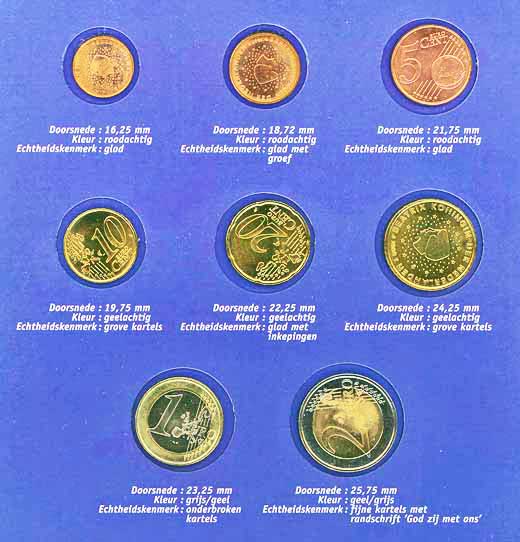
I wonder why they need eight coins? Euro coins are minted by most nations in the Euro Zone. The back side shows the value in cents or euros. The front face shows whatever the individual nation wants to show. Queen Beatrix ruled at the time, 2000, so this set of Dutch euro coins has her silhouette in relief. The girl threw down the crown in 2013 and her son Willem-Alexander took over as king. A new issue of coins shows the king. This set was a gift from my friend Paula in Haarlem.
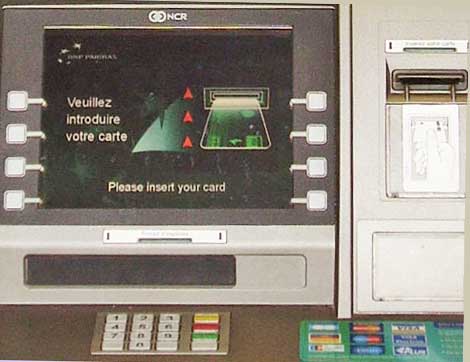
Europe probably has as many ATM machines as the USA. Here is a bilingual cash machine on Boulevard St. Germain in Paris, France. Use your home ATM card to withdraw euros day or night from your American bank account. You get euros and your dollar account is debited the equivalent amount in dollars, plus whatever fee your bank charges. This machine accepts nine kinds of plastic. Hey, you can learn some French here, but can you pronounce it?
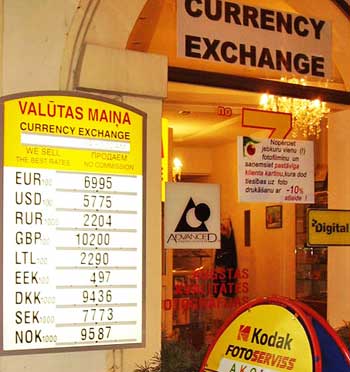
Stores like this were common throughout Europe before the euro came. Now you only see them in countries where the euro is not the official currency. This merchant in Riga sells Kodak products and bought nine kinds of currency when I was there. But Latvia joined the Euro Zone on January 1, 2014 so much of his business has probably evaporated. Latvia now accepts those euros you purchased in any of the other Euro Zone countries.
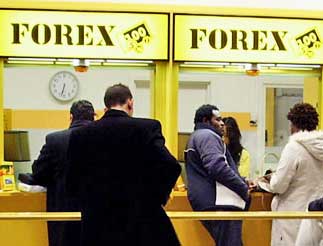
The Forex company specializes in foreign exchange. Forex offices are frequently found in countries which do not accept the euro. This bureau is in the Oslo, Norway train station.
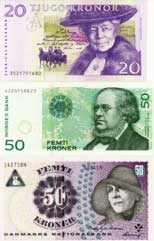
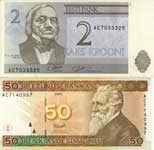
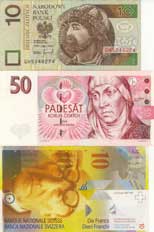
Here are miniature views of some of the other money afloat in Europe. From upper left are 20 Swedish kronor, 50 Norwegian kroner, 50 Danish kroner, 2 Estonian krooni (Estonia now uses the euro), 50 Lithuanian litu, 10 Polish zlotych, 50 Czech korun, and 10 Swiss Franken.
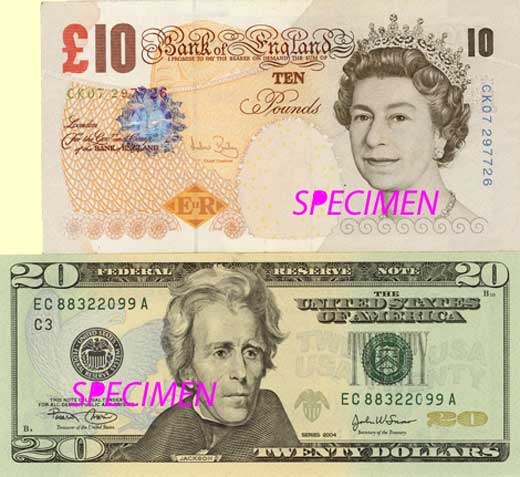
The UK has not adopted the euro and never will. Britain continues to use the pound sterling, £. Here is a comparison of a British £10 bank note with an American $20 bill. The Queen's mug is on the face of all of the currency of the Bank of England. The back side has the face of a famous person from their history books. If you are in Scotland, Wales, or Northen Ireland you'll see much different money but it is all official throughout the UK.
Have a good trip!
NOTE TO READERS
I welcome questions, comments, and complaints. If you have any concerns about your trip to Europe that have not been covered well enough on my web site please do not hesitate to write. Ask, cuss, discuss, or whatever. I read every email and update my pages when I see a question repeating, Then I will not get that question again, hopefully. In some cases readers have been so generous with their time and talent that I have included their emails verbatim, e.g. chapters 22 and 25.
I do not open attachments. I do not click links to web pages of any kind. If you have an item you want me to comment on please send the name of the manufacturer and the model number, or the Amazon.com ASIN number. I will reply in a day or two, usually.
My email address is [email protected].
Do not forget to smell the hyacinths. At your liesure scroll through the Table of Contents of How To Europe: The Complete Travelers Handbook and read all 30 chapters, FREE on line. Good deal! You'll probably find the answers you seek, and some you didn't know you needed.
FREE
This web site is totally free for everyone, and a labor of love for me. To keep it afloat I receive a commission from Amazon.com for all goods purchased through the adverts I have selected, and any other products you might buy when you are on the Amazon site. Amazon has almost everything for sale, except the Brooklyn Bridge and Mount Rushmore.
Please visit my on-line store at
 .
Your support is most gratefuly appreciated. TIA.
.
Your support is most gratefuly appreciated. TIA.
To like and like not:


Adverts
To support this site:
Please buy your goods at:Amazon.com
Shop in your shorts!
Please clean out your cookie jar before clicking.
An RFID blocking wallet protects your passport and credit cards from identity theft in public places.
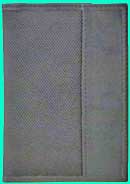 Travelon RFID Blocking Passport Case
Wear a money belt under your shirt to protect your passport and valuables, especially if you are staying in hostels or dorms.
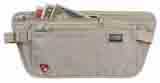 Lewis N. Clark RFID Blocking Waist Stash
Here is a secure option for women.
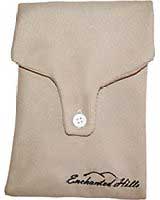 Large Adjustable Hidden Bra Pouch
Use these RFID blocking sleeves to secure your passport and all your credit cards against electronic pickpockets. These vermin are patiently waiting and know where you will be going.
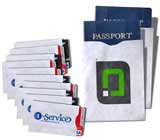 RFID Blocking Sleeves (10 Credit Card & 2 Passport Protectors)
The links in this pink field take you directly to a page at Amazon.com. The Amazon page details the item, and in most cases includes candid and critical comments from others who have bought the item.
Amazon pays my site a small commission when you click and order an item, if you put it in your shopping cart within 24 hours based on the cookie they set on your computer. If you don't want to make a quick decision just put it in your shopping cart, think it over, and come back later. The revenue covers the cost of maintaing this web site and keeps it free to users.
You benefit when buying here because Amazon has:
- 20% - 30% discount on many items,
- free shipping deals, direct to your door,
- no sales tax on internet purchases in most states,
- zillions of products, well almost,
- fast delivery even when it is free,
- shipment tracking in UPS, USPS, FedEx,
- easy returns if you are not happy with the product.
You win we win. Thanks for your support!!
Have a good trip in life,
John Bermont
Note: Italicized notations by the author.
This negotiating assistant will save you cash, as described in chapter 6.
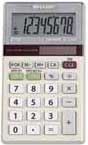 8-Digit Display Hand-Held Calculator by Sharp
Plug adapters are needed throughout Europe. There are at least five models used in different countries.
Note: The highlighted #E number is purely arbitrary. It is meant to help quickly identify products in this advert column when you write in for electrical advice.
See NOTE TO READERS.
This adapter is for the standard grounded plug in France, Germany, and northern Europe. It does not fit in outlets of Italy, Switzerland, Ireland, and Britain.
#E-010
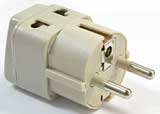 Grounded Universal 2 in 1 Plug Adapter
European Schuko plug.
4.8 mm prongs.
Equivalent to type E and F.
You can use this ungrounded Euro plug in some European countries.
#E-020
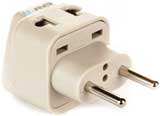 Universal 2 in 1 Plug Adapter
Euro Plug
4.0 mm prongs.
Equivalent to type C.
This is a universal plug adapter for the UK and Ireland.
#E-030
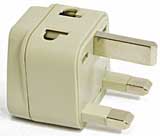 AC Adapter Plug for use in England, Scotland, Wales, and Ireland
Equivalent to type G.
Here is the Swiss version.
#E-040
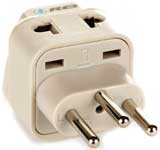 Grounded Universal 2 in 1 Plug Adapter
Type J for Switzerland
Here is the grounded Italian model.
#E-050
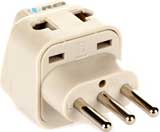 Grounded Universal 2 in 1 Plug Adapter
Type L for Italy
This 110-250 volt power surge strip has three universal outlets and an American grounded plug so it needs a plug adapter for the countries you are visiting. Make sure your gizmos are rated for 110-240 volts.
#E-060
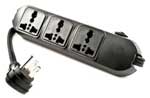 SM-60 Universal 3 Outlet Power Strip Surge Protector for Worldwide Travel. 110V-250V with Overload Protection.
If your gizmos charge through a USB port this can keep you going. European cars have the same 12 volt system as American cars.
#E-200
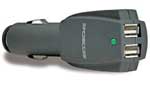 Scosche Dual USB
Car Charger Absolutely the best battery for digital cameras which use AA batteries.
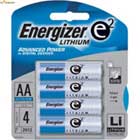 EnergizerAA Lithium Batteries4 Pack
This charger is good for worldwide voltage and comes with 4 pre-charged batteries. It requires a plug adapter for the countries you are visiting.
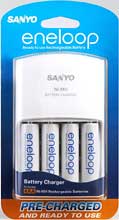 Sanyo SEC-MQN064 Eneloop 4 Pack AA NiMH Pre-Charged Rechargable Batteries with Worldwide 110-240 volt charger
This kit includes a pair of rechargeable batteries with a USB powered charger.
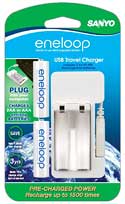 SANYO NEW 1500 eneloop 2-AA Ni-MH Pre-Charged Rechargeable Batteries w/ USB Charger
This is my favorite pocket size travel journal.
It is 5½"x3½"x½".
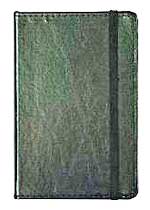 Markings by C.R. Gibson Brown Ruled Paper Bonded Leather Journal, Small (MJ3-4792)
For reading maps and other stuff with fine print.
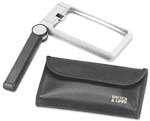 Bausch and Lomb 2X Folding Lighted Magnifier
A Swiss Army Knife is unquestionably the handiest item a traveler can carry, except not on a plane.
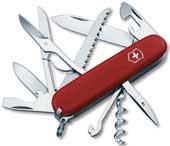 Victorinox Swiss Army Huntsman II Knife
My book will get you started.
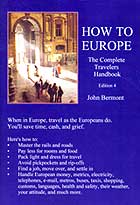 HOW TO EUROPE: The CompleteTravelers Handbook by John Bermont
The best travel guide to all of Europe.
 Europe on a Shoestring
Lonely Planet