European Rail Stations
Finding Your Way
Your station, platform, train, rail car, reserved seat. Crime, bicycle, luggage, toilet, diner, bar.

The departure board for international trains at the rail station Zuid/Midi in Brussels, Belgium shows trains departing for Paris, France, Köln (Cologne), Germany, London, England, Zurich, Switzerland, etc., etc. Doesn't this sign just get your blood running? You can go anywhere! My train was the second in line, the 10:40 Thalys to Paris Gare du Nord (North Train Station) departing from platform 6. The Thalys is a high speed TGV type train, and what a beautiful train. By the way, Brussels has three major train stations — Nord, Centraal/Centrale, and Zuid/Midi. Notice that everything has two names in Brussels, including the city, Bruxelles/Brussel, because the city is officially bi-lingual, Walloon (French) and Vlaanders (Dutch).
Carpe diem. Vivere bene! Gratia Deo.
Chapter 17 part 2 of
HOW TO EUROPE:
The Complete Travelers Handbook
John Bermont

This entire book is published totally free on-line by the author, photographer, and webmaster, yours truly, with help from my daughter Stephanie. I welcome all questions, comments, compliments, and complaints. For contact information please see NOTE TO READERS. Updated 21 November 2015.

Your Go-To Travel Store
Each station is unique.
This Internet edition of chapter 17 is divided into four parts because it is so big. The four parts are:
- Trains in Europe: A Rail Primer.
- European Rail Stations: Finding Your Way.
- Night Trains in Europe: Sleeping City to City.
- Boat and Bus: High Seas Ferry, Highway Coach .
Every train station has a rail track. Beyond that there is virtually no end to the variety of facilities provided and the configuration thereof.
GOING TO THE STATION
Find Your Station
Know which station your train departs from. Major cities usually have more than one. London and Paris have at least half a dozen stations but neither city has a "central station." Go over to your station the day before departure and do a little exploring. Some stations, especially in Spain and Italy, are poorly posted. The non-Latin alphabet in some of the eastern countries will give you pause. You don't want to be mad-dashing around, lugging your suitcase and working up a sweat trying to find your platform at the last minute, or after the last minute.
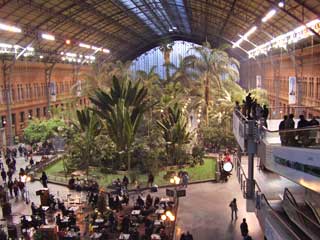
Madrid, Spain has two major train stations, Chamartin and Puerta de Atocha. This is the interior of the beautiful and unique Atocha. It looks more like a tropical garden, which much of it is. I took this photo from the terrace of the bar, an excellent place to wait if you are meeting someone in this station. Have a beverage and enjoy the view.
There are two basic designs for train stations. In the majority of stations the trains come in at one end and exit at the other end, straight through. In the rest of them, primarily in major cities, the trains come in and exit from the same direction. If you are continuing a trip through one of these stations you will need to change seats if you still want to face forward, or backward.
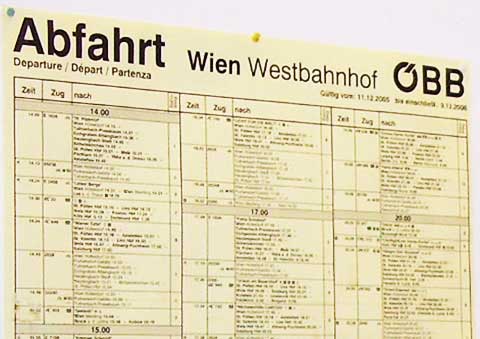
This Abfahrt (departure) poster at Westbahnhof in Wien, Österreich (West Train Station in Vienna, Austria) is translated into English, French, and Italian, except for the small print that really counts. Detailed departure information is usually posted on yellow or buff colored posters like this one in train stations throughout Europe. The columns from the left give you the Zeit (time), Zug (train number and type), Nach (destination and intermediate stops), and track/platform number. A similar poster, though white, for arrivals is posted nearby. Unfortunately the best rail timetable, the Thomas Cook European Rail Timetable, discontinued publication in August 2013.
Find Your Train
As you enter major train stations you will usually see a large airport style departure board hanging about a mile high in the main hall. Scattered around on the station walls will be poster size schedules of departing trains. Smaller stations usually have only the posters. Locating your train is most easily done by using departure time and destination, rather than by train number. The track or platform number will be with the train identification information, though you will not see the word "track" or platform. It will be the local name, e.g. voi, spoor, etc.
Sometimes, while you are standing on a platform, everybody around you grabs their bags and starts trotting toward the exit stairs. They probably just heard an announcement over the public address system saying that there has been a change and your train will depart from another platform. Quickly find a conductor and ask for help. Failing that, ask one of the local citizens in the migrating herd. You are bound to find an English speaker very quickly.
Find Your Wagon
Platforms in major stations of some countries have boards showing the complete assemblage of each train. The train number, departure time, and destination are shown, followed by an outline of the train with engine, first class cars, second class cars, diner, mail, etc., in the same order as on the train. An indicator on the board shows where the board is located relative to the train when it stops. In Germany there are also zones A, B, C, D on the board and above the platform to further help you find your car. The car location board also shows the car numbers. You can be standing next to your car when it stops and not have to haul your luggage through the narrow, crowded passageways of several other cars.
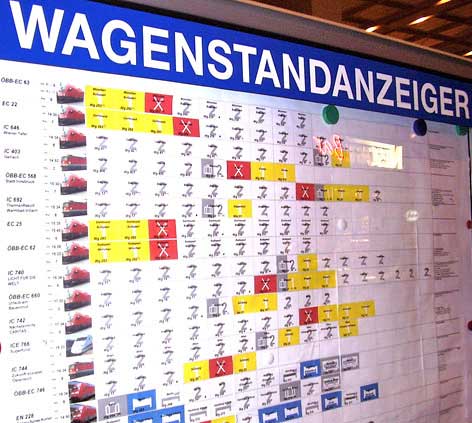
The Wagenstandanzeiger is literally the "rail car position indicator," auf Deutsch (in German). This is a typical one at Westbahnhof in Wien showing you where to find the 1st class (yellow with number 1), 2nd class (white with number 2), sleeper (blue with bed), and restaurant wagons (red with crossed knife and fork). It shows train type and train number, times for arrivals and departures, car numbers, and the destination for each car. The little green puck at the top shows where this board is located relative to the stopping positions of the rail wagons. If you have a reservation stand by your car. A couple of those overnight trains even allow autos on board. That can save you time and trouble, but will not be cheap. Click on the picture to see it in greater detail.
These boards are not evident in some countries. Often, track numbers are not even posted in Spain and Portugal and you must ask at a ticket window where to go to get on your train.
In Italy, car locations are stated on the yellow departure posters, Treni in Partenza. They tell you where the first class cars are located: testa (front), centro (middle), coda (rear), verso testa (toward the front) or verso coda (toward the rear) is about as descriptive as it gets.
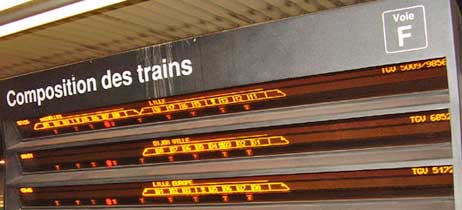
Here is the Composition des trains board for departures from platform F at Marseilles, France. The red dot indicates the approximate position of this board relative to the stopping positions of the voitures. All pertinent information about the train is shown: departure time, train number, and destination, number, class of service for each car, and type of train. On this platform all trains are TGV type, the high speed trains of France.
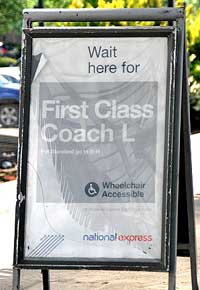
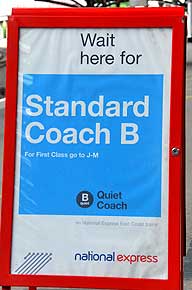
The train station in York, England has signs like these placed along the platform. Coaches are identified by letter, not numbers as on the Continent. If you have a reservation, walk along the platform until you find the sign for your car. In a "Quiet Coach" cell phones are prohibited.
If the train is originating in your city it will probably be in position long before departure time. Get to the station a half hour early, get on board, and pick a good seat. If the train is passing through, get there early enough to locate the track, eyeball the board giving the Composition des Trains, and position yourself near the designated stopping point for a first or second class car (as your case may be) going your way. If there is no board showing car locations, ask a conductor on the platform or at the station master's office before the train arrives.
Double check to make sure you are boarding the correct car. Almost all cars have a signboard near the door, either outside and/or inside, showing the car number and origin and destination of that particular car. Some will have a sheet of paper with the destination taped to a window and visible from outside.
Just because a car is sitting on the track from which your train departs does not mean that it is going your way, or that it is going all the way, or that it is going at all. Trains are split and portions are sent in different directions along the way. Sometimes the first few cars nearest the main hall are not even attached to the train. If there are no signs on the cars, go to the head of the train and ask a conductor or engineer. Just point to the train and ask "Madrid?" or whatever city you are bound for.
Find Your Seat
When the train stops, move quickly to a door and scramble on board, not waiting for other travelers hauling six oversized suitcases up the narrow steps. Get a seat, stash your bags on the overhead rack, spread out, and don't budge until the train has pulled out of the station and the seat grabbing flurry has settled down.
If it's night and you want to sleep but have not reserved a bunk, get in an empty compartment if available, pull the seats down, turn off the lights, and pull the curtains closed. This discourages other travelers from intruding into "your" compartment and cramping your sleeping style. However, don't hesitate to open the door and pull back the curtains of other compartments at any time. Often you'll find one person comfortably occupying a curtained compartment while five may be stuffed in the next one. Park yourself where you will have the most comfort.
Try to get a seat on the shady side of day trains. On the shady side the sun is not glaring on your window, perhaps giving you a sunburn, and it's much easier to see out and photograph the countryside. Don't immediately sit down on the shady side though. When the train leaves it might toot toot north for a few minutes and then head south. Know your route and which way the train is going. Sit on the north side of east/west trains, the west side of morning trains, and the east side of afternoon trains.
When you get settled, make a note of your car number and seat number so if you forget something it will be much easier to find it or report it. I saw one worried man telling the conductor that his coat and luggage were stolen while he was in the restaurant wagon. He was simply looking in the wrong car, which the conductor pointed out after looking at the passenger's reservation receipt.
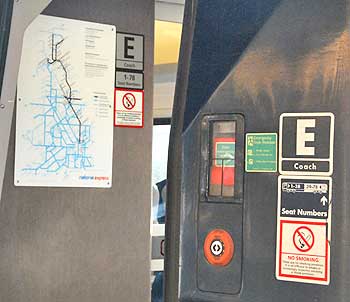
England's National Express posts seat numbers at the door. The big letter E is the car number. There is also a map of the system as you enter. No smoking has become nearly universal in Europe. Maybe they'll just stop posting it in a generation.
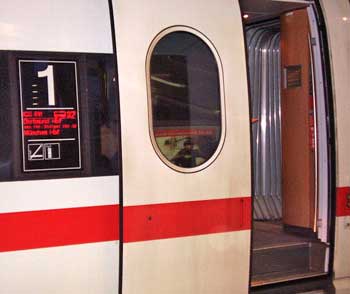
The sign next to the door of a wagon on a German ICE, InterCity Express, gives you the particulars of this car. The big number 1 tells you that it is a first class car. For the rest see the next photo.
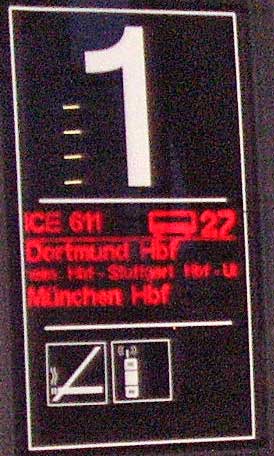
The sign next to the door in the previous photo is too small to read, and fuzzed up because it is an LED display. It reads that this is car 27 on ICE 611 from Dortmund Hbf to Munich Hbf. Smoking is not allowed but those pesky cell phones are OK. I'd rather have a fly on my nose than one of those within earshot. Hbf is something you will see fairly often in Germany. It means Hauptbahnhof, the main train station in that city. Many German trains stop at Flughafen. Those are airports.
ON THE TRAIN
Smoke Zone
The smoking situation has really changed in Europe over the past decade. Indoor smoking is now forbidden or severely restricted in most countries. Where smoking is allowed, train cars are divided into smoking sections and non-smoking sections. Sometimes the whole car is nonsmoking. Sometimes the whole train is non-smoking, as in Italy. My train tickets in Germany even had a notice that smoking is forbidden on all trains in Italy. Smoking is prohibited almost everywhere in Spain, France, Holland, and other countries. I am an ex-smoker and really appreciate this. Nonsmoking is always posted, and smoking usually is.
In addition to the multilingual notices, look for the cigarette symbol with or without a line through it. A cigarette symbol is usually posted at each door, and again in the car. Cigars and pipes are allowed, and common if you are in a smoking section. Be prepared for beaucoup plenty of smoke. When requesting your reservation, specify non-smoking or smoking.
You can sit in non-smoking and then go to the smoking area when you want to puff. Even smokers get burning eyes if they sit in that haze too long. If you want to relocate to another seat after getting on the train, just do it as long as your chosen seat is not reserved.
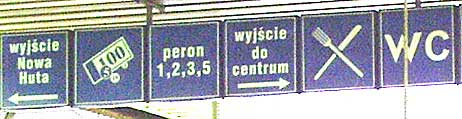
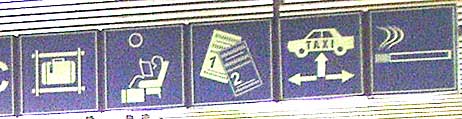
A typical train station tell-you-where-it-is board, courtesy of the Krakow, Poland station. To the left is an exit to Nowa Huta, money exchange, and platforms/tracks 1, 2, 3, 5. To the right are exit to the center of the city, restaurant, and toilets. In the next photo is the continuation of the sign showing luggage storage, waiting room, ticket windows, taxi stands, and the smoking zone. Pretty easy, huh? These modern day hieroglyphics are used throughout Europe, an almost nation with about four dozen languages. It is interesting that so much communication these days uses the oldest form of writing known, pictures. Everybody knows this language.
Luggage
Luggage can sometimes be checked, but almost everybody carries theirs on board. The only exception I ever saw was a Saudi princess who, with her 20 servants, filled an entire baggage car with their stuff.
There are one or two luggage racks above the seats which easily hold any bag which you can carry on a plane, plus a smaller bag. Can you lift your luggage and put it on a narrow ledge six feet above the floor? If not leave it on the floor.
The newer airline-style coaches operated on some trains, especially the premium trains, have luggage compartments near the doors in addition to luggage space above the seats. Some have space for a bag between back-to-back seats. I prefer to keep my goods close at hand. If you leave your luggage in a luggage area near a door keep your eye on it when the train is making a stop. Never leave any valuables in your luggage.
The need to pack light has been discussed in other chapters on this website. Traveling by train in Europe is not like driving your SUV out on vacation in the USA. With an SUV you can make ten trips from your house to your SUV carrying your maximum load. You can take an hour or more, and have a lunch break when you need to take a rest. I cannot emphasize enough, especially for first time visitors to Europe, that the stuff you pack is the stuff you carry — in airports, train stations, streets, up stairs, and everywhere. You are the burro, hee haw. So pack light. My Pack Light Field Test will let you know if you have packed light. See chapter 7, Luggage for Europe: Let It Roll for information on luggage and a link to the Pack Light Field Test in chapter 5. Do not fail.
For photos of luggage storage on trains see the first part of this chapter, Trains in Europe: Guide to Train Travel in Europe.
Bicycles
Many people, locals and tourists, bring a bicycle on the train. I've done this a few times in Holland. If there are not many people on board you can stand with your bike in the entryway area of any car, so try to avoid the rush hours. However you must pay to bring your bike aboard. The fee is rather steep, especially if you are making a short one-way run. The pay period runs from midnight to midnight so it would be worthwhile to do this if you wanted to take a day trip on the train to ride around another city in Holland. The Hague is a beautiful city for bike riding. If you have a fold-up bike it has a free ride, but those little things cost a small fortune.
For an excellent discussion of bringing your bike on trains go to the web site of Brian Wasson at Bikes on trains in Germany, Austria and Czech Republic. The first-hand details in this report will save you time and plenty of anxiety. You'll be an expert before you get there.
Windows
On most of the older trains, you can pull the window down for a better look and a breath of fresh air. Newer cars are air conditioned and have sealed windows.
Windows have blinds. Some are like curtains, some are like shades, and some cars have manual or electric venetian blinds between the inner and outer sealed windows. Play with them for a minute to see how they work.
Newspaper
Carry a newspaper or magazine. Put it on your seat while you are in the dining car, the toilet, or just roaming around. This will discourage others from rearranging themselves into your window seat. A newspaper is also handy for relaxing your feet. Put it on the seat opposite and prop up your leathers. Otherwise you must take your shoes off, which could spoil the appetite of others nearby.
Plumbing
Functioning toilet and hand wash facilities are found on virtually every train. The unisex toilet is at the end and has a locking door. Bring your own butt wipes or tissues because you never know if there will be TP in the WC. Floor pedals, levers, or push buttons activate the flush and basin water. The basin water is nonpotable. Do not drink it or brush your teeth with it.
Use of the toilets is normally forbidden while the train is stopped in a station. The reason is that they flush right down onto the tracks. Stations would soon start smelling like construction site porta potties. Some of the newer premium trains have enclosed sanitary systems so toilets can be used at any time. Check to see if there is a notice in the toilet advising against use in a train station.
On some trains in Spain, the toilets are locked at the origin until the train is out of the station. When the conductor comes around to check tickets, which could be a half hour later, he unlocks the toilets. Don't drink coffee until the toilets are unlocked.
There is usually a 220 volt electric shaver outlet. See chapter 11, Electricity in Europe, to get juiced up on electro info for Europe.
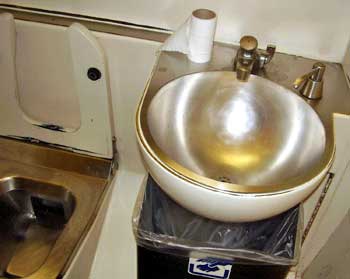
Here is a typical throne and wash basin on a train. Hey, it even has TP! Well, it has a little bit of TP. Always bring your own in your day bag, and bring your day bag with you to the toilet. There is slightly more room in here than there is in an airplane toilet. Do not use the train pottie while the train is in a station. That is forbidden.
Crime
Keep your seat and keep your eye on your luggage while the train is in a station. Keep your hands on your laptop or keep it hidden. Professional thieves loiter on some platforms, board trains, walk through the cars, grab what they can, and jump off just before departure.
Keep your valuables under your control at all times. Elizabeth had her purse rifled while we slept on an overnight train from Venice to Vienna, probably by a fellow passenger. A friend of mine went to the toilet and had his cash and camera taken out of his bag by a new-found "friend" on a French train. Never leave money or valuables in your bag anytime anywhere anyway.
Laptop computers are targeted by criminals, especially on airport commuter trains. The common modus operandi is to stage a distraction as the passenger is getting on the train or is in the process of stowing luggage on the overhead rack. Any bag that is not being held is fair game. The criminals grab and jump off the train just as the doors are closing.
I have heard reports of other problems, including a bizarre story of a couple who were offered oranges by some other travelers on a train in Portugal. They ate the oranges and the next thing they remember was waking up with no wallets and no luggage. At least twice I have heard the story of a gang which operates on trains from Milan. They open the train compartment door, mace the passengers, and grab their wallets and suitcases.
As discussed in other parts of this book, do not stand out as wealthy or as an American. If you do you are making yourself a tasty target for the vermin. Most Americans are open and trusting by nature and are the easiest pickings on the street. Orientals should be aware that pickpocket professionals know that you are likely to be carrying a large quantity of cash. It's part of your culture. Less cash and more credit cards would be advisable when traveling in Europe.
Please see chapter 8, Cash, ATMs, Credit Cards, for more examples of the underworld at work, and sure-fire means of defense against these lowlifes.
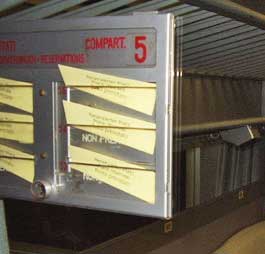
This is a plexiglass bracket designed to hold reservation cards. You'll see it on the window facing the corridor of train compartments. All of the seats in this compartment are reserved for at least part of the journey, though none was occupied at the time I came on board this train from Geneva, Switzerland to Milan, Italy. This is compartment 5 in which you'll find seats 51 through 56. Put your luggage up on that rack inside the compartment. When on a train, and always for that matter, make sure that your passport and other valuables are NOT IN YOUR LUGGAGE.
Seat Reservation Card
Never sit in a seat displaying a reservation card, unless it's yours. However if the reservation card indicates that the seat is reserved from say Karlsruhe to Frankfurt, and you are going from Basel to Karlsruhe, just help yourself to the seat. The reservation card will be attached to the seat, or be in a holder on the outside of the compartment. On those reservation only trains in Sweden and Norway, though, reservation cards are not evident. Ask the conductor if there is a seat available. On a train with reservation cards, all seats without a card are available. First come, first served.
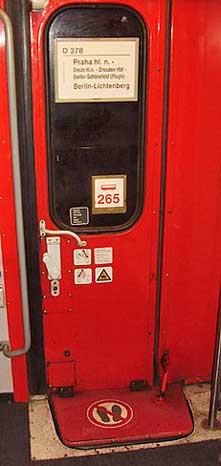
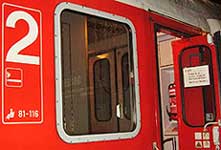
On the right is the outer door area of a car ready to go from Prague to Berlin Lichtenberg station, with stops in Decin, Dresden Hbf (where I got off), and at Berlin Schönefeld airport. Seats 81 through 116 are at this end of the car. The cigarette symbol indicates that smoking is allowed.
The photo at left is from the inside showing the handle you push down to open the door. The warning on the floor in front of the door is serious. I was standing on the top step when the door suddenly closed and this thing flipped down on top of my feet. The car number, 265, should be prominently displayed on the outside of the car. The hl.n. is hlavni nadrazi (main station). Flugh is short for Flughafen. D378 is the train number.
If someone claims that you are in their reserved seat (though the seat does not have a reservation card), politely ask to see his/her reservation receipt and make sure to check the car number. The car number will be posted in large numbers on the outside and/or inside of the car near the door and it will be indicated on the reservation receipt. Being in the wrong car is the most common mistake made by people with reservations. The reservation system is computerized, and it works better than you would expect. Request a window seat if you want it.
Seat Numbers
Seat numbers in compartments vary from country to country. The numbers may be in sequence from the door or from the window and may have odds and evens on opposite sides. Numbers normally start with 11, 21, 31, etc. in each compartment, but you can find some like 1, 2, 4 opposite 5, 6, 8 and other combinations around Europe.
Back and Forth
Train cars travel in both directions. With a reserved seat, you are just as likely to be traveling forward as backward. In those stations where the train comes and goes at the same end of the station a new engine will be attached to the former rear and the train will take off. On one train in Spain when it reversed in a station, the passengers got up, pushed a lever at the base of each seat, and rotated all the seats so they faced forward. This feature was unique. I've never seen it on any other train.
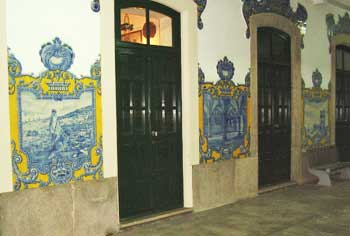
Even if you aren't using the trains, many stations in Portugal are worth a visit just to see the azulejos (tiles) on the walls. This is at Vilar Formoso. I was traveling on a night train from San Sebastian (Donostia) Spain to Lisboa Portugal.
EATING ON TRAINS
Dine Well
At the moment of writing this on a TEE (Trans-Europe Express) train from Amsterdam to Paris many years ago, the head waiter has just come through the car, suitably attired with menu in hand. He announced the first sitting, speaking in French. You do parlay the fransay, don't you? Immediately the stampede to the dining car started. Late arrivals do not get much attention. If you wish to eat, get up and get moving with the locals. American deference, courtesy, and service are pretty rare in Europe.
TEE trains were exclusively first class. TEE trains don't exist anymore and my nostalgia for a by-gone era will never be cured. On the successors to the TEE, the InterCity, TGV, ICE, and others, the dining cars are very nice and the food is generally very good, though it costs more than in a normal restaurant. Dining is pleasant on these trains. It's a good way to pass the travel hours and presents opportunities to meet others. Most eaters are European businessmen or relatively well-to-do Europeans. Occasionally a few drops of wine may splash out of your glass, thanks to rough tracks. The new generation of high speed trains carries both first and second class cars so everybody can get there faster.
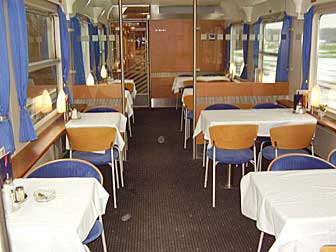
Breakfast was served in my compartment on the overnight Fulda, Germany to Copenhagen, Denmark train. Later I went for a coffee in the diner. It cost €2.70, equal to about $3.25, for one cup of coffee. Ouch!! Most of the dining cars I have been in are much better appointed than this one.
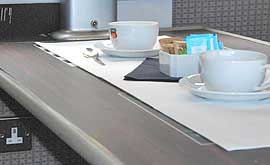
Everywhere you go in Britain you see cups, tea, and sugar set up and ready for hot water. These are on the National Express train from Edinburgh, Scotland to York, England. That upside down T under the table is a British electrical outlet. Before you use it read chapter 11, Electricity in Europe.
If you intend to have dinner on the train make sure that there is a dining car. Consult a timetable and look for a crossed knife and fork. For example, I was expecting a nice meal on a TGV train in eastern France one Sunday evening and asked the conductor where the dining car is located. The conductor replied that the dining car only ran on weekdays. Weekenders are served from a small bar and can get a croque monsieur or pizza. I was severly disappointed.
One of my most pleasant European diners was on an IC coming down along the Rhine River from Essen en route to Frankfurt. Not only was the meal great, but the moving scenery along the river is outstanding. Utterly relaxing.
Before boarding inspect the train composition board to locate the diner. It is often placed between the 2nd class and 1st class cars. On some trains, the head waiter will accept reservations for a seat in the dining car. Ask as soon as possible. Specify nonsmoking or smoking for your comfort, if smoking is allowed. National laws throughout Europe have just about eliminated smoking everywhere.
Cart Service
If there is no diner car or snack bar, a waiter pushes a cart through the trains except on local commuters. Food and drink are sold on virtually all of the international trains and on most other long distance trains. Selections are normally limited to coffee, milk, beer, wine, soft drinks, yogurt, cold sandwiches, and sausages which resemble hot dogs. Service is available for only part of a journey, even though the attendant is on board for the duration of the trip. However even though there is cart service, the "service" may be less than you expect. I saw a young man push his cart into the far end of a car I was in and then he had a call on his cell phone. He stopped right there for half an hour talking his important business while the customers in the car watched the dork. Fortunately I had brought my own beer on board.
Service at Your Seat
Diner can be served at your seat on some trains. On a Talgo in Spain the head waiter came through the car at about noon to see who would like to have lunch. I volunteered. An hour later he put a tray on my seat similar to those on some airplanes. Then followed a delicious fish with pimentos, a pork chop, peas, a half bottle of vino tinto (red wine - very good, but the train shook up the sediment), roll, sweet roll, banana, and coffee. Total cost for a great meal was about the same as you would pay in a restaurant at home.
Brown Bag It
Budget travelers, including most Europeans and usually me, bring a sack of ham, cheese, rolls, fruit, and beer or wine on board and fix dinner at their seat. Do the same. There is often a mini market in or near the station with much better selection and prices than on the train. Can your trash. The symbol on the window of all trains, with windows that can open, means "Do not throw bottles out the window." Don't throw anything out the window. Don't stick your head out the window either, unless there is nothing in it.
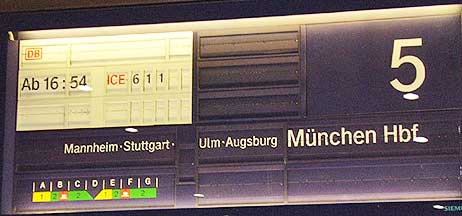
This sign for the DB, Deutsche Bahn, (German Rail) train at the Frankfurt Flughafen (airport) train station shows the continuing route. The train started in Dortmund, not indicated here, made stops in several cities on the Rhein and stops further in Mannheim, Stuttgart, Ulm, and Augsburg on its way to München Hauptbahnhof (Munich main train station). The scale A through G indicates where the first class (yellow), second class (green), and bar/diner (red) cars are located relative to the corresponding zones on the platform, in this case platform 5. This is a sleek ICE, InterCityExpress, train number 611, requiring a supplemental fee if you have a regular ticket but no supplement is required for Eurailpass holders. Seat reservations are not required because the reservation indicator R is not shown, as is the case with 99% of the trains in Germany. Ab (departure) is 16:54 which is 4:54 PM. Don't be late because only trains can do that, and they do that even in Germany.
MOVING ON
This page is the second of the four parts of chapter 17. There is more as listed below.
- Trains in Europe: A Rail Primer.
- European Rail Stations: Finding Your Way.
- Night Trains in Europe: Sleeping City to City.
- Boat and Bus: High Seas Ferry, Highway Coach .
Have a good trip!
NOTE TO READERS
I welcome questions and comments. If you have any concerns about your trip to Europe that have not been covered well enough in this section please do not hesitate to write and ask. When you write please include relevant details, per the folowing paragraphs.
I do not open attachments. I do not click links to web pages of any kind. I will reply in a day or two, usually.
Do not forget to smell the hyacinths. At your liesure scroll through the Table of Contents of How To Europe: The Complete Travelers Handbook and read all 30 chapters, FREE on line. Good deal! You'll probably find the answers you seek, and some you didn't know you needed.
My email address is [email protected].
FREE
This web site is totally free for everyone, and a labor of love for me. To keep it afloat I receive a commission from Amazon.com for all goods purchased through the adverts I have selected, and any other products you might buy when you are on the Amazon site. Amazon has almost everything for sale, except the Brooklyn Bridge and Mount Rushmore.
Please visit my on-line store at
 .
Your support is most gratefuly appreciated. TIA.
.
Your support is most gratefuly appreciated. TIA.
To like and like not:


Adverts
To support this site:
Please buy your goods at:Amazon.com
Shop in your shorts!
Please clean out your cookie jar before clicking.
This rail timetable is produced by the compilers of the former Thomas Cook European Rail Timetable, my bible for decades of train travel in Europe.
 European Rail Timetable
Summer 2015
 Europe by Rail:
The Definitive Guide for Independent Travellers
Thomas Cook Rail Guides
 Europe by Eurail 2015:
Touring Europe by Train
by Laverne Ferguson-Kosinski
 Rail Map of Europe
The best travel guide to all of Europe.
 Europe on a Shoestring
Lonely Planet
A comprehensive guide to 3,000 hotels and restaurants in 44 major cities throughout Europe, in English. Separate books in the Michelin Red series cover individual countries in greater detail. This is a must have for frequent travelers.
 Main Cities of Europe 2015
Michelin Guide
This is my book, available at Amazon.com. The last edition was published in 2003. Critical up-dates are on this web site.
 How To Europe
The Complete
Travelers Handbook
by John Bermont
Keep a travel journal, so you can write your own travel book. This is my favorite pocket size note book.
It is 5½"x3½"x½".
Markings by C.R. Gibson Brown Ruled Paper Bonded Leather Journal, Small (MJ3-4792)
Rolling luggage sure beats lugging a pack on your back.
 Travelpro Luggage Maxlite 2 20" Expandable Spinner
A shoulder bag for your daily walk-about.
 Travelpro Luggage Maxlite3 Soft Tote
Keep your stuff organized.

Luggage Packing Cubes
eBags 3pc Set
The two gallon size is excellent for packing your clothes, but it is hard to find in Europe.
 Two gallon plastic bags
ZipLoc by SC Johnson
Inconspicuously lock your zippered luggage with a black wire tie.
 Cables to Go 43036 Cable Ties - 100 Pack (Black)
A Swiss Army Knife is unquestionably the handiest item a traveler can carry, except not on a plane.
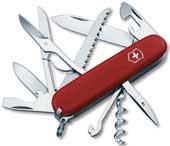 Victorinox Swiss Army Huntsman II Knife
 Anne Klein Women's Classic Double-Breasted Coat
 Hot Chillys Women's Peach Skins Solid T-Neck Shirt
Plug adapters are needed throughout Europe. There are at least five models used in different countries.
Note: The highlighted #E number is purely arbitrary. It is meant to help quickly identify products in this advert column when you write in for electrical advice.
See NOTE TO READERS.
This adapter is for the standard grounded plug in France, Germany, and northern Europe. It does not fit in outlets of Italy, Switzerland, Ireland, and Britain.
#E-010
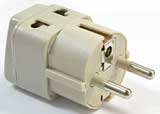 Grounded Universal 2 in 1 Plug Adapter
European Schuko plug.
4.8 mm prongs.
Equivalent to type E and F.
You can use this ungrounded Euro plug in some European countries.
#E-020
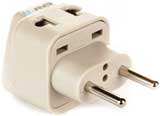 Universal 2 in 1 Plug Adapter
Euro Plug
4.0 mm prongs.
Equivalent to type C.
This is a universal plug adapter for the UK and Ireland.
#E-030
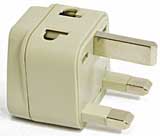 AC Adapter Plug for use in England, Scotland, Wales, and Ireland
Equivalent to type G.
Here is the Swiss version.
#E-040
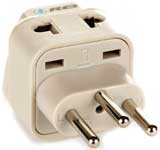 Grounded Universal 2 in 1 Plug Adapter
Type J for Switzerland
Here is the grounded Italian model.
#E-050
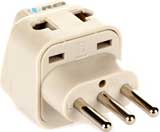 Grounded Universal 2 in 1 Plug Adapter
Type L for Italy
This 110-250 volt power surge strip has three universal outlets and an American grounded plug so it needs a plug adapter for the countries you are visiting. Make sure your gizmos are rated for 110-240 volts.
#E-060
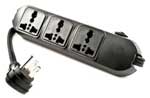 SM-60 Universal 3 Outlet Power Strip Surge Protector for Worldwide Travel. 110V-250V with Overload Protection.
The links in this pink field take you directly to a page at Amazon.com. The Amazon page details the item, and in most cases includes candid and critical comments from others who have bought the item.
Amazon pays my site a small commission when you click and order an item, if you put it in your shopping cart within 24 hours based on the cookie they set on your computer. If you don't want to make a quick decision just put it in your shopping cart, think it over, and come back later. The revenue covers the cost of maintaing this web site and keeps it free to users.
You benefit when buying here because Amazon has:
- 20% - 30% discount on many items,
- free shipping deals, direct to your door,
- no sales tax on internet purchases in most states,
- zillions of products, well almost,
- fast delivery even when it is free,
- shipment tracking in UPS, USPS, FedEx,
- easy returns if you are not happy with the product.
You win we win. Thanks for your support!!
Have a good trip in life,
John Bermont
Note: Italicized notations by the author.
For small appliances travelers may find these true transformers useful. They deliver the full sine wave. Caution: The wattage rating is the max short term. For continuous duty I recommend that you select a transformer rated at two times the combined watts of all gizmos plugged it. But check your gizmo's electrical specification plate before buying one of these. Most electronic devices are dual voltage and can be plugged in any European outlet when using the appropriate plug adapter.
This 50 watt 220/110 volt step down transformer is good for very small 110 volt appliances and light duty chargers.
#E-070
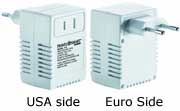 Travel Smart by Conair 50-Watt International Transformer
Wear a money belt under your shirt to protect your passport and valuables, especially if you are staying in hostels or dorms.
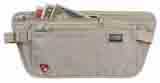 Lewis N. Clark RFID Blocking Waist Stash
An RFID blocking wallet protects your passport and credit cards from identity theft in public places.
 Travelon RFID Blocking Passport Case
Rolling luggage sure beats lugging a pack on your back.
Travelpro Luggage Maxlite 2 20" Expandable Spinner
A shoulder bag for your daily walk-about.
Travelpro Luggage Maxlite3 Soft Tote
Keep your stuff organized.
Luggage Packing Cubes
eBags 3pc Set
The two gallon size is excellent for packing your clothes, but it is hard to find in Europe.
Two gallon plastic bagsZipLoc by SC Johnson
Inconspicuously lock your zippered luggage with a black wire tie.
Cables to Go 43036 Cable Ties - 100 Pack (Black)
A Swiss Army Knife is unquestionably the handiest item a traveler can carry, except not on a plane.
Victorinox Swiss Army Huntsman II Knife
This adapter is for the standard grounded plug in France, Germany, and northern Europe. It does not fit in outlets of Italy, Switzerland, Ireland, and Britain.
#E-010
Grounded Universal 2 in 1 Plug Adapter
European Schuko plug.
4.8 mm prongs.
Equivalent to type E and F.
You can use this ungrounded Euro plug in some European countries.
#E-020
Universal 2 in 1 Plug Adapter
Euro Plug
4.0 mm prongs.
Equivalent to type C.
This is a universal plug adapter for the UK and Ireland.
#E-030
AC Adapter Plug for use in England, Scotland, Wales, and Ireland
Equivalent to type G.
Here is the Swiss version.
#E-040
Grounded Universal 2 in 1 Plug Adapter
Type J for Switzerland
Here is the grounded Italian model.
#E-050
Grounded Universal 2 in 1 Plug Adapter
Type L for Italy
This rail timetable is produced by the compilers of the former Thomas Cook European Rail Timetable, my bible for decades of train travel in Europe.
European Rail TimetableSummer 2015