Best Luggage for Europe
Get Wheels and Let It Roll!
Luggage, backpacks, carry-on bags, wheeled luggage, TSA, locks, security.
 Your Go-To Travel Store

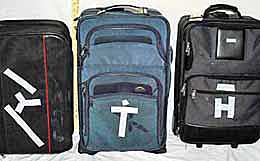
Brand your bag. So many bags look alike these days that it pays to "brand" yours. Here are my "Double Slant Y", "Dotted T", and "Bar H" — all visible at 100 yards in a busy airport.
Maybe this looks crazy. It works. Put your mark on both sides. Strapping tape is highly reflective. Be creative.
Normally I use my "Bar H" bag. That baby includes wheels and handle. Gotta have wheels. Else, why did some genius invent the wheel thousands of years ago. Nobody ever mentions the other genius — the guy who invented the handle. Meanwhile, some donkeys scorn the tree of knowledge and still pack their load on their back. How does it feel?
Carpe diem. Vivere bene! Gratia Deo.

This is chapter 7. The entire book is published free on-line by the DIY traveler, author, photographer, and webmaster —yours truly— with help from my daughter Stephanie and good friend Paula in Haarlem, Nord Holland, Netherlands. Questions, comments, complaints, and contributions are welcome. Please click footnote. Patronage at my euro-shoppe™ keeps this site on line. Updated .
Don't be a burro.
PACK LIGHT
This is a guide to practical luggage for traveling in Europe.
Closely related subject matter is at:
- Chapter 5. What To Wear in Europe: Your Best Travel Clothes for Every Occasion.
- Chapter 6. Pack Light Field Test: Validating Your Europe Packing List.
- The Mother Of All Packing Lists. Last Call: Travel Prep and Pack Lists for Europe.
LUGGAGE VERSUS THE AIRLINES
The first stop for you and your luggage is going to be the airline check-in counter. Here you will see the initial rewards of packing light. Traveling with only carry-on luggage eliminates the hassle of standing in line at baggage check-in.
Your disposition at the other end of your flight is the real payoff for those who do not check luggage. If you do not check any luggage, you don't have to wait a half hour for the carrousel to deliver your bag on arrival. Your luggage does not get mutilated by man and machine. It doesn't get lost (funny how bags often take free rides all over the world, or no ride at all). You don't want to wait a day or two on arrival in Europe for your luggage to be found and delivered, perhaps interrupting plans and forcing you to change onward reservations.
These things have all happened to gazillions of travelers and have cumulatively caused untold centuries of grief. Even though it might sound like it, don't think that airline people are bad — they're just human.
Other pack light advantages for those who do not check luggage are to be pronto in line at customs and first out of the terminal. Then you're at the head of the line for train tickets, taxis, buses, car rental, hotel space, ATMs, and other amenities. When 300 passengers get off a jumbo jet there are long lines everywhere.
CARRY ON LUGGAGE
Carry-On Luggage is also called Cabin Baggage.
Pack Light
When following the rule of pack light, all that a traveler has is one carry-on bag. Typically the maximum allowable size is 22"x14"x9". Check with your airline for their exact dimensions. The general rule is that the total linear dimensions may not exceed 45". The fundamental requirement is that your luggage must fit in the overhead bin. You can also stow it under the seat in front of you but then you have very little room for your feet.
In actuality, carry-on used to be whatever you could talk and walk your way on board with, especially for the return trip. Those were the old ways. Airlines have started enforcing the rules very strictly, especially certain European airlines. Bins at the check-in counters and/or cutouts on the security belt machines have been installed to verify the size of suitcases going on board with you. If your bag doesn't fit in the bin or through the cutout you must check it. Have your wallet ready. Checked luggage is a major revenue source for the airlines. If you happen to get an oversized bag on board, you could find that the overhead bin has a standard 9" opening, whereupon you do have a problem.
Gate Check
And if you sneak past the check-in counter with an extra bag you will probably be stopped at the gate and requested to check one of them. This is common. I see a row of gate-checked bags almost every time I board a plane. You might as well get it right the first time at check-in or the airline will get it right at the gate. Have your wallet ready.
If you are flying a small regional plane to your international departure airport there might not be enough space for your otherwise permitted carry-on. In this case the flight attendants at the plane door will ask you to have it checked there at the door. You will have to reclaim it at the international departure airport and may need to clear security again. But you should not have to pay the checked luggage fee, which could be as much as $100 for some airlines.
Carry On Weight Limit
Airlines have various rules on the maximum weight allowed for carry-on luggage. This is not much of a concern when flying across the Atlantic but if you have a connection within Europe it could be an issue. The limits are lower and it is a virtual certainty that your carry-on luggage will be weighed when you are flying within Europe. Excess weight will cost you, excessively. Have your wallet ready.
Ask your travel agent or airline for cabin luggage restrictions within Europe. You can probably find your airline web site on my page at Airlines for Travel to Europe: TRAVELERS YELLOW PAGES. Locate your airline and find the section on luggage to get specifics for your flight. First class passengers get to bring more stuff on board than us bovines stuffed in the back of the bird.

After waiting in the airport for a couple of hours you are allowed to board. You find your row and seat and then look skyward. This is the overhead luggage bin, about 6 feet up. The illustrated instruction says to tip your bag to the short edge to conserve space. The little black notice advises that the maximum capacity of this bin is 95lb/43kg. Since this bin serves 6 passengers, do the math. It is always good to get on the plane at the earliest chance for your class of service to improve your chance finding a bin near your seat. That's my Cardinal ball cap.
3-1-1 Liquids Rule
Starting in August 2006 the Transportation Safety Administration, the "TSA" for short, now prohibits all but sample size bottles of liquids and gels in carry-on luggage. The major exceptions are baby milk, if you are traveling with a baby, and prescription medicines that you need during the flight. There are other TSA provisions regarding weapons and anything that could be used as a weapon, e.g., certain sports equipment. Each airline has additional slightly different provisions, some of which depend on your class of service. Check with your airline if you want to bring anything unusual on the plane, you know, stuff like the starter cannon for your yacht race.
In summary, you are allowed to bring a one liter/quart size zip type clear plastic bag with as many 100 ml or 3.4oz bottles of whatever will fit in the zip bag. When I was still drinking I would fill my zip bag with airline size, 50 ml, bottles of Crown Royal Black, for emergency use only of course. Read the full 3-1-1 story on the TSA site at 3-1-1 Liquids Rule. By the way, unlimited free booze, beer, and wine is still served on international flights in all classes of most airlines.
IATA Cabin OK
The International Air Transport Association, also known as the IATA, bills itself with the statement "Our mission is to represent, lead, and serve the airline industry." It exercises its mission through a number of standards and policies, some of which are mandatory for airline members and others are advisory.
On 9 June 2015 the IATA issued a press bulletin touting a new proposed standard named "IATA Cabin OK." This standard would change the size of allowed carry-on luggage. The size was to be reduced, and reduced just enough that 99% of passengers would have to buy new carry-on luggage. The reason given was rather specious, to put it kindly. There was an uproar.
Eight days later the IATA issued a press release titled "IATA Pauses Rollout of Cabin OK to Reassess Initiative." They backed off without taking blame for their dishonest justification of the new rule. But they took a swipe at you-know-who for raising hell. IATA said "While many welcomed the Cabin OK initiative, significant concerns were expressed in North America."
Actually airline acceptance of the new rule was milky at best. But Tumi, a luxury luggage maker, was quick out of the box with a press release. Tumi said that they would meet the demand with more of their $700 carry-on bags which fit the specifications of the new rule. So nice of them.
By the way, the major change in the new Cabin OK rule was the thickness of allowed carry-on bags. The rule would reduce the small dimension from 9" to 7½". That is the critical dimension of the opening to the overhead luggage bins and also space under the seats. This change would in no way make it easier to stow cabin bags or allow more bags in the cabin. Boeing and Airbus, the two major manufacturers of international jet planes, both issued statements that 9" is just dandy with them. And 9" thick openings are already in place on all international flights. So, just what was this manure that IATA was spreading around? Tip, follow the money. Looks like a con.
Speaking of "significant concerns expressed in North America" I must pass this story on. My Dad, Walter C. Broad, traveled the world as a start-up engineer for an American chemical company. Late one night he arrived in Amsterdam and checked into the Grand Hotel Krasnapolsky. This large historic hotel is on the Dam facing the Royal Palace. The maids had apparently missed his room so he gathered up the used sheets and towels and went to the front desk to get clean linens. The desk clerk gave him a look and told him "You Americans are always complaining." My Dad replied "We have a right to complain."
CHECKED LUGGAGE
If you must carry more with you than you can fit in a carry-on or you are traveling with items that are not allowed in the cabin, you can check your bags. Most people seem to check as much luggage as is allowed. I think that if the limits were ten times as much, many people would take the limit. Please see chapter 24, Shipping Your Treasures Home: Travelers Options from Europe, for more complete information on airline luggage allowances. You can also ask your travel agent or surf the website of your airline.
Most airlines are now charging for checked luggage, another reason to leave a few things at home. Fees start at $50 per bag and up from there. Oversized and overweight bags are also assessed an over budget fee. The days of two 70 pound checked pieces are long gone.
Airlines within Europe have particularly tight restrictions on luggage, checked and carry-on. If you are changing planes after arrival find out what the rules are before you load up the burro. The burro would be you.
RECOMMENDED LUGGAGE
Specifications
My recommendation for a traveler's bag is:
- Carry-on size:
The maximum linear dimensions must be less than 45" (114 cm) and one dimension must be no more than 9" (23 cm). -
Soft case with zippered openings:
You can stuff this into odd shaped tight places. It won't break your kneecap when walking, and it is lighter than a hard case. -
At least three separate compartments:
Ideally each section should be accessible from the outside. If not, or even if you have separate compartments, make liberal use of plastic zip-type bags or packing cubes to segregate your goods. Organize well and you'll be able to get at anything in seconds. Pack separately:- clothes
- toiletries and hardware
- maps and guidebooks.
-
Handle and shoulder strap:
Shoulder strap is the key word, unless you have wheeled luggage. Carry more with less fatigue and have two hands free at all times. -
Wheels:
This is something I wouldn't have considered 20 years ago, but I have become a convert. If you are marginal on the Pack Light Field Test (chapter 6, Pack Light Field Test: Travel Europe in Comfort and Style) a wheeled suitcase can be a big aid to your comfort. Wheels and handle take up space so select a good one. See the Travelpro advertised in the column on the right or browse Amazon for many other options. -
Heavy duty hardware:
Selecting durable lightweight luggage is a challenge. Make sure the handles and strap attachments are heavy duty. Even the most expensive leather cases often have handle attachments that are hardly more than tinfoil. Some handles are sewn onto areas that are not adequately reinforced and seem to be designed to fall off under moderate use in a short time. Good quality wheels are critical as are heavy duty zippers. Inspect carefully or read the Amazon customer reviews before buying anything. -
Expandability:
Many soft sided bags include an expansion capability. The bags are 9" thick but a zipper opens them up another 2" or so. This is very handy when you get to Europe, allowing space for new purchases. It is best to not fill that expansion pocket before you fly unless you can keep the total thickness of your bag at 9" max.
NEVER NEVER place your passport, important documents, cash, credit cards, diamond necklaces, or any other valuables in your luggage.
A Good Choice
For a long long time I traveled with nothing but an old shoulder bag which fit the specifications above. It's pretty beat up after the years and now looks like it went through the last war. I haven't seen anything like it in decades. The outside dimensions are 13" high by 18" wide by 9" thick. It has a capacity of 2,100 cubic inches, equivalent to 34 liters. That is about 9 gallons for most of us, but luggage capacities are normally given in cubic inches and/or liters. Deal with it. See chapter 27, Europe's Metric System if you need help. After repairing my bag a number of times (NO, not with duct tape!) I've retired it. This was all I carried over the years, for many months of non-stop travel and tens of thousands of miles and/or kilometers on the trains throughout Europe.
If you are of the pack everything just-in-case mentality make sure you first have a look at my chapter 6, Pack Light Field Test: Validating Your Europe Packing List.
I'm presently using a soft side nylon rolling bag with dimensions of 14" by 20" by 9". The wheels add more than 2" so it is over 22" high and the pull mechanism adds an inch so it is 10" thick. See the "Bar H" bag in the photo above. I don't fill it to the brim so it can fit in as carry-on luggage.
After looking over the luggage in department stores and luggage shops, pay a visit to a well-stocked office supply store, for example Office Max or Staples. Examine the array of bags designed for frequent business travelers. They are made of tough nylon, have a shoulder strap and/or wheels, and have more pockets than a hunter's jacket. Some, like the one I use, have the expansion zipper so the big compartment can be enlarged by a couple of inches, after you get to Europe. These bags are great and cost a fraction of similar bags sporting famous brand names. Do you want to pay to advertise someone's product wherever you go?
For your convenience, shop from your computer. You save gas money and probably get a very good price. Have a look at the products offered in the "Pack It Up" Luggage Department of
 , my on-line travel store. Amazon pays my site a small commission when you buy here. That cash helps fertilize the site and pay my Internet service fees. Thanks for your support.
Brand Your Bag
A lot of bags look so much alike nowadays that it is difficult to find your bag on the carrousel. To help find their bag many people tie a ribbon on the handle to make it easier to find their bag on arrival. The result is that you have dozens of bags at the luggage-go-round with red ribbons tied to the handle. I go one step beyond the red ribbon. With strapping tape I put a "brand" on both sides of my bag. See the photo at the top. This makes it identifiable at 100 yards.
Take a picture of your luggage and keep a copy during your travels. It will be helpful when your bag is mislaid by the airline and you have to file a report. If you need to report a lost bag the clerk at the lost luggage service desk will hand you a laminated 12"x18" card with photos of a few dozen types of luggage. You have to pick out the closest cousin to yours. The photo will help narrow down the line-up.
Tote a Tote
Besides your regular luggage, travelers should have a personal day bag, usually called a tote. Use your tote for the daily neccessities as you walk about. The stuff you need in Europe includes things like your guide book, city map, extra batteries, a snack, beverage, roll of toilet paper, and other daily odds and ends that won't fit in your pockets. Many museums and monuments will not allow anything bigger than a small purse and require that larger bags be checked. NEVER place your passport or any valuables in your day bag or purse whether you have it on your shoulder or it is checked in a cloak room. Carry these valuables on your body and underneath your outer clothes at all times.
On arrival in most cities you can stash much of your stuff in a train station locker or luggage check room. Then use your day bag while you are out looking for your hotel for the night.
A tote is also very handy when making an afternoon stopover in a city along the way to your final destination for the day. If you are on a "see everything" trip with a rail pass there are many places you might want to see without spending the night. Unless you are on a train requiring a reservation you can hop off at any stop and get back on another train a few hours later to continue your trip.
Your day bag can be a light weight nylon or canvas bag with a shoulder strap. My roller luggage was part of a set of three, the smaller bag making a perfect day bag. I gave away the larger bag.
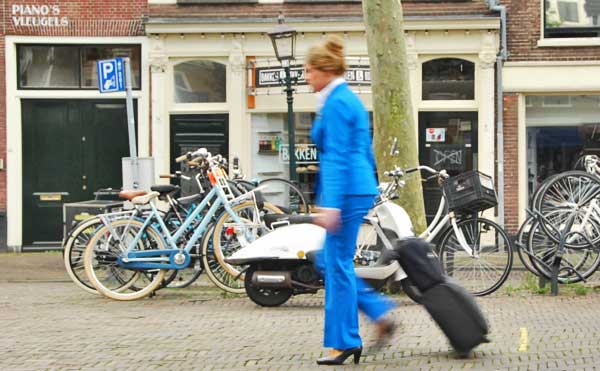
Here is the way the pros do it — luggage on wheels. This KLM Royal Dutch Airlines flight attendent crosses the bricks at the Boter Markt in Haarlem, The Netherlands. She is on her way to catch bus 300 which stops just a minute away at the corner of the Gedempte Oude Gracht and the Grote Hout Straat. The bus gets her to Amsterdam's Schiphol Airport in about 45 minutes. Bus 300 is the economy no-hassel way to go. My dear friend Annette Kampinga was a KLM flight attendant.
Several days a week there is a farmer's market at the Boter Markt and every day of the week there are a half dozen local pubs open for business. There is even a bicycle parking garage, and the city library is around the corner. I love libraries, especially those with free internet computers. My favorite weed shop and an excellent Moroccon grocery store are on the west side of the square, and arguably the best herring wagon in Holland is on the east side. Bicycles are called fiets in The Netherlands. Everybody from 5 to 95 has a few of them.
The Boter Markt is one of the most laid-back town squares in Europe. For people who want a "non-touristy" place to visit, I am whispering Haarlem.
ALTERNATE LUGGAGE
Other forms of luggage commonly used by travelers are the full size suitcase and the backpack.
Full Size Suitcase
A large plastic hard-side suitcase is a definite mistake for Europe. Put that old Samsonite out at your next garage sale. If you bring it to Europe it must be checked for air travel. It does not fit in overhead luggage racks on trains. It will not fit in many of the train station lock boxes. You might even have trouble getting it in the trunk of your rental car or taxi. It will be difficult to get on the elevator or up the stairs at many hotels. It will weigh a ton after two blocks. You will be the beast of burden. Poor burro, you.
If you absolutely must bring too much stuff, a large suitcase with rollers or one of the fold-up luggage carts would help, but would still leave severe disadvantages. It would be better to carry two smaller cases. But think about it — are you going to Europe to enjoy some time off or do you want to hurt yourself struggling with and sweating over a stupid plastic box full of dirty clothes? They do have laundromats in Europe so you only need to pack a few days supply of stuff to travel for months, and that is the way I do it. You meet some nice folks in laundromats — people like me!
Backpack, a.k.a. Rucksack (Deutsch)
Backpacks are very popular with young travelers, and are even used by a few grandmothers. A great load can be carried with relative ease, at least without pulling your arms out of their sockets. Backpackers who normally carry entirely too much stuff would do well to consider rolling luggage, unless you like to punish your back.
A few problems should be mentioned. To get at things like maps and guidebooks, you have to sling it off your back. Many people overload themselves to the point that they need someone to help them get the pack mounted on their back. Also, some rigid frame packs are so large that they do not fit in the train station lock boxes. When mounted, the big backpacks make it nearly impossible for you to get on a typical European midget elevator or up the steps of a train. Some travelers complain about careless backpackers who bump into them with the heavy things as the campers walk through the aisles of the trains.
A backpack can also be a temptation for street thieves. A beautiful petite leather backpack that Elizabeth bought at the Grand Bazaar in Istanbul quickly attracted the attention of some gypsies. They staged a cute rouse and nearly had their mitts inside her backpack as we were strolling an Istanbul boulevard in broad daylight. Be on guard at all times. Learn more about these very clever gypsy thieves in chapter 8, Pickpockets in Europe: They're Everywhere.
Airline baggage men can shake the tar out of a loosely packed backpack. I've seen backpacks coming down the ramp at baggage claim, followed by pots and pans, toothbrush, guidebooks, shoes, unmentionables, and etc. You can request a box or plastic bag from the airline in which to place your backpack before the airport luggage crew starts to treat it like a soccer ball. Not all airlines at all airports offer plastic bag wrapping service anymore. Make sure to pick up the right bag at the luggage-go-round since there may be other backpacks traveling in similar bags.
Backpacking, as such
The word "backpacking" has come to connote a style of travel. The style is "go cheap." Backpacking also implies that you are a young buck and strong enough to carry all of your wordly possessions on your back. As shown in the photo from Schiphol Airport below, you can also be a young doe carrying way too much. Ask yourself, is it really necessary to work like a burro when you are out for the adventure of your life? Work is a four letter word.
Hostels everywhere include sheets and towels with the price of the bunk so there is no need to bring linens with you. Hostels also provide breakfast and/or use of the house kitchen and table utensils. See my illustrated monolog in the Travelers Yellow Pages at Hostels in Europe. You don't need to haul around your kitchenware. This is the 21st century, in the USA and in the EU and the UK.
Whatever fits in a 20" wheeled bag is all that you need to travel in Europe. I've traveled with less stuff many times on the trains of Europe, for months and months and kilometers and kilometers. Leave the gross backpacks to the chumps. Backpacking in Europe is old camp. Be smart and look smart with a roller bag.
Note that you do not need to be a "youth" to take advantage of youth hostels, or any hostels for that matter. I am a 70+ retired geezer and I am welcome in hostels from Dresden, Germany and Riga, Latvia to Chicago, IL and Washington, DC.
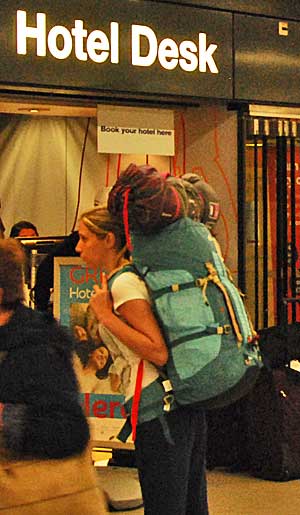
After landing in Amsterdam's Schiphol Airport in early August 2015 I passed the tourist information and hotel booking offices right there in the airport. I saw this and had to have a photo. The distraught girl is leaning 20 degrees forward in order to avoid falling over backwards. That backpack certainly weighs over 60 pounds and she might tip the scales at 110. She has been in Holland less than an hour and is already exhausted.
It can probably be said that she did not take my Pack Light Field Test. For weeks to come
this poor burro will feel the pain. Fortunately the best pain killer is available in Holland. Lovely weed is legal and cannabis shops are everywhere.
Before you pack up all your belongings for what should be a pleasant expedition around Europe, take my Pack Light Field Test.
PACKING
Gravity Rules
Gravity is the stuff that makes apples fall from trees. It has many other applications, and that includes your packing strategy. The bottom line is that heavy stuff likes to settle to the bottom. Put it there in the first place so it doesn't mess things up as it goes down. The bottom of your luggage as you carry it is not necessarily the bottom as you pack it. Put the heavy stuff on the side opposite the handle.
Roll 'em or Fold 'em
Some packing experts suggest that you roll up your clothes before packing them. Others say to pack flat. I've packed both ways and have concluded that both ways work best, depending on the clothes. Fold your outer garments, shirts and slacks especially. It's OK to roll your underwear, though I don't find any advantage in doing that with soft sided luggage. If you made the mistake of buying a hard case piece of luggage, rolling your underwear would allow you to stuff those items in the corners.
Vacuum Pack
I learned one of the best travel tips from a friend in Holland decades ago. Use the 2 gallon Ziploc® bags to pack your clothing. Each Ziploc® bag holds a couple of shirts or slacks. After neatly folding your clothes put them in the Ziploc® and zip it up except for the last inch. Lay it on your bed, sit on it, and zip it up. The result is like vacuum packed cheese. This keeps your clothes reasonably well pressed, and clean and dry no matter what.
Placing your clothes in 2 gallon Ziploc® bags helps you in other ways. It keeps things organized. If/when your bag is searched by TSA it is easy for them to get all your stuff back in your bag in some reasonable order. If your bag is searched by a foreign customs agent you have the same advantage. On one of my entries to a foreign land I was asked to open and empty my suitcase. I opened it, turned it over, and dumped everything out in front of the agent. He was a bit shocked by my abrupt action but he was satisfied after a cursory look at my clear plastic bags.
Use smaller Ziploc® bags for other items also, especially for liquids. I pack a couple of sandwiches whenever I go to the airport for a flight. Security takes their time and my homemade hi-protein tuna-egg sandwiches sure beat the airport stuff, in price and quality.
Write your name, telephone number and/or email address on each Ziploc® bag. This will help you recover your stuff if a baggage handler rips your luggage open. This has happened to me. This has happened to millions of travelers. If not identified and claimed your stuff ends up in a garage sale in Alabama. No kidding.
Packing Cubes
My first set of packing cubes was a gift. That was one of the best gifts ever. These things are so handy.
Packing cubs are small nylon box shaped containers. The top is an open mesh and the closure is a zipper. Packing cubes are available in several sizes. Please see my euro-shoppe™.
Trial Packing
Do a trial packing a few days before you depart. If you do the Pack Light Field Test you will have done this. See chapter 6, Pack Light Field Test: Validating Your Europe Packing List. My trial packing usually turns up the fact that my luggage needs repair work, something I conveniently forgot to do after my last trip. Something is always going off. Mother Nature is on the side of the hidden flaw.
BUSTED BAGS
The men and machines of the airlines behind the wall can easily inflict severe damage on your innocent luggage. If your bag is damaged complain immediately. The worst harm that I have experienced was on a KLM flight from Los Angeles to Amsterdam. The zipper had been ripped out and destroyed, leaving the bag wide open. KLM's service desk told me to see the luggage repair shop in Schiphol airport and they would pay for repairs, or KLM would give me a flat $25. I went to the luggage repair but it was a Sunday and it was closed. So I looked in the airport luggage shop and was surprised to find the exact same bag available for $75. Only then did I remember having bought my bag there the year before. So I bought a new one and went back to KLM's service desk with both bags and the receipt. The service desk paid the full $75, but the attendant not especially happy about it.
LOST BAGS
Checked luggage sometimes doesn't make it to the carrousel on arrival. This is usually caused by late check-in, either your fault or late arrival of your flight to make a connection. Winter flying in the north is particularly susceptible to late arrivals. In either case your luggage is usually put on the next flight and delivered to your door the next morning at the airline's expense.
To get your baggage returned you must file a report with the airline on arrival. Major airlines in major airports usually have a special office for this near the carrousels, with a line waiting. You'll need your baggage claim check. The clerk will give you a brochure with illustrations of dozens of different bags and ask you to pick out the style and color of your bag. Fill out the form, but don't rush away just yet. Ask the clerk if they have a toiletries kit to get you through the next day until your luggage arrives. In one case I was given an allowance to buy replacement clothes. Usually I get a toiletries kit and a T-shirt.
LOCK IT UP
It is a good idea to secure your luggage against casual snooping which can lead to pilferage.
Locks
Small locks designed to hold the zippers of soft sided bags can be purchased in most stores selling luggage or travelers supplies. I don't trust those bright brass luggage locks. They are not industrial grade for sure. Also, they make a statement — "there must be valuable stuff in this locked bag." The TSA is infamous for destroying locks, even those which are advertised as being approved by the TSA. TSA people have a master key and can open these locks. Good theory. TSA agents are government employees. Some of them have an attitude. Not many of them have a brain. It is easier or more fun for them to use the bolt cutter instead of finding the master key. If they do this to your luggage file a claim. Good luck.
Wire Ties
For checked luggage, when I have it, I prefer to seal the zippers with a wire tie, also called a cable tie. Wire ties are strong. The black ones are inconspicous and don't advertise the fact that you have locked your bag. To use a wire tie, you insert the small end in the eye and pull it through to lock it with the ribbed side on the inside of the loop. Snip off the tail with nail clippers if you wish. To remove a wire tie you must cut it off. Bring nail clippers in your carry-on bag. Yes you can.
There is a chance that the TSA will open your luggage for inspection. Therefore, it would be a good idea to leave a little slack in the loop of your wire tie to make it easy for them to cut it off. After they open it they usually put their own style of plastic lock on the zipper pulls. They also put a notice inside that they had a peek. On my last flight the inspector also broke the zipper.
Wire ties can also be used to tie your luggage to the rack in a train. This gives you additional security when you go to the toilet or to the café car. Loop the wire tie through the handle of your bag and around a sturdy member of the rack. Wire ties can be joined together if you need more length. Just put the point of one into the eye of another. Schedule your café car visit or potty trip between stops and be at your luggage whenever the train is in a station. You can't use the toilet when the train is in a station anyway. Since a ticket is not required to board a train in most countries, luggage thieves can board trains at stops. Then they can walk through the cars, grab what they can, and jump off before the train departs. The wire tie would slow them down for a moment but probably not thwart the thief.
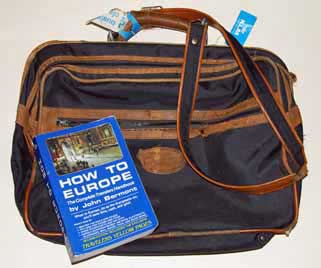
This was my 1980s luggage. I would still be using it but it is really beat up, like an old pair of jeans. The old bag is a souvenir now. KLM bumped me up to business class with this tattered thing in tow, and they did it twice, Los Angeles round trip Amsterdam. What a surprise and what a ride!
There is the second edition of my book, published in 1984. For a brief blurb see HOW TO EUROPE. Another travel writer who claims to update his dozens of books every year is still plagiarizing from mine three decades later. Huh?
Have a good trip!
Selections at
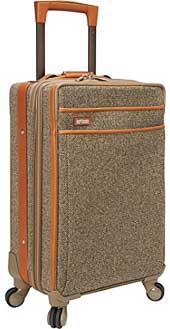 Hartmann Tweed Collection Carry On Expandable Spinner
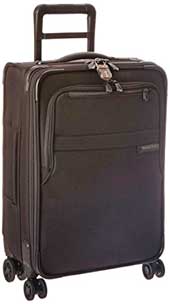 Briggs & Riley Baseline Domestic Carry-On Exp Spinner
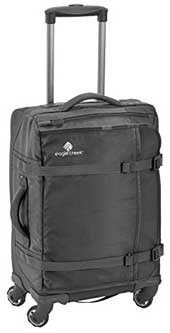 Eagle Creek No Matter What Flatbed AWD 22 Carry-On Luggage
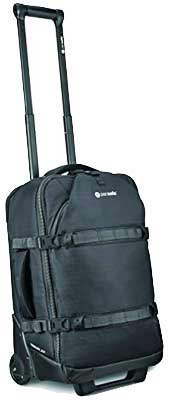 Pacsafe Toursafe EXP21 Anti-Theft Wheeled Carry-On
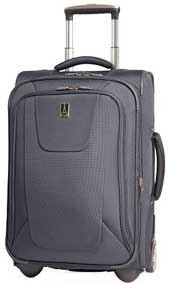 Travelpro Luggage Maxlite3 International Carry-On Rollaboard
A shoulder bag for your daily walk-about.
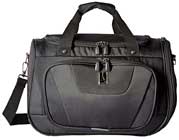 Travelpro Maxlite 4 Tote
Keep your stuff organized.
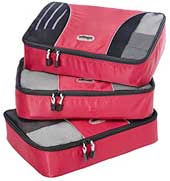 eBags Medium Packing Cubes 3pc Set 13¾"x9¾"x3"
 Assorted Packing Cubes
eBags 3pc Set
The two gallon size is excellent for packing your clothes.
 Two gallon plastic bags
13"x15½" ZipLoc
Inconspicuously lock your zippered luggage with a black wire tie.
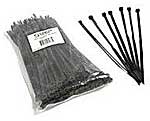 Cables to Go 43036 Cable Ties 100 Pack (Black)
A quality passport wallet that will last for decades. This one is RFID blocking to protect your identity in public places.
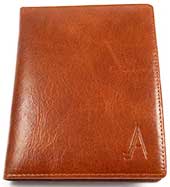 Leather Passport Wallet


HOW TO EUROPE
The Complete Travelers Handbook
Chapter 1

What's It All About?
Travel Like a Native In EuropeChapter 2, Part 1
On Budget in Europe
Travel Costs: How Much?Chapter 2, Part 2
Europe on WHAT! Per Day?
My Actual ExpensesChapter 3
Passport and Visas
Identity and Travel DocumentsChapter 4
Flying to Europe
Travel Starts at the AirportChapter 5
What to Wear in Europe
Your Best Travel Clothesfor All Occasions
Chapter 6 Part 1
Pack Light Field Test
Travel Europe in Comfort and StyleChapter 6 Part 2
Personal Care Items
Pack Your Toothbrush, Toilet Paper, and Vinegar.Chapter 6 Part 3
Travel Supplies
Small Stuff Packing ListChapter 6 Part 4
Bringing Valuables
Not in Your Luggage or PurseChapter 7
Luggage for Europe
Pack Light, Let It RollChapter 8 Part 1
Pickpockets in Europe
They're EverywhereChapter 8 Part 2
ATMs in Europe
Machines Dispense Travel CashChapter 8 Part 3
Cash and Credit
Paying Your Way in EuropeChapter 8 Part 4
Money Potpourri
Cash, Coins, Transfer, BarterChapter 9

Your Travel Diary
Blog ItChapter 10

Europe Guide Books
Reviews of Tomes for Travelers
Chapter 11, Part 1

An Electric Converter in Europe
Electric power converters supposedly change 220 volts to 110 volts.Chapter 11, Part 2
Plug Adapters for European Outlets
American plugs do not fit in any power outlet in Europe.Chapter 11, Part 3
European Voltage Essentials
220 Volts of Power 50 Hz Frequency.Chapter 12

Photography in Europe
Take Your Best ShotChapter 13

Bring a Smile
Travel Europe in Good AttitudeChapter 14
Hotels, B&Bs, Hostels, Homes
Travelers' Sleep OptionsChapter 15
Eating In Europe
Travel on Thy BellyChapter 16
City Transport in Europe
Bus, Streetcar, Subway, Taxi, Bike, Shoe, Gondola
Chapter 17, part 1,
Trains in Europe
A Rail PrimerChapter 17, part 2,
European Rail Stations
Finding Your WayChapter 17, part 3,
Night Trains in Europe
Sleeping City to CityChapter 17, part 4,
Boat and Bus Services
High Seas Ferry, Highway CoachChapter 18, part 1
European Auto Rental
Details and DocumentationFor all 30 chapters and much more see
HOW TO EUROPE
The Complete Travelers Handbook
Free to use but not to abuse.
Copyright:
Internet edition
© 2001-2017 James J. Broad
All rights reserved. Tous droits réservés.
This is copyrighted material. Do not reproduce, copy, plagiarize, re-craft,
store, modify, extract, transmit, or purloin any part of this
publication in any nation in any form or by any means or for any purpose whatsoever without permission
in writing.
Copying:
You may print one paper copy of this web page for your personal use.
Permissions:
If you want to adapt any part of this material to use in your blog, forum, web site, book, article,
speech, term paper, movie, video, or any other media please write to me and get
permission before you do so. Otherwise it is a copyright violation or plagiarism.
Plagiarism includes paraphrasing text and copying ideas. Imitation,
the old saying goes, may be the highest form of flattery. However, plagiarism is outright theft and is usually
compounded by the lies of the perpetrator.
Everything on my web site is original, created at great personal expense
in time and cash in the course of my extensive travels throughout Europe. Please respect my property.
For detailed descriptions of the many forms of plagiarism see
Plagiarism.org and
A Plagiarism Guide for Students.
For permission to use material from this web site contact:
[email protected].
Bloggers and Webmasters:
You may link the URL http://www.enjoy-europe.com/best-luggage-for-europe.htm freely. Please do. When you link please send the URL for your linking page. I will be happy to return the favor if your site has significant content for travelers in Europe.
Free, free, and free
This web site is totally free for everyone, and a labor of love for me.
Support
To keep enjoy-europe.com afloat I advertise scores of travel related books and products. My site receives
a commission from Amazon.com for all goods purchased through the advert links. These advert links are
displayed on individual pages and on my on-line store at
. Your support is most gratefully appreciated. TIA.
Your Blow Back
I welcome questions, comments, and complaints. If you have any concerns about your trip to Europe that have not been covered well enough on my web site please do not hesitate to write. Ask, cuss, discuss, or whatever. I read every email and update my pages when I see a question repeating,
Utilities:
- How To Europe: The Complete Travelers Handbook.
- Home.
- To the top of this page
- E-Mail to John Bermont
- Meet the Author
- Privacy Policy
- Site Map
- Advertising Policy