City Transportation in Europe
Bus, Streetcar, Subway, Taxi, Bike, Shoe, Gondola
How to save time, trouble, and money using public transportation in Europe.
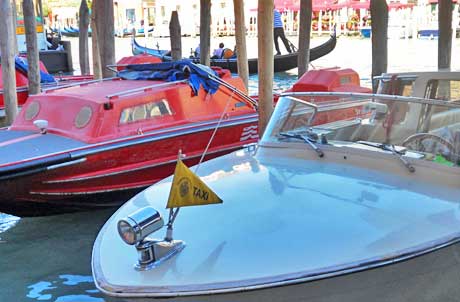
The city transport system in Venice Italy is primarily of the floating sort. Here is an official Commune de Venezia flagged taxi and a traditional gondola in the background. Photo by Stephanie.
Carpe diem. Vivere bene! Gratia Deo.
Chapter 16 of
HOW TO EUROPE:
The Complete Travelers Handbook
John Bermont

This entire book is published totally free on-line by the author, photographer, and webmaster, yours truly, with help from my daughter Stephanie. I welcome all questions, comments, compliments, and complaints. For contact information please see NOTE TO READERS. Updated 8 December 2015.

Your Go-To Travel Store
Leave your car at the city gates.
PERSONAL AUTO
Don't Even Think About It
Europe's cities are much more difficult to drive and park in than ours in the USA. Among the drawbacks of using a personal auto in the major cities are the following hazards and headaches: lack of parking spaces, very expensive parking, confusing parking regulations in the local language, massive traffic jams, narrow one-way streets, poorly marked streets, streets with new names every few blocks, theft, vandalism, bus lanes indicated in the local language, fearless jay walking pedestrians, rule-the-road streetcar drivers, double-parked delivery trucks, radar/camera traps everywhere, the notorious Z.T.L. zones in many Italian cities, and the numerous unpredictable and utterly unfamiliar driving habits of the local citizens.
If you must for whatever reason take life and liberty into your own hands and drive a car in a European city, first read the details on driving in Europe starting at chapter 18 European Auto Rental: Details and Documentation.
Safe and Sane Alternates
Use the indigenous public transportation facilities to enjoy your time, avoid major hassles, and save money. The preferred means of navigating European cities are subways, streetcars, buses, taxis, bicycling, and walking.
PUBLIC TRANSIT
Most cities have excellent public transportation systems. The subways, streetcars, and buses are part of an integrated network that was designed for daily commuters but can be efficiently used by tourists. Routes for city rail systems often extend to the suburbs and airports.
Tickets and Passes
Tickets can be purchased at windows or kiosks in the train stations, and sometimes from the driver or from ticket automats. Tickets are often interchangeable between buses, trams (streetcars), and metros (subways) in the major cities.
Passes or blocks of tickets can usually be purchased which give a discount to regular users of the system, and save time standing in ticket lines every time you get on a bus. In Paris, purchase a carnet of ten tickets and save time and money using the Metro. If you are doing a lot of travel on the Metro a Paris Visite card gives you freedom to come and go as you like for a limited number of days. For longer stays in Paris the Navigo Decouverte weekly or monthly pass is a great deal. It has some kind of chip in it so you don't have to take it out and run it through the machine. Stephanie kept hers in her little purse and just waved her purse over the Metro turnstile while she was there for a month studying French at the Alliance Française. London has it's Oyster Card, definitely a money saver compared to individual tickets. The combo bus and Tube (subway) Oyster Card is probably best for a lot of travel in the city. The Netherlands has introduced it's OV-Chipkaart which is not exactly a convenience for tourists. The strippenkaart is no longer valid in Holland.
Some tourist transport passes include entry to many museums and other points of interest. These cards may also allow you to by-pass the ticket lines at some sites. In my opinion you really have to hustle to get your money's worth with these combination transport and museum passes. Also, not all museums are included.
Transport passes and block ticket discounts are not always designed for tourists. The passes facilitate use of the systems by commuters going to work every day. Make sure the terms suit your sightseeing schedule before buying.
For a flat fee in some cities you can travel as far as you can go in one hour. In other cities you must pay for distance according to zone maps. Since each city has a different manner of doing business, ask for information at the city tourist office about fares, zones, and hours of operation. Much of this information is available on web sites of the individual cities or the city transport companies. Do a search for the name of the city plus bus. These web sites are often designed for form and not function so have some patience. Most of them have a British flag, the "Union Jack," to indicate the English language version.
In most cities you must validate your ticket. Tickets are sometimes issued without a validity date. On the bus or metro, or in a stamper machine or the platform, you will see a metal box. Put your ticket in the slot and it will be stamped. Ask someone at the local tourist office or bus terminal for instructions. If a validation stamp is required and you don't have it you are due for a fine. There goes the lunch money.
Routes and Schedules
Request a route map at the city tourist information office or at a ticket window. A route map might be called a plan or plano or mappa or something similar depending on where you are. There are usually route maps posted in the subway stations and itineraries posted at streetcar and bus stops. But the time when you need one is the time that it won't be handy. Be prepared. Route maps are usually free and they are often detailed enough so that you don't need to buy a city map. That will save you $10.
Bus and tram routes are numbered. Metro routes are usually identified by the names of the stations at each end of the line and/or by route numbers and letters.
If you're new in town and not sure where to get off, it's a good idea to tell the driver of a streetcar or bus where you want to go. The driver probably can't speak English, so point out the place on a city map or in a guidebook, or write it in block letters in your travel record book and show it to the driver. You won't be able to understand the name of the stop he tells you to get off at either, and if you can understand it the windows may be so dirty or fogged that you won't be able to see it anyway. So sit as close to the driver as you can. When your stop comes up, he'll let you know. Keep one eye on the driver.
Schedules are sometimes posted at streetcar and bus stops. Bus drivers often ignore schedules, so you should also. Since you don't know when your ride will show up, allow yourself an extra fifteen minutes when using the public transports. At a remote stop you might wait half an hour and then have two of your number pass within minutes.
Upgraded bus and tram stops often have a lit display showing the arrival time for the next ride arriving at that stop. Almost all metro and subway lines have this feature.
Subways, streetcars, and buses have limited, if any, service after midnight. Before you take off for a night of carousing on the other side of town, make sure you can get back to your hotel. Night buses are often indicated by an N in the bus number.
Weekend service is less frequent than during the week, and stops earlier in the evening. Public transportation is severely reduced on public holidays. Employee job actions, "strikes," are frequent, but usually last for only a day or so.
Subways
Just outside or in another cavern of the main train station, the Métropolitain (Métro), U-bahn, Underground (Tube), or otherwise named subway lines originate or intersect.
Boarding usually involves putting your ticket into a turnstile and walking through. If you are carrying a heavy load you might have a slight difficulty getting through. Later on you may have a major difficulty finding your wallet. Be careful of pickpockets at the turnstiles. After getting through the turnstile you have to find the right platform and get on the right train to go in the right direction. Almost all stations are very well posted, but it sure helps to have that system map in hand just in case. Maps are usually posted in the stations but are sometimes decorated with graffiti covering the information you need. Parts of the maps are often rubbed out by the millions of fingers used to point out a location.
Making transfers is easy. When you get off, just follow the signs to the rail line going in your direction. Some of those connecting tunnels are pretty long so have patience and keep walking. Don't bother running because there is a train every few minutes anyway.
Getting off is a snap everywhere except in London and in Rome. In most cities, just follow the exit signs, e.g., sortie in Paris, Ausgang in Munich, Way Out in London, and soon you'll see daylight, or city lights. Paris makes it especially easy with those Plan du Quartier maps in all the Metro stations so you know where you're coming out.
The problem in London is that you have to put your ticket in another turnstile machine to get out. Many people on the Continent ride for free, illegally. In Paris it is usually easy to get on without a ticket. Teenagers are adept at jumping the turnstiles, and older folks have learned the art of squeezing two at a time through a turnstile. One did it to me. However, special agents may ask to see your ticket and slap a fine on you if you don't have one. Some Metro stations in Paris post names of recently convicted free riders, with the amounts they were fined. It can be expensive.
The Munich system is a relatively new one in Europe. It opened for the 1972 Olympics. The subways in Paris and London are over a century old. Amsterdam has a new and very good metro system but it is only worthwhile for getting to the nearby suburbs. Most of Amsterdam can be walked or navigated by tram.
Most Metro and U-bahn stations have escalators to help you get up out of the tunnels. If the escalator is not running, walk up and step on the metal plate in front of it. It will probably start. If it does not start, you are probably in Rome. Rome also has poorly marked directions and the deepest, deepest tunnels on the Continent. If you can't find an escallator look for an elevator.
Streetcars
Many major cities have streetcar systems. Streetcars are called trams in Holland and S-Bahn in Germany. Since these run on city streets, stop often, and compete for limited space with autos and pedestrians, the traveling is slow compared to the subways. But going slow can have its advantages for sightseers. Armed with a good city map and a day ticket, you can scoot all over town, checking out the people, architecture, parks, and castles in the relaxed position. A "good city map" shows all streets, numbered tram/bus routes and stops, and the major edifices.
The main streetcar station is usually right outside the main train station. There are stops every quarter mile or so, and frequent service. If you see a track, you're not far from a ride.
On boarding, show your ticket to the driver or put it in the time stamper machine as the local rules specify. Just because you see a lot of people get on and sit down, apparently without a ticket, does not mean that you can ride for free. Those people might have a monthly pass or a transfer in their pocket, or they might be risking a fine by riding for free.
Do not drive, ride a bike, or walk on or between tram rails. The trams are electric and are very quiet, especially with all the other street noise around you. Amsterdam tram conductors love to wait until they are on your heels and then they RING THE BELL!!!
Buses
Buses are sometimes called autobuses.
Buses are in use in all of the large cities, most of the small ones, and cross-country. A card valid for unlimited travel for a day or for several days can be purchased which would make for generally good do-it-yourself sightseeing. A bus pass and a subway pass are usually different, but can be a combo.
Rail travelers who want to get to a small town which has no train service should inquire at the railroad information office in a nearby city about bus service. Bus terminals are usually located just outside the train stations. Intercity service often includes stops at crossroads and in the middle of nowhere. Tell the driver where you want to get off. In some countries bus drivers stop for people waving them down along the highway.
Sometimes you can pay on the bus, but before you stand in a line waiting to get on, find out whether you will be able to purchase a ticket on board. Ask at the bus terminal or at the city tourist office about the method of operation. In some countries you can buy bus tickets in cafes and newsstands. Tickets are usually more expensive when you buy them individually or from a driver. When buying a ticket from the driver, try to have the correct change.
Buses typically have stop buttons so you can let the driver know when you want to get off, at the next stop. Know your route or ask the driver.
Schedules for intercity buses originating at main train stations are followed more closely than those for the in-town buses. I've had pretty good service in Germany, Holland, Greece, Norway, Ireland, Portugal, and the Baltic countries on intercity buses. These buses are fairly comfortable for short rides up to a few hours. Long rides, like 5 hours from Tallinn to Riga and similar stretches continuing to Vilnius and Warsaw are not especially pleasant. I wish there was a train. See chapter 17 part 4, Europe's Bus and Boat Services: High Seas Ferry, Highway Coach.
TAXIS
Taxis seem to be everywhere, except when you need them most. Taxis wait at train stations, airports, at large hotels, and outside night clubs.
If you are a fan of the wild rides in amusement parks, you might want to take a taxi ride just for the thrill of it. They're not for the fainthearted. Also, some will rip you off, just like at home. Another thrill. Not.
Before getting in any taxi, find out approximately how much the ride will cost. Ask the hotel concierge or the tourist office for an estimate. Ask also about official taxis and unlicensed free lancers.
Also ask the taxi driver for his estimate before getting in or letting him throw your luggage in his trunk. Write down the name of your destination and the price you think you heard from him and ask him to agree to what you have written. Compare. If he quotes 59 verbally, it may turn out to be 95. This is not necessarily an attempted rip-off. See chapter 26, Languages, Numbers, Alphabets: Encounter The Tower of Babel in Europe.
If the taxi driver plays dumb and can't speak English, get suspicious in a hurry. Find someone to translate, or take another taxi. In all cases, write down the name of your destination and show it to the driver. Unless you are a fluent native, there is always the possibility that you will be deposited on the wrong side of town.
The average London taxi driver is the most helpful and civilized member of the taxi driver species. Irish cabbies are also good. But across the Channel, be careful. I found the drivers in Rome to be particularly suited to larceny. On a visit to my client in Aachen, Germany I had been faxed a map and a taxi estimate for the trip from the train station to the factory. The first taxi driver looked at it and agreed. About 15 minutes later the meter was getting close to the amount and the client's factory was nowhere in sight. I asked about it and the taxi driver said that we were going the "fast way" and that my "company was paying for it anyway." Stuff this balogna. I was paying for it. I got him to turn off the meter and deliver me for the price he had agreed to.
Catching a Taxi
With enough patience, you can get a taxi by waiting in the designated line at the train station or airport. You can wave them down in some cities, though taxis rarely cruise and usually will not stop for you except in London, Madrid, Lisbon, and Athens. Taxis wait at some Metro stations in Paris. You can phone them, or tip a hotel bell captain or head waiter to order one around. At the disco there is normally a line of taxis waiting outside late at night. Many people use taxis for going out carousing because of the severe penalties for driving after drinking.
Taxi drivers do not like to make short runs when there is a line of waiting taxis. If they take you three blocks, they have to go to the back of the taxi rank and wait another half hour for their turn again when they return. So they probably won't give you a ride. That's your problem if it's raining.
When taking a taxi to a slightly out of the way place where you won't be staying long, tell the driver to wait. It may be difficult to hail another taxi when you're ready to return. A good example is Athens, Greece. If you take a taxi to the Acropolis and pay him it might take a long time to get another taxi after walking around the ruins for a half hour. In Sintra, Portugal, I had an excellent English speaking taxi driver who drove me from the train station up to the castle, waited 45 minutes while I took the guided tour, and drove me back to the town square, all for about the price of a good lunch.
Night Charges
Taxis operating late at night typically charge a higher rate than during the day. Don't be surprised to pay twice as much to get home. Taxis often charge more than the meter on Sundays also. And sometimes they arbitrarily charge 10% to 20% more than the meter. I don't know why, but when they do it I take all the change.
Taxi Fares
Taxis are expensive in northern Europe and darn cheap in the Mediterranean countries. Have plenty of cash with you in Stockholm, Sweden, even for short trips. In Athens, Greece you can be almost anywhere in the city for about the price of a beer.
Taxis will take you cross-country also. One driver in Athens quoted $45.00 for the three hour trip to Patras, Greece. I took the bus. And "taxi drivers" can pop up just when you need them most. Thanks to my lack of attention when crossing from Portugal to Spain, I just missed a train to Huelva. The next train would be four hours later. There was a fellow from Brazil and a girl from Australia similarly stuck. I went to the café across the street to use the facilities and have a brandy. While there, one of the good old boys at the bar said he has a "taxi" and would drive me the 50 miles for $14.00. Though neither of us could speak the other's language, I negotiated it down to $10.00 for the three of us. So for about $3.50 each, Ernest, Kathrine, and I got a one hour ride in the oldest limo I've ever seen, arriving at Huelva in plenty of time to make our connection to Seville. (Note: When crossing from Portugal to Spain, advance your watch, and vice versa; they are in different time zones.)
In the eastern countries taxis are also very cheap. From a beach hotel on the north end of the city a taxi ride into the center of Constanta, Romania was about a dollar. I didn't want to drive too much around there anyway, preferring to leave the car in the guarded parking lot of our hotel.
Domus
In Istanbul, Turkey a type of taxi called a Domus is very handy for getting across the city. We stayed near Topkapi Gate and learned about the Domus after a couple days. The Domus driver waits until his car is full and then takes off for the top of the hill. Passengers can go all the way or get off when they want. Taxis and the Metro are already very cheap in Istanbul, but we saved a few more pennies with this very interesting arrangement, stuffed into a little car with the locals.
Treintaxi
Some cities in Holland have a Treintaxi service. They load up at the train station and drop passengers off at their home or office. If you are traveling with a group this is an excellent way to go from the station to your hotel. The cost is a few dollars per person. Treintaxis are available at most major train stations in Holland, except Amsterdam. If there isn't one parked, there will be a telephone handy to call one.
BICYCLES
Holland
Bicycles may be the most common form of transportation in Holland. There is some danger in riding a bike, particularly in Amsterdam, and it may take a while to get accustomed to the local rules. An ambulance nearly ran me over in Haarlem. Generally, bicycles have the same right to the road as automobiles, and they take it. Use arm signals to indicate turns, make sure your bell and front and rear lights work, and that it has fenders. It rains a lot in Holland and you don't want back splatter.
In many Dutch cities, and between cities, narrow roads have been constructed for the exclusive use of bicycles and mopeds, normally called brommers in Holland. These little roads usually have separate traffic signals using the outline of a bicycle. Depending on distance, traffic, and parking conditions, a bicycle may get you there faster than any other vehicle in Holland.
For some views of bicycle paths in Holland see my photolog report of a trip from Haarlem to Keukenhof at Keukenhof.
Elsewhere
Bicycles are also popular in Denmark, parts of Belgium, and in northwestern Germany.
In Aschaffenburg, our German home town, we used our bicycles frequently for short trips to the market and for Sunday rides along the Main River. During the summer it was impossible to ride for half an hour without finding a beer Fest of some sort in one of the Dorfs (towns) facing the river. For the most part, there is a paved bike path on at least one side of the river. Along the path late in the season we made frequent stops to get off and pick wild raspberries which seemed to be everywhere.
Some major cities have free or very cheap temp loaner bicycle programs. You'll find free bikes in Geneva, Copenhagen, Amsterdam, and other cities which are trying to cut down on traffic congestion. Paris has instituted a cheap bike rental plan called Velib'. You can get a bike at hundreds of locations and drop it off at any other location. I had a free bike in Blois, France that enabled me to visit the château at Chambord.
MOPEDS
Mopeds are probably the second most popular form of transportation in Holland. Moped drivers are allowed to use the bicycle paths. Helmets are required and the maximum size engine for a moped is 50 cc. This noisy two-wheeler is the vehicle of choice for pre-car teenagers. They are known colloquially as brommers, officially as bromfiets.
WALKING
Shoe leather should not be forgotten. The most interesting parts of most major cities are relatively small in area and can be reached within half an hour from a central location.
Sidewalk Hazards
Some sidewalks are very narrow And they are often used for parking cars, café extensions, and glass recycle bins. Additionally, watch out for dog droppings. Don't worry too much about muggers except in some neighborhoods which are easy to identify. Unfortunately Barcelona is becoming infamous for daylight muggings. In most of Europe even after dark the streets are generally safer than in America. However, do be careful of pickpockets and camera and purse snatchers, especially in the capital cities and in the Mediterranean countries.
There is sometimes a certain lack of courtesy by European pedestrians. In Amsterdam, locals play "sidewalk chicken" to see who will step out of the way first. In the big cities in southern Europe, "sidewalk bumper shoulders" is played by many locals. They seem to want to bump into you, and they succeed. This could be a distraction to allow them to get their hands in your pockets. Be alert.
Crosswalks
Do be careful crossing streets. Crosswalks in some countries are meaningless, or if they have any meaning, it is simply that they are a target zone for drivers. Look around for traffic, and move quickly when it is clear. Crossing signals vary in appearance, but all will be red for "Don't Walk" and green for "Walk." In some countries the signals also give an audible sound indicating when it is safe to cross and when to wait. These sounds are different in each country.
Rome deserves special consideration by pedestrians, and since I lived to tell about it, here goes. Do not start to cross a street if the walk signal, AVANTI, is already lighted when you get to the corner. It can change to ALT within seconds and give drivers the green light to run you down. Be patient and wait until you see the signal turn to AVANTI with your own eyes. Then move quickly. The drivers in Rome don't like to slow down, much less stop. Some of them speed up when they see a red light. The red must drive them mad. In the city they don't like to waste their headlight bulbs either so they often drive with parking lights or even no lights at night.
"When in Rome, do as the Romans do" is an adage with a great deal of merit. But, when in Athens I would not advise following the locals jaywalking and crossing against the signals. I have seen citizens stranded in the middle of busy boulevards by swarms of speeding drivers hell-bent to take their right to the road. Courtesy? Are you kidding?
On the other hand, the drivers in Sweden and Finland are more courteous than any I have seen anywhere. Crosswalks are honored and pedestrians are given an opportunity to escape when caught in traffic. The Germans are very obedient when it comes to crosswalk signals. If you jaywalk you are given the most scornful looks by all of the people on the other side of the street who are waiting for the signal to change.
Pedestrian Tunnels
In many large cities, underground tunnels are provided for pedestrians to cross the major boulevards. Some of these feature escalators. I have seen some tourists who actually made it running across the Place Charles de Gaulle to visit the Arc de Triomphe. There are several underground tunnels so you do not have to run like a rabbit. Notice the posters that the city has set up in the neighborhood showing a lifeless body on the Étoile.
If you see chains or guard rails along the curb, you can assume that it is illegal to jump over to cross the street. Look for a tunnel or a crosswalk somewhere on the block. Otherwise you might come home as hamburger in a wooden box.
NOTE TO READERS
I welcome questions and comments. If you have any concerns about your trip to Europe that have not been covered well enough in this section please do not hesitate to write and ask. When you write please include relevant details, per the folowing paragraphs.
I do not open attachments. I do not click links to web pages of any kind. I will reply in a day or two, usually.
Do not forget to smell the hyacinths. At your liesure scroll through the Table of Contents of How To Europe: The Complete Travelers Handbook and read all 30 chapters, FREE on line. Good deal! You'll probably find the answers you seek, and some you didn't know you needed.
My email address is [email protected].
FREE
This web site is totally free for everyone, and a labor of love for me. To keep it afloat I receive a commission from Amazon.com for all goods purchased through the adverts I have selected, and any other products you might buy when you are on the Amazon site. Amazon has almost everything for sale, except the Brooklyn Bridge and Mount Rushmore.
Please visit my on-line store at
 .
Your support is most gratefuly appreciated. TIA.
.
Your support is most gratefuly appreciated. TIA.
To like and like not:


Adverts
To support this site:
Please buy your goods at:Amazon.com
Shop in your shorts!
Please clean out your cookie jar before clicking.
Rolling luggage sure beats lugging a pack on your back.
 Travelpro Luggage Maxlite 2 20" Expandable Spinner
A shoulder bag for your daily walk-about.
 Travelpro Luggage Maxlite3 Soft Tote
Keep your stuff organized.

Luggage Packing Cubes
eBags 3pc Set
The two gallon size is excellent for packing your clothes, but it is hard to find in Europe.
 Two gallon plastic bags
ZipLoc by SC Johnson
Inconspicuously lock your zippered luggage with a black wire tie.
 Cables to Go 43036 Cable Ties - 100 Pack (Black)
Your negotiating assistant will save you cash, as described in chapter 6.
 8-Digit Display Hand-Held Calculator by Sharp
A Swiss Army Knife is unquestionably the handiest item a traveler can carry, except not on a plane.
 Victorinox Swiss Army Huntsman II Knife
What a dandy of a camera! It includes a GPS that automatically sets the internal clock depending on which time zone you are in. You'll always know where and when you took the shot.
 Panasonic Lumix ZS20 14.1 MP High Sensitivity MOS Digital Camera with 20x Optical Zoom
Bring home the memories.
 Olympus FE360 8MP Digital Camera with 3x Optical Dual Zoom (Silver)
This is the camera that I use,
 Nikon D60 10.2MP Digital SLR Camera (Body Only)
with this amazing zoom lens,
![Nikon 18-200mm f/3.5-5.6 G ED-IF AF-S VR [Vibration Reduction] DX Lens](http://www.enjoy-europe.com/images/B000BY52NU.jpg) Nikon 18-200mm f/3.5-5.6 G ED-IF AF-S VR [Vibration Reduction] DX Lens
Nikon 18-200mm f/3.5-5.6 G ED-IF AF-S VR [Vibration Reduction] DX Lens
and this filter to reduce reflections and enhance colors.
 HOYA 72mm Circularizing Polarizing Filter
This tripod clamp is a handy accessory.
 CLAMP-POD Adorama SMALL 4001
Absolutely the best battery for digital cameras which use AA batteries.
 Energizer
AA Lithium Batteries
4 Pack
Plug adapters are needed throughout Europe. There are at least five models used in different countries.
Note: The highlighted #E number is purely arbitrary. It is meant to help quickly identify products in this advert column when you write in for electrical advice.
See NOTE TO READERS.
This adapter is for the standard grounded plug in France, Germany, and northern Europe. It does not fit in outlets of Italy, Switzerland, Ireland, and Britain.
#E-010
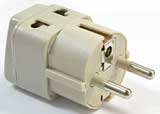 Grounded Universal 2 in 1 Plug Adapter
European Schuko plug.
4.8 mm prongs.
Equivalent to type E and F.
You can use this ungrounded Euro plug in some European countries.
#E-020
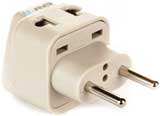 Universal 2 in 1 Plug Adapter
Euro Plug
4.0 mm prongs.
Equivalent to type C.
This is a universal plug adapter for the UK and Ireland.
#E-030
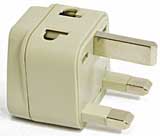 AC Adapter Plug for use in England, Scotland, Wales, and Ireland
Equivalent to type G.
Here is the Swiss version.
#E-040
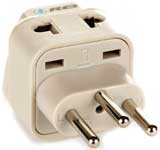 Grounded Universal 2 in 1 Plug Adapter
Type J for Switzerland
Here is the grounded Italian model.
#E-050
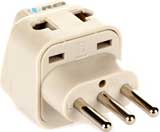 Grounded Universal 2 in 1 Plug Adapter
Type L for Italy
This 50 watt 220/110 volt step down transformer is good for very small 110 volt appliances and light duty chargers.
#E-070
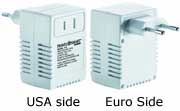 Travel Smart by Conair 50-Watt International Transformer
This little booklet is my favorite map of Paris.
 Michelin Paris Pocket Atlas (by Arrondissements) Map No. 16
A pocket map of Amsterdam that won't get soggy in the drizzle.
 Streetwise Amsterdam Map - Laminated City Center Street Map of Amsterdam, Netherlands
Here is the heart of London, a very big city.
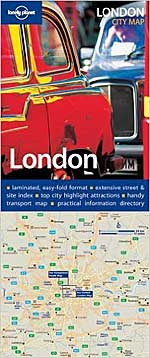 Lonely Planet London City Map
Wear a scarf for comfort and style. Nobody will ever suspect that you are an American.
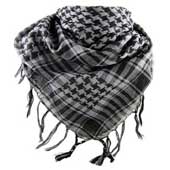 Very soft houndstooth neck scarf. Various colors available
 Anne Klein Women's Classic Double-Breasted Coat
 Hot Chillys Women's Peach Skins Solid T-Neck Shirt
 Clarks Women's Wave.Run Slip-On