Languages, Numbers, Alphabets
Encounter The Tower of Babel in Europe
Europeans speak dozens of foreign languages, including English, sort of.
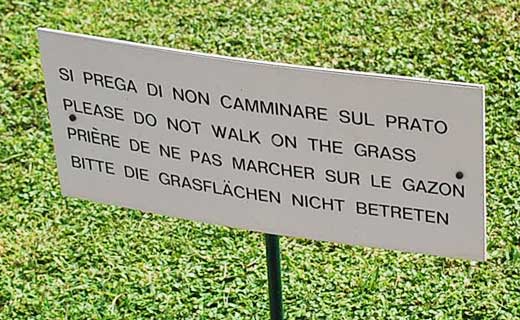
The city of Pisa has at least one multi-lingual sign, but it is certainly not the most important sign in town. Here the city advises locals, English and Americans, French, and Germans not to walk on the grass. You can learn a bit of three languages here. Typical signs throughuot Italy are in one language only, including the esential traffic signs. Learn about those in chapter 18 part 2, Driving in Europe: Back Alley to Blazing Autobahn. Photo by Stephanie.
Carpe diem. Vivere bene! Gratia Deo.
Chapter 26 of
HOW TO EUROPE:
The Complete Travelers Handbook
John Bermont

This entire book is published totally free on-line by the author, photographer, and webmaster, yours truly, with help from my daughter Stephanie. I welcome all questions, comments, and complaints. For contact information please see NOTE TO READERS. Updated 21 December 2015.

Your Go-To Travel Store
A, B, C.
1, 2, 3.
Ja, Oui, Si.
It is not quite that simple for Americans in Europe.
LANGUAGES
American or English
Americans speak English, we say. Actually it is a dialect of English. It differs in a number of ways from the language as used in England.
When you're in Britain you'll notice the differences right away. Some of the grammar and vocabulary is a bit strange. One of the major differences involves pluralizing words that apply to a group, e.g. they say "the team are playing." Also, Britishers don't "go to the hospital." They "go to hospital." Many words are different on the Island, including spanner (wrench), bonnet (automobile hood), loo (toilet), lift (elevator), torch (flashlight), and scores more. Going colloquial, bull to Yanks is rubbish to Brits. When an American is pissed he is angry. When a Brit is pissed he is drunk.
Before going to Britain, I recommend an interesting hour of reading from the front material of any college dictionary. There is usually a chapter there on the subject of the history of the English language. Read it. Among many other things, you'll learn why Bostonians put an "r" in many words that don't have it (remember President John F. Kennedy's "Cuber"), and leave it out of words that do have it ("khah" for "car"). Some people from New York do likewise. Britishers have the same habit, only more so. Same for the Irish. I love the fish chowdah in Dublin.
European Languages
There are dozens of languages in use in the countries of Europe. While it is generally not necessary to know anything more than English, it certainly helps to know a little bit of the language for those countries you plan to visit. In the eastern countries, a little bit of German can be quite valuable. People you come in contact with at airports, hotels, restaurants, and train stations in western Europe often speak excellent English. But occasionally, the people you would really want to speak with know only broken English. Then some familiarity with the native tongue is a great help.
Rudiments Are Appreciated
Learn a few simple phrases in the local language. For instance, use the native words for "please" and "thank you" as a minimum. When you enter a store or restaurant, ALWAYS begin and end with a "good day" in the local language. It's not that difficult to learn bon jour (French) or guten tag (German). Learning to pronounce dag (Nederlands) is difficult but the locals won't mind if you say "good day" or "hello." They all speak English. When departing give them a robust tot ziens ("see you later") and they will love it.
If you start up speaking in English and they don't understand, you'll get a frown and a wave off in a few seconds. Then point to yourself, say "American" with a smile, and ask if someone speaks English. Nine times of out ten someone will come forward or the one you are talking to will run into the back room and bring out a teenager who has learned it in school or picked it up from American rock 'n' roll music. American is the language of the future throughout the world.
When using English, speak clearly and slowly and keep your ear tuned because the reply could be distinctly accented. If you know one of the romance languages you might try to use it in another romance language country. French, Spanish, Portuguese, Italian, and Romanian have the same source.
Double Language Nations
Political boundaries do not always equal language boundaries. In at least half of the countries of Europe, more than one language is in use. Belgium and Switzerland, two of the smallest countries, are notable examples. Besides the major languages, there are a number of regional and national languages which have survived invading armies and national prohibitions. Notable among these is the Irish language and its unusual alphabet. Basque is coming back to northern Spain after decades of government prohibition.
Phrase Books
Phrase books are fun reading, but not so much fun trying to use. Once you find the phrase that you want to use, you'll probably botch up the pronunciation. Then you'll show the book to the native and point to the phrase you were trying to say. The native will look, nod his head, smile, and then ramble on in the native tongue for a minute. Now what? These books can be very helpful, but I find that a pocket translating dictionary usually works better. I use both.
Dual Language Dictionary
I wouldn't travel in a foreign country without a pocket translating dictionary. You can find lingua/language paperbacks in any bookstore or department store in Europe.
When using your translating dictionary to hunt up the foreign equivalent of an American word, also look up the reverse translation to see if it is the meaning you want. Many American words have more than one meaning and several foreign words may be presented.
For instance, in my Portugues Ingles / English Portuguese dictionary, the American word "bill" is followed by half a page of Portuguese words. Looking them up to find the reverse meaning, I find: conta meaning "count, computation, calculation, reckoning; account, bill; note; report, statement; esteem," etc., for another half a page; nota meaning "a note, mark, sign, memorandum, bill, memorial," etc., for ten lines further; factura meaning "invoice, bill of parcels;" lista meaning "strip of cloth, ribbon, slip of papper (sic), shred of linen," and a load of other words including podao meaning, among other things, "a clumsy, awkward man." When asking your waiter for the bill, I don't think you want to use that last one.
Pronunciation
Speaking foreign languages is far beyond the scope of this book, but a few tips here may help you pronounce a word or two.
Words are often divided into syllables differently in most foreign languages. Words are usually broken after a vowel or between double consonants. For instance, monopoly would be mo-no-po-ly rather than mo-nop-o-ly.
Pronunciation of e can be like i or a, or mute at the end of a word; a can be like o, u like oo, and i like ee. Combinations of vowels, diphthongs and triphthongs, are generally impossible to express except in speech by a native.
Consonants are also different. The letter g can sound like y or a cough. The k can sound like c or ch, and t like d. The letter r is the most erratic of all. It can be mute, trilled, coughed, or even spoken where it isn't seen.
Also, all languages have a rhythm and character which seems to go with the people who speak it. German is noted for having, to most ears, a rather brusque tone. Some of the Mediterranean languages, reflecting a more relaxed life style, have an almost poetic rhythm.
LANGUAGE LESSONS
Learning or brushing up on a foreign language is one of the reasons some people go to Europe. Teachers use the summer to brush up on their foreign language specialty. For transferees it's a must-do because you are working over there and need to communicate. For first timers in any language, it's hard work, mentally intimidating, and worth close to nothing when you get home.
At Home
Many Americans had two to four years of foreign language study in high school or college. Then they go to, say, Nimes and can't even make the waiter understand that they want a glass of wine. Well, you turkeys probably copied the homework from someone else and cribbed on the exam. Anyway, the best way to learn a foreign language is to go there, and speak it or suffer.
My foreign language experience was two years of Latin and two years of German, in high school many years before I went to Europe. I had forgotten everything except how to count in German.
Dutch
Why would someone want to learn Dutch? I took Dutch lessons at a private institute, the Talenpracticum Dreefzigt, when I lived in Holland. This was an almost comical arrangement due to the informal setting and the highly individual character of our teacher. I also bought a teach yourself book and studied every morning for a half hour at my desk. One day my boss came in early and asked me what I was doing. When I told him he scowled "What are you learning this language for? Nobody speaks it except us!"
I ended up learning most of my Dutch by hanging out in the local cafes, watching TV, and by dating Dutch girls. Learning Dutch was my first experience with a foreign language, except for the high school Latin and German. Picking up Dutch is very difficult because everybody in Holland wants to, and can, speak English. And some of them have an attitude about foreigners learning their tongue, as my boss demonstrated. Another time I was washing my car in the street when a car pulled up and stopped next to me. A spry old man leaned out the window and asked me how to get to the train station. I started to tell him, in my best Dutch of course, and was nearly done when he abruptly shouted back in English "In your own language! In your own language!" And again, I was back in Amsterdam after my first month of studying French at the Alliance Française in Paris. In a bakery I ordered a loaf of that beautiful Dutch bread, speaking Dutch. The owner replied in English. I replied in French. Then she retreated to Dutch. Yippee! I won. Oh, that felt so good.
Alliance Française
I have attended the Alliance Française in Paris twice. It is cheap and good and fun. Classes consist of a maximum of 20 students from all over the world. No English is spoken — everything is taught by sight and sound. With four hours a day in class and four hours a day studying, plus the environment of Paris, on my first visit I finally understood the teacher in my third week. It was an amazing feeling when all that darkness and confusion fell away in the light. I would expect that three months at this pace would bring most people to a fairly competent level in French. I regretted that I only had time for one month, so I took another of my self-induced sabatticals to Paris and went again eight years later. That's where I met Elizabeth and amour. It's over now, but as Bogart said, "We'll always have Paris."
And we'll always have our daughter Stephanie because of the Alliance Française. In her 22nd year, 2010, I sent her there for a month to learn some more French and give me next generation feedback for this website. She learned the French, found her way around Paris, had a great time, and wrote/photographed a blog. See it at O hey Europe.
Berlitz
The famous name in language lessons is Berlitz. It's also expensive and used primarily by business people who need to get started in a hurry. We used Berlitz in getting prepared for our transfer to Germany. I would rate our experience as pro-forma. We learned about the difficulties of learning the language, but little else in about six weeks at a couple of hours a week with a one-on one instructor. It's about as effective as learning to cook without a stove.
German at the Volkshochschule
On moving to Germany, we took German at a private school in one-on-one lessons. I also signed up at the local Volkshochschule, a kind of adult education type of school in Aschaffenburg. This seemed to work better for me. I was in class for three hours a week for two years. Only German is used in these schools and it sinks in after a while. But everybody in the office spoke fluent English and I hardly had a chance to use my German except when I had business trips to the former East Germany and other countries in the east. In the office I became the company's part-time de facto translator for everything from Christmas cards to sales literature to a patent. Believe it or not but the Christmas cards were the most difficult to translate.
Elizabeth had continued with intensive study at the private school and progressed faster than I did. She also used her German more frequently, in shopping and in talking with Stephanie's kindergarten teacher and the neighbors.
Spanish for Stephanie
I sent Stephanie to the Universidad de Salamanca in Spain in 2008 to improve her Spanish. She was already fairly fluent but formal training in the native land gave her an extra edge. She also learned some of the way of life of Spain and nearly had a one-on-one with a bull. See Bull Flight.
Further Studies
There are a large number of other schools in all countries which specialize in teaching the local language to foreigners. French, German, Italian, and Spanish lessons are readily available in the respective countries. Russian language study has recently become popular and schools have opened their doors in major cities.
If you are interested in studying in any country, obtain information from the official tourist office of the country you plan to visit. An Internet search will turn up thousands of possibilities.
Language Lessons by Tape
Taped language lessons provide a convenient and inexpensive way to learn a few words of a foreign language. We have used several of these and have found big differences in the approach and the value of the tapes.
For German, we used tapes from Berlitz, SyberVision, and "Just Listen 'n Learn" (Passport Books). By far the best, and the most expensive, is SyberVision. Another company, Audio-Forum, publishes tapes on a large number of languages. Get their catalog of "264 courses in 91 languages." Tapes are available for all the major languages. Many are available at your bookstore, library, and over the internet.
Language Lessons by Computer
The Rosetta Stone software offers audio with print words and images. A friend gave me the Dutch version. I tried it out but found that I am already good enough in Dutch that I don't need it. Rosetta Stone would be an excellent way to get started in a foreign language.
Potpourri
A couple of nuisance items on languages should be mentioned.
Americans in France should get used to saying "yes" or "oui" (pronounced "whee") when giving an affirmative answer. Never say "yeah." To the French ear, "yeah" sounds like "ja," the German word for "yes." Many French don't care much for Germans.
Finger language should be avoided. Americans start counting with the index finger, go up to the pinky and then hit the thumb, Europeans start with the thumb, and count through to the pinky. This may seem innocuous, but in some countries, our number two with raised index and middle finger is equivalent to the American middle finger high sign, popularly known as "the finger" or "the bird." Our way of showing two might be interpreted as the "finger salute."
NUMBERS
There are some small but potentially significant differences in the way numbers are expressed in Europe.
One and Twenty
Beware of numbers like neunundfünfzig and negenenvijftig. These are respectively German and Dutch for fifty-nine (59). The literal translation of both is "nine-and-fifty." Thus, these languages employ the "olde English" system of counting from 21 up, that is, one-and-twenty, to nine-and-ninety. Some shopkeepers who are not too smart, or who are flustered at meeting an American, may announce a price as 59 when they actually mean 95. It will sound like a bargain until you get 5 euros change from a 100 euro note. This happens often so be alert. N.B.: whenever you are buying anything in Europe write down the price you think you heard and show it to the seller for agreement.
To avoid misunderstandings, always ask for the price, bus number, address, taxi cost estimate, or whatever to be written down. If it is not convenient for them to do it, pull out your notebook and pen, write down your interpretation, and show it to the other person for agreement. Heads talk. The smiling, affirmative nod and the frowning, negative shake are almost universal language, except in Bulgaria where a nod is no and a shake is yes.
French 70
The French have a peculiarity in their number system which anthropologists may be able to explain. They can't count past 69. To the French, 70 is soixante-dix, literally translated as "sixty ten," and so on up to sixty-nineteen for 79. At 80, a new system takes over. The French for 80 is quatre-vingts, literally translated as "four-twenties." This continues as four twenties-one for 81 all the way up to and including four-twenties nineteen for 99. Those who feel that they may have seen something like this before may recall Abraham Lincoln's opening words at Gettysburg: "Four score and seven years ago..." One hundred is simply cent, pronounced something like "sawn," if you can swallow the n.
Decimal Point
Numbers can be written differently. The decimal point is usually a decimal comma in Europe, i.e., "78.5" is written as 78,5 over there.
And the comma separating thousands can be a point, e.g. "8,642" is written as 8.642. However, if a number is given to you verbally as seventy-eight-point-five, it means 78,5 to them and 78.5 to us. If you are working on a computer spreadsheet in Europe, you'll come across this situation right away. Change the default settings for your program to the decimal point/comma protocol of your choice.
You may occasionally see the decimal point located halfway up the number rather than at the base, e.g. 78·5 rather than 78,5 or 78.5. Don't be confused.
1,000,000,000,000, trillion or billion?
If you're talking big numbers in Britain there is a big difference. The American trillion has 12 zeros, but that is a called a billion in Britain. The American billion has only 9 zeros. The American billion is a milliard in Britain.
Handwritten Numbers
Your bill (l`addition or rekening) at a restaurant or cafe may look like a bunch of crazy squiggles. The number one (1) is usually written as an inverted V and is easily mistaken for a seven. Seven usually has a slash across its middle, or looks like a Y or a 4. Two, three and five are often garbled. Eight is started with the lower loop. Zero is usually impossible to decipher except by excluding all other possible translations.
Roman Numerals
Fibonacci is credited with bringing the Arabic number system to Europe in the 12th century. Prior to that, Roman numerals were the only means of counting in Europe.
To recap, Roman numerals are alpha characters which can be combined to form larger numbers. The base numbers are:
| Roman | I | V | X | L | C | D | M |
|---|---|---|---|---|---|---|---|
| Normal | 1 | 5 | 10 | 50 | 100 | 500 | 1,000 |
Roman numerals have been trashed almost everywhere but there are a few places where they are still in public use. One is at the Albacete, Spain, train station. Track numbers there are posted with Roman numerals. Arrondissements (districts or wards) in Paris are normally indicated with Roman numerals. And they are sometimes used as the month indicator in dates, as in 10.XI.1942 for November 10, 1942, the greatest day in my life. They are also used as the whole year for copyright notices, e.g. MMX for 2010. Major sports events come with the name of the game and the series number in Roman, e.g. the Superbowl. Other than that, for the most part they are engraved in cornerstones. But there is an interesting legend in Michigan that the city of Novi got its name because it was the sixth stop on the suburban Detroit train system a century ago. No. VI was shortened to Novi. Is that true? I don't know.
Remember that Roman numerals can be subtractive besides additive. That is, the number 4 can be written as IV instead of IIII and 19 is XIX instead of XVIIII.
Fibonacci, the merchant's son who brought the decimal number system to Europe from Arabia, also developed an interesting sequence of numbers. The first two are 0 and 1. Subsequent numbers are formed by adding the two previous numbers in the sequence giving you 0, 1, 1, 2, 3, 5, 8, 13, . . . The interesting part of this is that the ratio of one number to the one previous approaches the "Golden Ratio" of 1.618... This ratio is frequently found in the natural structures of flora and fauna, in financial analysis studies, and in famous human artifacts such as the Parthenon on the Acropolis in Athens, Greece.
Mathematically the Fibonacci number is an irrational number. It can be expressed as the formular (1+√ 5 )/2.
ALPHABETS
So you think that everything is a, b, c? Wrong! There are very few languages, if any, which use all of and only the 26 letters in the English alphabet.
Code Breaking
In western Europe it's usually not as bad as alpha, beta, gamma. Irish puts the lie to that statement with a thoroughly unique set of alpha characters. Three alphabets in eastern Europe also fail to follow the Latin version. Greek is the one you are most familiar with. Another is Cyrillic, used in Russia, Ukraine, Belarus, Moldova, and Serbia. The unique hybrid Bulgarian alphabet looks like Cyrillic and Greek. The two monks, St. Cyril and his brother St. Methodius, who invented this cipher are celebrated as national heroes and given a holiday in their honor.
If you are going to spend an extended time in one country, make an early stop in a bookstore and buy a local English bi-directional translating dictionary. You'll have a much wider selection of dictionaries available in European bookstores than you will find at home. In the eastern countries these books cost pennies compared to their prices in the USA.
Latin Alphabets
Following is a summary of some of the major differences you'll find, and ways to cope with sometimes strange looking signs and menus. Use this as introductory material only.
We can be very thankful that the Germans and Swedes have abandoned their old medieval script, Fraktur, which makes Greek look easy in comparison. But both languages have retained some features which are strange to us. In German, the three "umlaut" vowels ä, ö, and ü are used in addition to the basic five: a, e, i, o, and u. When used with the umlaut, spelling order is mixed in with the regular vowel. However, the umlaut is gradually being dropped with the spelling changed to ae, oe, and ue, respectively. So the umlauts are de facto diphthongs. For instance, Munich is spelled in German as München, and is sometimes written as Muenchen. This gets the spellings to fit into the 26 character international telegraph system and the ASCII computer system. A practical consequence and nuisance of this pops up when you are looking for a street on a map or a name in a phone book. Koenig would come after Köln and be mixed in with König. Just regard any spellings with ae, oe, or ue as the single letters ä, ö, and ü. German also has an extra consonant which looks like ß. It is equivalent to ss in pronunciation and alphabetically lies between s and t.
Heading north, the Danish alphabet runs from a to z, and then adds æ, ø, and å. Equivalent characters are: ä for æ, ö for ø, and aa for å. You'll find ü mixed in with y. The Norwegian alphabet is identical to the Danish. Swedish twists this a bit. After the normal a to z, they have added å, ä, and ö. Thus, look for råka after ryka in your Swedish to English dictionary. Finnish only adds the ä and ö, but has very little use for b, c, f, q, w, x, and z.
The French have done little to the alphabet, except to add some accent marks to help them pronounce it. You'll see é, è, ê, á, â, ô, and ç. Don't sweat there — I can't pronounce them either. The letters oe in sequence are a ligature, run together as in œuf, the French word for egg, pronounced something like oof. French also has the accented ë to indicate that it is part of a new syllable and not a diphthong, e.g. Noël (Christmas).
Portuguese uses é, ê, á, à, ã, õ, ú, and ç. All of the marks are strictly for pronunciation. The Italians have no unusual letters or arrangements, but have no use for the letters j, k, w, x, and y except in words of foreign origin. Spanish has four additional consonants: ch, ll, ñ, and rr. They come right after c, l, n, and r, respectively. The rr combination does not rate a separate chapter in the dictionary, but each of the others does. Thus, you can look for rechazar after recusor in your Spanish to English dictionary.
Dutch, more properly Nederlands, is spoken in The Netherlands, half of Belgium, and even a small piece of France, I'm told. Dutch uses most of the normal alphabet with one oddity. The combination ij isn't sure yet whether it's a y or just a humble ij. In dictionaries it sits between ig and ik. But in modern usage, such as in telephone books and street indexes on maps, it is equivalent to y. Its pronunciation is very similar to our y. Thus the Dutch word dijk sounds almost the same as its English translation, "dike." Another quirk of this combo is that if it begins a proper noun both letters are capitalized, as in IJmuiden, a city on the coast of Holland. Dutch also uses the "umlaut" e, ë, where they want to break a word between vowels for pronunciation, for example cliënt.
That was all of the easy stuff. Now we'll take a quick look at the strange alphabets used further east.
The eastern European languages which use the basic Latin alphabet have additional characters. Special characters involve various marks on the standard characters, combinations which receive separate chapters in the dictionary, and changes to the word order because of the new characters. In short, it's more of the kind of thing you see with Spanish. I'll add in some examples in the next update to this chapter. In the meantime, when you travel to any of the former eastern European countries, one of the first things you should do is buy a translating dictionary. Study the alphabet first and then learn a few of the polite words. By the way, some of the "former eastern countries" are now more or less in the middle of Europe. The citizens like to regard themselves as living in "central Europe."
Other Alphabets
The classic Greek alphabet has contributed its first two letters to make our word "alphabet." Even though the Greek symbols are familiar to those in science, mathematics, fraternities, and sororities, they aren't in the daily diet of most of us. Look in the front or back cover of a college dictionary for a tabulation of the Greek alphabet. This may look forbidding, but it's really not so bad. In fact, with the street signs and many other signs in Athens using both the Greek and the Latin alphabets, you start to learn Greek by assimilation after a few days in town.
The Cyrillic alphabet is a bit more difficult to assimilate. You might also see it listed in a table inside the covers of your college dictionary, though it might be labeled Russian. They use it in Russia.
The Bulgarian alphabet is similar to Cyrillic but you won't find it very easily in reference books. If you are in Bulgaria, buy a dictionary and ask someone how to pronounce it for you.
Punctuation
There are a couple of strange punctuation marks in use in European languages. As examples, the Germans put the first quotation mark in the subscript position rather than the superscript position. Sometimes quotation marks are shown as double angle brackets, <<like so.>>
Spanish uses two question marks, the normal one plus an inverted one at the beginning of the question. To be consistent they do the same with exclamation marks. ¿Why do they do this? ¡Because this way you'll know what's coming!
Have a good trip!
NOTE TO READERS
I welcome questions, comments, and complaints. If you have any concerns about your trip to Europe that have not been covered well enough on my web site please do not hesitate to write. Ask, cuss, discuss, or whatever. I read every email and update my pages when I see a question repeating, Then I will not get that question again, hopefully. In some cases readers have been so generous with their time and talent that I have included their emails verbatim, e.g. chapters 22 and 25.
I do not open attachments. I do not click links to web pages of any kind. I will reply in a day or two, usually.
My email address is [email protected].
Do not forget to smell the hyacinths. At your liesure scroll through the Table of Contents of How To Europe: The Complete Travelers Handbook and read all 30 chapters, FREE on line. Good deal! You'll probably find the answers you seek, and some you didn't know you needed.
FREE
This web site is totally free for everyone, and a labor of love for me. To keep it afloat I receive a commission from Amazon.com for all goods purchased through the adverts I have selected, and any other products you might buy when you are on the Amazon site. Amazon has almost everything for sale, except the Brooklyn Bridge and Mount Rushmore.
Please visit my on-line store at
 .
Your support is most gratefuly appreciated. TIA.
.
Your support is most gratefuly appreciated. TIA.
To like and like not:


Adverts
To support this site:
Please buy your goods at:Amazon.com
Shop in your shorts!
Please clean out your cookie jar before clicking.
Note: The highlighted #E number is purely arbitrary. It is meant to help quickly identify products in this advert column when you write in for electrical advice.
See NOTE TO READERS.
Plug adapters are needed throughout Europe. There are at least five models used in different countries.
This adapter is for the standard grounded plug in France, Germany, and northern Europe. It does not fit in outlets of Italy, Switzerland, Ireland, and Britain.
#E-010
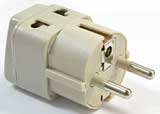 Grounded Universal 2 in 1 Plug Adapter
European Schuko plug.
4.8 mm prongs.
Equivalent to type E and F.
You can use this ungrounded Euro plug in some European countries.
#E-020
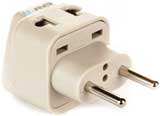 Universal 2 in 1 Plug Adapter
Euro Plug
4.0 mm prongs.
Equivalent to type C.
This is a universal plug adapter for the UK and Ireland.
#E-030
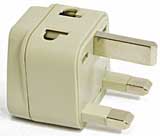 AC Adapter Plug for use in England, Scotland, Wales, and Ireland
Equivalent to type G.
Here is the Swiss version.
#E-040
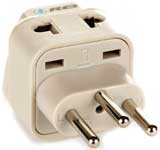 Grounded Universal 2 in 1 Plug Adapter
Type J for Switzerland
Here is the grounded Italian model.
#E-050
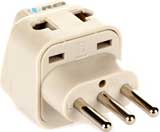 Grounded Universal 2 in 1 Plug Adapter
Type L for Italy
The links in this pink field take you directly to a page at Amazon.com. The Amazon page details the item, and in most cases includes candid and critical comments from others who have bought the item.
Amazon pays my site a small commission when you click and order an item, if you put it in your shopping cart within 24 hours based on the cookie they set on your computer. If you don't want to make a quick decision just put it in your shopping cart, think it over, and come back later. The revenue covers the cost of maintaing this web site and keeps it free to users.
You benefit when buying here because Amazon has:
- 20% - 30% discount on many items,
- free shipping deals, direct to your door,
- no sales tax on internet purchases in most states,
- zillions of products, well almost,
- fast delivery even when it is free,
- shipment tracking in UPS, USPS, FedEx,
- easy returns if you are not happy with the product.
You win we win. Thanks for your support!!
Have a good trip in life,
John Bermont
Note: Italicized notations by the author.
Absolutely the best battery for digital cameras which use AA batteries.
#E-120
 Energizer
AA Lithium Batteries
4 Pack
An RFID blocking wallet protects your passport and credit cards from identity theft in public places.
 Travelon RFID Blocking Passport Case
This is my book, available at Amazon.com. The last edition was published in 2003. Critical up-dates are on this web site.
 How To Europe
The Complete
Travelers Handbook
by John Bermont
The best travel guide to all of Europe.
 Europe on a Shoestring
Lonely Planet
A comprehensive guide to 3,000 hotels and restaurants in 44 major cities.
 Main Cities of Europe 2015
Michelin Guide
Rolling luggage sure beats lugging a pack on your back.
 Travelpro Luggage Maxlite 2 20" Expandable Spinner
A shoulder bag for your daily walk-about.
 Travelpro Luggage Maxlite3 Soft Tote
Keep your stuff organized.

Luggage Packing Cubes
eBags 3pc Set
A Swiss Army Knife is unquestionably the handiest item a traveler can carry, except not on a plane.
 Victorinox Swiss Army Huntsman II Knife
To help find your way on the winding and poorly posted roads of Europe.
 Lensatic Military Marching Compass
Inconspicuously lock your zippered luggage with a black wire tie.
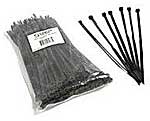 Cables to Go 43036 Cable Ties - 100 Pack (Black)
Ernest Hemingway writes about his life in Paris. I lived there about 50 years later.
 A Moveable Feast
Ernest Hemingway
The classic journal of a Brit who moved to France.
 A Year in Provence
Peter Mayle
Ms. Mayes went and bought the house she fell in love with in Italy.
 Under the Tuscan Sun
Frances Mayes
This humorous introduction to Holland is spot on.
 The Undutchables
Colin White
and Laurie Boucke
 Anne Klein Women's Classic Double-Breasted Coat
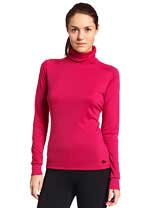 Hot Chillys Women's Peach Skins Solid T-Neck Shirt
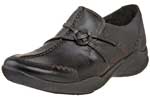 Clarks Women's Wave.Run Slip-On
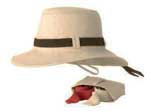 Tilley Endurables TH9 Women's Hemp Hat
Wear a scarf for comfort and style. Nobody will ever suspect that you are an American.
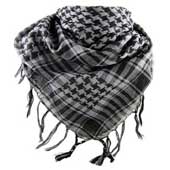 Very soft houndstooth neck scarf. Various colors available
My favorite T-shirt/undershirt has a pocket for securely carrying passport, cash, and credit cards under my outer shirt.
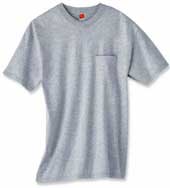 Hanes Tagless Short Sleeve Tee with Pocket
For leg comfort on the plane.

Arriva Travel-Tec Travel Legwear with Smart Compression Technology