Driving in Europe
Back Alley to Blazing Autobahn
Expressways, streets, signs/route numbers, do not enter, priority, yield, speed limits, pedestrians.

What is going on here? These drivers did not see or chose to ignore the 'Do Not Enter' sign (center, background). They were immediately confronted by bollards preventing entry to the city center of Cambridge, England. Only buses and bicycles are allowed. The four drivers are making some sort of U-turn to get out of there. In the background is an open-top hop-on hop-off, 'HOHO,' tour bus. One of the stops in Cambridge is the American Cemetery and Memorial. This is dedicated to American soldiers and airmen who lost their lives in World War II, including Glenn Miller, the great band leader who was over there entertaining the troops and disappeared while on a flight to France. I recommend a visit to the RAF Eagle Bar to view the ceiling in the back room. The airmen gave it their all.
Carpe diem. Vivere bene! Gratia Deo.

This is chapter 18.2. The entire book is published free on-line by the traveler, author, photographer, and webmaster — yours truly — with help from my daughter Stephanie and good friend Paula in Haarlem, The Netherlands. Patronage at euro-shoppe keeps this site on line. Questions, comments, contributions, and complaints are welcome. Please see NOTE TO READERS. Updated .
Drive it or park it.
IN FOUR PARTS
This Internet edition of chapter 18 is divided into four parts because it is so big. The four parts are:
- 18.1 European Auto Rental.
- Details and Documentation
- 18.2 Driving in Europe.
- Back Alley to Blazing Autobahn
- 18.3 European Driving Laws and Habits.
- Police, Speed Limits, Tailgaters
- 18.4 Parking, Gasoline, Safety.
- Adjuncts to Driving
STREETS AND ROADS
Flying Low
Probably the best road in the world is an hour stretch of the E19 through Belgium. It is a straight, flat, wide freeway and completely lighted at night. For real excitement try keeping up with the Fiats on the winding A7 tollway through the mountains of Northern Italy. Sweaty palms, even in my Porsche!!
Expressways
The variety of roads in Europe is greater than in America. There is a superhighway system throughout Europe that is equivalent to our Interstate Highway System. Parts of it, particularly in France, Greece, Spain, and Italy, are tolled. Austria, Switzerland, Slovakia, and some other countries charge an annual fee to use the expressways. You will be required to buy a sticker for your car as you drive into the country. In all other countries it is generally freeway.

This view shows a motorway passing through the city of Belfast, Northern Ireland. Notice that all of the cars are going the wrong way! Traffic travels on the left in Britain and Ireland. At one time this was the rule in Sweden also, but they got smart some decades ago.

Here is the open road in eastern France on an early spring day. Most French expressways are tolled, thus there is very little traffic except when school lets out for the summer and every French family heads south for 6 weeks.

There are no speed limits on most German Autobahnen but that doesn't mean that you will get there faster. This is a stand up traffic jam on the westbound A3 on a sunny summer Sunday just southeast of Frankfurt am Main. We lived nearby in Aschaffenburg for two years.
Secondary Roads
Off the superhighways, road quality drops suddenly to winding, two-lane asphalt paving. There is usually little or no shoulder and the road sometimes narrows to one and a half or even one lane. You might find yourself driving under a haystack in rural areas. Since most of Europe is agricultural, be prepared for livestock and produce wagons moving at a slow clip. In eastern Europe, horse drawn wagons are common on the highways. Sunday afternoon is walking day in rural areas throughout Europe. You may run across (not literally, I hope!) whole families walking abreast on the road.
City Streets
In the cities and towns, anything is possible. Surfaces can be concrete, asphalt, brick, dirt, or tooth rattling cobblestone. There are very few cities with wide boulevards, and not many with a one mile stretch of straight street. Besides having narrow, winding, brick streets, names sometimes change at irregular intervals. A good example is a major ring road in Düsseldorf, Germany. The name changes eight times within one mile.
Good maps are essential. Because of the narrow medieval streets, there are many which are one-way. If you miss a turn, it is difficult to double back. Gothenburg, Sweden reminds me of a whirlpool. Once I get in the center of town, I find it almost impossible to get out.
Some streets are posted to allow entry only for busses, taxis, or local merchants. It's easy to miss these because the sign may be in the local language. They usually have hydraulically operated pipe barriers which rise and lower when an authorized person inserts a special magnetic card in the control mechanism. German cities are almost always in reconstruction with detours galore. These can be extremely frustrating.
The problems of the streets should be added to the problem of parking and then added to the crime problem. Then you come to the conclusion that driving in the cities of Europe is not a good idea. Leave your rental car at the city gates.
ROAD MARKINGS
Route Numbers
There is a definite lack of route signs on the roads. Those roads which are numbered on maps seldom have the numbers posted along the roads. Compass directions, e.g. north and south, are not posted at intersections or expressway exits. To get to where you are going, you often need to know the name of every village or Dorf in between. It's not difficult to get lost.

This sign on an expressway near Milan, Italy shows that small engine mopeds and scooters are prohibited, along with pedestrians and horse drawn wagons. The left side showing the bridge is a standard sign indicating a limited access highway. Stopping is not allowed so make sure you have enough gas to get to the next exit.
Street Signs
In the cities street names are seldom seen on signposts at intersections. The usual practice is to have the street name posted on the corner of a building just above the ground floor. New buildings and redecorated buildings often have no street names posted. Again, it is not difficult to get lost, especially on a rainy night.
Do Not Enter
European road signs are mainly symbolic due to the large number of languages and the great amount of international traffic. These signs are virtually unknown in America, though they are coming into use in some areas and it's easy to learn the most important ones. However, modifiers to the posted regulation, e.g. "Sunday only," are always given in the local language.

The most important street sign throughout Europe is the one for DO NOT ENTER — WRONG WAY. It's about 18 inches in diameter with a horizontal white band on a red background. Here is one in Italy with an exception written in Italian. Unless you are driving an ambulance just don't go into this street.
One Way
One way signs in Europe are usually blue or black with a large white arrow on a horizontal rectangular plate. Inside the arrow is usually the local word(s) for one way, e.g., senso unico in Italy and Einbahnstraße in Germany. One-way signs in Ireland are white round boards with a red border and an arrow pointing up. The ones I saw in England were round blue boards with a white arrow and a sign underneath saying "One Way."

This one way street in Copenhagen, Denmark allows exceptions for bicycles. Keep your eyes open for approaching bikes.
Stop
Although STOP signs are rare in Europe, they pop up in some unusual places. French speaking locales seem to have the most and they are popping up in eastern Europe. They are also used in Ireland.

Here is one of those rare stop signs, in Riga, Latvia. The sign underneath indicates no standing. In other words, don't stop your car here for more than a moment even if you are in it. I learned that expensive lesson in Germany.

A yield sign in London, England with accompanying translation, in English. You must turn left at this intersection.

At an intersection in Kiev, Ukraine, I saw the red octagon hanging right up there next to a nondescript sign with the word 'stop' in Cyrillic. If you learn the alphabet it is amazing how many words jump right out at you. You'll notice that in Greece, also.

In driving across northwestern Turkey from Istanbul to Bulgaria we saw this traditional American octagon with the Turkish word DUR in the center. I guess we know what that means.
Priority and Yield
Another common sign is the yellow diamond, indicating PRIORITY over the intersecting road. The intersecting road will have an inverted triangle sign, white with a red border, meaning YIELD. If neither road has a sign, the vehicle coming from the right has the right of way.
Unposted intersections are rare in the countryside but common in the cities. Watch out. Europeans, especially taxi drivers, who are making a right turn do not even look for oncoming traffic since they have the right of way at unposted intersections. If they are going straight through, they only look to the right. If they see that a pump on the accelerator will get them into the intersection before another vehicle gets there, they do it. Sometimes it gets interesting. In Amsterdam I heard the standard "whoomp" of an accident and looked over to see one of the cars skidding on its roof.
Speed Limits
Speed limit signs are round. These signs have only a number indicating the speed limit, in kilometers per hour on the Continent. In Britain the number is miles per hour. In Ireland the number has km/h under it. Speed limits within cities are generally 50 kph (30 mph). Speed limits between cities are normally 90 to 110 km per hour (approximately 65 mph) on the major roads. Speed limits on most expressways in Europe are 130 kph (80 mph). In some countries citizens obey absolutely and in others they sing and laugh as they put the pedal to the floor.
Speed limit signs on the Autobahnen (expressways) in Germany are for the most part merely advisory, as you will learn soon after getting on an Autobahn. The legal limit is no limit. My daily drive to work in Germany in a 1.9 liter Opel was normally at 105 mph (170 kph). I was passed often. Sometimes I had that inconspicuous sedan up to 120 mph (190 kph +) but even then the Beamers would blow my doors off before I knew they were anywhere near me. In the frequent construction zones speeds are severely regulated. Speed limit signs in Germany with the added words bei Näse indicate that the limit applies only when the road is wet.

On this small street in Paris the speed limit is 20 kilometers per hour. That is about 12 MPH. Helping to enforce it is a sign warning of speed bumps ahead, in French of course. This is also a one way street except that bicycles are allowed in both directions. [Photo by Stephanie.]

Trucks longer than 10 meters (about 33 feet) are prohibited on this dead end street
in Dresden, Germany. Parking is allowed with
a parking voucher, 'mit Parkschein.' Look for a nearby Parkschien automat and buy a
voucher for at least as long as you plan to park. Leave it on your dash board
with the date and time legible from the outside.
See more about parking at part 4 of this chapter, Parking, Gasoline, Safety.
NO
Also round are signs indicating that ENTRY IS PROHIBITED for certain types of vehicles. A silhouette of a car, motorcycle, or truck in the white circle is specific for that type of vehicle.
A round sign with two cars, the one on the left being red, means NO PASSING.
A round plaque with no image means NO VEHICLES of any kind may enter. This is enforced by cameras which are everywhere. You will pay dearly.
A round blue sign with the silhouette of people walking, typically an adult holding the hand of a child, means that the road or path may be used by PEDESTRIANS ONLY.
Diagonal Line
Any road sign with a diagonal line across it means that the action illustrated is prohibited, or that this is the end of the condition. You see this most often on signs with a direction arrow. A sign with the diagonal band means NO LEFT TURN or NO RIGHT TURN depending on which way the arrow is pointing. If there is no diagonal band on the sign it means that the turn is required.
Hazard
Triangles pointing up warn of SPECIAL ROAD CONDITIONS. They usually show a silhouette of the hazard such as curves, skidding auto, running children, crosswalk, overhead clearance, or just a large exclamation mark! Be alert.

This sign warns of running children near a school in Paris. Ecole is the French word for school. After stopping, the speed limit is 40 kph, about 25 mph.
Signals
Traffic signals are the same as in America, green for go and red for stop. Signals are normally turned off at 11 PM, or changed to blinking yellows or blinking reds.
In Germany, traffic lights change from red to yellow before going green. As soon as the yellow comes on, everybody shifts into first gear and revs up. When the green comes on, they pop the clutch and move out. Austria has a similar system.
Between stop lights in many German cities, a small lighted number will be seen on a post by the curb. This indicates what maximum speed (in kilometers per hour) you can drive in order to avoid stopping at the next light.
In Holland some traffic lights are synchronized for the maximum speed allowed. This will be posted as Groen Golf (green wave) on a green sign of course. Don't speed and you don't have to stop. I read recently that some American cities have just inaugurated this decades-old traffic system. We're catching up to those clever Dutchies.
Right on Red
Making a right turn on a red signal is forbidden in every country I've visited in Europe. It is particularly dangerous to violate this law in Holland because there are so many bicycle roads running parallel with the streets and roads. The bicycle roads have their own traffic signals. People from 3 to 103 ride bikes in The Netherlands.
Pedestrians
Most intersections with traffic signals also have a pedestrian walk-stop signal. This is normally controlled by a person wishing to cross. The pedestrian pushes a button and waits for the walk signal. Many do not wait. Jaywalking is almost universal in Europe, except in Germany. People obey the law in Deutschland. In other countries it is common to see a brigade of jaywalkers jumping out into the street. The ones at the rear are at risk because drivers are more inclined to honk than slow down.
Pedestrians in some cities are treated to audio versions of walk and don't walk. This is to assist blind persons.
City Center Prohibitions
Many streets in city centers are reserved for local business people, residents, city buses, or pedestrians. To enforce this the entry to the street is always marked as such, in the local language and with standard signs, and is often blocked by a couple of 8" diameter steel posts rising up from the road. Those with permits have a swipe card which lowers the posts momentarily so they can drive through. If you try to sneak through right after someone goes in you might hear a sort of crunching sound as the posts come up under your car. This will be an embarrassing moment.

Ignorance or disregard of the Z.T.L. sign has cost thousands of drivers zillions of euros in Italy. This one is in Pisa. Similar zones exist in Florence, Milan, and other popular tourist cities. As you can see, Z.T.L. stands for zona traffico limitato, restricted traffic zone. You are not allowed to drive past this sign. If you break the law a hidden traffic camera will photograph you. The picture is then sent to the car rental agency which tags your credit card for $50. This is simply for administrative work in providing the municipality with your name and home address. Official things move slowly in Italy so it will be up to six months before you get the official ticket. The ticket will order you to pay the actual fine, probably a few hundred euros. Ouch.
Cities are doing this to control traffic in the city centers, and to fill the city coffers. If your hotel is in the center of the city it is likely that it is in a Z.T.L. Contact your hotel to get a temporary pass if possible. Otherwise you may end up paying dearly just to get to your room, long after your trip.
How do you pay if you are summoned? Good question. One way is to make a wire transfer from your bank or credit union account. That will cost you another $50 or so. Visit your local office. However, many banks have discontinued this service in the past few years. No bank will do it unless you have an account. If you are caught in this limbo you can use an international currency exchange service. Try XE for starters.
By the way, the empty red circle ALWAYS means 'do not drive on this street' no matter what. The red circle with the number 30 means that the speed limit is 30 kph, about 18.6 mph, IF you are authorized per the small print in Italian. In most countries the typical 10% American slack is not an option. Stay under the limit. [Photo by Stephanie.]
DRIVE ON
As noted above, this Internet edition of chapter 18 is divided into four parts because it is so big. The four parts are:
- 18.1 European Auto Rental.
- Details and Documentation
- 18.2 Driving in Europe.
- Back Alley to Blazing Autobahn
- 18.3 European Driving Laws and Habits.
- Police, Speed Limits, Tailgaters
- 18.4 Parking, Gasoline, Safety.
- Adjuncts to Driving
Have a good trip!
Selections at

#E-010
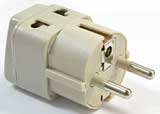 Grounded Universal 2 in 1 Plug Adapter
European Schuko plug.
4.8 mm prongs.
Equivalent to type E and F.
You can use this ungrounded Euro plug in many European countries.
#E-020
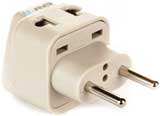 Universal 2 in 1 Plug Adapter
Euro Plug
4.0 mm prongs.
Equivalent to type C.
A universal plug adapter for the UK and Ireland.
#E-030 hhh
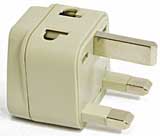 AC Adapter Plug for use in England, Scotland, Wales, and Ireland
Equivalent to type G.
Here is the Swiss version.
#E-040
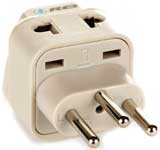 Grounded Universal 2 in 1 Plug Adapter
Type J for Switzerland
Here is the grounded Italian model.
#E-050
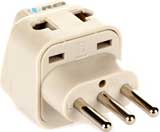 Grounded Universal 2 in 1 Plug Adapter
Type L for Italy
Note: The highlighted #E number is arbitrary. It is meant to help identify products in this advert page when you write in for electrical advice.
This 110-250 volt power surge strip has three universal outlets and an American grounded plug so it needs a plug adapter for the countries you are visiting. Make sure that all your gizmos are rated for 110-240 volts.#E-060
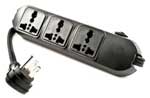 SM-60 Universal 3 Outlet Power Strip Surge Protector for Worldwide Travel. 110V-250V with Overload Protection.
For charging up to six gizmos at a time use this 250 volt universal power strip. It comes with a grounded Continental plug.
#E-070
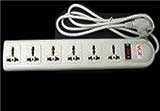 Surge Protector
Power Strip
6 Universal Outlets
220/240 Volt 50/60Hz
If your gizmos charge through a USB port this can keep you going. European cars have the same 12 volt system as American cars.
#E-200
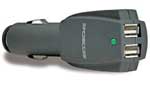 Scosche Dual USB
Car Charger
This 50 watt transformer changes 220 V electricity to 110 V. It works for small devices up to 35 watts continuous service, if they can operate on 50 Hz which is true for many battery chargers. Check your electrical nameplates and refer to chapter 11 for further information.
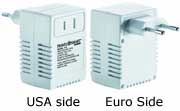 50-Watt International Transformer.
Travel Smart by Conair.


HOW TO EUROPE
The Complete Travelers Handbook
Table of Contents
Chapter 1
Travel Like a Native In Europe
Chapter 2, Part 1
Travel Costs: How Much?
Chapter 2, Part 2
My Actual Expenses
Chapter 3
Identity and Travel Documents
Chapter 4
Travel Starts at the Airport
Chapter 5
Your Best Travel Clothes
for All Occasions
Chapter 6 Part 1
Travel Europe in Comfort and Style
Chapter 6 Part 2
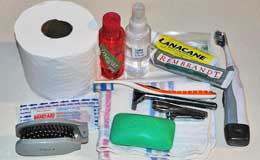
Pack Your Toothbrush, Toilet Paper, and Vinegar.
Chapter 6 Part 3
Travel SuppliesSmall Stuff Packing List
Chapter 6 Part 4
Bringing Valuables to EuropeNot in Your Luggage or Purse
Chapter 7
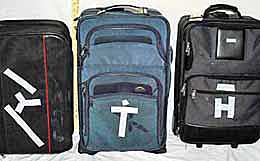
Pack Light, Let It Roll
Chapter 8 Part 1
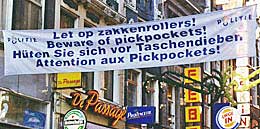
They're Everywhere
Chapter 8 Part 2
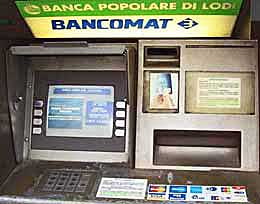
Machines Dispense Travel Cash
Chapter 8 Part 3
Paying Your Way in Europe
Chapter 8 Part 4
Cash, Coins, Transfer, Barter
Chapter 9
Blog It
Chapter 10

Reviews of Tomes for Travelers
Chapter 11, Part 1

Why You Should
NEVER Use a Converter
Chapter 11, Part 2
Outlets, Plugs, Converters, Adapters, Voltage, Power, Frequency, Watts.
Chapter 12
Take Your Best Shot
Chapter 13

Travel Europe in Good Attitude
For all 30 chapters and much more see
HOW TO EUROPE
The Complete Travelers Handbook
Free to use but not to abuse.
Copyright:
Internet edition
© 2001-2016 James J. Broad
All rights reserved. Tous droits réservés.
This is copyrighted material. Do not reproduce, copy, plagiarize, re-craft,
store, modify, extract, transmit, or purloin any part of this
publication in any nation in any form or by any means or for any purpose whatsoever without permission
in writing.
Copying:
You may print one paper copy of this web page for your personal use.
Permissions:
If you want to adapt any part of this material to use in your blog, forum, web site, book, article,
speech, term paper, movie, video, or any other media please write to me and get
permission before you do so. Otherwise it is a copyright violation or plagiarism.
Plagiarism includes paraphrasing text and copying ideas. Imitation,
the old saying goes, may be the highest form of flattery. However, plagiarism is outright theft and is usually
compounded by the lies of the perpetrator.
Everything on my web site is original, created at great personal expense
in time and cash in the course of my extensive travels throughout Europe. Please respect my property.
For detailed descriptions of the many forms of plagiarism see
Plagiarism.org and
A Plagiarism Guide for Students.
For permission to use material from this web site contact:
[email protected].
Webmasters:
You may link the URL http://www.enjoy-europe.com/hte/chap18/auto-2.htm freely. Please do. When you link please send the URL for your linking page and a crosslink will be installed in one of the categories of the TRAVELERS YELLOW PAGES to your site if it has significant content for travelers in Europe.
Free, free, and free
This web site is totally free for everyone, and a labor of love for me.
Support
To keep enjoy-europe.com afloat I advertise scores of travel related books and products. My site receives
a commission from Amazon.com for all goods purchased through the advert links. These advert links are
displayed on individual pages and on my on-line store at
. Your support is most gratefully appreciated. TIA.
Your Blow Back
I welcome questions, comments, and complaints. If you have any concerns about your trip to Europe that have not been covered well enough on my web site please do not hesitate to write. Ask, cuss, discuss, or whatever. I read every email and update my pages when I see a question repeating,
Utilities:
- How To Europe: The Complete Travelers Handbook.
- Home.
- To the top of this page
- E-Mail to John Bermont
- Meet the Author
- Privacy Policy
- Site Map
- Advertising Policy