Money Potpourri
Cash, Coins, Transfer, Barter.
Banking hours, ATM hours, International Transfers, shoe money.

Exchanging currencies is a free market business. There is no official exchange rate and dealers will charge whatever they can get. This GWKTravelex office in Amsterdam's Schiphol Airport has several customers for euros, the official currency of the Netherlands and many nations of Europe, members of the group affectionately named the Euro Zone.
The ATM machine on the wall in the background certainly has better rates than the serviced desk. There is at least one other bank, the ABN-AMRO, in the airport and another half dozen in most Dutch cities.
Carpe diem. Vivere bene! Gratia Deo.
Chapter 8 Part 3
HOW TO EUROPE:
The Complete Travelers Handbook
John Bermont

This entire book is published totally free on-line by the author and photographer, yours truly, with help from my daughter Stephanie. Yes, you can copy — if you ask first. Please read my copyright and permissions statements. Visit my home page at enjoy-europe for truck loads of more helpful illustrated travel information sans pareil. If you have questions or comments after reading this chapter please see NOTE TO READERS. Updated 6 November 2015.

Cash is king.
IN FOUR PARTS
This Internet edition of chapter 8 is divided into four parts because it is so big. The four parts are:
- Pickpockets: They're everywhere.
- ATMs in Europe: Travel Cash.
- Cash and Credit: Paying Your Way in Europe.
- Potpourri: Barter if you're broke.
Part 1 of this chapter focused on the issue of protecting your stash. Part 2 discussed the European version of ATMs, autiomatic teller machines. Part discussed the money instruments at your disposal. This part is a catch-all for remaining miscellaneous but important inormation.
There are many nuances of using money in Europe. For example, getting change from a merchant if you need some coins is virtually impossible. Then if you try to buy something just to get some change you will be asked if you have the exact amount.
CASH
There is is no universal rule that says you must use credit cards when you travel. True, there are some specifics that make plastic better. E.g., it is virtually impossible to rent a car without a credit card and it is somewhat impractical to fork over a thousand bucks cash for an airplane ticket. However, in general credit cards are an American curse from the 1960s and never took hold in Europe.
For the vast majoriy of everyday travel expenses there is always that old standby — cash. You can buy enough Franks, euros, kroner, pounds, or whatever to pay for your entire trip. They will be accepted in the country which issues them, and you won't have to worry about fluctuating exchange rates as you travel. Nowadays the best place to "buy" European currencies is at an ATM attached to any bank in Europe. Cash machines are everywhere.
If you see a person using plastic it is usually a bank card with a chip+pin, not a VISA or MC credit card with only a magnetic strip. European chip+pin cards work like American debit cards but they are far more secure because they have an electronic chip in addition to a required personal identification number, a PIN for short. The chip is visible on the face of the card. I call it a little spider. European chip+pin cards also have a hologram on thier face.
I tend to pay for everything with cash, as do most Europeans. I draw what I'll need for half a week at an ATM and leave the credit cards for big expenses at hotels and such. This minimizes the risk of having my credit cards compromised, a frequent occurence in Europe despite my frugal use of them. It also helps control expenses and stay within budget. See chapter 2, On Budget in Europe: Travel Costs. How Much?, for help in making your budget.
Coins
Europe doesn't use silver or gold anymore. European countries have debased their coinage just like the USA did. When I was a kid everything from a dime to a dollar was silver. Copper, nickel, and aluminum alloy coins are now in circulation in Europe. Heck, why don't they just make them out of plastic?
The biggest coin for Americans in everyday use is a quarter. Coins valued at €2 are normal in Europe. That's about ten times the value of a quarter. There are copper "pennies" in Europe but you'll probably never see one. When change is due and it is less than a dime it is usually not returned.
Last Minute Needs
On leaving any country by train, plane, or ship don't trade in all your local currency before boarding. You may want to buy a last minute apple or newspaper, or you may be charged a reservation fee or departure tax. Refreshments on board can be purchased with departure country currency, and often at a lower equivalent price than if you use the money of the destination country. Keep ten or twenty dollars worth of your departure country currency until you are well over the border.
On leaving Romania we had a problem with this. Even though it was illegal to leave with any of the local wampum, and we had receipts for all that we had bought, the border bank refused to accept our Romanian lei and give us Hungarian forints as we were crossing the border. They know the value of their own stuff — not much. Over the border in Makó we were able to unload the Romanian rubbish at a steep discount for Hungarian forints at our motel. But then the motel keeper would not accept the Hungarian money for the room. We had to pay with German currency. The motel keeper didn't like his native forints either.
Emergency Greenbacks
Lastly, always carry some greenbacks wherever you are, and use them only in emergencies. If you have no need, just bring them home. I would recommend carrying five each of $1, $5, and $20 for emergency exchange situations. I also bring ten $100 bills in case of a big emergency. Bring these from home, of course. Make sure you bring crisp new bills. Europeans do not like dirty old money. And bring the new style "big face." These US bills are now water marked, among other anti-counterfeiting measures. Europe has had water marks for decades and finally the USA got around to it, but not before millions of forged $100 bills went into circulation around the world.

The ABN-AMRO Bank in Schiphol Airport Amsterdam posts these exchange rates for major world currencies. Here is a code breaker for this table. "Amerika" is the USA and "USD" is US dollar. "We buy" means that you will receive €0.835 for each greenback. Well, not actually. You have to read the small print in the bottom line, "Commission: EUR 3.25." I traded $105.00 cash for €87.72 and paid the commission. This netted me €84.47. Each euro cost $1.24. The next day in Haarlem I used my credit union ATM card and drew €100. My credit union statement shows a withdrawal of $110.17 plus a Mastercard Cross-Border Fee of $0.88. So that cost me $111.05, or $1.11 per euro. That was a savings of 10.66% versus trading cash at the airport bank the day I arrived. Overnight the dollar went up by 0.82% so my true net saving was 9.84%. Round it off to 10% to keep it simple. The lesson, which I already knew: always use ATM machines for currency transactions. Most of the rest of the table is intuitive, even with those country names spelled in Dutch. The currency abbreviations are common in international commerce. Next to Switzerland you see CHF which means Confoederatio Helvetica, the Latin name for those hills, and Frank, the name of the currency. Why do they call it CH? Ask Arnold Winkelried. And by the way, the date 03-08-2015 at the top is not March 8, 2015. It is August 3, 2015. See my chapter European Dates and Time.
MONEY POTPOURRI
Identification
When exchanging money in many countries your passport is required as identification. If you are one of those paranoid insecure beings who leave your passport in the hotel safe, well you can have a small problem. In some countries it is required to have a government issued photo I.D. on your person whenever you are in public. It would be a rare event if a cop on a street were to stop you and ask for it, except in Switzerland. That can be a major problem.
Interbank Transfers
If you are a regular visitor to Europe there are other ways to get your money overseas. One is to have your bank transfer funds by wire from your account to an account you have established with a foreign bank. Make arrangements for transfers before departure. This service costs $25 to $35 per transfer. Banking and money laws vary from country to country so check out all the rules before jumping to this course of action. This procedure would be practical for someone making a long journey or many frequent trips, or planning to settle down over there.
Resident Bank Account
Those planning to live overseas for work or study should get a resident bank account. But this may present at least one other problem. You may be prohibited from maintaining a bank account at home. For example, Dutch authorities will be very curious if they notice money flowing between your Dutch account and another account under your name outside Holland. Their first suspicion is that you are transferring money out to avoid taxes.
Tax evasion is a practiced art throughout Europe. Few people miss a chance to hide some zwart gelt (black money) from the confiscatory tax man. In 2009 the German tax collectors were offered a list of wealthy Germans who had secretly parked piles of money in Swiss banks to avoid taxes. The list had been stolen but the German tax authority paid a premium to get it because the return on their investment was huge. Many people were nabbed and had to ante up. The French really did the job on their millionaires in 2012 with a 75% income tax. One famous actor quit the country and moved to, of all places, Russia. He was greeted with a bear hug by Prime Minister Putin and settled in, paying only 13% tax in the former (?) communist country.
For more information on the tax situation in Europe see Working in Europe. If you complain about American taxes you ain't seen nothing till you see the tax laws in most of Europe.
Some countries regulate the amount of money that anyone, resident or not, may take over the border. Even US citizens are required to report large transfers, those exceeding $10,000. This regulation is supposed to help stop traffic in illegal drugs. Fat chance. Why don't we just legalize marijuana? That would bankrupt the drug cartels. We wouldn't need all these fascist laws. Then tax the grass like booze and eliminate the national debt. Everybody be happy! This paragraph is dedicated to former Congressman Ron Paul. Unfortunately most of the other politicians are stupid, corrupt, or incompetent.
Letter of Credit
Another way to carry money overseas is to obtain a letter of credit from your home bank. These are usually used by commercial establishments in paying for imported goods, and are therefore written for very large amounts of money. In practice, a letter of credit could be likened to a certified check or a travelers checque. It's reported that letters of credit are not held in the highest esteem because of the ease of forgery. Don't play with this unless you really know what you are doing. Ordering a direct electronic funds transfer is the modern, and safer, way to transfer a large batch of money overseas.
Caveat Cash
Be careful that you don't receive some funny money as change from storekeepers. This has happened to me several times in Holland. The Dutch had retired their beautiful old bank notes and substituted new bank notes in gaudy pastel colors. No Dutchman would accept the old currency because they knew that it was out of circulation, but it was passed to American tourists in the 1980s. Germany introduced new banknotes in 1993 and obsoleted the old ones. These countries now use the euro so you shouldn't be seeing any Dutch gulden anymore, period. It is worthless.
Also, beware of counterfeit money. Several times I have seen French storekeepers hold a 100 or 500 franc note up to the light to make sure that it was good. Bank notes in Europe are watermarked and have been for decades. Usually the watermark is the portrait of a national hero found in a blank oval on the note. Sometimes it is a geometric pattern. The new euro is also watermarked. Make yourself familiar with the characteristics of the local currency to help avoid the sting.
Regulations
A few of the eastern countries prohibit import of their currencies. That assumes that you could buy them somewhere in the first place. When you do buy currencies in the east, make sure that you obtain and keep the receipt. These countries are extremely upset by black-market dealing in their currencies. As mentioned above, even with the receipt I was not able to reconvert my Romanian lei.
Before returning to the United States, it is best to trade all your excess foreign money back to US dollars. At home, banks charge a fee per transaction per currency, in addition to their high buy/sell spread. Instead of cashing it in at home you would probably be better off if you framed the money you brought home. What the heck, it makes a nice souvenir of your trip.
Barter
If you're out of cash and credit, try the oldest means of exchange -- barter. I met an Australian traveler who claimed to have traded a pair of Levis for three nights of room and food for himself and his wife in Yugoslavia. Barter is not very effective in western Europe, even though the price of Levi's is about triple what we pay in the USA. Levi Strauss is pretending to be Calvin Klein in Europe.
MORE ON MONEY
As noted above, this Internet edition of chapter 8 is divided into four parts because it is so big. The four parts are:
- Pickpockets: They're everywhere.
- ATMs in Europe: Travel Cash.
- Cash and Credit: Paying Your Way in Europe.
- Potpourri: Barter if you're broke.
Have a good trip!
NOTE TO READERS
I welcome questions, comments, complaints, and compliments. If you have any concerns about your trip to Europe that have not been covered well enough on my web site please do not hesitate to write. Ask, cuss, discuss, or whatever. I read every email and update my pages when I see a question repeating, Then I will not get that question again, hopefully. In some cases readers have been so generous with their time and talent that I have included their emails verbatim, e.g. chapters 22 and 25.
I do not open attachments. I do not click links to web pages of any kind. I will reply in a day or two, usually.
My email address is [email protected].
Do not forget to smell the hyacinths. At your liesure scroll through the Table of Contents of How To Europe: The Complete Travelers Handbook and read all 30 chapters, FREE on line. Good deal! You'll probably find the answers you seek, and some you didn't know you needed.
FREE
This web site is totally free for everyone, and a labor of love for me. To keep it afloat I receive a commission from Amazon.com for all goods purchased through the adverts I have selected, and any other products you might buy when you are on the Amazon site. Amazon has almost everything for sale, except the Brooklyn Bridge and Mount Rushmore.
Please visit my on-line store at
 .
Your support is most gratefuly appreciated. TIA.
.
Your support is most gratefuly appreciated. TIA.
To like and like not:


Adverts
To support this site:
Please buy your goods at:Amazon.com
Shop in your shorts!
Please clean out your cookie jar before clicking.
Wear a money belt under your shirt to protect your passport and valuables, especially if you are staying in hostels or dorms.
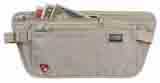 Lewis N. Clark RFID Blocking Waist Stash
An RFID blocking wallet protects your passport and credit cards from identity theft in public places.
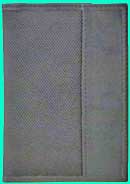
Travelon RFID Blocking Passport Case
The links in this pink field take you directly to a page at Amazon.com. The Amazon page details the item, and in most cases includes candid and critical comments from others who have bought the item.
Amazon pays my site a small commission when you click and order an item, if you put it in your shopping cart within 24 hours based on the cookie they set on your computer. If you don't want to make a quick decision just put it in your shopping cart, think it over, and come back later. The revenue covers the cost of maintaing this web site and keeps it free to users.
You benefit when buying here because Amazon has:
- 20% - 30% discount on many items,
- free shipping deals, direct to your door,
- no sales tax on internet purchases in most states,
- zillions of products, well almost,
- fast delivery even when it is free,
- shipment tracking in UPS, USPS, FedEx,
- easy returns if you are not happy with the product.
You win we win. Thanks for your support!!
Have a good trip in life,
John Bermont
Note: Italicized notations by the author.
Rolling luggage sure beats lugging a pack on your back.
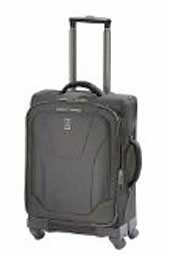 Travelpro Luggage Maxlite 2 20" Expandable Spinner
A shoulder bag for your daily walk-about.
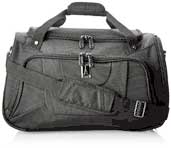 Travelpro Luggage Maxlite3 Soft Tote
Keep your stuff organized. There are more than a dozen colors and patterns to choose from.

Luggage Packing Cubes
eBags 3pc Set
The two gallon size is excellent for packing your clothes.
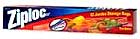 Two gallon plastic bags
ZipLoc by SC Johnson
Inconspicuously lock your zippered luggage.
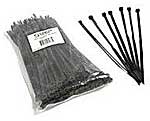 Cables to Go 43036 Cable Ties - 100 Pack (Black)
Note: The highlighted #E number is purely arbitrary. It is meant to help quickly identify products in this advert column when you write in for electrical advice.
See NOTE TO READERS.
Plug adapters are needed throughout Europe. There are at least five models used in different countries.
This adapter is for the standard grounded plug in France, Germany, and northern Europe. It does not fit in outlets of Italy, Switzerland, Ireland, and Britain.
#E-010
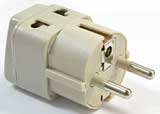 Grounded Universal 2 in 1 Plug Adapter
European Schuko plug.
4.8 mm prongs.
Equivalent to type E and F.
You can use this ungrounded Euro plug in some European countries.
#E-020
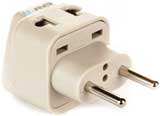 Universal 2 in 1 Plug Adapter
Euro Plug
4.0 mm prongs.
Equivalent to type C.
This is a universal plug adapter for the UK and Ireland.
#E-030
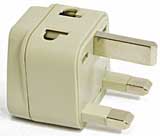 AC Adapter Plug for use in England, Scotland, Wales, and Ireland
Equivalent to type G.
Here is the Swiss version.
#E-040
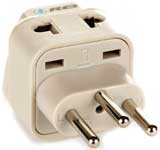 Grounded Universal 2 in 1 Plug Adapter
Type J for Switzerland
Here is the grounded Italian model.
#E-050
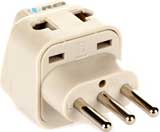 Grounded Universal 2 in 1 Plug Adapter
Type L for Italy
If your gizmos charge through a USB port this can keep you going.
#E-200
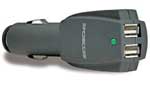 Scosche Dual USB
Car Charger
A Swiss Army Knife is unquestionably the handiest item a traveler can carry, except not on a plane.
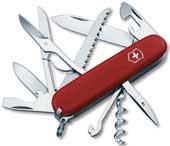 Victorinox Swiss Army Huntsman II Knife