Working in Europe
Get Paid to Travel
How to find a job in Europe. Work permit, residence permit, employment contract, benefits, quirks.
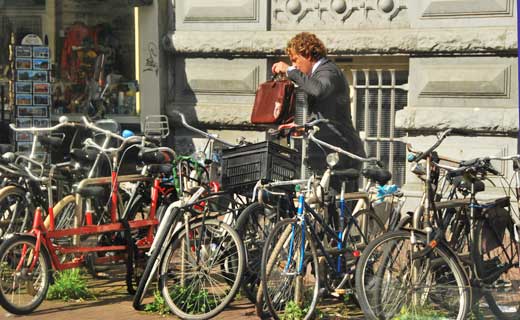
This young professional parks his bicycle in Amsterdam on his way to work. This is the way most Dutch people commute, and the way I did it when I worked in nearby Haarlem. This is one of the many many differences you will experience when working in Europe. You deal with it, and you love it.
I took this photo on my 2015 summer tour of Holland. The weather was fantastic, for the most part. But it rains and rains in Holland during most of the year. The day may start off with a beautiful sunrise but the North Sea may dump part of itself on Holland at any moment. For weather protection and clothing suggestions see my chapter 5, What To Wear in Europe: Your Best Travel Clothes for Every Occasion.
Carpe diem. Vivere bene! Gratia Deo.
Chapter 21
HOW TO EUROPE:
The Complete Travelers Handbook
John Bermont

This entire book is published totally free on-line by the author, photographer, and webmaster, yours truly, with help from my daughter Stephanie. I welcome all questions, comments, and complaints. For contact information please see NOTE TO READERS. Updated 21 December 2015.

Your Go-To Travel Store
The Joy of Work
GET A JOB, IF YOU CAN
If you like to travel in Europe, what better way is there than if somebody pays you to do it? With a job in Europe, you settle in, learn the way of life, learn the language like a local, make new friends, and open yourself to an experience that will become a major part of your life.
Barriers to Employment
Before discussing the ways of getting a job in Europe, first it is important to state the reasons why you probably will not get one. It can be done and many thousands or millions have done it. But it is as much luck as hard work, and plenty of both. Officially I've done it twice. No comment on the un-official stuff.
Unemployment Rate
The first reason that getting a job is difficult is that the unemployment rates in most European countries are higher than in the United States. If Europeans are having trouble getting jobs in their own countries, why would it be easy for someone from halfway around the world? No government has its door open welcoming you to come over and take a potential job away from a local voter. Only the United States does that.
Most of those out of work in Europe are barely looking for work. Why would you look for a job if you are getting 90% of your prior salary in unemployment insurance? That's about the way it is in Europe. I guess you would look for a job only if you are too stupid to hold one. When I worked in Holland there was a story going around about a TV actress who got the pink slip. No worry, she began collecting 90% of her previous million dollar salary as unemployment benefits. She was probably a certified air head but she was smart as a fox.
Work Permit
The second obstacle for Americans is that the European Union (EU) is basically a closed society to citizens from countries which are not members. The EU consists of over two dozen countries, more than half of Europe, and is growing as we breath. Check EU Country List for an overview of the EU.
Getting a work permit is all but impossible except for those with special professions and skills, even in good times. My two work experiences were for American/European companies which did the work permit paperwork. I had to fill out some forms and the company certified I was needed and that nobody in the European homeland could be found to do the job. For the German transfer, the company stated that I was on a technical exchange program. Ten Germans were transferred to the USA for the seven Americans sent to Germany. I guess that is a fair exchange.
If you are married your spouse had better like the idea of doing nothing productive for the duration. This caused some grief for us on the German transfer. Elizabeth quickly found a job at Frankfurt airport that could make use of her ability in four languages. The German Arbeitsamt (Labor Department) just as quickly denied her the work permit because of the high unemployment rate and the fact that I had a job.
GETTING A JOB
I was lucky to have obtained jobs in Europe twice. The way I did it can probably be described as serendipity, though I did have a plan to explore the possibility when I joined each of the companies which eventually transferred me. There are many professions which are transportable. As with many things in life, it's a matter of being in the right place at the right time. You have more control over place than time, so focus on being in the right place.
European Classified Ads
Job offers in the classified section of the International Herald Tribune, a newspaper targeting the American expatriate audience, usually include a statement that you must have valid work papers. This is true even for bi-lingual positions requiring a native English speaking person. These jobs will go to British people because Britain is a member of the EU. The most commonly advertised jobs of this sort are secretaries, English teachers, and translators.
American Companies
A way around the work permit hurdle is to work for an agency of the US government or for an American company. It is easier to find these jobs in the US than in Europe.
American specialists occupy a small number of key positions in the European offices of many American companies. However each company is as individual as it's name. Some will hire only nationals of the country where they are located while others will use Americans in many jobs.
Educational Jobs
Transitions Abroad, a monthly magazine oriented to work, study, and living overseas, regularly publishes articles and advertisements on specific career positions available overseas. This would be a good place for someone with a liberal arts education to start exploring.
Seasonal Jobs
Tourism and agriculture require large numbers of employees for just a few months a year. Businesses from vineyards to ski resorts need semi-skilled workers during their high season. There are directories and official agencies which can point you to these jobs. The pay is lousy. Many workers in seasonal agricultural jobs are reportedly working illegally. Sound familiar?
European Employment Bureaus
Generous social benefits and extreme taxes are a bane of employers throughout Europe. Companies must cope with the decades-old laws giving workers an absolute right to a job and wonderful benefits. Consequently, employment bureaus offering part time or contract employment have started to spring up. It's very prevalent in Holland, a country with some of the highest taxes and juiciest employee benefits. To get around some of the costs of complying many companies employ short term workers on contract. In Holland you'll see many uitzendbureaus (literally "send out agencies") offering jobs such as secretary, bookkeeper, or draftsman. You will need a work permit to take one of these jobs, and probably need to speak Dutch. Stop in one of these offices and have a chat the next time you are strolling in Amsterdam.
My Luck
I'm a chemical engineer, playing roles as process engineer, project manager, and business development manager over the past few decades. In the mid 70's I went to work for a major engineering and construction company which had offices and projects around the world. I was single and was regarded as "transportable" by management. I was soon sent on assignments for weeks to months at a stretch, domestically and internationally. In late 1975 I was asked to transfer to the Netherlands office for a two year assignment. It turned out to be the best two years of my life on the social side, but not so good on the professional side. Nevertheless, I would do it again.
Then in early 1991 I accepted another transfer, this time to Germany. I was working for an environmental consulting company in Los Angeles. Suddenly it was purchased by a division of a major German conglomerate. Knowing something about what to expect, I grabbed for the opportunity when a transfer became available. This company knew nothing about transferring people overseas so the experience was much different. Being married and with a three-year old daughter at the time contributed to the differences.
These two experiences point out one excellent way for a technically trained person to obtain a paid leave to Europe. Get a job with an American company which has offices in Europe or which is owned by a European company. Then let it be known that you are interested in moving over there. When you hear about transfer opportunities coming up move quickly and get in the front of the line.
FINDING A REAL JOB IN EUROPE
The balance of this chapter will focus on approaches that will land you a well endowed job in Europe. It assumes that you are, or will be, working for an American company and have been offered an overseas transfer. You are a professional with a college degree or with equivalent experience in your field. Your field is a specialty in business, finance, science, or engineering. This is the route I took and the one that I can speak to.
Find an Employer
How do you find a European oriented company? Start with the company you are working for. If they have branch offices in Europe, see about obtaining a transfer.
Directories
To locate companies with overseas operations, consult stock market and business directories. These publications list publicly traded companies. They are the biggest companies and the ones most likely to have foreign subsidiaries. Then write to or call the head office and request an annual report. This will give you a PR agent's view of the company with plenty of pretty pictures next to the columns of numbers and loads of footnotes. A good study of the annual report can be invaluable in approaching a company when you are looking for a job, whether here or over there.
A visit to your library will turn up a number of directories listing companies doing business in Europe. The listings in these directories are based on a number of different criteria and they are published on individual schedules. Thus, none of them are complete or totally up-to-date at any one time. It's best to consult several of these directories.
One that I would suggest as a starting source is the four volume World Business Directory. This lists over 100,000 companies in 190 countries, including many listings for all of the European countries. Just look through the directory until you find names you recognize. That's not hard to do if you're into chemicals and sticky paper. 3M seems to be in every country and is usually listed first. Most of the major American companies have operations in Europe, as do many smaller companies. Research the prospective employers to find out where their European offices are located. Other reference materials to look in are Standard & Poor's and Hoover's.
This is a lot of hard work. Success is not guaranteed, but 1,000 failures are history after you score. I've worked with enough Americans overseas, from superbly qualified to sorely incompetent, to be convinced that anybody can do it.
Internet
Try the internet job search engines using keywords that describe your profession and the countries you are interested in.
You can also locate jobs through some bulletin boards on the internet. These services are free, and can offer information on thousands of positions everywhere. Computer oriented jobs dominate the listings but there are plenty of other positions.
Action
When you find potential companies, get the name of the VP of International Operations or European Operations and write directly to him/her with your resume. Do not send your letter to the human resources department. If the VP is interested in you, he will have the HR department contact you. If you can't find a suitable VP write directly to the CEO. Make it brief and business like.
EMPLOYMENT CONTRACT
After you have an offer for an overseas position you will be given a contract to sign. This sets out all of the conditions governing your transfer, your working conditions, overseas benefits, and miscellany. The contract will be 10 to 30 pages in length. Keep a copy where you can find it easily.
Term
All contracts must have a term, i.e. a start date and an end date. Typically this will be two to five years. Typically there will be options to break the contract which can be exercised by either party. Say, 30 to 90 days notice is needed to break the contract. Companies sometimes change this as they see fit, and/or fuzzy up the completion date to give them an out if things don't go right. On my first transfer I chose to come home about three months early, and on the second one the company chopped it with about six months to go.
Relocation
The company must pay for your relocation costs, though they limit what can be moved. For a family, normal household items are typically no problem, but may be too restrictive for your personal situation. I had to ask for a reversal on a prohibition against moving our piano, and got it. Most companies will not pay to move your car over.
Relocation assistance for single status is very thin. In 1975 I was given a plane ticket and $246 to cover my expenses, and told to report to work in Holland a week after the following Monday.
Housing
You might or might not be given a house and/or a housing allowance. Housing is very expensive where you will be living, probably in a major city or suburb. This is an important point in the contract. Consider your wife and children when looking for a home since they will be spending 90% of their time at home while you are at work or on the road for business.
Automobile
If you are living and working there, a car is becoming just as indispensable in most of Europe as it is in the USA. Having a company car in the contract can be worth many thousands a year since the cost of cars, maintenance, insurance, and gasoline is much higher over there. You can bring your own, as I did for my single transfer to Holland, or have one provided by the company, as was the case for our German transfer. A second car can be very helpful if you have children unless you are in the heart of a major city.
Home Leave
Typically you and your family will be given an annual home leave. The company contribution is the cost of the plane tickets to your home base as specified in the contract. You'll probably use your own vacation time. Going someplace other than "home" is probably OK with the company as long as it doesn't cost more. Bring this up after you get over there, or just do it and turn in the receipts after the fact showing that you saved them money.
Bereavement leave and plane fare home should also be provided in a oveerseas transfer contract.
Conditions
Get everything you want in the contract before you go because it won't happen after you get there, unless you are indispensable and threaten to resign. Personnel department clerks will not change anything for you. You must go to the VP or personnel director who is sending you over there and negotiate anything you want changed directly with him, and do it before you go. Don't expect an easy sell and don't expect a second chance. Your company has probably been using the same contract for years, or they may have just paid a consultant six figures to research the matter and write up a contract for overseas transfers. Your company will probably have little interest in spending time on your special case so handle your appeal with care.
BENEFITS
When you get over there you will find that Americans are treated as a special lot. Not all of the benefits given to European workers will be given to the Yanks, as we are sometimes called. But you will be getting some special privileges, a fact that is best kept to yourself. Also, you are subject to certain tax considerations.
Some of the following sections will not apply to Americans. I put it here so you know the general flavor of benefits given to European professionals and office workers.
Policy
If you are transferred by your employer to work in Europe, you will probably receive a small booklet of company "policy" relating to the transfer. This will be in addition to the contract and will be mentioned in the contract. Companies which have been transferring people for many years have a good handle on this while companies new to the international transfer arena will have a rough start. They either have no policy or they hired a consultant to write it for them. In this case the policy will not be absolutely universal and is probably subject to negotiation. This depends on your status in the company and/or the number of transferees raising a howl about one or another provision.
Vacations
Vacations are really nice in Europe. The Dutch company gave each employee a minimum of four weeks, plus they gave each vacationing employee a check for the "13th month" so they could enjoy it properly. We Americans were given only our standard two week vacation and the pity of our Dutch colleagues.
In Germany, the standard vacation is about 6 weeks. We Americans were only allowed 4½ weeks, but that was still twice as much as most of us were getting back home.
The German company also gave us an extra week off at Christmas. The standard work week is 37 hours in Germany. Thanks to an agreement between the company Board of Directors and the Bundsrat (Employees Council), we worked a 40 hour week and saved up the extra hours for year-end, getting another vacation from about the 22nd of December to after New Years Day. The balance of the hours were allotted as "bridge days," meaning that the office was closed on Fridays after some Thursday holidays. This gave us a few four-day weekends during the year, especially in May. There was plenty of time to go sightseeing in Deutschland.
Holidays
Holidays are also especially generous in some countries. We had over a dozen in Bavaria thanks to its Catholic tradition and all those saints and special events. For example, Good Friday and Easter Monday are holidays in much of Europe. There are so many holidays in Germany during May that it's best if you do not plan to do any business there during that month. When the holidays fall on a Thursday, e.g., Ascension and Corpus Christi, many people also take off on Friday, the "bridge day," and make a four day weekend out of it.
TAXES
Income Taxes
Income taxes in European countries are much higher than they are in the USA. Social security taxes are also much higher. Combined income and social taxes can easily take over 50% of your income in some countries. You will have to pay these taxes.
As an indication of the tax burden over there, the average American currently works until April 17 to pay income taxes. This date is known unofficially as "tax freedom day." Tax freedom day in the European Union averages out to much later in most countries. The average European works about an extra two months to pay the government. Within Europe, the date varies from March 13 in Cyprus to August 4 in Belgium! [source: Institut économique Molinari]. Before you go running off to live in Cyprus check the financial condition of the country. The situation in that tiny country had the euro and Europe on edge just a few years ago.
When working outside the USA, the IRS still wants you to file that tax return, though taxes on some or all of your income may be avoidable. If you meet one of two requirements, physical presence or bona fide residence in another country, your foreign earned income up to about six figues can qualify for exclusion from tax liability. Taxes and exclusions are also applicable to some expenses of relocating and living abroad when these are reimbursed by your company.
To satisfy the requirements for the exclusions, follow the rules to the letter. Keep your paperwork up to date. When entering and leaving the USA, make sure that your passport is stamped with exit and entry dates. Sometimes you have to ask for this. Keep a log of international travel with dates and times of arrival and departure, and stash away the boarding cards. I've noticed that many boarding cards do not include the year, only the month and day so write the year on if it's not printed. Keep your overseas permit, rental contract, utility bills, auto documents, travel receipts, and all other evidence establishing you as an overseas resident. But after all is said and done you can bet that the IRS shall screw you. They need the money to pay for their bonuses and parties in Las Vegas.
See the IRS web page Foreign Earned Income Exclusion for details of the income and housing exclusions.
Tax Equalization
If you are working for an American company, make sure you have a tax protection clause in your assignment contract. This specifies that your total tax liability, foreign and USA, will not exceed the tax bite had you stayed in the USA. This benefit is normally referred to as "tax equalization." If you have other sources of income it can get complicated.
Tax Accountant
Your company should also provide you with the free services of an international tax accountant. This is nice in theory. In truth the forms that you fill out for the tax accountant make the IRS forms look easy. I guess the accountants like to do a lot of extra work and run up big bills like the lawyers. It's a good idea to contact the IRS yourself and get copies of their special publications applicable to taxing Americans with foreign earned income. It's hard to believe but the IRS booklets are easier to understand than the stuff the accountants send you.
The big international bean counting firms, one of which will probably be chosen by your company to do your taxes, also publish booklets discussing the tax situation specific for each country. You can call several of these companies and request information on having them do your taxes for you. They'll probably send you their booklet just to prove that they know what they are doing.
Home State Tax
If your home state has an income tax they may try to levy you while overseas. Because of cross reporting of income between state and federal agencies, your state tax board may decide that you should pay even if you are no longer living there. Companies have a habit of continuing to use your former home state address while you are gone for a few years. This can lead to serious problems.
Stay Below Radar
To avoid tax problems Americans living overseas should keep off the radar screens of former home state tax people. To do this, avoid any situation which can lead the state to suspect that your domicile might still be the place you left behind.
For example, by law your bank must report interest income to the government. Close your savings accounts. Also, do not vote in local elections.
Foreign Residence Permit
To legally live in Europe you must have a residence permit. This is discussed in chapter 22, Living in Europe. The permit may be a stamp on a page of your passport. If it is a separate document keep that permit in a safe place. Make a copy and have the copy with you when you leave your country of residence.
If a problem comes up with USA tax people, have the proof of your foreign residence. In addition to your residence permit, get a driver's license after you get a home in your new European country. Register yourself and family with the local authorities as required. Always ask for passport stamps when crossing borders, especially when leaving or entering the USA. Passport stamps are not used these days so you must ask for them. Sometimes you must insist.
These are not sure-fire defenses and other items may be held to be determinant by your state tax board, e.g. if you kept ownership of your home. If you are in doubt, ask your tax board before departing and read whatever publications they have on their rules. Keep the publications covering the years that you are overseas because these things change, usually for the worse.
ON THE JOB
The Frustration
Working over there has some resemblance to working at home and working overseas is not for everybody. Work becomes work after the initial euphoria. Some people are not happy with their new boss, work assignments, or any of a hundred other things. About 1/3 of those going to work overseas get so frustrated within a few months that they start talking about going home. Some do. It is better to hang in there and stick it out. Chances are that you'll get over it and adapt to the new environment.
Language
You will probably be in a bilingual environment. If you do not already know the local language make a strong commitment to learn it, despite the nay-sayers.
One of my bosses in Holland saw me studying Dutch one morning before work. "Why are you studying that? Nobody else in the world uses it." Well, 15 million Dutchies use it and that's good enough reason to know a little of it. It certainly helps to improve your social life, important to me as a single guy over there.
In Germany we attended evening German classes at the Volkshochschule (municipal adult education). I also spent every Monday morning for two years at a private school, the local Eurosprachschule. I didn't need to know much German in our office, but it was invaluable when I went to Dresden and Leipzig, and to countries in the former Soviet Bloc. It has also enabled me to translate German technical and commercial documents. I became the de-facto translator for the company. My boss had obtained a German patent for a very unique chemical reactor. He tried to get it patented in the USA. No go. It was refused. He called in the German patent attorney and had me read the translation the attorney had submitted to Washington. What a mess. I re-translated it and drew a few more illustrations for it. We got the patent on the first try.
In addition to formal studies, you can learn a lot by watching TV and reading the newspapers.
So, the bottom line is maximize your opportunities by learning the local language. Do not give up because it is difficult. Go at your own speed and do as much as you can every day that you are in Europe. These are golden moments which will not come again.
Getting Paid
You probably won't get a paycheck. Direct deposit is normally used. This requires that you have a bank account. Your company's bank would be a good place to open it.
How you are paid can be a dilemma. You may be offered to have part of your pay in dollars and part of it in local currency, at some fixed or fluctuating rate of exchange. It can be distressing if you choose one option only to see the dollar rise or sink against you. There is no way to predict which way it will go. The only thing certain is that it changes every day.
Work Hours
Once you start to work, you are entering a whole new world. Flex-time is very common so you can probably start between 7 and 9 and go home between 4 and 6 in most offices. You might punch a clock, even for lunch break, to keep you honest. This is an advantage over keeping track of your own time and adding up the minutes every month. Be on the premises.
Guten Morgen
On meeting anybody in the office for the first time in the morning in Germany, it is customary to say "Guten Morgen Herr or Frau So-and-so." You can also look them in the eye and shake hands. Very formal, still.
Coffee
The next important part of the working day in Europe seems to be coffee. Pots and cups are full and hot throughout the day. You'll probably find that the building has a lunch room staffed with very helpful people. Coffee may be made by the kitchen staff or secretaries, and cups are cleaned every day.
Whenever you are in a meeting, coffee service is usually the first item on the agenda. It's served with some beautiful chocolate and sugar cookies. I grab those chocolates fast. In some offices coffee is provided by a machine located on every floor. Coffee, espresso, and cocoa are brewed in the machine and it is not bad, certainly far better than you would get from a coffee machine in the USA.
Smoke
Formerly an ever-present feature in European offices was smoke. It was everywhere. Not just the usual stuff either. Cigars were common. I enjoy a nice corona now and then and have given them to my secretary who also smoked them. A guy across the hall from me smoked some funny stuff on a regular basis, switching from clove cigarettes to bad grass as his mood changed. My German boss kept his office in a blue haze.
Smoke is history. Most countries in Europe now have laws against smoking on a par with the most restrictive laws in many states of the USA.
Social Environment
This is a second hand story. An American I met in Paris was manager of a hospital administrative staff. He could not get over the habit of the French workers spending about an hour each morning drinking coffee and chatting about last nights TV shows, their families, lovers, and anything else in the world. A lot of time was wasted in this socializing.
I didn't see such interest in personal affairs in offices in Holland and Germany. Generally, business is business where I worked.
Work
Work habits of the Dutch and Germans are much different than those of Americans. When I worked in Holland, the Americans could never understand how anything ever got done in that country. There seemed to be an interminable amount of time spent on everything. Nothing was ever released unless it was perfect. 99.44% was not finished and everything got held up for the last touch. The Germans are similar, though they sometimes take some short cuts.
I had Dutch people working for me and I worked under Dutch bosses. I often said that I was caught in the Dutch squeeze. It seemed that the bosses always wanted everything now but the fellows working for me always had a reason why it wasn't ready. Simpele dingen zijn soms erg moeilijk (simple things are sometimes very difficult), as they say in the Netherlands.
Business Letters
Writing a letter is different. Salutations and complimentary closings are different in each country. Nobody over there uses "Gentlemen:" or "Very truly yours," in a letter. The standard closing in international correspondence is "Regards," or "Best regards," for a more personal touch.
Virtually all correspondence includes a reference number and some other office code marks. When you respond it is polite to include the reference number of the letter you are responding to. Filing is done by secretaries in most offices and the reference number system works for them.
Signatures
Letters which are sent to another company require two signatures in Germany. One is yours and the other is that of your boss. Germans and Dutch sign their name in such a way that nobody can ever read it. If the person's name is not typed under it you won't know who it was. Sometimes they sign with all the letters stacked on top of each other. Sometimes they produce a magnificent swirl or two and some more flourish.
Angst
Angst (anxiety) is a German word that is so common that it has become part of the international business lingo. Everything must be analyzed and reverse analyzed as if it were a chess game to avoid error, or even more importantly it seems, a perception of error, that can be laid at your office door. angst is brought on by employees trying to avoid blame rather than just doing their job as best they can.
The most aggressive and corrupt German I worked with, or around, was paranoid of any mistake. "We will be blamed" were his watchwords. He tried to cover up his million Deutschemark mistake with childish stunts and by blaming others after his incompetence sank his fantasy project.
Air Conditioning
Central heating and air conditioning are rare. Open your windows for fresh air. Heating is often supplied by hot water radiators in each office.
By the way, German office windows are interesting. They have two sets of hinges and one handle. If the handle is horizontal the window swings open all the way. If the handle is swung up the window opens a few inches at the top. This allows air circulation and keeps most of the rain out. Swing the handle down to lock it. Once I somehow opened it both ways at the same time and the window almost fell out. Those windows are big heavy double pane beasts. Be careful.
Devil's Details
It's the little things that will get you.
I wrote a business plan to market a new environmental process during my first few months in Germany. There were 15 appendices labeled A, B, C, etc. Then I went to the supplies cabinet for tab dividers. Sorry, no C tabs. There are so few words in German that start with C that this tab was combined with D. We do the same with X, Y, and Z. Rather than edit the report and change the appendices from alpha to numerical I made the tabs.
A major difference throughout Europe is the size of business letter paper. Europeans use A4 paper rather than our 8½"x11" size. A4 is slightly narrower and a bit longer. A4 dimensions are 21 cm wide by 29.8 cm long, roughly equivalent to 8¼"x11¾". This was a continuing nuisance with the paper tray of the HP III laser printer I brought with me. The paper was always hanging out the back of the tray, unless I wanted to feed it sheet by sheet. Our 11"x17" B-size double sheet is similar in size to Europe's A3 but slightly off again. A3 is twice the size of A4. This may not seem like a big deal but it can be if you are bringing over pre-formatted documents and address forms in your computer. Stuff may not fit on the page the way you want it to. And documents will probably cause a problem fitting on shelves or in file drawers.
Envelopes are also different. The standard European business envelope is the DL which is 22 cm wide and 11 cm high. The standard business envelope in America is the number 10 which is fractionally larger than 9½"x4", and works out to 24 cm by 10.4 cm.
Two hole binders are used universally. There were no three hole punches in Europe except the one I brought with me. My files are about 50% two hole and 50% three hole.
Computer keyboards can be different in Europe. The worst problem I had was with the "qwertz" keyboard in Germany. American keyboards are called "qwerty" for the first six letters on the upper left. The Germans have transposed the z and y. If you are using a password that includes one of these letters you will have a challenge. I bumped into this one and eventually solved it, but it sure is wasted time.
Some computer software will also give you a problem. In spreadsheets, a comma is used instead of a decimal point. See chapter 26, Languages, Numbers, Alphabets: Encounter The Tower of Babel in Europe. In word processing programs you are better off to disable the automatic hyphenation because words are syllabified differently. For example you might see your machine printing out was-ted, pun-ch, and sc-hool. This problem is common with English translations made on European software.
COMING HOME
Trauma
Packing up and coming home after a couple of years overseas is going to be a mix of emotions and challenges.
The excitement of adventure you had in going overseas is going to be missing. You're going back, but it won't be the same company. The company kept moving and growing while you were out of town. New people came and some of your former colleagues left. Some of the people you left behind will feel jealous and others threatened and others won't take notice. The day you return will be another work day in their lives, but chances are that it will be the beginning of a major career hazard for you.
The Ax Man Cometh
The anxiety of your return to normal office life is going to dominate your career thinking, and well it should. Some years ago a study found that 25% of all returning expatriates change jobs within one year of returning home, either of their own choice or their company's. This statistic, in my experience, is well understated. Personally, I lost my job within eight months of each of my returns. And, of the seven of us who went in a batch to Germany, four were no longer working for the company within a year of returning to the USA.
Why does this happen? I can only speculate but I won't waste much space here. Figure that if the home company got along without you for two or three years, they can live without you forever. Just be aware of the statistic and make contingency plans. Stay tuned to undercurrents in the office. It may be that you were sent over to get you out of the office. When you return, if head hunters start making unsolicited calls, your job is changed without consulting you, your boss avoids you, your office is moved to the back of the building, or if other inextricable things start happening, make sure that your parachute is packed and ready. People are people and management is fickle. Most of America's corporations are run by "C" students who operate out of greed and fear. If you are a team player with a good pitching record you are a threat to their career. They will dispose of you.
RELATED PAGES
For those interested in a career in Europe these additional pages on my site are closely related.
- Moving to Europe: Things to Know Before You Go.
- Living in Europe: Travel to the Max as an Expatriate.
- Dave In Ireland: Technical Details for Moving to Europe.
Have a good trip!
NOTE TO READERS
I welcome questions, comments, and complaints. If you have any concerns about your trip to Europe that have not been covered well enough on my web site please do not hesitate to write. Ask, cuss, discuss, or whatever. I read every email and update my pages when I see a question repeating, Then I will not get that question again, hopefully. In some cases readers have been so generous with their time and talent that I have included their emails verbatim, e.g. chapters 22 and 25.
I do not open attachments. I do not click links to web pages of any kind. I will reply in a day or two, usually.
My email address is [email protected].
Do not forget to smell the hyacinths. At your liesure scroll through the Table of Contents of How To Europe: The Complete Travelers Handbook and read all 30 chapters, FREE on line. Good deal! You'll probably find the answers you seek, and some you didn't know you needed.
FREE
This web site is totally free for everyone, and a labor of love for me. To keep it afloat I receive a commission from Amazon.com for all goods purchased through the adverts I have selected, and any other products you might buy when you are on the Amazon site. Amazon has almost everything for sale, except the Brooklyn Bridge and Mount Rushmore.
Please visit my on-line store at
 .
Your support is most gratefuly appreciated. TIA.
.
Your support is most gratefuly appreciated. TIA.
To like and like not:


Adverts
To support this site:
Please buy your goods at:Amazon.com
Shop in your shorts!
Please clean out your cookie jar before clicking.
Note: The highlighted #E number is purely arbitrary. It is meant to help quickly identify products in this advert column when you write in for electrical advice.
See NOTE TO READERS.
Plug adapters are needed throughout Europe. There are at least five models used in different countries.
This adapter is for the standard grounded plug in France, Germany, and northern Europe. It does not fit in outlets of Italy, Switzerland, Ireland, and Britain.
#E-010
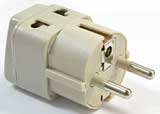 Grounded Universal 2 in 1 Plug Adapter
European Schuko plug.
4.8 mm prongs.
Equivalent to type E and F.
You can use this ungrounded Euro plug in some European countries.
#E-020
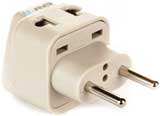 Universal 2 in 1 Plug Adapter
Euro Plug
4.0 mm prongs.
Equivalent to type C.
This is a universal plug adapter for the UK and Ireland.
#E-030
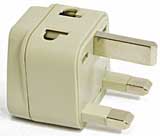 AC Adapter Plug for use in England, Scotland, Wales, and Ireland
Equivalent to type G.
Here is the Swiss version.
#E-040
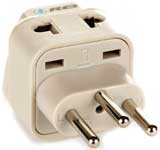 Grounded Universal 2 in 1 Plug Adapter
Type J for Switzerland
Here is the grounded Italian model.
#E-050
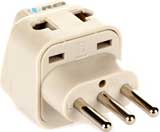 Grounded Universal 2 in 1 Plug Adapter
Type L for Italy
This 110-250 volt power surge strip has three universal outlets and an American grounded plug so it needs a plug adapter for the countries you are visiting. Make sure your gizmos are rated for 110-240 volts.
#E-060
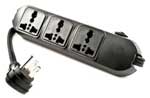 SM-60 Universal 3 Outlet Power Strip Surge Protector for Worldwide Travel. 110V-250V with Overload Protection.
If your gizmos charge through a USB port this can keep you going. European cars have the same 12 volt system as American cars.
#E-200
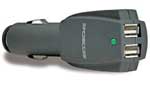 Scosche Dual USB
Car Charger
The links in this pink field take you directly to a page at Amazon.com. The Amazon page details the item, and in most cases includes candid and critical comments from others who have bought the item.
Amazon pays my site a small commission when you click and order an item, if you put it in your shopping cart within 24 hours based on the cookie they set on your computer. If you don't want to make a quick decision just put it in your shopping cart, think it over, and come back later. The revenue covers the cost of maintaing this web site and keeps it free to users.
You benefit when buying here because Amazon has:
- 20% - 30% discount on many items,
- free shipping deals, direct to your door,
- no sales tax on internet purchases in most states,
- zillions of products, well almost,
- fast delivery even when it is free,
- shipment tracking in UPS, USPS, FedEx,
- easy returns if you are not happy with the product.
You win we win. Thanks for your support!!
Have a good trip in life,
John Bermont
Note: Italicized notations by the author.
For small appliances travelers may find these true transformers useful. They deliver the full sine wave. Caution: The wattage rating is the max short term. For continuous duty I recommend that you select a transformer rated at two times the combined watts of all gizmos plugged it. But check your gizmo's electrical specification plate before buying one of these. Most electronic devices are dual voltage and can be plugged in any European outlet when using the appropriate plug adapter.
This 50 watt 220/110 volt step down transformer is good for very small 110 volt appliances and light duty chargers.
#E-070
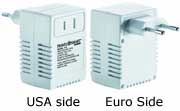 Travel Smart by Conair 50-Watt International Transformer
This 200 watt step up/down transformer is good for small appliances.
#E-080
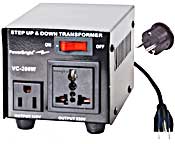 Power Bright VC200W Voltage Transformer 200 Watt
Step Up/Down
110/120 Volt-220/240 Volt
If you happen to be moving to Europe you will probably find a heavy duty transformer handy.
This 500 watt step up/down transformer is good for running very small appliances which need up to about 250 watts.
#E-090
 Power Bright VC500W Transformer 500 Watt
Step Up/Down
110/120 Volt - 220/240 Volt
You can probably operate most of your kitchen appliances with this, and run most of your electric hand tools and battery chargers, also.
#E-100
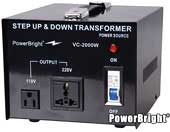 Power Bright VC2000W Transformer 2,000 Watt
Step Up/Down
110-220 Volt
Here is the whale of transformers, 3,000 watts. With this you can bring your power tools and all of your small appliances, but not your TV, to Europe.
#E-110
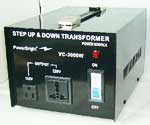 Power Bright VC3000W Transformer 3,000 Watt
Step Up/Down
110 Volt - 220 Volt
Absolutely the best battery for digital cameras which use AA batteries.
#E-120
 Energizer
AA Lithium Batteries
4 Pack
Make sure that your electrical appliances are 110-220 dual voltage so they will work in Europe.
Note:
These appliances require a plug adapter, NOT a converter, for the countries you are visiting. See plug adapters above.
#E-130
 Vagabond Compact Styler
Conair's Dual-Voltage Ionic Hair Dryer
#E-140
 Conair Flat Iron 2" Ceramic Straightener
Dual Voltage
#E-150
 Travel Hair Setter
Dual Voltage
Remington H-1015
#E-160
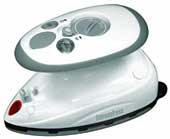 SteamFast SF-717 Home-and-Away Mini Steam Iron (dual voltage)
#E-170
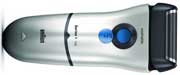 Braun Series 1 150 Men's Shaver with Automatic Worldwide Voltage Adjustment
An RFID blocking wallet protects your passport and credit cards from identity theft in public places.
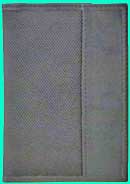 Travelon RFID Blocking Passport Case
This is my book, available at Amazon.com. The last edition was published in 2003. Critical up-dates are on this web site.
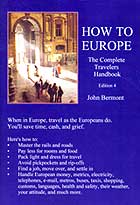 How To Europe
The Complete
Travelers Handbook
by John Bermont
The best travel guide to all of Europe.
 Europe on a Shoestring
Lonely Planet
A comprehensive guide to 3,000 hotels and restaurants in 44 major cities.
 Main Cities of Europe 2015
Michelin Guide
Rolling luggage sure beats lugging a pack on your back.
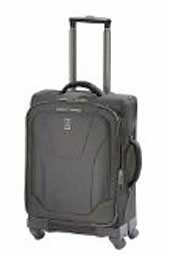 Travelpro Luggage Maxlite 2 20" Expandable Spinner
A shoulder bag for your daily walk-about.
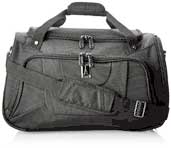 Travelpro Luggage Maxlite3 Soft Tote
Keep your stuff organized.

Luggage Packing Cubes
eBags 3pc Set
A Swiss Army Knife is unquestionably the handiest item a traveler can carry, except not on a plane.
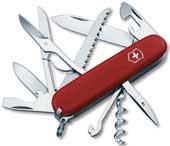 Victorinox Swiss Army Huntsman II Knife
To help find your way on the winding and poorly posted roads of Europe. It works for civilian travelers also.
 Lensatic Military Marching Compass
Inconspicuously lock your zippered luggage with a black wire tie.
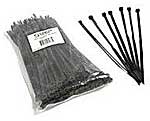 Cables to Go 43036 Cable Ties - 100 Pack (Black)
Ernest Hemingway writes about his life in Paris. I lived there about 50 years later.
 A Moveable Feast
Ernest Hemingway
The classic journal of a Brit who moved to France.
 A Year in Provence
Peter Mayle
Ms. Mayes went and bought the house she fell in love with in Italy.
 Under the Tuscan Sun
Frances Mayes
This humorous introduction to Holland is spot on.
 The Undutchables
Colin White
and Laurie Boucke
Wear a scarf for comfort and style. Nobody will ever suspect that you are an American.
 Very soft houndstooth neck scarf, Kanye West style, different colors available