Living in Europe
Daily life in Holland, Germany, France, Switzerland
Travel to the Max as an Expatriate

If you are really lucky your boss would transfer you to Paris. You would be riding the Metro often, maybe twice a day and making connections in the tunnels. The crowd will move you along at a high speed walk/jog as you try to read these signs and navigate your way to your next Metro train.
Here you see directions to Metro line 12 in both directions. This is indicated by the last station on the line. A good Metro map is something that you will want to keep in your pocket at all times. Save a significant amount of cash, time, and aggravation by using a weekly or monthly card. Individual tickets are more expensive and you will be standing in the traditional lines waiting to buy.
As you can see lines 6 and 13 also connect in this station, Montparnasse-Bienvenué. Gare Montparnasse with the SNCF, French National Railroad, are adjacent to this Metro station. There is plenty of other public transport in Paris, including an extensive bus system and the RER trains which can take you as far as CGD International Airport. A car in Paris is a millstone tied to your leg.
Carpe diem. Vivere bene! Gratia Deo.
Chapter 22 part 2 of
HOW TO EUROPE:
The Complete Travelers Handbook
John Bermont

This entire book is published totally free on-line by the author, photographer, and webmaster, yours truly, with help from my daughter Stephanie. I welcome all questions, comments, compliments, and complaints. For contact information please see NOTE TO READERS. Updated 17 November 2015.

Your Go-To Travel Store
You have to live somewhere. Why not Europe?
This Internet edition of chapter 22 is divided into two parts plus a special supplement consisting of an email from a high tech reader in Ireland. Thank you Dave.
- Moving to Europe: Things to Know Before You Go.
- Living in Europe: Travel to the Max as an Expatriate.
- Dave In Ireland: Technical Details for Moving to Europe.
OVERVIEW
Moving to Europe is the easy part. Facing the challenges of living there is another story.
Living in Europe is unlike living in America in so many ways. It's easier to mention those things that are the same. Off-hand the only item I can think of is that we breath the same air, but even that could be debated.
As mentioned in the first part of this chapter I have lived in Holland, France, Germany, and Switzerland. Some of this was as a single guy and some was family fashion, married with child. Altogether it totals about 7 years of actual residency with all the usual chores of life — shopping for groceries, walking to school, driving to work, traveling, relaxing, etc., etc.
This web page will open up the practical subjects that you need to know if you are planning to live in Paris, Amsterdam, Frankfurt, Geneva, or any city in Europe. When you know how "the system" works over there you will save yourself time, money, and plenty of aggravation. That aggravation is the thing you will remember most.
Presumably you have already read the first part of this chapter. If not I suggest that you start at Moving to Europe: Things to Know Before You Go.
GETTING SETTLED
Appliances
Once you arrive there are a number of things to get settled right away. First off you are going to need replacements for the refrigerator, TV, and other electrical necessities you did not bring over to Europe. All of that American 110 volt equipment would have been fast fried on the 220 volt electricity in Europe. See chapter 11, Electricity in Europe: Don't Blow Their Fuses or Bust Their Plugs, for details. Since the ocean shipment of your household furniture will take three to six weeks to arrive, you are going to be living in a hotel and eating out initially. Start shopping the major department stores in your vicinity for the things you need.
If you are on a company move, your European branch office probably has special discount deals established with certain vendors and stores, but they won't tell you unless you ask. Ours had a deal with an electrical goods store which sold everything from refrigerators to electric wire, and published a catalog listing all of it. We picked out the refrigerator and had it delivered the day after the furniture arrived. Later we went in for a vacuum cleaner, steam iron, toaster oven, and all the other items. When you buy, select major brand names so you can get parts and service when/if you relocate to another country. We bought a great vacuum cleaner but the company has gone out of business. Buying replacement bags has been impossible.
Electrical appliances, and virtually everything else, cost more in Europe. You can buy 220 volt appliances in the USA and ship them over. We did that for a multi-system TV and saved about 50% of the German price.
Utilities
You are also going to need electrical service, probably gas or oil, telephone, cable or satelite TV, and an internet service provider. Cable internet is less expensive than dial-up phone internet and is much faster. Talk to your landlord or real estate agent about these before signing any contracts. He/she should be able to help you out. Also, talk to your company's relocation or personnel officer, though these people are not too helpful on such items and are not likely to have much time to hold your hand. Talk to colleagues in the office or neighbors for additional help. These new friends are usually very helpful to new arrivals from the "States."
OFFICIAL STUFF
Permission to Live
You will need a residence permit or visa if you plan to stay for more than three months. Obtain the application from a consulate of the country you are going to live in. Get going on this as soon as possible. Besides your name and other basic data, the form asks about your arrest record, medical condition, and means of support while over there.
Good Guy Letter
Before leaving the USA get a letter from your home town Chief of Police attesting that you are clean. The letter will simply say that his office has failed to find any record of wrongdoing on your part. Where I come from it's called a "good guy" letter and it's all you need, but it costs $20.
Health Exam
Next, get a good health examination. This will prove that you are not carrying some bugs into the country that will cost the local health and welfare officers some trouble to control. When I moved to Holland the major concern there was TB. Get a chest x-ray and bring the doctor's statement with you.
Even though we went through extensive medical exams prior to moving to Germany, Elizabeth and I had to go through it again once we arrived over there. That was $600 our company wasted by asking us to take the exams here in the first place. A couple of weeks after my German exam I had to go back for an interview with the doctor. She was pleased to start the meeting by announcing that I don't have AIDS or syphilis. I was happy to hear that, but didn't even know that she was checking.
Financially Fit
Also, get a letter from your employer or show some other documentation that you have the means to support yourself. If you are working over there, this implies that you also have a work permit. Your company's personnel office should provide you with the proper letters to verify your status for the immigration office and for the labor department.
Where to Apply
Should you mail your application from the USA or just go over and find the local town administrative offices to submit your application in person? The foreign government consulate will advise you on this. In at least some cases you are required to obtain the permit before going over.
For Holland and Germany I applied after going there. I also think that this is the fastest way of getting it done. There are always at least two registrations required. The immigration people want to know who is coming into the country, and the local police want to know who is living in town. You are going to need some extra passport photos for all of these forms.
Staying American
As mentioned in chapter 21, Working in Europe: Travel for Free, you're still liable for paying US income taxes while in Europe. You're also still eligible to vote. Contact the nearest American consulate for information on registering and casting your ballot to cast the rascals out. You might have better assistance from your political party which tries to keep its voters voting. The Republican and Democrat parties have "abroad" organizations to help you vote.
Students
If you are going over to study, a major part of your belongings may be books instead of furniture and appliances. Books are small and heavy and you will be tempted to bring them as luggage. Instead, consider mailing them over. If you are shipping a lot of books to one address you can use the USPS "M Bag" and ship up to 66 pounds at a good price. The price varies by country.
Go to your local post office and inquire about the "M Bag" and which Customs forms you will need to fill out in duplicate or triplicate. Have patience. Postal clerks do not do this every day and are generally clueless about "M Bags." Recently I had two different clerks give me completely different information. The second one nearly broke into sailor's English describing "whoever it was who gave you those forms." My lips were sealed to prevent another assassination in a US Post Office.
Sending Mail to and from Europe in chapter 19 gives a general rundown on the mail situation. Also, go to your local post office after moving to Europe to inquire about mail provisions. Each country has its own rules.
You will need to change addresses for all your accounts. This can be problematic. The backroom staff at American banks and credit card companies is definitely bottom of the barrel. When we moved to Germany I changed all our addresses. I didn't notice that bills stopped coming for one of Elizabeth's accounts. About a year later I had a call from a collection agency in Frankfurt. They had paperwork indicating that our address was somewhere in Africa. We owed the balance, accumulated interest, and penalties. We settled up without paying the penalties. When I moved to Geneva, Switzerland my American Express bills started going to Geneva, Wisconsin. I was on top of that and settled with the Amex office in Geneva. Nowadays I pay electronically through my bank and their on-line systems, but I still get hard copies mailed to me as backup.
Magazines
There is a minor inconvenience which you should be aware of if you subscribe to magazines. The costs and delivery times will be different in Europe. When you change your address to Europe, magazines follow one of the following procedures:
a.) Keep the subscription at its present term and change
the price at the next renewal.
b.) Shorten the subscription period to compensate them for the
extra costs of postage.
c.) Send you a bill for the increased cost on the present
subscription.
If your magazine is on plan a.) above, sit down before you open the renewal bill when it arrives. I formerly subscribed to one of the technical magazines published by McGraw Hill, "Chemical Engineering." The US domestic rate is $30 per year. The rate in Europe is $177. Air mail postage is less than the difference. What do they do with all that money?
Therefore, one of the perks you should negotiate into your contract is remailing postage for your professional journals and hobby magazines from your company's home office. This shouldn't be a big burden for your employer since many companies use a weekly courier dispatch or express shipment from the home office to their overseas offices.
SHOPPING
Shopping for daily necessities in Europe is a bit different than it is at home. Each country has its own peculiarities and you'll quickly learn the local customs and rules.
A Few Examples
When we lived in Germany stores closed at 6 pm every day during the week, except for one day when some of the stores are open later. Even on that day, it's pretty much impossible to buy bread and milk since the grocery stores don't follow late closing hours. The restricted shopping hours were due to German labor laws. The law was changed in 2005 to allow stores to stay open later. Stores in smaller towns are not as likely to be open late as those in the major cities. On Sunday almost nothing is open in Germany except in airports and train stations.
Holland is pretty much the same, except that the Albert Heijn grocery stores are now open until 8 pm every day. And in beach towns like Zandvoort and Nordwijk you'll find almost everything open on Sunday throughout the year. Things sure have changed since my first time living here in the 1970s. The country was welded shut at 5:59 pm every day and for the full day on Sundays.
In France, stores generally close at 7 pm, though small Paris markets run by Algerians stay open until 10 pm selling basic food staples, beer, and essential household items. Bread, but little else, can be bought on Sunday mornings in Paris. A day without a fresh baguette would be a bad day. Supermarkets in some cities are open on Sunday morning.
Instead of using the grocery stores and super markets, it's convenient and interesting to use the farmers markets in Europe. These are open on different days in different parts of major cities, or in different cities in the regions. Ask a neighbor when the market is open, and where. In Paris my favorite is the market at Place Maubert. In addition to the produce stands there are small speciality stores for bread, wine, fish, meats, cheese, and flowers. Wow, what a selection of cheeses!
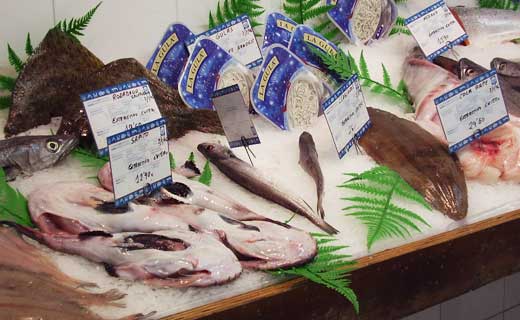
Fresh fish is normally sold with the face still on it. That way you'll know you are getting a pretty one. You do not need to smell it. If the eyes are clear it is fresh. If the eyes are milky forget it. This is in a market in San Sebastian, Spain.
"Standards"
Though every country has it's own peculiarities as noted, there are some general ways of doing business which are the same in most countries.
Meat, chicken, and fish can be bought almost "on the hoof," or precut and wrapped in styrofoam trays and cellophane just like at home. The cost of beef is very high throughout Europe, and it is usually tough. Cattle are fed on grass and not corn so there is little fat in the beef. Fat is what gives American beef most of its flavor and tenderness. Invest in a meat hammer to tenderize your steaks, then cook them fast on a very hot grill plate or pan.
Fruits and vegetables are left out in supermarkets so customers can paw over the goods and pick their own in most countries. Each bin of apples, broccoli, etc. will have a number. Make a mental note and go over to the scale, put your bag on the scale, push the button, and a bar-coded price sticker will spit out. Slap the sticker on the bag and put it in your cart. Some items like cucumbers, avocados, etc., are priced by the piece. At small grocers and at stands in outdoor farmers markets the vendor normally picks out the produce for you. Keep your hands off the veggies!
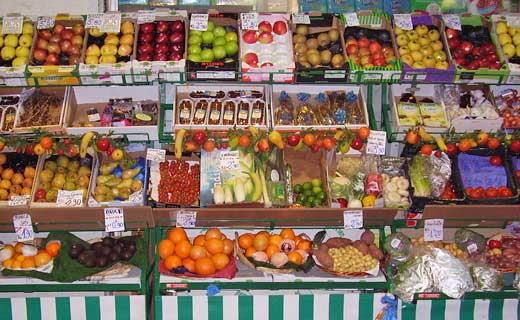
This fresh fruit display is typical throughout Europe. Small Algerian markets in Paris stay open until late at night, long after most businesses have closed shop.
Egg sizes in Switzerland are graded by weight, e.g., 55+ grams, 53+ grams, etc. For comparison, extra large eggs from Kroger in Michigan weigh in at 58 grams in 2012. A few years ago they were 60 to 65 grams. Free range chicken eggs are also noted on the package, and cost about 50% more than cooped chicken eggs. In my local Michigan grocery store eggs from un-cooped hens cost twice as much as regular eggs, as of 2013.
A Coin for a Cart
Shopping carts generally require that you insert a coin to unlock the chain holding it to the others. This pretty much eliminates the need for store owners to go around the block chasing their carts. Everybody brings the cart back to the rack to retrieve their coin, equivalent to a dollar or two.
Metric System
Keep the metric system in mind when shopping. See chapter 27, Europe"s Metric System: Travel with Grams, Meters, Liters, and Centigrade. Most items are priced per kilogram, though some of the more expensive things like meat and fish can be priced per 100 grams (the same as a hectogram) or per 500 grams to lessen the sticker shock.
In some areas 500 grams is called a "pound." There is no metric name for 500 grams, and a pound is actually 454 grams. Local names for the European metric "pound" are livre (F), das Pfund (D), pond (NL), libbra (I), libra (E), and others. The scientists may think that grams are a great way to weigh things, but your momma wants a pound of potatoes. Pricing is always in the local currency which means that you have to do two calculations to figure out what it costs in greenbacks per pound.
The Euro, €
In those European Union countries which have adopted the euro, prices of most items have been given in euros since early 1999. This is really great, saving you the most difficult part of the currency exchange arithmetic and making it easy to figure out the cost of things, but painful once you see what they cost. The euro became the official currency of a dozen nations and actually went into circulation on January 1, 2002. In France receipts sometimes still show the amount in the old French franc as a point of continuity for people who have trouble adapting.
The exchange rate changes continuously. See The Euro and Other Currencies for further information and links to current exchange rates. World economic turmoil keeps this in constant flux.
Notice that a comma is usually used instead of a decimal point in European prices. See chapter 26, Languages, Numbers, Alphabets: Encounter the Tower of Babel in Europe, for more details on the subject.
There is much more about shopping in Chapter 23, Shopping in Europe: Souvenirs, Gifts, and Stuff You Can't Live Without.
BANKING
Account
If you are living in Europe you probably need to have a bank account. It is rather simple to do this since most banks are only too happy to have another customer putting cash in their pockets.
When you sign up, make sure you get information on the full package of services available, and that you can figure out (in the local language) how to use them.
ATM Card
It is essential to have an ATM card. These work just like those at home and let you draw cash from your account from virtually any bank in virtually any country. But they are not called ATM cards in Europe. More likely it will be some local version of euro-card or euro-pass.
European Automatic Teller Machines are almost identical to those in the USA except that they are not called ATMs. Each country has its own name in its own language. For example, in Germany they are often called Geldautomat. Geld is the German word for money. See photos of some ATMs at The Euro and Other Currencies: Exchange Rates for Travel in Europe.
Keypads on ATMs rarely have the alpha characters. Memorize your PIN as a number. Four digits is the standard size of a PIN in Europe.
Besides the usual magnetic strip which we have at home, European bank cards also have a double hologram featuring the face of some long hair guy from the last century flipping with the expiration year of the card. This is a security feature.
Many bank cards also include a "chip." This is a copper spider-like thingy on the face of the card. With a four digit passcode the chip allows you to use your bank card to pay at restaurants, train ticket machines, and other places which do not accept credit cards. The chip is favored by many merchants who do not like paying commissions to Visa and MasterCard. The money flows directly from your bank account to the seller's bank account. In effect, the bank card is a debit card.
Checks
Request some checks when you open your bank account. You rarely need these but now and then they can save you some money since banks often charge extra if you pay a bill without the normal check. Checks are not the same as in America. In Europe you pay your bills at the bank, either automatically or by check.
Most statements, e.g. your phone bill, include a check which is already made out for the amount of the bill and payable to the creditors account. So all you do is fill in your account number, sign it, and take it to your bank. Sometimes you'll receive a bill without the check form attached. This is when you need your own checks. You fill in the creditors account number which is on his bill, his name, name and BIC number for his bank, and a notation regarding the reason for the payment, e.g. his invoice number. Bring it to your bank and it is taken care of. Well, it should be taken care of but sometimes the bank drops the ball. Follow up in a week with your creditor to make sure they got the money.
Automatic Debit
You can also have automatic electronic debit for routine bills. I do this for my international phone bill and for my internet service provider in Holland. You don't have to do anything, except to keep an eye on your bills and your account.
Credit Cards
Banks also issue credit cards. You can get a local branded MasterCard or Visa card in most countries. You may find however that they don't work the same as in America. The charges on our German MasterCard were automatically deducted from our bank account every month. The banks do not carry credit balances on which they would be charging interest. So a credit card appears to be little more than an extended ATM card. The debit comes from your account once a month rather than at the time of purchase.
Because credit cards are expensive, few Europeans use them. Most large and medium size stores, restaurants, hotels, and etc., accept payment via your euro-bank card as noted above.
Bank Routing Number, BRN
You'll probably have a need to transfer money between the USA and your overseas home now and then. This is when you learn a new term — "bank routing number."
When you are transferring money between continents, the safest and fastest way is to let the banks do it for you. So, before leaving home for relocation, talk to your bank and verify the data you need to make sure that everything goes according to plan.
Every American bank has (a few don't) a bank routing number. You will find this number imprinted on all your checks, at the bottom left in front of your account number. You probably never needed this number for anything unless you pay bills electronically, but the bankers need it.
In Europe the equivalent to a BRN is a BIC, Bank Identifier Code. This has not been universally accepted but is standard in the major countries. Instead of using your account number to direct money to your account you use your IBAN, International Bank Account Number. This number incorporates your account number and other information. Your bank's name and address and BIC and IBAN are all you need to transfer money into your European account. You can find your BIC and IBAN numbers on your bank statements.
Money Transfer
Find out which bank, usually a monster in New York, your bank uses for sending their international transfers. In Europe you might get lucky and find a bank which uses the same monster bank. This will probably speed your transfers but probably won't save you any money. The monster bank is going to take a cut no matter what, and the biggest cut at that. The banks at both ends are also going to take a cut. It pays to shop around to find the lowest fee, which will probably be at a medium or small bank since big banks got that way through tried and proven larceny.
Other Services
Banks provide a number of other services, many of them not found in American banks. You can buy auto insurance, for example. I used my bank in Holland as a stock/commodity broker to buy and sell on the Amsterdam Stock Exchange. And I did it electronically via an internet connection to the bank's web site.
SOME POTPOURRI
Neighbors
It is not especially easy getting to know your neighbors. People will nod or say hello if eye contact is made, but more than that needs a good reason. When single I spent a lot of time in the local pubs and had plenty of company. When married I had no time or interest for that and met almost nobody outside the office. Elizabeth got to know a few neighbors, primarily through school contacts because Stephanie was in a German kindergarden.
Chances are that your neighbors will be watching you, and talking with the other neighbors about you. New arrivals, no matter where you are on the planet, are the subject of natural human curiosity. For some of your neighbors this will be the first time they have seen an actual American person in the flesh. Some will want to meet you, but shyness and inhibitions will get in the way of most of them. So the first step must be taken by you, in whatever way you choose to do it.
A possible opportunity to get introduced can be on New Year's Eve. Traditionally Europeans stay home on New Year's Eve. Parties in restaurants and bars are rare. In fact virtually all restaurants and bars are closed on New Year's Eve in Holland. But at midnight all sparklers and sky rockets come out and light up the sky. Wow! You have never seen so much fireworks. Neighbors standing on the street watching what becomes a de facto war zone actually talk to each other and may invite each other into their home for a glass of champagne. So get ready with an extra bottle and glasses and maybe a sweet cake. It could be the beginning of a beautiful relationship.
Television
Our family may have been Schwartzsehers (literally "black watchers") in Germany. Some countries impose a monthly tax on all residences which have a TV. We never paid this in Germany because no official asked us to. Several people in my office told me that we should be paying, but a neighbor told Elizabeth that we only had to pay if we had more than one TV. We preferred to accept that interpretation of whatever law there was. Besides, public TV in Germany for the most part is fit for corpses.
I once saw an American news report which showed a special British police vehicle equipped with high tech electronic gear and whose job it was to prowl residential neighborhoods scanning for TVs by detecting the electronic waves they emitted. If the police found anyone who had not paid the TV tax the resident had to pay a stiff fine. George Orwell was ahead of his time.
The first part of this chapter, Moving to Europe: Things to Know Before You Go, provided important information about the differences between American TV broadcasting and the various broadcasting systems used in Europe. To recap the bottom line, American televisions will not work in Europe except on USA military bases. You will need a multi-system TV and DVD.
There is a further complication with DVDs and DVD players. The movie makers have divided the world into 5 regions. All disks and players are coded to a single region. Disks from the USA will not play on a DVD player sold in Europe, and vice versa. Pretty clever of those movie makers, eh? Well, they have been outsmarted by manufacturers selling code free DVD players. The movie makers are surely trying new technology to thwart this breakthrough, and then it is back to the DVD manufacturers to get around the new barricades. This technology is moving so fast that it is not worthwhile to go into it further. Just make sure that your DVD has specifications for 110/220 volt, 50/60 Hz, NTSC, PAL, SECAN, and is region code free.
Living Habits
Many Americans like to wash their car in the driveway on Saturday. You'll rarely if ever see this over there. Europeans take their motor vehicle to the car wash.
Room doors in northern Europe are normally kept closed within the house. Rooms which are not used much are not heated because of the high cost of gas and oil. You can catch a case of the shivvers in Holland every winter morning just going to the bathroom. A colleague in Germany commented once that his neighbor kept his doors open, and he said it in a disapproving way. On the other hand, blinds are often kept open. When you walk past a house in Holland you can often see straight through to the garden because many houses have a combination living room and dining room with huge windows on each.
Residential doors in France have locking systems which remind you of bank vaults. The closest I have seen to Paris home fortifications are those in New York City. Nevertheless, the burglars often get in.
On moving out, renters in Switzerland are responsible for leaving the apartment in such a condition that new renters can move in within minutes. If not, the cost can be as bad as everything else in Switzerland.
On moving out of our house in Germany the owner demanded new wallpaper throughout the house. The ugly stuff we tolerated for 2½ years was probably there for decades. We didn't know about a clause in the lease requiring us to leave new wallpaper. But I didn't sign the lease anyway. My company did and they were responsible. I still don't understand this. Six months earlier we had asked the landlord about changing the wallpaper and he replied something to the effect that "Why do you want to do that? You are leaving soon anyway." This was the first indication that our three year transfer was going to be less than three years. The company told the landlord long before they ever intended to tell us.
Internet
Getting reconnected to the internet in Europe has been one of my biggest hassles. In Holland in the late 1990s I subscribed to a local dial-up internet service provider (ISP) for about the same cost as back in California. However, the Dutch phone company charges by the minute for all calls. There is no "local calling area" in which the calls are pegged by call, not time. Thus, an hour on the internet can cost one or two dollars depending on the time of day. Since it's easy to spend several hours on line and phone bills come every two months, you can be shocked with a phone bill of several hundred dollars.
From Switzerland I planned to stay for only a couple of months so I did not get a local ISP. Instead I would dial my ISP in California during the lowest cost dialing period, quickly download my email, and then hang up. I would compose new email off line, dial, sign on, send, and sign off - just about that quick.
So the way to go for internet service is cable or DSL, if one of those services is available in your neighborhood. Because of the nature of the technologies involved, cable and DSL are only available where the local authorities have allowed it and where the providers have determined that they can make a fortune after making the hardware and installation investment. Talk with a neighbor to see what is available.
Garbage
The problem of garbage disposal has become one of worldwide environmental concern. Too much stuff is being thrown away and there is a growing need for waste reduction, althogh McVomit prides itself on generating more branded paper cups and wrappers than any other organization on the planet. Garbage dumps, now termed waste disposal sites, are filling up and new ones are difficult to install due to environmental permitting hurdles. Something must be done to halt the amount of refuse generated.
Europe is just as aware, if not more so, of this problem than any community in America. Our experience in Germany was very interesting. We had eight separate containers for household waste by the time we left in mid 1993. The objective was to recycle as much as possible. We segregated all paper, plastic, clear glass, brown glass, green glass, Bioabfall (biologically degradable waste), and batteries for recycle or special handling. Everything else went into the "garbage." The main reason was that our city had run out of space in the local landfill and could not get approval to install an incinerator due to strict environmental regulations and the nimby syndrome. All waste which could not be recycled had to be hauled about 300 miles east to another landfill. This was very expensive so the recycling program was instituted.
In practice, we had various containers for each waste and different collection schedules for each. Once a month the paper and plastic were collected. I had to take the cans and glass to special containers set up around the city. Every grocery store parking lot had containers for different colored glass and cans. You'll see these glass and paper recycling bins prominently located thoughout most of Europe.
MOVING BACK HOME
After living in Europe, leaving is likely to bring on mild trauma. Arriving home in the USA is going to be a let-down, and give you a few shocks.
Unplugging
Just as when you left the USA, you'll have to send out change of address cards, get a mover or do it yourself, disconnect the telephone and utilities, clean house and settle up with the landlord, say your good-byes, and go to the airport. I write this matter-of-factly, but leaving is an extremely unpleasant thing for me to do.
My first departure, from Holland after two years of living there, was an event. I let my friends know I was having a going away party at my favorite brown bar, scheduled for the night before my flight home. After packing up my apartment into eight oak barrels and delivering it all to the dock in Rotterdam, I checked into a hotel owned by the father of a good friend. Then I went to the bar and the party began. I woke up the next morning well past departure time for my flight. I went back to the pub, whose owners Jan and Ellie were surprised to see me, and learned that I still owed about $50 from the night before. The total bill had come to about $200, but that was in 1975 guilders and a significant sum in those days. I rescheduled my flight for two days hence and scheduled another going away party. This was not as extravagant, but I would have missed the plane again had my friend not awakened me, almost carried me to his car, stuffed me in, and drove me to the airport.
Our family departure went a bit smoother. Before leaving Germany we took the maximum one-month vacation in the company car. On returning to Aschaffenburg after the long drive back from Istanbul I made reservations and we were on the plane the next day. We were still a bit tired from the trip and our going away party was a quiet affair with our best German friends on the evening before our departure.
Don't forget to have your phone disconnected, and unplug all the accounts you set up, if need be. You will probably want to keep your bank account at least until your tax affairs over there are settled.
REPLUGGING
When you return home after a couple of years out of the country, things look the same but have a different complexion. You have another perspective, and comparisons with your European experiences are always creeping into your thoughts.
One of the striking things is that you can understand conversations you overhear.
There are two major changes that you can do little about. The cost of auto insurance is much higher and you have a good chance of going on the unemployment roles.
Auto Insurance
Everything else being equal, one thing that may cause a lot of grief on return is signing up for auto insurance again. If you've been out of the country for six months or more, you'll be treated as a new customer.
It would be a good idea to find out what your insurance company's policy is before going over. You might be better off storing your car in a neighbor's back yard and paying for minimal insurance while you are out of the country. Otherwise, no matter how long you had insurance before you went overseas, you'll probably be treated as though you never had it when you come back.
On your return you start to feel like you're at the beginning of the evolutionary chain when dealing with auto insurance salesmen. One way to make it easier and less expensive is to obtain a notarized statement from your European auto insurance company that you had no accidents or claims. You might also try to get a statement from the agency issuing drivers licenses that you had no violations.
You're Fired
As mentioned in chapter 21, Working in Europe: Get Paid to Travel (so here is a redundancy worth taking note of), another thing that may affect you is a new perspective in your job — if you thought that you had one to return to. Things kept changing while you were out of the country, and since you were not around you were not figured into the equations.
Both of my returns have been met with less than enthusiasm back in the home office. On returning from Holland, I lasted about three months before being laid off. The engineering and construction business is variable. On returning from France, I wasn't laid off because I was self-employed at the time. Then the problem was to re-establish client contacts. It took a few months before I landed another contract. The office had been reorganized with a new manager during my two years in Germany. I was soon out and started my own engineering consulting business again. That led to new opportunities in Southern California, Arabia, Africa, and Europe.
My reading indicates that these experiences are not unique. It is reported that something like 25% of all Americans sent overseas by their employers either quit or are terminated within the first year of returning to the USA. Of our group of 7 transferred to Germany, 4 were on the street within a year of the end of their overseas assignment.
Use this information to keep yourself alert to changes in yourself and/or your company so that you can be prepared for the high probability of a new job. Be especially alert to changes in management back home. If your boss has moved on, you are probably on the same track.
This chapter is in three parts due to its large size.
Have a good trip!
NOTE TO READERS
I welcome questions, comments, complaints, and compliments. If you have any concerns about your trip to Europe that have not been covered well enough on my web site please do not hesitate to write. Ask, cuss, discuss, or whatever. I read every email and update my pages when I see a question repeating, Then I will not get that question again, hopefully. In some cases readers have been so generous with their time and talent that I have included their emails verbatim, e.g. chapters 22 and 25.
I do not open attachments. I do not click links to web pages of any kind. I will reply in a day or two, usually.
My email address is [email protected].
Do not forget to smell the hyacinths. At your liesure scroll through the Table of Contents of How To Europe: The Complete Travelers Handbook and read all 30 chapters, FREE on line. Good deal! You'll probably find the answers you seek, and some you didn't know you needed.
FREE
This web site is totally free for everyone, and a labor of love for me. To keep it afloat I receive a commission from Amazon.com for all goods purchased through the adverts I have selected, and any other products you might buy when you are on the Amazon site. Amazon has almost everything for sale, except the Brooklyn Bridge and Mount Rushmore.
Please visit my on-line store at
 .
Your support is most gratefuly appreciated. TIA.
.
Your support is most gratefuly appreciated. TIA.
To like and like not:


Adverts
To support this site:
Please buy your goods at:Amazon.com
Shop in your shorts!
Please clean out your cookie jar before clicking.
Note: The highlighted #E number is purely arbitrary. It is meant to help quickly identify products in this advert column when you write in for electrical advice.
See NOTE TO READERS.
Plug adapters are needed throughout Europe. There are at least five models used in different countries.
This adapter is for the standard grounded plug in France, Germany, and northern Europe. It does not fit in outlets of Italy, Switzerland, Ireland, and Britain.
#E-010
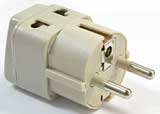 Grounded Universal 2 in 1 Plug Adapter
European Schuko plug.
4.8 mm prongs.
Equivalent to type E and F.
You can use this ungrounded Euro plug in some European countries.
#E-020
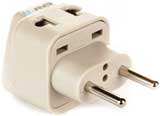 Universal 2 in 1 Plug Adapter
Euro Plug
4.0 mm prongs.
Equivalent to type C.
This is a universal plug adapter for the UK and Ireland.
#E-030
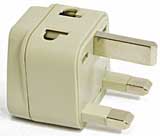 AC Adapter Plug for use in England, Scotland, Wales, and Ireland
Equivalent to type G.
Here is the Swiss version.
#E-040
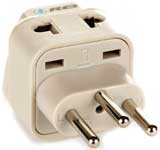 Grounded Universal 2 in 1 Plug Adapter
Type J for Switzerland
Here is the grounded Italian model.
#E-050
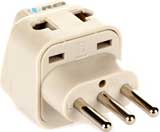 Grounded Universal 2 in 1 Plug Adapter
Type L for Italy
This 110-250 volt power surge strip has three universal outlets and an American grounded plug so it needs a plug adapter for the countries you are visiting. Make sure your gizmos are rated for 110-240 volts.
#E-060
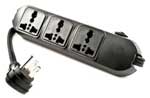 SM-60 Universal 3 Outlet Power Strip Surge Protector for Worldwide Travel. 110V-250V with Overload Protection.
If your gizmos charge through a USB port this can keep you going. European cars have the same 12 volt system as American cars.
#E-200
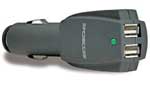 Scosche Dual USB
Car Charger
The links in this pink field take you directly to a page at Amazon.com. The Amazon page details the item, and in most cases includes candid and critical comments from others who have bought the item.
Amazon pays my site a small commission when you click and order an item, if you put it in your shopping cart within 24 hours based on the cookie they set on your computer. If you don't want to make a quick decision just put it in your shopping cart, think it over, and come back later. The revenue covers the cost of maintaing this web site and keeps it free to users.
You benefit when buying here because Amazon has:
- 20% - 30% discount on many items,
- free shipping deals, direct to your door,
- no sales tax on internet purchases in most states,
- zillions of products, well almost,
- fast delivery even when it is free,
- shipment tracking in UPS, USPS, FedEx,
- easy returns if you are not happy with the product.
You win we win. Thanks for your support!!
Have a good trip in life,
John Bermont
Note: Italicized notations by the author.
For small appliances travelers may find these true transformers useful. They deliver the full sine wave. Caution: The wattage rating is the max short term. For continuous duty I recommend that you select a transformer rated at two times the combined watts of all gizmos plugged it. But check your gizmo's electrical specification plate before buying one of these. Most electronic devices are dual voltage and can be plugged in any European outlet when using the appropriate plug adapter.
This 50 watt 220/110 volt step down transformer is good for very small 110 volt appliances and light duty chargers.
#E-070
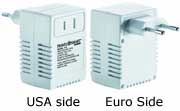 Travel Smart by Conair 50-Watt International Transformer
This 200 watt step up/down transformer is good for small appliances.
#E-080
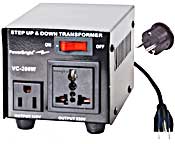 Power Bright VC200W Voltage Transformer 200 Watt
Step Up/Down
110/120 Volt-220/240 Volt
If you happen to be moving to Europe you will probably find a heavy duty transformer handy.
This 500 watt step up/down transformer is good for running very small appliances which need up to about 250 watts.
#E-090
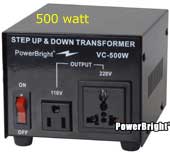 Power Bright VC500W Transformer 500 Watt
Step Up/Down
110/120 Volt - 220/240 Volt
You can probably operate most of your kitchen appliances with this, and run most of your electric hand tools and battery chargers, also.
#E-100
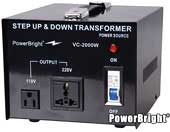 Power Bright VC2000W Transformer 2,000 Watt
Step Up/Down
110-220 Volt
Here is the whale of transformers, 3,000 watts. With this you can bring your power tools and all of your small appliances, but not your TV, to Europe.
#E-110
 Power Bright VC3000W Transformer 3,000 Watt
Step Up/Down
110 Volt - 220 Volt
Absolutely the best battery for digital cameras which use AA batteries.
#E-120
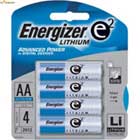 Energizer
AA Lithium Batteries
4 Pack
Make sure that your electrical appliances are 110-220 dual voltage so they will work in Europe.
Note:
These appliances require a plug adapter, NOT a converter, for the countries you are visiting. See plug adapters above.
#E-130
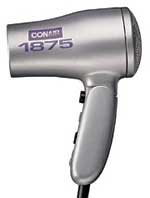 Vagabond Compact Styler
Conair's Dual-Voltage Ionic Hair Dryer
#E-140
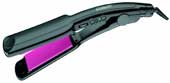 Conair Flat Iron 2" Ceramic Straightener
Dual Voltage
#E-150
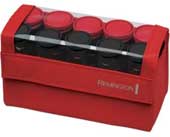 Travel Hair Setter
Dual Voltage
Remington H-1015
#E-160
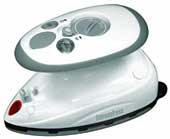 SteamFast SF-717 Home-and-Away Mini Steam Iron (dual voltage)
#E-170
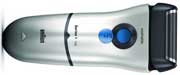 Braun Series 1 150 Men's Shaver with Automatic Worldwide Voltage Adjustment
An international "white noise" machine for light sleepers.
#E-180
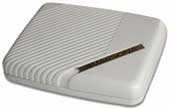 Marsona TSCi-330 White Noise Travel Sound Conditioner For both USA and International
For coffee or tea in your room, without waiting or paying for room service.
#E-190
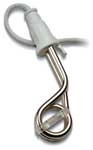 Lewis N. Clark Immersion Heater 120/240V
An RFID blocking wallet protects your passport and credit cards from identity theft in public places.
 Travelon RFID Blocking Passport Case
This will come in very handy very often.
 Fenix LD15
High Performance
LED Flashlight
This is my book, available at Amazon.com. The last edition was published in 2003. Critical up-dates are on this web site.
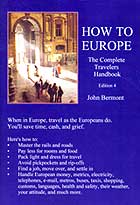 How To Europe
The Complete
Travelers Handbook
by John Bermont
The best travel guide to all of Europe.
 Europe on a Shoestring
Lonely Planet
A comprehensive guide to 3,000 hotels and restaurants in 44 major cities throughout Europe, in English. Separate books in the Michelin Red series cover individual countries in greater detail. This is a must have for frequent travelers.
 Main Cities of Europe 2015
Michelin Guide
Rolling luggage sure beats lugging a pack on your back.
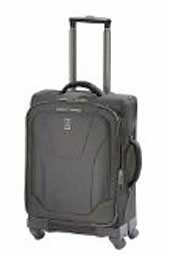 Travelpro Luggage Maxlite 2 20" Expandable Spinner
A shoulder bag for your daily walk-about.
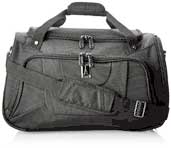 Travelpro Luggage Maxlite3 Soft Tote
Keep your stuff organized.

Luggage Packing Cubes
eBags 3pc Set
A Swiss Army Knife is unquestionably the handiest item a traveler can carry, except not on a plane.
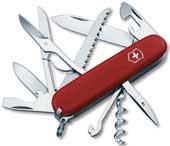 Victorinox Swiss Army Huntsman II Knife
To help find your way on the winding and poorly posted roads of Europe. It works for civilian travelers also.
 Lensatic Military Marching Compass
I bought one of these last year. What a dandy of a camera! It includes a GPS that automatically sets the internal clock depending on which time zone you are in.
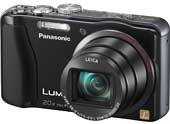 Panasonic Lumix ZS20 14.1 MP High Sensitivity MOS Digital Camera with 20x Optical Zoom
Inconspicuously lock your zippered luggage with a black wire tie.
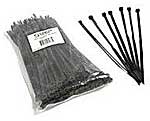 Cables to Go 43036 Cable Ties - 100 Pack (Black)
This is one of my favorite books. Ernest Hemingway writes about his life in Paris. I lived there about 50 years later.
 A Moveable Feast
Ernest Hemingway
The classic journal of a Brit who moved to southern France.
 A Year in Provence
Peter Mayle
Ms. Mayes went and bought the house she fell in love with in Italy.
 Under the Tuscan Sun
Frances Mayes
This humorous introduction to the Netherlands is spot on.
 The Undutchables
Colin White
and Laurie Boucke