Night Trains in Europe
Sleeping City to City
Couchettes, hotel trains, seat sleeping, reservations, cost, luggage, food, wine, bathrooms, security.
 Your Go-To Travel Store
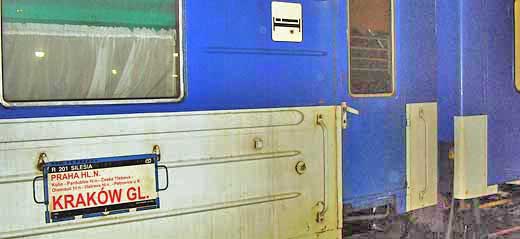
Open the door and enter this couchette car for the overnight ride from Prague, Czech Republic to Krakow, Poland. The icon of a bunk and reclining person (top center) idicates that it is a sleeper. I slept in this car in the other direction. At the time I rode this it was the oldest sleeper I had been on, but it was adequate. The sign board shows that this is train number 201 named the "Selesia" and requires a bunk reservation, as is the case with all couchette and sleeper cars throughout Europe.
Carpe diem. Vivere bene! Gratia Deo.

This is chapter 17.3. The entire book is published free on-line by the DIY traveler, author, photographer, and webmaster —yours truly— with help from my daughter Stephanie and good friend Paula in Haarlem, Netherlands. Questions, comments, complaints, and contributions are welcome. Please click footnote. Patronage at my euro-shoppe™ keeps this site on line. Updated .
Sweet dreams on the midnight express.
This Internet edition of chapter 17 is divided into four parts because it is so big. The four parts are:
- Trains in Europe: A Euro Rail Primer.
- European Rail Stations: Finding Your Way.
- Night Trains in Europe: Sleeping City to City.
- Boat and Bus: High Seas Ferry, Highway Coach .
SLEEPING ON NIGHT TRAINS
Benefits
Night trains are a great way to travel in Europe. The major advantage is that the cost of a bed is about as low as it gets, even cheaper than many youth hostels. Another great plus item is that traveling at night saves a day of your vacation. One thing about vacations is that they are never long enough.
Lockable doors provide good security. Breakfast can be delivered to your cabin, and some cabins include a full bathroom. This is royal class traveling. It's a no-brainer compared to a long boring day on a train with limited flash scenery, most of which is blocked by rail-side trees, shrubs, berms, and brick walls. It's a double no-brainer compared to the cost and aggravation of taking a flight to cover major distances. Luggage restrictions on those cheap intra-Europe airlines are tighter than whities and bloody expensive.
Night train service has been reduced over the years thanks to the new high speed trains which reduce the need for it. But the night trains which remain are a wonderful way to travel. You can wake up in the center of a different city every morning, rested and refreshed and ready to take on the new town. I've done it recently for weeks on end while researching this web site. This chapter is a summary of those experiences.
If you can't find a suitable night train in regular schedules you might do a workaround. Say if you want take a night train from Paris to Berlin look at a map and try to spot a likely connection city. For example from Paris you can take a TGV train to Basel during the day, enjoy the city and dinner, and then take the EuroNight from Basel at about 9PM arriving in Berlin at 6:30 the next morning. Connecting in Zurich is another option. For links to major national rail companies see my page at Trains in Europe: Travelers Yellow Pages. The German Rail site is very user friendly and covers trains throughout Europe. Germans love to travel.
Rocking the Crib
Noise and motion bother some people but for others it is like being in a rocking crib. I am in the latter group. I find the "white noise" of moving trains very conducive to sleep.
Beverage and Food
To help doze off I always board with a bottle of wine, bread, cheese, and fruit for a late night snack, and for breaking fast. You can buy these in the station or in nearby shops. Bring a corkscrew, as in your Swiss Army knife. If your compartment does not have a toilet keep the empty bottle and cork handy. It makes a good bedpan for a late night pee so you don't need to go to the toilet at the end of the rail car. You might want to bring a small funnel to help the flow go where it belongs.
Drawbacks
You might be uncomfortable sleeping in communal conditions. There is a risk when sleeping a few inches or feet from complete strangers who might not speak English. There have been reports of theft on some lines. In fact Elizabth's purse was rifled on a night train from Venice, Italy to Vienna, Austria. But she was guilty of contributary negligence — she had left it on the luggage rack in plain sight. She could have put a sign on it saying "Here, steal me!" I sleep on my valuables.
My worst experience was on a sleeper from Bordeaux, France to Paris. My two compartment mates were French guys who chatted and laughed for hours. I couldn't understand any of it but it kept me awake. That was the good news. Before sleeping they took off their shoes, unmasking the fact that they had not washed themselves or their socks in weeks. Whew! OMG! What an acrid stink! Absolutely horrible.
Say "Hello!"
To ease the stress of sleeping in close quarters with complete strangers I suggest a hearty "Hello, I'm Johnny/Jenny (or whoever) from the USA, Cleveland/Topeka (or wherever)" when you meet your cabin mates. The problem with this is that you may have trouble shutting off the conversation later on. You are probably the first Yank (American) that these people have ever met and they want to know all about the USA and/or practice their English. Try to avoid politics. The conversation could last an hour, a week, or a generation. This will be a travel moment.
Extra Comfort and Security
For an extra cost you can have your own private room on most trains. If you travel in off season you'll often have a 4 or 6 bunk cabin all to yourself, at no extra cost. Doors on modern train compartments are all equipped with locks, sometimes two locks. Some use a plastic slot key so you can lock up when you leave the compartment.
SLEEP OPTIONS
You have three sleep options on trains. You can sleep in a regular or recliner seat, sleep in a couchette bunk, or sleep in a mini hotel style room complete with a full bathroom.
Sleep in Your Seat
When I was younger I didn't use sleeping berths in western Europe since I was always able to stretch out in a first class compartment for a reasonable night's sleep, even with five other people in the compartment. The seats can be slid out together and the armrests lifted so that the compartment becomes the equivalent of a king size bed. Everybody flops in. When fully loaded with Eurail Pass travelers a six seat compartment looks like a can of sardines.
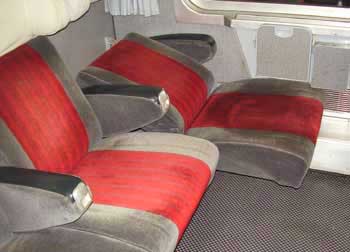
In my first class compartment on the InterCity train from Geneva, Switzerland to Milan, Italy I could pull out the seats and form a king size bed. This is what it looks like when you pull out just one seat. There are another three seats opposite and they all come together. There is no need to sleep sitting up. Now why can't airlines use seats like these? That would end the continuing battle between people who want to recline and the person behind who just wants knee room.
The major problem in the days prior to the European Union and the Schengen Agreement was that the train conductors and border police seemed to be continuously checking tickets and passports. In the middle of the night in the middle of nowhere they would slam the door open and turn on the light. "Your ticket? Your passport?" Nowadays this is only true when crossing into Switzerland and on a few borders in and out of some of the former communist countries. Even in former communist countries which are now members of the EU the border police still inspect and stamp your passport, especially when traveling in second class. Train conductors change crews on long distance and international trains so you are subject to ticket inspection at any time of the day or night.
There is also the sometimes inconvenience of people climbing over you, or vice versa, to make for the toilet or a breath of fresh air. Everybody quickly accepts the etiquette of temporary communal living. When sleeping with a group and/or with unlocked doors, keep your wallet and passport stuffed in with your private parts, and sleep on your camera and electronic gizmos. Do not put any valuables in your luggage, day bag, or purse while on a train, or at any time for that matter.
Sleeper Cars and Couchettes
Sleeping cars and couchette berths are offered on many long distance overnight trains. The trains are called CityNightLine (CNL), NachtZug (NZ), EuroNight (EN), and others.
When traveling with a Eurail Pass use of sleeper compartments with bunks or beds is not included in your pass. The cost is different in each country and ranges from about $25 to $45, probably averaging $35 per night depending on the value of the dollar versus the euro. You can't find a hotel for that price, and probably not even a hostel or a B&B in many countries.
In first class you have a choice of sleeper compartments with 1, 2, or 3 beds, plus a wash basin and perhaps a full toilette with a shower. These are identified as T1, T2, and T3 for the number of beds. In second class, bunk-style "couchettes" are provided. These come in T4 and T6 configurations. T-4 is sometimes offered in first class.
My first experience in an overnight couchette was over in the Ukraine. I traveled east from Kiev, sharing a compartment with three colleagues. We had a fine time, especially since a fellow traveler had brought along adequate provisions of bread, sausages, and vodka which was shared all around. Our train left about midnight and reached our destination in the eastern Ukraine at 9:30 the next evening, a 21½ hour ride. The Ukraine is a mighty big wheat field. The toilets were filthy and overflowing despite the presence of a "maid" in each car. She seemed to be glued to the chair in her cubicle. The restaurant crew was wonderful. See the picture in chapter 1, What's It All About: Travel Like a Native in Europe.
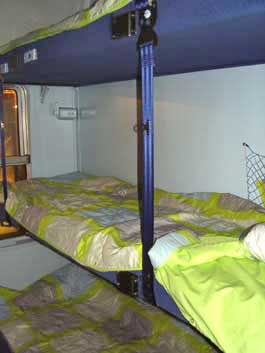
Here is half of a typical second class T6 (6 bunk) couchette. This is on the Corail night train from Paris to Hendaye in far southwest France, nearly on the Spanish border. I was in a T4 traveling first class with a Eurail Pass and had paid €23 for my bunk supplement. From Hendaye I bought a ticket on the Eusko Tren to San Sebastian. That was only €1.35. San Sebastion is in the Basque region of Spain and it's also known as Donostia. It is one of the most beautiful cities in Europe.
BOARDING NIGHT TRAINS
Traveling on night trains is slightly different than on day trains.
Night Train Reservations
You must reserve your bunk and pay a supplement fee in advance for all night trains. You do this in special offices or ticket windows in the major stations. These are usually easy to find but do it early so there will be no problem in catching the train, or in finding an available bunk. When traveling vagabond style in January I would go to the reservation window every morning and take care of business immediately. I never had a problem getting the train I wanted for that night. If you are traveling in summer this strategy could be problematic. Many night trains on the busy routes are sold out weeks and months in advance.
When making your reservation you must select a bunk or let the system do it for you. I prefer the lower bunks because I'm not too handy on ladders. If you like more privacy take the upper bunks. See the section titled Berth Notation below to help you select the location of your berth. Check your supplement receipt before leaving the window to make sure they have given you the location you want. Often they will not give you what you asked for. Then you may be told that the middle bunk is the only one available, and when you get on board you discover that you are the only person in the compartment. Now it is time to talk to the conductor or conductress and try to change to the bunk you wanted. Make sure you get an OK before taking another bunk. Just because it is empty when you get on doesn't mean that someone down the line won't get on and claim the bunk.
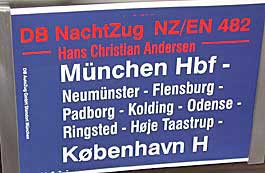
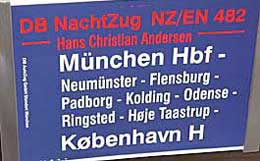
The "Hans Christian Andersen" could only be going to one city, though it stops in plenty of others along the way. This is the signboard on a car of the DB NachtZug (Night Train) NZ/EN 482 from München (Munich) to København (Copenhagen). I boarded in Fulda, Germany, slept well, was served a free breakfast in my compartment, and arrived well rested in Copenhagen at 9:59 in the morning. It kind of makes you feel like royalty.
Find Your Sleeping Car
Boarding a sleeping car is much different than boarding a normal train on the Continent. Before you board a sleeping car you show your ticket or railpass along with your berth reservation and supplement fee receipt to a conductor on the platform. The conductor normally keeps all the paperwork and returns it to you in the morning. If the conductor doesn't return them make sure to ask for your rail pass or ticket before the train gets to your destination. If you are crossing a border or traveling on a Eurailpass you might also be asked for your passport. Normally this is returned to you immediately but sometimes the conductor will keep this also and return it to you in the morning, even if you are traveling entirely within the European Union. Old habits are hard to break.
Sleeper compartments are really nice, but tight. My experience in couchettes and sleepers has been in January when there are few travelers. I have had first class T3 and T4 compartments all to myself in most cases, but never with more than one other person. With a first class Eurail Pass you are allowed to travel in a second class T6 couchette to save money. My close call with second class was rather short term. There was a family of 6 making a bunch of noise in the next cabin. I quickly upped to first class after paying the premium.
T3 cabins have three berths going up one side of the cabin. Head room in all the berths of a T3 is extremely limited. A T6 has three bunks going up each side.
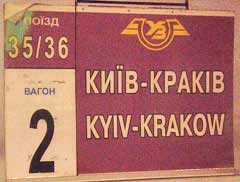
This train itinerary board shows the origin, Kyiv, Ukraine and destination, Krakow, Poland written in Cyrillic, the alphabet used in the Ukraine. The second line is more understandable to most of us. This is wagon number 2. It is train 35 to Kyiv and train 36 to Krakow, 17 hours in each direction. It would be a good idea to bring along some provisions because this night train doesn't reach either destination until mid afternoon the next day.
Sleeping Berth Notation
The lowest berth is always berth 1. Above that is 3 and then 5. So e.g., in compartment 5 the lower berth would be number 51 in that compartment. Bottom bunk is also often called berth B where B stands for bas, meaning "low" in French and other romance languages. The middle berth would be 53, also called M for medio or some similar word meaning middle. The upper berth is 55 and also called A for alt or alto for "high."
T4 cabins are similar except that they have two bunks on each side of the cabin with enough aisle space to drag in a carry-on bag. Even numbers starting with 2 are on one side and odds starting at 1 on the other, e.g. 51 and 52 are both the lowest berths in compartment 5.
Luggage on Night Trains
Luggage is stowed under the lower bunks, on a ledge above the door, or next to the window. Clearance under the lower bunk is maybe 8" maximum. There is not much room. Six backpackers in a T6 would have a definite storage problem. There is always a coat rack with hooks or hangars. In some rail cars there is a special room near the outside door for oversized luggage, bicycles, skis, and such. Lock your stuff.
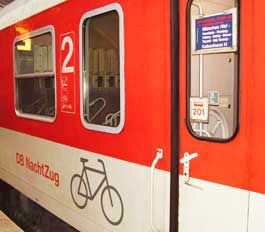
Yes they do allow bicycles on night trains. It will cost extra but the cost will certainly be less than renting a car in Denmark. It will probably cost about the same as a gallon of gasoline over there. The big number 2 indicates that this is a second class car. Under that are some particulars, e.g. the no smoking icon. On the door window is the train itinerary (pictured above in detail) and the wagon number, 201. DB NachtZug is Deutsche Bahn (German Rail) Night Train.
Night Security
Many people are concerned about security these days. Rightfully so. If you are sound asleep on a train you might think that there is a good possibility of getting rolled and robbed. A possibility perhaps like anywhere else on the planet but not a very good possibility inside a sleeper compartment. Each one that I have used has at least a knob lock and a bolt. Several have had card keys so you can lock up when you leave the cabin. There is often no need to leave the cabin since many first class cabins include a toilet and even a shower in first class. If there is no potty, keep your empty wine bottle as a night pan so you don't need to leave your cabin.
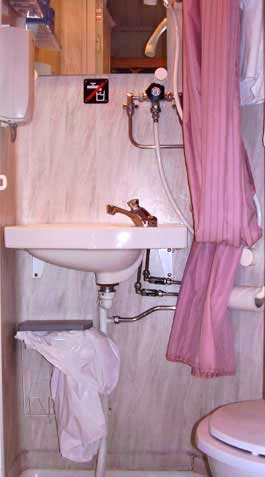
This is the bathroom in the first class sleeping compartment of my overnight train from Malmo, Sweden to Oslo, Norway. It is complete with toilet, shower, shower curtain (!!), towels, trash can, and even a hair dryer. Notice the icon of a faucet and glass with a red diagonal line across it. This means that the water is non-potable, i.e., do not drink it or brush your teeth in it. Overnight trains are a great way to get around Europe. Keep in mind that you are paying separately for two services when you use an overnight couchette or sleeper car — the ride and the bunk. On this train my Eurailpass covered the cost of the train ride, and the compartment cost 251 Danish kroner extra. I was supposed to get a free breakfast at the Oslo station but nobody would tell me where to go for it. Notice that the TP roll is getting slim. ALWAYS carry a roll with you. TP in Europe is like taxis and cops — you can never find it when you need it most. No bidet, but you do have the shower instead. If you can't figure out how to get water ask the conductor. Some simple things are not easy in Europe.
Train Plumbing
Virtually all of my first class compartments had a basin with running water. Several had en suite toilets and even showers. Toilets in second class are at each end of the car. Put on your drawers and flip flops, and bring your valuables with you when you go to the 'bathroom.'
Wake Up Call
Yes, they'll wake you as you get within a half hour of your destination. One of the beauties of Eurailpass is that you don't have to get off if you don't want to. I was traveling from Dresden to see friends near Frankfurt, Germany. The train was scheduled to arrive in Frankfurt at 5:30 in the morning and I couldn't see my friends until late in the day. Rather than get off into the dark icey winter morning I rolled over and slept until Düsseldorf, had a nice day in the Altstadt, and then hopped on an afternoon train back to Frankfurt.
Breakfast in Bed
Many first class overnight trains include a continental breakfast. This is usually delivered to your cabin. Sometimes you have to put on your sandals and walk to the diner car. Speaking of sandals, these are very handy on overnight trains. In fact they are very handy on all trains and in hotels, hostels, and B&Bs. I never go anywhere without my Birkenstocks. If you don't have a pair buy them when you get to Germany for half the American price. Flip-flops are OK, also.
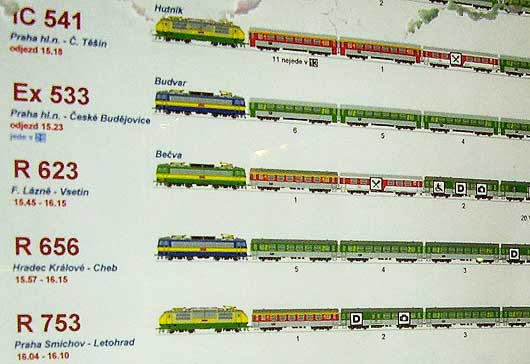
This is a small portion of the train composition board at the Praha (Prague), Czech Republic station. Trains often have names. I especially like the name of Express 533, the "Budvar," one of the best beers in the world. IC is an InterCity, Ex is an Express, and R indicates a smaller caliber Regional train.
ARRIVING
Getting Off
Know your route. Just after the train pulls out of the last station before your destination or connection, start getting ready to get off. Take a pit stop. Shave. Brush your hair. Powder your nose. Whatever. Gather up your belongings. Recheck around your seat and in the luggage rack. Darn, I have forgotten to check the luggage rack and have lost several items in my travels, including my favorite hat in Edinburgh. It was a beautiful black wool Fedora, very handy in drizzly weather.
Train stops are announced in some countries, but usually in the local language. On International Express class trains in Germany and Spain, train stops are also announced in French and English a few minutes before arrival. On InterCity trains in Germany, the conductors pass out a complete schedule, Ihr Zug-Begleiter (Your Guide to the Train). This shows every stop and connection. The symbol translation table is in German and in English.
To open the door on a train, you usually push a latch lever down and push the door outward. I found that the doors of trains in Spain open inward, the opposite of most countries. Sometimes a small section of the floor in front of the door folds up, revealing the steps. Some trains in Holland and Britain have push buttons for opening the door. Why doesn't every country have this?
Short Train Stops
Be at the door before the train comes to a stop. Train stops are typically two minutes. If the train is running late, the stops are abbreviated. Be quick and bully your way off just like the locals. There may be a crowd trying to board. If you don't get off before the first passenger pushes on, you have a chance of riding that train to the next station.
Longer Stops
Though trains normally make two minute stops in major cities they sometimes stop for 15 to 30 minutes to load and unload mail and do some car switching. You may have time to jump off and buy a snack, but this can be risky.
Our train from Budapest, Hungary to Trieste, Italy had a scheduled 15 minute stop in Zagreb, Croatia. I decided to buy sandwiches in the station because there was no food on the train. There was supposed to have been a diner car, but there wasn't and we were starving. Prior to jumping off, I walked back through the train to a car where I could get a better view of the platform and see if there was a food kiosk convenient on the platform. While looking out the window, the train started moving back toward Budapest, and picking up speed. I looked out the end window and saw the car with Elizabeth in it, but it was still standing! After some panicky shouts to an unconcerned worker on the train, the car I was in finally stopped a mile down the track. I jumped out and ran back up the tracks to the station. I still had some time. I found a bank in the station to change money, bought two sandwiches, and scampered back out to the car where Elizabeth was. It was gone! Oh my! Then, from another track on another platform, I heard Elizabeth calling me. They had moved our car to attach some more before continuing on to Italy. It took a while for my heart to resume normal speed.
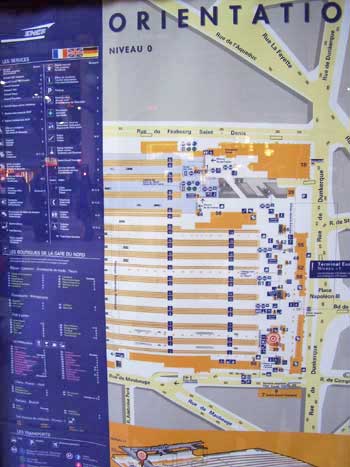
This orientation plan of the Gare du Nord in Paris, France has a legend on the left keyed in French, English, and German. You'll see all the platform numbers, station services, and streets surrounding the station. There is always a red bullseye on maps like this with the notation "Vous étes ici" which means "You are here." How could they make it easier for you? Click on the picture to see it in greater detail. There is always a tribe of gypsies working the people arriving at this staton out front at Place Napoléon III. Be careful. Take their picture. They hate that.
Where You Are is Where You Are
My worst gaffe in train travel involved a northbound German train when traveling with my daughter Stephanie. We were to get off in Darmstadt at 16:29 (4:29pm; trains use the 24 hour system). As the time approached I heard an announcement which included the word Darmstadt. When the train stopped we got off. This was one of the few times in my European travels when someone was to meet us at the station, however our friend Connie was not there. After a beer I called her home and her husband Uwe told me that she had also called and was waiting at the station for us. I looked again, everywhere, but couldn't find her. Finally I asked the cafe owner what city we were in. It was Bensheim, about 10 minutes before Darmstadt. We caught the next train to finish the trip. Contributing to my error was the fact that our train had stopped in the middle of nowhere and then proceeded slowly past a red light on the tracks. We lost about ten minutes, and the announcement that I had heard was simply mentioning that the following stop would be Darmstadt. So, check the signs on the platform to make sure you are where you want to be before jumping off.
I had a near miss on a train from Milan to Monza, Italy also. Those darn Italian train stations are so poorly posted. I jumped off thinking I was in Monza. Then I looked around and didn't recognize the place. I jumped back on in the nick of time and arrived in Monza 10 minutes later.
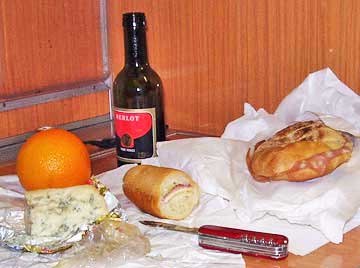
As usual I brought my own dinner on board my overnight train from Milan, Italy to Vienna, Austria. You can buy your bread, cheese, cold cuts, fruit, and wine in station shops or in nearby markets. The Swiss Army knife is an essential travelers tool — it includes a cork screw. See the packing list pages in chapter 6 starting with one of the most important things you can do before leaving for the airport, do my Pack Light Field Test.
EUROPE TRAIN POTPOURRI
Good Travel Days
Tuesdays are good days to travel. Fridays and Sundays are busy. It is best to avoid traveling on Sunday since tourist offices and other friends of the traveler may be closed or have limited hours. Also watch out for Easter, Christmas, New Years Day, and local holidays. They are busy traveling periods, though many trains don't operate, schedules are usually different, and many businesses are welded shut. See the Prime Travel Data section for dates of local holidays to be aware of.
The Best Trains, and Also Ran
The best trains are in central Europe. France and Germany are the tops in my book, but not to be slighted are Switzerland, Austria, and the Benelux countries. Iberia and Scandinavia, both large but sparsely populated, have less frequent service than I would like. Ireland does not have a very extensive rail system but there is always an inter-city bus. The trains in Britain have been privatized and are very good on the main lines. Local lines are slow.
Italy has probably the most confusing train stations in Europe, with little help available from conductors on the platforms. Allow yourself extra time to find your train.
Maybe the worst train I was ever on, except for Amtrak in the USA, was on a leg of the Orient Express from Vienna to Budapest. We had visions of romance and intrigue because of the name of the train, but this busted up piece of rolling junk was a misery from start to finish. That was back in the commie days and I would imagine that this train has been scrapped by now.
The trans-Ukraine train was well built, but the plumbing was a disaster in our car. You needed galoshes to get into the backed-up toilet. That was also in the commie days and hopefully things are better now.
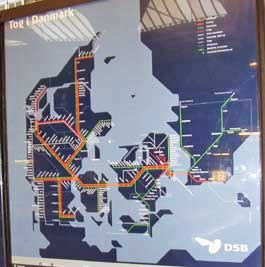
A Copenhagen station map shows all rail lines in Denmark, and a few over in southern Sweden. Denmark is a small country mainly consisting of the Jutland pennisula and about 400 islands, the largest of which is Zealand on which Copenhagen is located. The body of water in the middle is the Kattegat, connecting the Baltic Sea with the North Atlantic via the Skagerrak. From Frederikshavn at the northern end of Jutland you can take a short ferry ride over to Göteborg, Sweden.
Modern Mode
Stephanie and I are on an ICE, InterCity Express, train from Basel, Switzerland to Karlsruhe, Germany at the moment I am writing this paragraph. The car is a beauty. In second class we have our choice of several channels of music using our own stereo headgear and the train's stereo system. She can have her teen stuff and I have relaxing jazz. The seats are comfortable and recline, and the car is air conditioned on this hot July day. Though not as smooth or quiet as the TGV trains I've been on, this car is certainly very nice. Stephanie checked on the first class accommodations and found three across seating instead of four, and more comfortable seats. This second class wagon has open airline type seating plus compartment seating as in the old days. A small area is reserved for heavy luggage to save you the effort of lifting your bags about six feet onto the rack, and a hook in the car lets you hang your coat. There is a telephone booth in the dining car.
TRAIN STATION FACILITIES
In any city, the train station is a hub of activity.
Tourist Office
When arriving in town, don't waste any time getting to the tourist office or hotel information office if you don't already have a hotel reservation, city map, and directory of sights and events. These offices are generally either in or near the train station, port, or center of town. Request a town map and a hotel list. The best time to arrive anyplace is between ten in the morning and noon. It's at this time that the hotel keepers know who is leaving and how many rooms will be available for that night, and the tourist office has not yet closed for the two hour lunch break.
Tourist offices close for the day early in the afternoon in Scandinavia and Ireland. It seems that my train always arrives a half hour too late in these countries. If the tourist office is closed, I ask at the information office (see below), a ticket window, or the money exchange window for a town map and hotel list. One of these is usually able to help me. But, failing that, I buy a town map at the newspaper kiosk in the train station and go out on my own to find a hotel room.
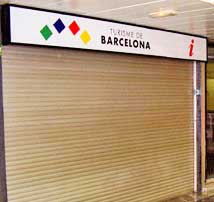
Uh oh. It's 10:30 on a Friday morning. The tourist office in the Sants train station in Barcelona, Spain is closed. Huh? The hotel booking office was also closed but everything else in the station was open. What gives? It was a national holiday in Spain, January 6, the Feast of the Three Kings, Epifania. The municipal workers had the day off but everybody else seemed to be working. I guess it pays to be a government employee.
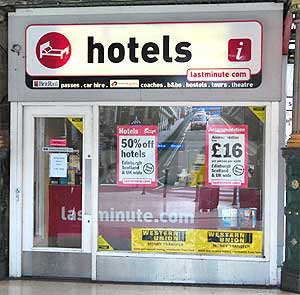
The Edinburgh, Scotland tourist office is way out in the center of the city, not where it should be — in the center of Waverly Station. So I booked my B&B from this office of lastminute.com at the station. Later I found the tourist office and accidentally put a credit card in the ATM machine out front. The machine promptly ate my card. By experience I travel with several credit cards and at least two ATM cards, one from a bank and one from a credit union.
i
For connection information and special help, major train stations typically have an office for train information. This is marked with a large lower case i or marked information. Try pronouncing it "een-for-mah-cee-ohn." You normally cannot get hotel or tourist information in these offices, but they will tell you where the tourist office is located.
Pickpocket Central
At the risk of boring you to death with this warning, train stations are notorious as hangouts for pickpockets and luggage thieves. Some stations have posters to this effect, and some have periodic warnings over the public address system. Most stations do not mention anything. Keep your "American space" around you at all times. When you are in a line, a "queue" to you Brits, be especially wary of those who are trying to butt in.
Pickpockets usually work as a team. One or more distracts you while another makes the lift and passes your goods to another, never to be seen again. The distraction can be a bump, dropping something on the floor in front of you, asking you for the time, or something else. Go on high alert when something out of the ordinary happens.
Never respond to strangers in a rail station. You are not the information office. Any talkative stranger is probably trying to pick off some of your goods. Girls, ignore the charming accent. Take your bag and move away if he persists. Hold on to your luggage at all times. You are not in your home town grocery store. Keep your wallet in a tight front pants pocket or under your blouse or shirt. Some travelers use "money belts" for security. I keep my passport and big bills in a pocket in my T shirt under my regular shirt.
I have never been robbed though any number of attempts have been made on me. I must have a target painted on my back. Rust, dust, and pickpockets never sleep. Stay alert at all times, especially in those train stations and within a few blocks.
For a detailed discussion of the subject see my chapter 8.1, Pickpockets in Europe: They're Everywhere.
Reading Train Timetables
Departures and arrivals are posted in each station, departures normally on a yellow or buff-colored poster and arrivals on a white poster. Timetables use the 24 hour clock. Therefore 16:00 or 16h00 is 4 pm to us Americans.
Codes for the days of the week go from Monday = 1 to Sunday = 7.
Codes for the months use Roman numerals; e.g., January = I to December = XII.
See chapter 28, European Dates and Time Zones: Traveling in a Distant World, for more information on this important subject.
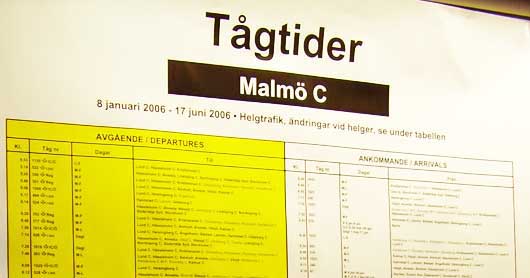
Arrivals and departures are posted on a single poster in the train station at Malmö, Sweden. Throughout Europe departure schedules are usually yellow or buff and arrivals are white.
Station Luggage Lockers
Luggage lockers are almost universally available in train stations in Europe. Usually there are three sizes available. The depth X height X width dimensions at Brussels Central Station are 36"x15"x12", 36"x24"x15", and the jumbo is 36"x36"x20". This is more or less typical throughout Europe. However, lockers in some countries have a narrower doorway than the width dimensions given here. In skiing areas you'll find tall narrow lockers designed for your skis.
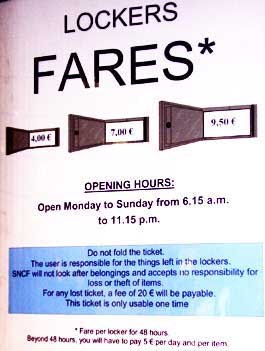
This sign at the entrance to the luggage lockers at Gare du Nord (North Train Station) in Paris, France announces the conditions for doing business. The 2006 prices are €4.00, €7.00, and €9.50 respectively for the baby, junior, and jumbo sizes. Notice the asterisk and the small print at the bottom. After 48 hours you pay much more. A lost ticket will cost you €20.00. These prices are higher than most in European train stations, but hey, this is Paris. Also, notice the hours of business. This place is not 24/7. In fact almost nothing is 24/7 in Europe. You can expect to have your goods x-rayed. Once again the French have made it easy for us — the sign is 100% English.
In most stations you can leave your goods for up to 24 or 48 hours. After 72 hours, station attendants may remove the contents to the baggage checkroom. You'll pay again to retrieve your belongings. Baggage checkrooms are almost always available in stations if your bag doesn't fit in a locker or if all of the lockers are full. I've seen bicycles and other sports gear behind the fence at baggage checkrooms.
Bike Rentals
In Holland and Belgium, bicycle rental offices are generally in or handy to the station. If you don't see one immediately ask around. A bicycle is a fiets in Holland. Before renting a bicycle check it out mechanically. Make sure the lights, bell, and brakes work. Drive it around the block to make sure you are comfortable and secure on it. Bring it back immediately for adjustments if there is anything wrong.
The price for a day's bicycle rental is about what you would pay for lunch. Leave your International Driving Permit as security, not your passport. You'll probably need your passport during the day and you don't want it lying there amongst some oily papers and receipts. In fact, in Holland you are required to have your passport with you at all times in case a police officer wants to know who you are. And if you have an accident the police will know to call the Ameican Consulate to arrange for whatever needs to be done for you.
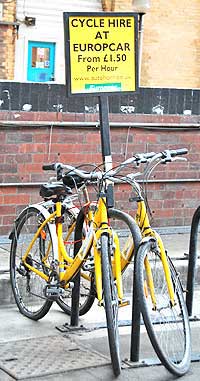
Bicycle rentals are available at the York, England train station. The two-wheeler on the left needs some air in the rear tire. I wouldn't rent it even if they pumped it up because it will leak again. Remember that autos and bicycles travel in the left lane in Britain and Ireland. Watch for one-way streets.There are plenty of them. Be careful, and always lock your bike and loop the chain through the front wheel. A plastic shopping bag can keep the seat dry. It rains often in England.
Other Station Facilities
Banks and/or foreign money exchange companies are established in the larger train stations. There is usually a line waiting. There is probably a bank cash machine where you can use your ATM card, and it probably offers a slightly better exchange rate. But chances are that your home bank will charge you up to $5.00 per transaction. In countries where the euro is not accepted you'll see money exchange stores, not only in the station but throughout the business districts of cities. See my page The Euro and Other Currencies: Exchange Rates for Travel in Europe for more information.
Larger train stations also have snack bars, drink bars, restaurants, showers, toilets, post offices, newsstands, grocery stores, and candy stands. Some major stations have been expanded underground to include large shopping centers. Train stations are good places for after hours shopping. City stores in western Europe generally close at 6 or 7 pm, even earlier on Saturday, and are not open on Sunday. Major city train station markets selling everything from bananas to birthday cards are often open until midnight, and on Sunday.
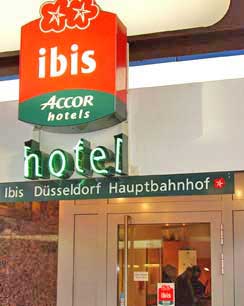
An Ibis Hotel is located right in the Hauptbahnhof (main train station) in Düsseldorf, Germany. Ibis is a reasonably priced chain with hotels throughout Europe. The Düsseldorf Altstadt, 'Old Town,' is an action zone, especially on Saturday nights. For live music and a good time I would have suggested the Dr. Jazz bar but their web site seems to be saying that it has closed. That's a pity if true. Dr. Jazz was one of the best cafes in Europe.
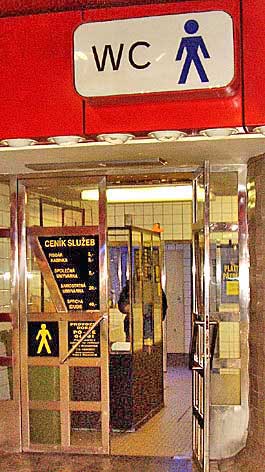
This entrance to the men's room in the Prague, Czech Republic train station shows the price of entry at 5 koruns, about 20 cents. A shower costs 40 koruns, about $1.60. Use the potty on the train and save a couple of dimes.
MOVING ON
This page is the third of the four parts of chapter 17. There is much more as listed below.
- Trains in Europe: A Primer for Riding the Rails.
- European Rail Stations: Finding Your Way.
- Night Trains in Europe: Sleeping City to City.
- Boat and Bus: High Seas Ferry, Highway Coach .
Have a good trip!
HOW TO EUROPE
The Complete Travelers HandbookChapter 1
What's It All About?
Travel Like a Native In EuropeChapter 2, Part 1
On Budget in Europe
Travel Costs: How Much?Chapter 2, Part 2
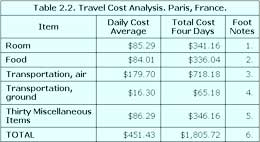
Europe on WHAT! Per Day?
My Actual ExpensesChapter 3
Passport and Visas
Identity and Travel DocumentsChapter 4
Flying to Europe
Travel Starts at the AirportChapter 5
What to Wear in Europe
Your Best Travel Clothes for Every Occasion
Chapter 6 Part 1
Pack Light Field Test
Validating Your Europe Packing ListChapter 6 Part 2
Personal Care Items
Pack Your Toothbrush, Toilet Paper, and Vinegar.Chapter 6 Part 3
Travel Supplies
Small Stuff Packing ListChapter 6 Part 4
Bringing Valuables
Not in Your Luggage or PurseChapter 7
Luggage for Europe
Get Wheels. Let It Roll!Chapter 8 Part 1
Pickpockets in Europe
They're EverywhereChapter 8 Part 2
ATMs in Europe
Machines Dispense Travel CashChapter 8 Part 3
Cash and Credit
Paying Your Way in EuropeChapter 8 Part 4
Money Potpourri
Cash, Coins, Transfer, BarterChapter 9
Your Travel Diary
Blog ItChapter 10
Europe Guide Books
Reviews of Tomes for Travelers
Chapter 11, Part 1
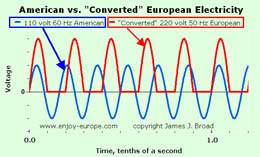
An Electric Converter in Europe
Electric power converters supposedly change 220 volts to 110 volts.Chapter 11, Part 2
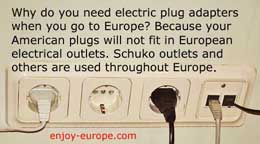
Plug Adapters for European Outlets
American plugs do not fit in any power outlet in Europe.Chapter 11, Part 3
European Voltage Essentials
220 Volts of Power 50 Hz Frequency.Chapter 12
Photography in Europe
Take Your Best ShotChapter 13

Bring a Smile
Travel Europe in Good AttitudeChapter 14
Hotels, B&Bs, Hostels, Homes
Travelers' Sleep OptionsChapter 15
Eating In Europe
Travel on Thy BellyChapter 16
City Transport in Europe
Bus, Streetcar, Subway, Taxi, Bike, Shoe, Gondola
Chapter 17, part 1,
Trains in Europe
A Rail PrimerChapter 17, part 2,
European Rail Stations
Finding Your WayChapter 17, part 3,
Night Trains in Europe
Sleeping City to CityChapter 17, part 4,
Boat and Bus Services
High Seas Ferry, Highway CoachChapter 18, part 1
European Auto Rental
Details and DocumentationChapter 18, part 2
Driving in Europe
Back Alley to Blazing AutobahnChapter 18, part 3
Driving Habits and Laws
Police, Speed Limits, TailgatersChapter 18, part 4
Parking, Gasoline, Safety
Adjuncts to Driving in EuropeChapter 19, part 1
Telephoning to, from, and within Europe
City Codes, 10-10, cell phonesChapter 19, part 2
Sending Mail
Priority Mail, Poste RestanteChapter 19, part 3
Internet and Email
Europe's Cyber Cafes and WiFiChapter 19, part 4
Telegrams
Wiring Cash
Chapter 20

Health and Safety
Travel in Confidence but with CautionChapter 21
Working in Europe
Get Paid to TravelChapter 22, part 1

Moving to Europe
International shipping and finding a home in Europe.Chapter 22, part 2
Living in Europe
Travel to the Max as an ExpatriateChapter 22, Special email
Dave In Ireland
Technical Details for Moving to EuropeChapter 23
Shopping in Europe
Souvenirs, Gifts, and Stuff You Can't Live WithoutChapter 24
Shipping Your Treasures Home
Travelers' Options from EuropeChapter 25
Passing Customs in Europe
Know the Rules When Crossing BordersChapter 26
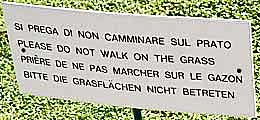
Languages, Numbers, Alphabets
Encounter The Tower of Babel in EuropeChapter 27
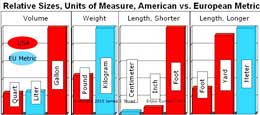
Europe's Metric System
Travel with Grams, Meters, Liters, CentigradeChapter 28
European Dates and Time
Traveling in a Distant Time ZoneChapter 29
Weather in Europe
Travel under Your UmbrellaChapter 30
Melding with Europe
Travel Is Interesting and EntertainingLast Call
Travel Prep and Pack Lists for Europe
For all 30 chapters and much more see
HOW TO EUROPE
The Complete Travelers Handbook
To like and like not:


Adverts
 European Rail Timetable Winter: December 2016 - June 2017
 Europe by Rail:
The Definitive Guide for Independent Travellers
Thomas Cook Rail Guides
 Europe by Eurail 2017:
Touring Europe by Train
by Laverne Ferguson-Kosinski
 Rail Map of Europe
The best travel guidebook to all of Europe.
 Europe on a Shoestring
Lonely Planet
This is my book. The last edition was published in 2003. Critical up-dates are on this web site.
 How To Europe
The Complete
Travelers Handbook
by John Bermont
Rolling luggage sure beats lugging a pack on your back.
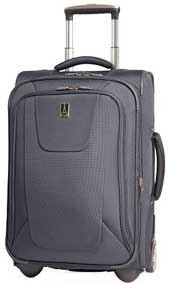 Travelpro Luggage Maxlite3 International Carry-On Rollaboard
A shoulder bag for your daily walk-about.
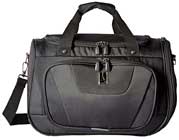 Travelpro Maxlite 4 Tote
Keep your stuff organized.
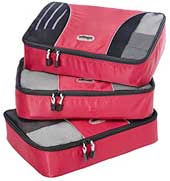 eBags Medium Packing Cubes 3pc Set 13¾"x9¾"x3"
 Assorted Packing Cubes
eBags 3pc Set