Weather in Europe
Travel under Your Umbrella
Fair is rare. Rain, Gulf Stream, Fahrenheit, Centigrade, Celsius, weather map.
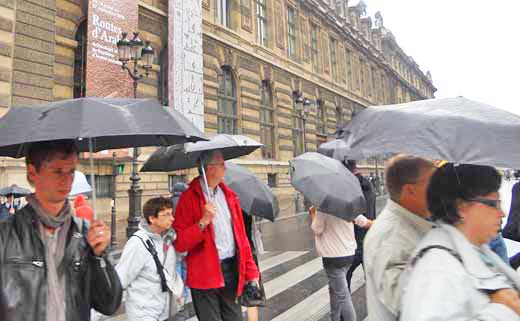
Well prepared tourists unfurl their umbrellas on a cool drizzly day as they exit a famous Paris museum
in August. Summer weather in Paris is highly variable.
The fellow on the left is obviously French — he is wearing a scarf. Or he may be a tourist who has read my chapter 5, What To Wear in Europe: Your Best Travel Clothes for Every Occasion. Photo by Stephanie.
Carpe diem. Vivere bene! Gratia Deo.
Chapter 29
HOW TO EUROPE:
The Complete Travelers Handbook
John Bermont

This entire book is published totally free on-line by the author, photographer, and webmaster, yours truly, with help from my daughter Stephanie. I welcome all questions, comments, and complaints. For contact information please see NOTE TO READERS. Updated 24 December 2015.

Your Go-To Travel Store
The sun is always shining, but it may be behind a cloud at the moment.
HOW'S THE WEATHER?
Travelers need to have some idea of the general flavor of the temperatures and precipitation. Should you take along a mackintosh or a bikini, or both?
The Gulf Stream
Most of Europe is further north than Chicago, and none of it is as far south as Atlanta or Los Angeles. However, this information won't tell you much about the weather.
The warm Gulf Stream, starting out south of Florida, crosses the Atlantic and passes all the way up the West Coast of Europe. This stream moderates the temperature throughout northern Europe. Norwegian harbors located hundreds of miles north of the Arctic Circle rarely freeze. Meanwhile cold winds sweep down from the Arctic and clash with the vapors from this warm water. This creates a virtual constant drizzle over much of western Europe. The result is generally cooler and wetter summer weather than in much of America, but the winters are not nearly as harsh as in the upper midwest.
Take London for example. London is about 800 miles further north than Chicago but it has average January temperatures about 15 degrees warmer. It seldom freezes and rarely has snow. But when London has even a few inches of snow the city shuts down for days. Chicago can be sub-freezing for weeks on end, and intermittently for six months. The snow in Chicago is legend, but it is well managed unless a few feet of the stuff comes in. I lived there in 1967 when we had 24" in two days. The drifts were 6 feet and covered every car on my street. Wow. But I guess that is nothing compared to Buffalo, NY.
When you go east in Europe you get away from the calming influences of the ocean. Winters can get mighty fierce out there in Poland and the Ukraine, even in October. Napoleon and Hitler learned that the hard way.
Off Season
Summer is when most Americans go to Europe because that's when the school teachers get a two month vacation. They deserve it. Summers in northern Europe can be warm, though seldom scorching. Average July highs run in the seventies and rarely hit ninety. The summer of 2003 was an exception with weeks of 100o plus temperatures throughout Europe.
Often the best weather to be had is in some month other than July. In northern Europe, April and May tend to be the driest months, though they will be a bit cooler than July. I prefer to travel in the spring for this and a few other reasons. The tulips are in bloom at Keukenhof and there are not many tourists about.
Sunshine
None of this applies to Europe south of the Pyrenees and the Alps, the two mountain ranges forming the French/Spanish border and the country of Switzerland, respectively.
In many areas of Portugal, Spain, France, Italy, Greece, and Turkey there is hardly a drop of rain during July and August and the thermometer runs in the high eighties. It is no wonder that planning for an annual one month vacation on one of the southern beaches is the preoccupation of many northern Europeans for eleven months of the year.
Summer is not always the best weather for travel. We drove across Greece to Istanbul in blistering heat. It can really knock you out if you're not used to this. And I've sweated it out in the heat and humidity of southern France where it is also buzzing with mosquitos and flies in the summer. Visit a cathedral if it gets too warm for you. It is usually 10o or 15o cooler inside.
The Rush
Most European schools are closed for only six weeks, typically mid-July through August. Most workers enjoy a four to six week vacation. So everybody goes at the same time. The result is a procession heading south in middle and late July that reminds you of the Oklahoma land rush. The dates are infamous in Holland as a convoy of caravans heads south on the Route du Solei in eastern France. I was stuck in that traffic several years ago. You do not want to be there.
WEATHER DATA
Temperature Scale
The USA uses the Fahrenheit temperature scale. On this scale water freezes at 32oF and boils at 212oF. Meanwhile Europe uses the Centigrade scale. On this scale water freezes at 0oC and boils at 100oC. Learn how to use the Centigrade scale, also known as the Celsius scale on my page at Travel Weather in Europe: They Measure It Differently. This page also has on-line links to a number of sources for current weather conditions.
Weather Map
Weather maps and data are printed in the major European daily papers. The European edition of USA Today provides one of the best weather maps available anywhere. It can't keep up with the changes in Holland though. Really terrific storms can come in off the North Sea faster that you can say Tot ziens ("See you later.").
Local TV also has periodic weather reports, usually coming just after the news and sports. Dutch TV has a feature called teletext which allows you to look at weather maps and data at your pleasure, 24/7. The controls for teletext may be inside a special slide-open part of the remote control device. Teletext also has dozens of other pages featuring news, financial and market data, sports, and many other things.
For an excellent review of what makes the weather work in Europe, see Fair Weather Travel in Western Europe by Edward D. Powers. This book has historical weather data for scores of European cities giving average temperatures and precipitation. It also has some very interesting maps showing why it is the way it is. You'll be a meteorologist in a week.
Have a good trip!
NOTE TO READERS
I welcome questions, comments, and complaints. If you have any concerns about your trip to Europe that have not been covered well enough on my web site please do not hesitate to write. Ask, cuss, discuss, or whatever. I read every email and update my pages when I see a question repeating, Then I will not get that question again, hopefully. In some cases readers have been so generous with their time and talent that I have included their emails verbatim, e.g. chapters 22 and 25.
I do not open attachments. I do not click links to web pages of any kind. If you have an item you want me to comment on please send the name of the manufacturer and the model number, or the Amazon.com ASIN number. I will reply in a day or two, usually.
My email address is [email protected].
Do not forget to smell the hyacinths. At your liesure scroll through the Table of Contents of How To Europe: The Complete Travelers Handbook and read all 30 chapters, FREE on line. Good deal! You'll probably find the answers you seek, and some you didn't know you needed.
FREE
This web site is totally free for everyone, and a labor of love for me. To keep it afloat I receive a commission from Amazon.com for all goods purchased through the adverts I have selected, and any other products you might buy when you are on the Amazon site. Amazon has almost everything for sale, except the Brooklyn Bridge and Mount Rushmore.
Please visit my on-line store at
 .
Your support is most gratefuly appreciated. TIA.
.
Your support is most gratefuly appreciated. TIA.
To like and like not:


Adverts
To support this site:
Please buy your goods at:Amazon.com
Shop in your shorts!
Please clean out your cookie jar before clicking.
 Totes Titan Super Strong Auto Open Close Compact Umbrella
 Anne Klein Women's Classic Double-Breasted Coat
 Clarks Women's Wave.Run Slip-On
Wear a scarf for comfort and style. Nobody will ever suspect that you are an American.
 Very soft houndstooth neck scarf. Various colors available
The links in this pink field take you directly to a page at Amazon.com. The Amazon page details the item, and in most cases includes candid and critical comments from others who have bought the item.
Amazon pays my site a small commission when you click and order an item, if you put it in your shopping cart within 24 hours based on the cookie they set on your computer. If you don't want to make a quick decision just put it in your shopping cart, think it over, and come back later. The revenue covers the cost of maintaing this web site and keeps it free to users.
You benefit when buying here because Amazon has:
- 20% - 30% discount on many items,
- free shipping deals, direct to your door,
- no sales tax on internet purchases in most states,
- zillions of products, well almost,
- fast delivery even when it is free,
- shipment tracking in UPS, USPS, FedEx,
- easy returns if you are not happy with the product.
You win we win. Thanks for your support!!
Have a good trip in life,
John Bermont
Note: Italicized notations by the author.
Rolling luggage sure beats lugging a pack on your back.
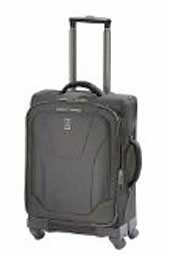 Travelpro Luggage Maxlite 2 20" Expandable Spinner